Last updated: September 28, 2026
Talk With Rhythm360 About Your Monitoring Workflow
Automated arrhythmia monitoring follows a defined sequence from device to documentation. Each stage below explains one step in that pipeline.
The monitoring pipeline begins with the implanted or wearable device itself. Device types include pacemakers, implantable cardioverter-defibrillators (ICDs), cardiac resynchronization therapy (CRT) and cardiac contractility modulation (CCM) devices, implantable loop recorders (ILRs), subcutaneous rhythm monitors, and physiologic monitors such as CardioMEMS pulmonary artery pressure sensors.
Cardiac remote monitoring transmissions fall into two categories: scheduled transmissions that occur automatically at set intervals, often nightly, for routine follow-up, and alert-triggered transmissions that fire in real time when the device detects readings outside programmed thresholds, such as a sustained arrhythmia or a significant change in a heart failure parameter. A single transmission can contain device diagnostics (battery status, lead impedance, sensing thresholds), arrhythmia logs, therapy records, and heart failure parameters such as fluid status indicators and activity levels.
Most modern CIEDs transmit data wirelessly via short-range radiofrequency or Bluetooth to a manufacturer-provided home transmitter or smartphone app. That transmitter or app then uploads data securely to the manufacturer's remote network for clinic access.
The fragmentation problem begins at this step. Each major cardiac device manufacturer operates its own proprietary remote monitoring network, such as Medtronic CareLink, Boston Scientific LATITUDE, Abbott Merlin.net, and Biotronik Home Monitoring. Clinics following patients across manufacturers must log into multiple portals, each with its own interface, alert logic, and report format. A 2024 real-world study found that cardiac device centers are not widely adopting alert-based monitoring strategies, in part because managing multiple vendor systems makes standardizing workflow models difficult.
Vendor-neutral consolidation provides the operational fix. Rhythm360 ingests and normalizes data from all major manufacturers, including Medtronic, Boston Scientific, Abbott, Biotronik, and others, using API, HL7, XML, and PDF parsing via computer vision, with redundant data feeds for reliability. The HL7 CardX CIED implementation guide defines FHIR profiles for CIED data exchange. These profiles standardize device interrogation data into computable resources that can move across manufacturer platforms, middleware, and provider systems instead of remaining siloed in vendor-specific portals.
Once data reaches the platform, automated algorithms perform the first pass on every transmission. Clinic operators evaluating these systems benefit from a clear view of what “automated” means in practice.
The algorithm works in layers. Core behaviors include QRS detection, template matching, contextual beat analysis, and artifact suppression. QRS detection anchors each heartbeat in time, and template matching then compares every beat against a representative morphology to separate true arrhythmia from noise or isolated ectopy. Contextual analysis adds a second pass, examining neighboring beats for pauses, early beats, or rapid runs. Artifact suppression runs alongside these steps, filtering mechanical noise from motion, muscle movement, or poor electrode contact. A two-stage hybrid framework uses synchronized accelerometer motion detection and electrode impedance gating to reject corrupted intervals before software-based classification, then applies morphological consistency checks against adaptive templates.
Automation serves as a triage layer. Its job is to filter a massive data stream down to the events a human must see. A 2023 study in Pacing and Clinical Electrophysiology found that most CIED alerts (73%) and scheduled transmissions (90%) were nonactionable, with only 7% of alerts leading to in-office follow-up. Studies cited by AHRQ's PSNet show that 80 to 99% of ECG monitor alarms are false or clinically insignificant, which underscores the value of structured, vendor-neutral triage. False positives in AF/AFL detection occurred in non-AF patients with high RR variability due to other arrhythmias or noise, while false negatives appeared in AF cases with relatively low variability. These findings reinforce the need for context-sensitive models that use more than a simple threshold.
As Andrew Beaser, MD, Associate Professor of Medicine at the University of Chicago Medicine, noted, “Decision support, including AI-assisted decision support, will become increasingly important as data volumes grow.” The 73,000-report annual volume noted later in this article illustrates the scale that makes algorithmic triage essential.
See How Rhythm360 Handles AI Triage
AI triage prioritizes transmissions, and the care team then interprets and acts on those findings. This stage defines how roles divide across the device clinic.
The typical role map in a device clinic includes several distinct responsibilities:
Automation ends at the flag. The CCT or RN validates the algorithm's output, and the physician interprets and signs. Every platform follows this basic sequence, and the main difference lies in how efficiently the handoff occurs.
The false-positive and false-negative tradeoff shapes daily operations. Artifact from motion, poor lead contact, or patient activity generates non-actionable alerts at high volume. High dismissal rates in CIED monitoring at UCM are structural features of safety-first remote monitoring, with most OEM-generated alerts being nonactionable across the same high-volume environment. Alert fatigue, the desensitization that follows an unmanageable volume of non-actionable notifications, explains why structured triage and clear roles matter.
Rhythm360 offers optional 24/7/365 oversight by certified cardiac technicians supervised by physicians. This service ensures that critical alerts bypass standard queues and reach the right clinician without delay. UCM's implementation of Rhythm360 enabled clinicians to review more transmissions daily and identify more abnormalities.
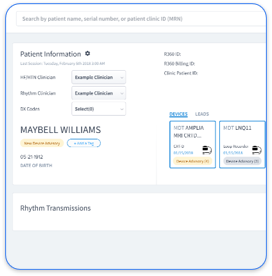
The final stage converts a completed clinical review into a documented encounter and a compliant billing claim. Bi-directional EHR integration means finalized reports push into the patient's chart without manual entry. The platform also pulls discrete EHR data elements, such as hospitalizations, diagnosis codes, and current medications, to give clinicians context when reviewing a transmission. Without bi-directional EHR integration, care teams must toggle between separate systems and manually reconcile information, which adds time, introduces error, and increases pressure on already stretched device-clinic staff. Rhythm360 integrates with Epic, Cerner, Athenahealth, eClinicalWorks, Greenway Health, and others via HL7.
Remote CIED monitoring billing runs on device-specific CPT codes tied to defined monitoring periods. Incorrect pairing of code and device type remains one of the most common reasons a cardiac monitoring claim is denied.
For pacemakers and ICDs on a 90-day cycle, 93294 is the professional component for pacemakers, 93295 is the professional component for ICDs, and 93296 is the shared technical component for both pacemakers and ICDs.
For physiologic monitors and loop recorders on a 30-day cycle, CPT 93297 covers remote interrogation of an implantable cardiovascular physiologic monitor, such as a CardioMEMS pulmonary artery pressure sensor, and is reported once per completed 30-day period. CPT 93298 covers remote interrogation of a subcutaneous cardiac rhythm monitor system. This device is also called an implantable loop recorder (ILR) or insertable cardiac monitor (ICM), and the code applies to up to 30 days of recorded heart rhythm data. These are device-specific codes. Each is billable once per 30 days and can be billed global, with modifier -26 for the professional component, or with modifier -TC for the technical component, depending on whether one entity or separate entities perform the professional versus technical work.
For remote physiologic monitoring of chronic conditions such as heart failure and hypertension, CPT 99454 covers remote patient monitoring device supply for a 30-day period, requiring 16 days of physiological data transmission that is automatically transmitted rather than manually uploaded.
Five documentation elements support a remote monitoring claim: proof of a completed remote transmission with timestamp and correct patient/device; evidence the monitoring period was completed; review of recorded rhythm data including stored and patient-triggered episodes; a physician-authored interpretation; and a signature and date matching the date of service. Automated tracking of device-specific CPT pairings prevents device-type mismatch denials and unbilled technical components. As Gaurav A. Upadhyay, MD, at UCM, observed, “We have improved billing and accountability for our patients after the integration.”
The five-stage pipeline above applies to every device type, but the device itself changes what the pipeline can capture. Modality selection is driven by the clinical question, symptom frequency, and the duration of monitoring required to capture an event.
Holter monitors provide continuous ECG recording over 24 to 48 hours, making them well suited for patients with daily or near-daily symptoms such as frequent palpitations, presyncope, or known arrhythmias being evaluated for burden or treatment response. When symptoms occur less than daily, Holter diagnostic yield drops significantly. The 24-to-48-hour window is both the Holter's strength and its ceiling.
Extended-wear patch monitors are worn continuously for 7 to 30 days using a single adhesive patch without leads or a separate recording unit, which improves compliance for patients who find traditional Holter equipment cumbersome. Patch monitors are commonly used for palpitation workups, cryptogenic stroke evaluation, and AF screening. Most store data locally and are analyzed only after device return. That delay means a clinically significant event may not be known to the care team until the device is retrieved.
Mobile cardiac telemetry (MCT) devices record continuously and transmit data in real time to a remote monitoring center where trained analysts review incoming strips and flag findings for physician review. MCT is indicated for patients with high-risk syncope, suspected malignant arrhythmias, or symptoms frequent enough to require immediate clinical response, and when prior Holter or patch monitoring has been inconclusive while the index of suspicion remains high. Coverage criteria for ambulatory cardiac monitoring emphasize symptoms such as palpitations, dizziness, presyncope, syncope, chest pain, or shortness of breath that occur infrequently, which supports escalation beyond short Holter monitoring when episodes are not daily.
Implantable loop recorders (ILRs) are small subcutaneous devices inserted under the skin of the chest during a minor outpatient procedure, recording cardiac rhythm continuously for up to three years and transmitting data automatically at regular intervals. ILRs are indicated when external monitoring has failed to produce a diagnosis. Unexplained syncope is the most common indication, particularly when episodes are infrequent enough that no external device is likely to capture one. ILRs are also used for cryptogenic stroke workups where AF detection is the primary goal.
Stage 2 introduced the fragmentation problem, and this section explains why a vendor-neutral layer provides a structural fix rather than a temporary workaround. Multiple manufacturers will always exist, but clinics can still run a unified workflow.
A vendor-neutral platform receives, processes, and manages transmissions from devices made by all major manufacturers without requiring staff to log into separate manufacturer portals. It consolidates the entire device population into one workflow regardless of device type or brand. Bi-directional integration eliminates duplicate documentation, reduces manual entry errors, and keeps the care record accurate without extra steps from clinical staff. The 2023 HRS/EHRA/APHRS/LAHRS expert consensus statement acknowledged that optimal remote monitoring workflows require coordination of programmers, monitors, remote monitoring platforms, third-party resources, and electronic health records.
Other platforms in this space include Murj, Implicity, Rhythm Management Group, and Octagos. Rhythm360 ingests and normalizes data from all major manufacturers, applies AI-assisted triage with human oversight, integrates bi-directionally with the EHR, and captures the correct CPT codes automatically, with deployment measured in days to weeks.
See How Rhythm360 Handles Multi-OEM Data
Rhythm360 is a cloud-based, vendor-neutral, HIPAA-compliant platform that ingests and normalizes data from all major device manufacturers using API, HL7, XML, and PDF parsing via computer vision, with redundant data feeds for reliability and greater than 99.9% transmissibility.
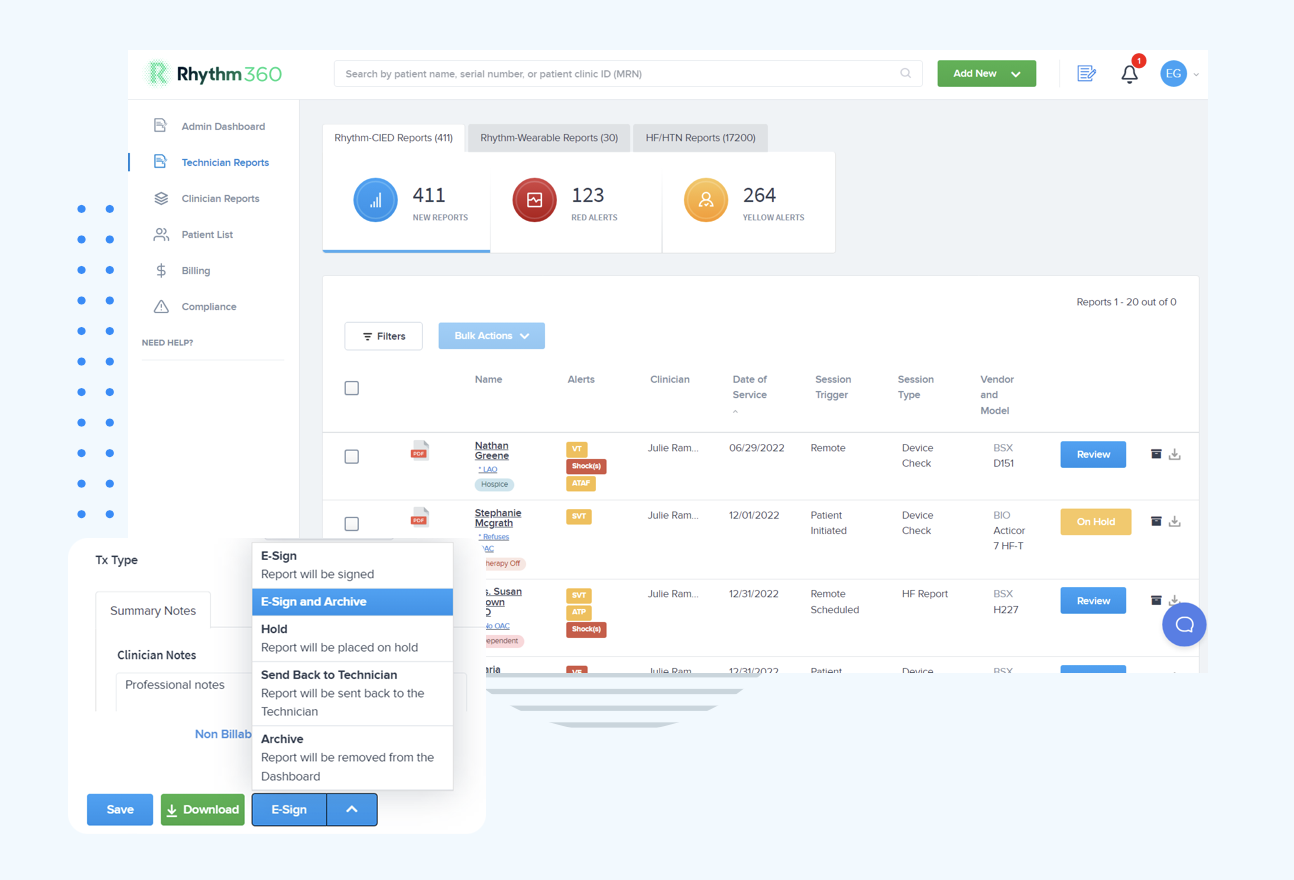
Practices implementing Rhythm360 have achieved up to an 80% reduction in critical alert response times and up to a 300% increase in revenue capture. University of Chicago Medicine reviewed more than 73,000 reports annually through Rhythm360 in calendar year 2025, averaging more than 18,000 reports per quarter, with stable dismissal rates that highlight scalable monitoring in a high-volume environment.
Explore Rhythm360 For Your Device Clinic
Clinicians evaluating a platform are not the only audience for these questions. Patients ask their own set of questions about arrhythmia monitoring, and the answers shape how clinics explain the workflow.
Patients commonly ask whether they can sleep with a Holter monitor. The answer is yes, and overnight data is often diagnostically valuable for detecting nocturnal arrhythmias. Patients also ask whether coffee affects a monitor. Caffeine may increase ectopic beat frequency in some individuals, but the 2023 ACC/AHA/ACCP/HRS AF guideline does not recommend caffeine avoidance as a standard intervention.
Patients also want to know whether an Apple Watch can replace clinical arrhythmia monitoring. Consumer wearables can screen for irregular rhythms but do not meet the documentation, sensitivity, or physician-interpretation standards required for a definitive clinical diagnosis or a billable monitoring encounter. Clinical-grade monitoring through a structured workflow remains the standard of care.
Clinicians bring a different set of questions that focus on diagnostic thresholds and risk.
For AF detected by screening tools, wearables, or mobile devices, a tracing of ≥30 seconds or a 12-lead ECG showing AF, interpreted by a physician with ECG expertise, is needed to establish a definitive diagnosis. AF episodes ≥30 seconds were associated with increased major cardiovascular events, while episodes <30 seconds were not significant in that cohort. In a clinic running automated arrhythmia monitoring, the platform detects and time-stamps episodes meeting this threshold, routes them for physician review, and generates the documentation needed to support a definitive diagnosis and downstream treatment decisions such as anticoagulation initiation.
The four arrhythmias most commonly associated with sudden cardiac death and cardiac arrest are ventricular fibrillation, ventricular tachycardia, asystole, and pulseless electrical activity. These fall into two mechanistic categories. Ventricular fibrillation/ventricular tachycardia and asystole/pulseless electrical activity now represent the most frequent initial rhythms in out-of-hospital cardiac arrests. The 2017 AHA/ACC/HRS Guideline for Management of Patients With Ventricular Arrhythmias and the Prevention of Sudden Cardiac Death estimates 230,000–350,000 sudden cardiac death events per year in the United States, accounting for approximately 50% of all cardiovascular deaths. Automated arrhythmia monitoring platforms detect these rhythms through continuous surveillance, trigger real-time alert-based transmissions when programmed thresholds are crossed, and route critical findings to the clinical team immediately to enable the fastest possible intervention.
Rhythm360's streamlined implementation process, including EHR integration, typically takes a few days to a few weeks. The onboarding timeline minimizes disruption to existing clinic workflows while establishing full connectivity to all major device manufacturer networks and the practice's EHR system.
Automation serves as a triage layer rather than a replacement for clinical judgment. Algorithms filter the data stream and prioritize clinically significant events, but a physician or qualified healthcare professional must interpret the findings and sign the report. The signed physician interpretation is also a documentation requirement for compliant billing of remote monitoring CPT codes.
A vendor-neutral platform ingests and normalizes data from all major manufacturers, including Medtronic, Boston Scientific, Abbott, Biotronik, and others, into a single dashboard. This approach eliminates the need for separate portal logins and manual transcription. Rhythm360 accomplishes this using API connections, HL7 messaging, XML parsing, and PDF parsing via computer vision, with redundant data feeds to ensure continuity when a manufacturer's server experiences downtime.
The five documentation elements listed in Stage 5 apply here as well. The key point is that the physician-authored interpretation must reflect the clinician's own review rather than a vendor printout alone. Automated documentation tools help ensure these elements are captured consistently for every billable encounter.
Multi-OEM portal fragmentation, alert fatigue, manual transcription, and missed billing opportunities arise when clinics operate without a unified, vendor-neutral platform. Rhythm360 consolidates the five-stage monitoring pipeline into a single source of truth, from device transmission through AI triage, human review, EHR documentation, and CPT code capture.
When evaluating automated arrhythmia monitoring platforms, use this checklist. It maps to the five stages above, with one additional criterion for implementation speed:
Request A Rhythm360 Walkthrough