Last updated: July 14, 2026
Schedule a demo to see how unified cardiac monitoring improves patient care and revenue capture.
A typical electrophysiology clinic manages patients implanted with devices from Medtronic, Abbott, and Boston Scientific. Each manufacturer requires a separate login: Medtronic CareLink, Abbott Merlin.net, and Boston Scientific LATITUDE. When a patient transmits data, a technician must locate the correct portal, retrieve the report, and manually transcribe findings into the EHR. Then the technician cross-references anticoagulation status, recent hospitalizations, and medication changes stored elsewhere. To act on a device alert, clinicians must leave the monitoring platform and open the EHR to manually piece together context. Most device clinic teams have stopped noticing this cumulative time cost.
This manual reconciliation directly delays diagnosis. Real-world clinical data are fragmented, inconsistently labeled, and collected using variable equipment. This increases false-positive alerts and delays diagnosis of impending heart failure hospitalizations. At the University of Chicago Medicine, pre-implementation workflows were described by Andrew Beaser, MD, Associate Professor of Medicine, as "a major challenge and incredibly difficult", a characterization that reflects the experience of device clinics nationwide.
Fragmented data infrastructure forces clinicians to review transmission records, implant history, symptoms, and clinical events across multiple systems, relying on manual interpretation to connect the dots. This fragmentation is what drives the context switching between vendor portals and EHRs. That switching leads to variable clinical decisions even when the underlying data is identical, because each clinician fills gaps differently. A unified platform that normalizes data from all OEM portals into one dashboard removes the root cause of that variability and speeds clinical response.
Continuous remote monitoring significantly increases clinician workload due to high data volume. Organized review procedures are required to prevent alert fatigue from poorly adjusted systems. Fragmentation across multiple vendor portals compounds this problem. In some cardiac clinic databases, error rates reach 50%, and in others only 40 to 60 percent of listed patients are truly active. Clinicians responding to alerts drawn from inaccurate or incomplete datasets face an impossible triage burden, and this burden manifests as alert fatigue across several stages of processing.
Alert fatigue includes failure to detect alerts, superficial processing through mental shortcuts, and excessive cognitive effort required to interpret them. Participants in a 2026 qualitative study described habitual overrides such as "clicking through them automatically" and "whack-a-mole" dismissal of alerts, with potential missed critical information affecting patient safety. For electrophysiologists managing hundreds of CIED patients, one missed ventricular tachycardia alert can result in syncope, sudden cardiac arrest, or stroke.
The lack of interoperability standards between devices, platforms, and protocols creates data silos that limit the clinical utility of remote monitoring data. Each CIED manufacturer uses proprietary nomenclature and communication protocols to describe similar or identical features. No manual workaround fully resolves this structural incompatibility. Rhythm360's vendor-neutral ingestion layer normalizes data from all major OEMs into a single AI-triaged workflow, converting alert noise into prioritized, actionable information.
Heart failure patients need continuous, coordinated monitoring to catch early signs of decompensation, such as fluid retention, weight gain, and changes in pulmonary artery pressure, before hospitalization becomes necessary. When monitoring data lives in disconnected OEM portals and EHRs, that early-warning window closes. AI-powered tools such as the LINK-HF wearable chest-patch system can predict impending hospitalizations days in advance, but data fragmentation compromises this potential.
The downstream consequences are measurable. A study of more than 340,000 adults with newly documented HFrEF found only 33.8% underwent repeat echocardiography within 12 months, with a median time to reassessment of 155 days. Patients with persistent HFrEF experienced higher 12-month mortality than those with improved heart function. Delayed reassessment driven by fragmented data contributes directly to these outcomes.
After implementing Rhythm360, Andrew Beaser, MD, noted: "We are able to address these issues earlier; rather than waiting for a 3-month visit, we can call patients in for evaluation." This shift from reactive to proactive monitoring is the intervention that reduces avoidable readmissions. Rhythm360's integrated HF monitoring service line consolidates data from CardioMEMS pulmonary artery monitors alongside CIED transmissions, giving care teams one complete hemodynamic picture.
Siloed billing systems cause practices to lose money on cardiac remote monitoring. It's one of the fastest-growing and most consistently underbilled revenue categories in cardiology, spanning CIED monitoring (CPT 93296 to 93298) and remote physiologic monitoring (CPT 99453, 99454, 99457, 99458). When clinical documentation, inventory data, and billing platforms operate separately, charge capture becomes inconsistent and claims go unfiled. CIED transmissions received but not billed within the 90-day cycle are lost permanently.
The OIG's August 2025 RPM billing report found many practices billing CPT 99454 never billed CPT 99457 for most enrolled patients, a workflow failure where device data was captured but management time went unbilled. Under the 2026 Medicare Physician Fee Schedule, one RPM patient meeting standard thresholds generates $1,300 to $2,000 per year from the base stack of CPT 99453, 99454, and 99457. For a practice managing hundreds of device patients, the gap between billable and billed services can total hundreds of thousands of dollars annually.
The 2026 CMS Final Rule adds CPT 99445, reimbursed at roughly $47 for 2 to 15 days of device data, and CPT 99470, reimbursed at roughly $26 for the first 10 minutes of management, letting practices bill short-month RPM patients who previously fell below the 16-day or 20-minute thresholds. Capturing these codes requires automated transmission tracking, real-time documentation, and EHR integration, none of which fragmented systems can deliver. Rhythm360's automated CPT capture and documentation layer identifies, documents, and submits every billable event compliantly.
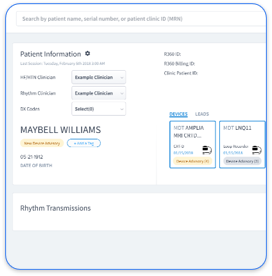
Rhythm360 is a cloud-based, vendor-neutral platform built to resolve cardiac monitoring fragmentation. Instead of requiring staff to log into separate portals for Medtronic, Boston Scientific, Abbott, Biotronik, and other OEMs, Rhythm360 ingests data through APIs, HL7, XML, and computer-vision PDF parsing. It normalizes disparate formats into one unified patient record. This approach achieves greater than 99.9% transmissibility through redundant data feeds and AI-powered extrapolation that fills gaps when an OEM server goes down.
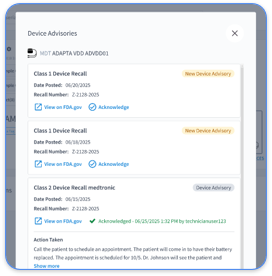
The platform's AI-powered triage filters non-actionable notifications and surfaces clinically significant events, including new-onset AFib, ventricular tachycardia, lead malfunction, and ERI/RRT indicators, in prioritized order. This reduces critical response times by up to 80%. Bi-directional EHR integration with Epic, Cerner, Athenahealth, eClinicalWorks, Greenway Health, and others means medication lists, recent hospitalizations, and active diagnoses appear the moment a report opens, with no manual retrieval needed. A HIPAA-compliant mobile app extends this beyond the clinic, letting physicians review transmissions and coordinate care remotely. The University of Chicago Medicine reviewed more than 73,000 reports in 2025, averaging over 18,000 per quarter, a volume that fragmented OEM portals could not sustain.
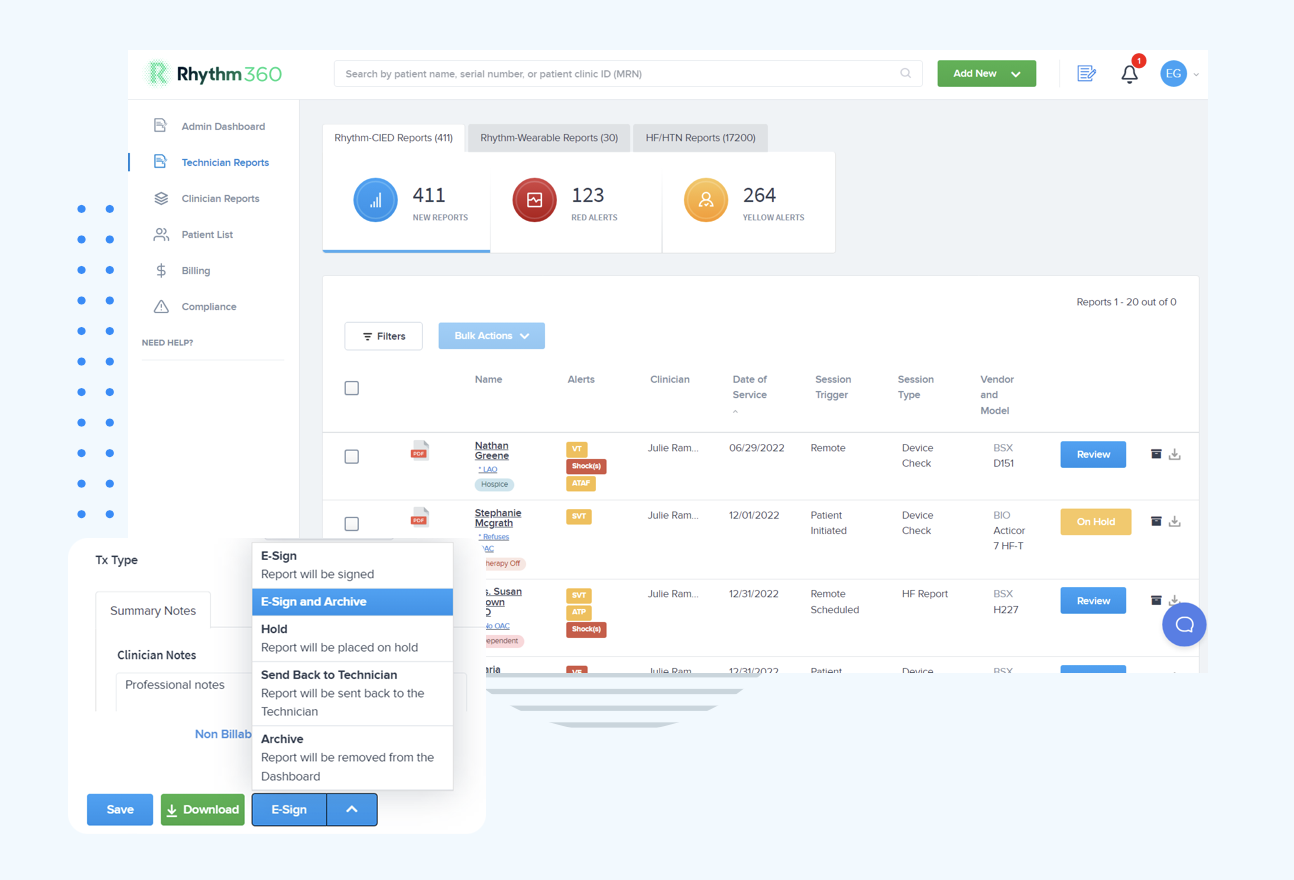
Other cardiac remote monitoring platforms exist, but Rhythm360 is built to serve the full clinical, operational, and financial scope of a cardiology or electrophysiology practice from one system.
Clinically, consolidating CIED and RPM data into one AI-triaged dashboard puts arrhythmia alerts, heart failure decompensation signals, and device integrity warnings in a single workflow. This eliminates the context switching that drives missed events and alert fatigue. Operationally, automated reporting, patient messaging through a Twilio-powered communication hub, and a real-time administrative dashboard reduce manual burden on staff. This addresses the staffing challenges Gaurav A. Upadhyay, MD, FACC, FHRS, Director of the Pacing and Defibrillation Device Clinic at UCM, described: "Staffing was always an issue for our center, because our device clinic, like many other medical centers, had struggled with technician turnover and timely weekend coverage."
Financially, Rhythm360's automated CPT documentation and compliance tracking help practices capture revenue across the full billing stack, from 93296 through 93299 for CIED monitoring to 99453, 99454, 99457, and the new 2026 codes 99445 and 99470 for RPM. Practices report up to a 300% increase in revenue after implementation. As Dr. Upadhyay observed: "We have improved billing and accountability for our patients after the integration." A unified platform isn't a convenience. It's the infrastructure that makes cardiac monitoring safe, scalable, and financially sustainable.
Ingest all OEM transmissions into one AI-triaged dashboard with EHR context available the moment an alert surfaces. That single change, already detailed above, is what cuts response times by up to 80% instead of requiring technicians to manually cross-reference multiple portals.
API-driven integration built on the FHIR standard now lets platforms pull current patient context, including medications, diagnoses, and labs, from the EHR the moment a report opens, replacing outdated batch-sync methods. The 2026 CMS Final Rule also expanded RPM billing codes, requiring practices to track short-month transmissions to capture the new CPT 99445 code. IDCO format adoption still varies across manufacturers, so proprietary OEM formats continue to need normalization, which Rhythm360 provides through API, HL7, XML, and AI-powered PDF parsing.
Yes. When arrhythmia data and physiological data such as weight, blood pressure, and pulmonary artery pressure live in one workspace, care teams can correlate a new arrhythmia with a concurrent fluid overload event, a combination that raises hospitalization risk. Rhythm360 integrates its Rhythm-CIED and HF/HTN service lines into a single view, letting clinicians act earlier, as demonstrated by UCM's shift to proactive patient outreach discussed earlier.
Cardiac data silos in 2026 produce six measurable harms. They are delayed arrhythmia diagnosis, missed critical events, alert fatigue, increased heart-failure readmissions, CPT billing leakage, and clinician burnout.
Each harm traces back to the same structural failure: device data, EHR records, and clinical context stored in systems that cannot talk to each other. The manual workarounds cardiology practices rely on aren't scalable, safe, or financially sustainable as device populations grow and CMS billing rules become more granular.
Rhythm360 addresses all six effects through vendor-neutral data ingestion, AI-powered alert triage, high-reliability transmissibility, bi-directional EHR integration, automated CPT documentation, and HIPAA-compliant mobile access. The platform gives electrophysiologists, cardiologists, and practice administrators one source of truth instead of another portal to manage.