Last updated: September 24, 2026
Four prerequisites support a reliable 93298 automation sequence.
This structure creates a workflow a practice can hand to an EHR analyst and billing team this quarter.
This sequence moves a subcutaneous cardiac rhythm monitor transmission from OEM portal to audit-ready claim. Each step names the data field, the system of record, and the validation check.
Pro Tip: For CPT 93296 remote cardiac device monitoring, billing on transmission receipt rather than after confirming the complete technical service (data acquisition, technician review, technical support, and distribution of results) is a top denial cause. For RPM codes such as 99454, the most frequent denial cause is failing to meet the 16-day transmission threshold. The automation rule: the billing trigger fires on signed interpretation.
Common Mistake: Billing 93298 when the device is actually an implantable cardiovascular physiologic monitor, which is reported under CPT 93297, creates a device mismatch that payers catch on review. Build the device-class check into Step 3. CPT 93297 and 93298 are device-specific codes rather than a professional and technical pair.
Rhythm360, developed by RhythmScience, is a vendor-neutral, HIPAA-compliant platform built to execute each step of the workflow above. It consolidates data from all major OEM portals, including Medtronic, Boston Scientific, Abbott, and Biotronik, into a single source of truth. This consolidation removes redundant logins and manual transcription across fragmented portals.
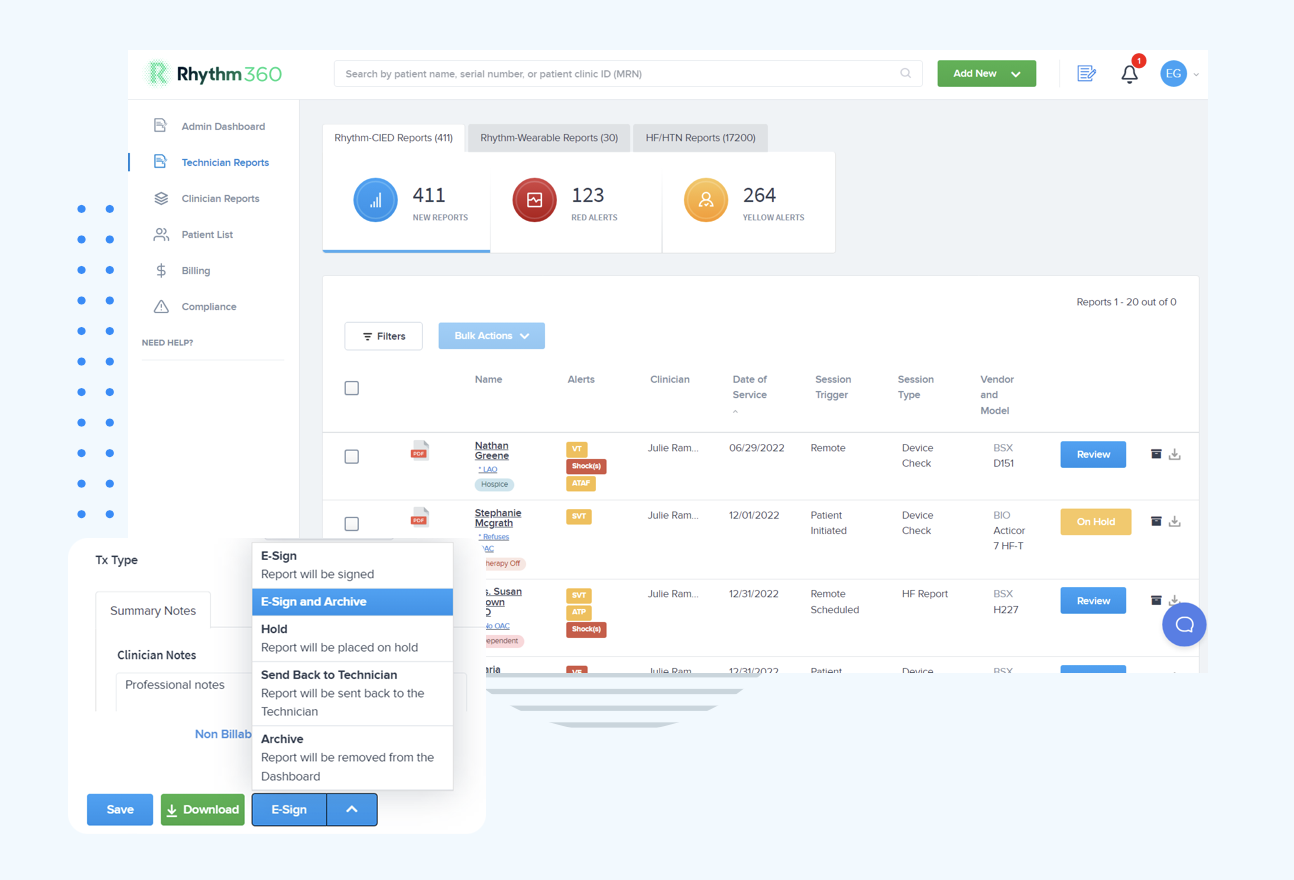
Rhythm360 automatically tracks device-specific CPT pairings and 30-day cycles for both 93297 and 93298. This tracking prevents device-type mismatch denials and unbilled technical components. The platform automates data ingestion, report generation, and billing documentation. Its AI-powered alert triage and optional oversight by certified cardiac technicians (CCTs) can reduce critical alert response times by up to 80% and increase revenue capture by up to 300%.
See How Rhythm360 Automates 93298
Automation works best when compliance rules sit inside the workflow. Three guardrails matter most.
Human sign-off rule: CMS and most commercial payers expect a signed report that documents the clinical interpretation. A platform printout alone does not support payment. The reviewing physician must generate the interpretation rather than countersign a service center's report. One signed sentence noting a normal rhythm and no intervention satisfies the requirement. An unsigned report invites recoupment audits even after the claim pays.
Billing trigger: Because payment depends on a signed interpretation, the billing trigger must fire on completed professional review and the 30-day service definition. A trigger tied to data arrival releases claims before the documentation that justifies them exists.
Pre-claim validation checklist: Every claim must clear these seven checks before it leaves the billing queue. A failure on any one of them often becomes a denial or recoupment.
Troubleshooting: Missing the -TC component when the practice owns the technical component leaves revenue on the table. The billing record should name which organization performed each component. That single field settles most component disputes at appeal. Failing to link the claim to the signed interpretation creates a clean-claim failure.
Talk With Rhythm360 About Compliance Guardrails
An audit-ready packet traces every claim back to raw transmissions, the order, the interpretation, and the signature. Recommended technical audit evidence for a CPT 93298-TC claim includes data receipt confirmation, device and patient matching, transmission processing records, technician review and support logs, results distribution records, monitoring period tracking, and the identity of the technical billing entity. When a MAC requests records, this is the packet that answers the request without follow-up.
Pro Tip: The billing record should name which organization performed each component, professional versus technical. That single field resolves most component disputes at the appeal stage without additional documentation.
A fully automated, compliance-safe 93298 workflow produces clear, verifiable outcomes that support audits and revenue goals.
Once the core 93298 workflow runs smoothly, several extensions can strengthen compliance and expand revenue capture.
Rhythm360 supports these adjacent workflows within the same vendor-neutral platform, so practices can manage loop recorders, physiologic monitors, and pacemaker or ICD families in one environment.
CPT 93298 can be billed globally with no modifier, with modifier -26 for the professional component, or with modifier -TC for the technical component. The choice depends on which entity performed each part of the service. CMS deleted HCPCS code G2066 effective January 1, 2024, and assigned technical component values directly to CPT 93298. Older billing guides that reference G2066 for the technical work no longer reflect current policy.
CPT 93298 is reportable once per completed 30-day monitoring period, and that interval comes from the CPT descriptor itself rather than a surgical global period. Because the window is fixed, a second 93298 claim inside the same 30 days is rejected as a duplicate or frequency violation. The code should not be reported when the monitoring period runs shorter than 30 days, and CPT instructs that 93298 not be reported when the monitoring period runs under 10 days. Multiple device transmissions or alerts within a single monitoring period do not create additional billable units. One unit represents one documented remote interrogation period. Practices that carry a 90-day billing calendar over from pacemaker codes file four claims a year where twelve were payable, which creates significant lost revenue per monitored patient annually.
CPT 93297 and CPT 93298 are device-specific codes rather than a professional and technical pair. CPT 93297 covers remote interrogation of an implantable cardiovascular physiologic monitor system, a device that records hemodynamic data such as pulmonary artery pressure and supports heart failure management, for example CardioMEMS. CPT 93298 covers remote interrogation of a subcutaneous cardiac rhythm monitor system, a device that records heart rhythm data and supports indications such as unexplained syncope, suspected paroxysmal atrial fibrillation, cryptogenic stroke workup, and unexplained palpitations, for example Medtronic LINQ II, Abbott Assert-IQ, Boston Scientific LUX-Dx, and Biotronik BIOMONITOR. Both codes run on a 30-day interval and both allow the -26 and -TC split, and code selection depends entirely on the implanted device.
Medical billing for CPT 93298 can be automated when compliance guardrails control the workflow. Automation handles aggregation, normalization, 30-day cycle enforcement, draft report generation, and routing. The billing trigger fires only on completed professional review. The clinician interprets and signs the report, and the system enforces the sequence. The pre-claim validation checklist gates claim release, ensuring no claim exits the queue without a correct device class, a completed 30-day period, an active order, a complete interpretation, a dated signature, a duplicate check, and payer-specific rules applied. This structure satisfies CMS expectations that the reviewing physician generate the interpretation rather than countersign a vendor document.
The required data fields for a CPT 93298 claim are patient and device identifiers, implant date, transmission dates, monitoring period start and end dates, episodes detected (stored and patient-triggered), device status, ordering clinician, and reviewing clinician. The signed report must also show the type of subcutaneous cardiac rhythm monitor in place, the rhythm episodes captured during the monitoring period, the physician's clinical interpretation, any action taken when findings warrant it, and a legible signature with the review date. The signature date should match the date of service on the claim. A raw device transmission or vendor printout does not satisfy the interpretation requirement because the physician must add a clinical impression to the record.
Manual 93298 documentation assembled across fragmented OEM portals creates predictable failures such as device-mismatch denials, missed 30-day cycles, unsigned reports, and modifier errors that survive initial claim payment and surface later as recoupment. The workflow described above, which aggregates transmissions, normalizes required fields, enforces the 30-day cycle, routes to physician sign-off, and releases claims only after a pre-claim validation checklist passes, turns 93298 billing into an audit-ready, repeatable process.
Rhythm360 executes that workflow end to end. The platform is vendor-neutral, consolidates data from all major OEM portals, tracks device-specific CPT pairings and 30-day cycles automatically, and builds the human sign-off rule into every claim release. Practices using Rhythm360 have achieved the 80% reduction in critical alert response times and the 300% increase in revenue capture and profitability described earlier.
Request A Rhythm360 Workflow Review