

Patients with modern pacemakers can take an active role in battery and device monitoring through manufacturer-supplied home transmitters. Boston Scientific's LATITUDE Communicator automatically collects remaining battery energy data from pacemakers, CRT devices, and ICDs at physician-scheduled intervals and transmits that data to the care team without requiring patient initiation in most cases. The general home monitoring process follows these steps:
Home monitoring does not replace in-clinic interrogation. The LATITUDE Communicator does not reprogram or alter implant functions and does not contact emergency services during health events. All clinical decisions remain with the care team after reviewing transmitted data.
For clinics managing patients across multiple device manufacturers, consolidating these transmissions into a single review workflow helps ensure no critical data is overlooked. See how Rhythm360 unifies home transmissions from every manufacturer into one dashboard.
Monitoring frequency depends on device type, patient risk profile, and how far the battery has progressed through its service life. General 2026 guidelines follow this schedule:
Achieving reliable transmission at every scheduled interval is a documented operational challenge for multi-vendor practices, where server outages or connectivity gaps can cause scheduled battery checks to be silently missed. Rhythm360 addresses this through redundant data feed architecture that combines direct API connections, HL7, XML, and AI-powered PDF parsing via computer vision to deliver greater than 99.9% transmissibility across all supported manufacturers.
Device manufacturers define two critical battery depletion thresholds that every patient and clinic team should recognize.
Elective Replacement Indicator (ERI) / Recommended Replacement Time (RRT): These terms are used interchangeably across manufacturers and signal that the battery has reached a voltage level at which replacement should be scheduled. At this stage, the device has limited remaining service life that varies under normal operating conditions and may be shorter for pacing-dependent patients.
End of Life (EOL) / End of Service (EOS): The battery voltage has dropped to a level at which the device can no longer guarantee full therapy delivery. Replacement at this stage is urgent.
Patient-reported symptoms that may accompany battery depletion include:
On the clinic side, ERI/RRT alerts are transmitted automatically by the home communicator and should trigger a defined triage protocol. However, when alerts arrive across four separate OEM portals, they can be delayed, duplicated, or missed entirely during high-volume periods. Unified vendor-neutral platforms solve this by consolidating alerts into a single triage layer, reducing non-actionable transmissions and alert fatigue while delivering same-day alert reporting and improved compliance for multi-vendor CIED patients.
A pacemaker battery does not fail without warning. The ERI/RRT stage provides a clinically meaningful lead time, typically 6–9 months, during which the replacement procedure can be scheduled electively. Generator replacement is a low-complexity surgical procedure performed under local anesthesia in which the existing leads are retained and only the pulse generator is exchanged. This procedure is not an emergency for patients who are monitored appropriately and whose ERI alert is acted upon promptly.
For pacing-dependent patients, who rely on the device for the majority of their heartbeats, the urgency of scheduling replacement at ERI is higher. Clinics managing large CIED populations must ensure that ERI alerts from all manufacturers surface in a single, prioritized worklist rather than remaining siloed in individual OEM portals. Multi-vendor CIED data management now includes alert prioritization, clinical documentation, billing readiness, audit trails, and recall management within a single operational platform.
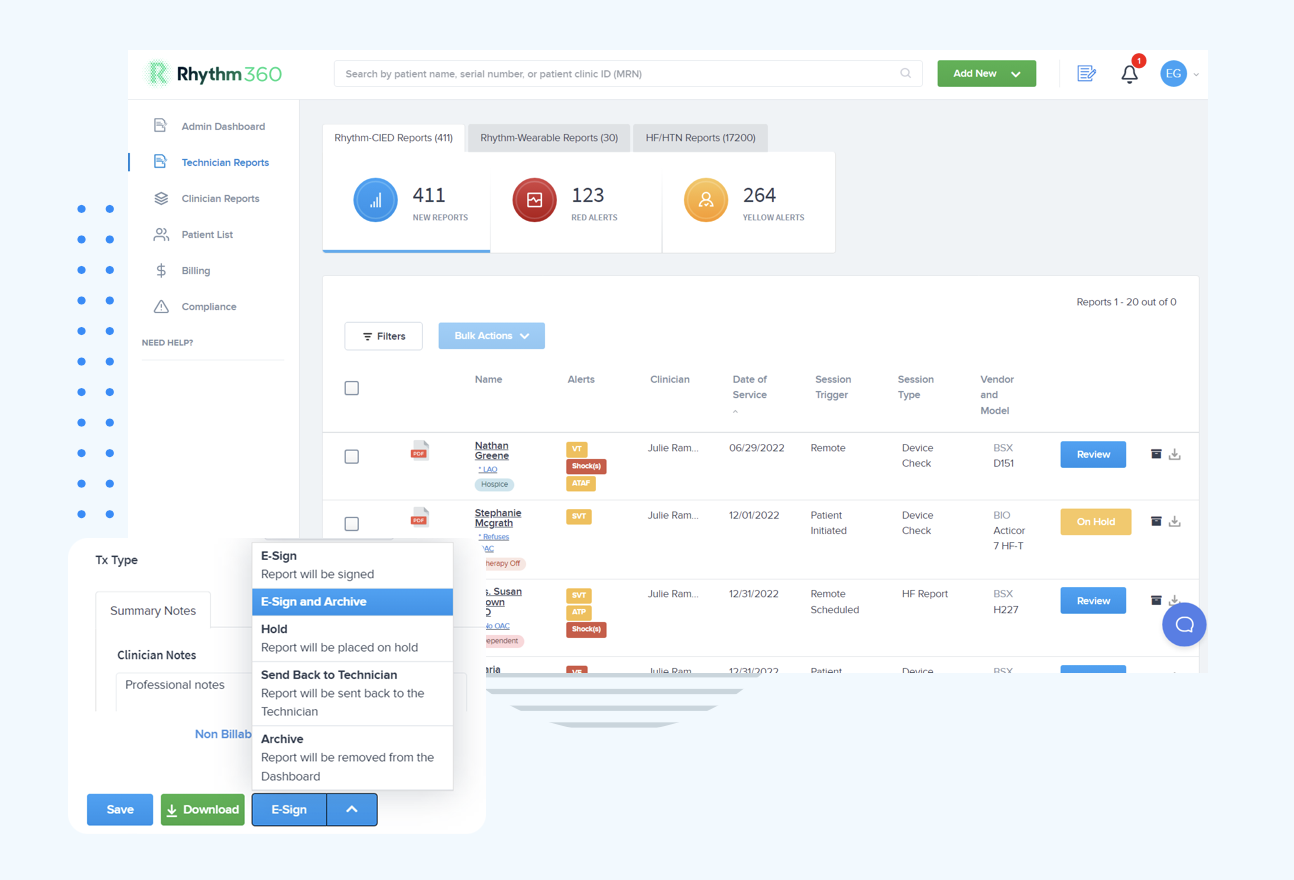
An efficient clinic-side remote monitoring workflow for pacemaker battery checks and all CIED transmissions follows these steps:
Rhythm360 executes every step of this workflow within a single platform, reducing critical alert response times by up to 80% and enabling practices to capture up to 300% more revenue through optimized CPT documentation.
Watch a live demonstration of the complete Rhythm360 workflow.
Practices that implant devices from more than one manufacturer face a structural data fragmentation problem. Each OEM operates a proprietary portal with its own login credentials, alert formats, and export protocols. The table below maps each major manufacturer's data feed to the administrative burden it creates and the benefit delivered by a unified platform.
| Manufacturer | Transmitter / Data Feed | Portal Requirement (Without Unified Platform) | Unified Platform Benefit (Rhythm360) |
|---|---|---|---|
| Medtronic | CareLink Network (API + HL7) | Separate CareLink portal login, manual report download | Automated ingestion, single worklist entry, CPT documentation auto-generated |
| Boston Scientific | LATITUDE NXT (scheduled automatic transmission) | Separate LATITUDE portal login, alert emails require manual triage | Alerts normalized and prioritized alongside all other vendors in one queue |
| Abbott | Merlin.net (XML feed) | Separate Merlin.net portal login, XML parsing required for structured data | AI-powered XML normalization, ERI flags surfaced in unified alert triage |
| Biotronik | Home Monitoring (API) | Separate BIOTRONIK portal login, daily trend data requires manual reconciliation | Redundant feed ingestion achieves the high transmissibility rate described earlier, with no manual reconciliation |
Unified vendor-neutral platforms eliminate manual steps across alert review, documentation, and billing preparation while supporting secure EHR integrations for documentation continuity. Rhythm360's AI-powered alert triage layer filters non-actionable transmissions, building on the alert fatigue reductions described earlier and allowing device technicians to focus on events that require intervention, including ERI/RRT battery alerts that demand timely scheduling of generator replacement.
Learn how your team can eliminate portal switching with Rhythm360.
No. Pacemaker batteries deplete gradually and predictably. Device firmware monitors internal voltage continuously and triggers the Elective Replacement Indicator (ERI) or Recommended Replacement Time (RRT) alert when the battery reaches a predefined threshold, typically providing 3–9 months of remaining service life. Patients enrolled in remote monitoring transmit this status automatically to their care team, allowing elective scheduling of generator replacement well before the device reaches End of Life (EOL).
ERI (Elective Replacement Indicator) and RRT (Recommended Replacement Time) refer to the same clinical concept, a manufacturer-defined battery voltage threshold signaling that generator replacement should be scheduled, but the terminology differs by manufacturer. Both indicate that the device remains fully functional but has entered the final phase of its battery service life. Clinics managing multi-vendor populations must recognize both terms and ensure their monitoring platform surfaces alerts from all manufacturers in a single, standardized format.
When a practice manages devices from multiple manufacturers without a unified platform, ERI and RRT alerts arrive in separate portals, are formatted differently, and require manual review by staff who must toggle between systems. This environment creates conditions for alerts to be delayed or overlooked, particularly during high-volume periods or staff transitions. A unified platform like Rhythm360 ingests transmissions from all manufacturers into one AI-prioritized worklist, ensuring every battery alert is triaged consistently and documented automatically for CPT billing. Practices using Rhythm360 have achieved the alert response and revenue improvements described earlier by recovering revenue that was previously lost to incomplete or untimely billing workflows. See how Rhythm360 addresses these gaps for your practice.
Pacemaker battery monitoring in 2026 is a shared responsibility between patients using home transmitters and clinic teams managing automated data feeds from multiple device manufacturers. For patients, the process is largely passive, because home communicators transmit scheduled data automatically and symptoms of battery depletion are well-defined. For clinics, the challenge is operational, since teams must consolidate transmissions from Medtronic, Boston Scientific, Abbott, and Biotronik into a single, actionable workflow that supports timely ERI triage, compliant CPT documentation, and EHR integration without overwhelming staff with fragmented portal management.
Rhythm360 addresses every layer of that challenge, from AI-powered alert triage and greater than 99.9% transmissibility to automated billing capture and bi-directional EHR integration, in one vendor-neutral platform. See how Rhythm360 can reduce administrative burden and protect patient safety across your entire CIED population.





