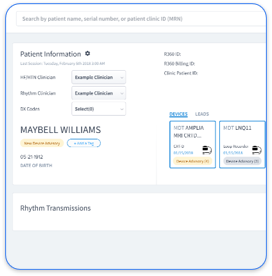
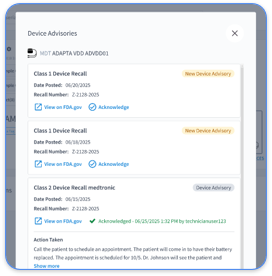
Rhythm360, from RhythmScience, is a cloud-based, vendor-neutral, HIPAA-compliant platform for cardiac data management. The system supports patients with Cardiac Implantable Electronic Devices (CIEDs) and chronic conditions such as heart failure and hypertension.
Key features of Rhythm360 include:
To see how Rhythm360 can support your cardiac monitoring program, schedule a demo.
Many cardiology practices manage fragmented data across multiple OEM portals such as Medtronic, Boston Scientific, and Abbott. Staff often spend time logging in and out of different systems, which increases the chance of errors and makes it harder to see a complete clinical picture.
Look for a platform that ingests and normalizes data from all major device manufacturers. This should include CIEDs such as pacemakers and ICDs, implantable loop recorders, and sensors such as CardioMEMS. Support for APIs, HL7, XML, and computer vision for PDF parsing helps build a unified view.
A single source of truth reduces administrative work, improves data accuracy, and gives clinicians one dashboard for each patient. Device technicians no longer move between portals, and practices can recover hours each week for direct patient care.
High alert volume from remote monitoring devices often creates alert fatigue, where important notifications get buried in low-value noise. Even a modest false positive rate can produce an unmanageable number of alerts when devices run continuously, as shown in wearable monitoring programs, where a 2% false positive rate can generate thousands of extra alerts per year.
Cardiology teams can adopt platforms that use AI and machine learning to rank alerts by clinical significance. These systems should surface issues such as critical arrhythmias, device malfunctions, and significant changes in patient status, while suppressing alerts that do not require action.
AI-driven triage focuses staff attention on high-risk events and reduces time spent on low-value notifications. Rhythm360 applies this approach to filter non-actionable noise and prioritize clinically important events, which helps shorten response times for critical alerts.
Manual entry of cardiac monitoring data into an EHR takes time and introduces opportunities for transcription errors. These gaps can affect documentation quality, billing, and clinical decisions.
Practices can improve efficiency by using platforms that offer bi-directional integration with EHRs such as Epic, Cerner, Athenahealth, and eClinicalWorks through HL7 or APIs. Monitoring data should flow automatically into the patient chart, and relevant demographics or clinical notes from the EHR should inform the monitoring platform.
Integrated workflows streamline reporting and keep records consistent across systems. Clinicians gain immediate access to monitoring data where they already work, and staff can redirect time from data entry to patient support.
Many practices under-bill for remote cardiac monitoring when documentation is incomplete or when staff miss billable services under CPT codes such as 93298, 93299, 99454 for CIEDs and 99453, 99454, 99457 for RPM. These missed opportunities create financial leakage that adds up over time.
Cardiology practices can protect revenue by automating CPT-related documentation. Effective platforms track billable events, capture time spent on monitoring and patient communication, and generate auditable reports that support compliant billing.
Automated CPT code capture helps ensure that all eligible services appear on claims with the correct documentation. Rhythm360 supports this by tracking required elements and producing structured reports, which can materially improve practice profitability without adding extra manual work.
Clinicians often need to review transmissions and respond to alerts while away from a workstation. Limiting access to desktop systems can delay care and increase stress for on-call staff.
Practices can address this by giving clinicians secure, HIPAA-compliant mobile access to their monitoring platform. A dedicated app should allow users to review alerts, read strips or summaries, sign reports, and coordinate next steps from a smartphone or tablet.
Mobile access supports faster responses and more consistent follow-up, especially for high-risk patients. Rhythm360 offers a secure mobile application so clinicians can manage key monitoring tasks remotely and address urgent issues without waiting to reach a workstation.
Reliable, continuous data is essential for safe remote monitoring. Gaps in transmission, mismatched formats, or server outages can hide important trends or events.
Advanced platforms now use AI and computer vision to ingest and normalize data, even when it arrives as unstructured PDFs or atypical files. A redundant data feed that activates when an OEM server is unavailable adds another layer of protection and helps maintain continuity.
These safeguards support very high data transmissibility, as demonstrated by Rhythm360’s focus on redundant feeds and AI-driven parsing. Clinicians can act with greater confidence that they are seeing a complete and accurate record for each monitored patient.
Many patients with CIEDs also live with conditions such as heart failure and hypertension. Treating device data in isolation can overlook risk patterns that emerge when all conditions are viewed together.
Cardiology programs can expand impact by embedding Remote Physiological Monitoring (RPM) for heart failure and hypertension into the same platform used for device monitoring. A single interface should support onboarding, weight and blood pressure tracking, and communication workflows for multiple chronic conditions.
This multi-modality model lets practices coordinate care more fully while using existing infrastructure. It also creates new billable services under RPM codes such as 99453, 99454, and 99457. Rhythm360 provides integrated service lines for CIED monitoring and HF/HTN RPM so practices can align clinical and financial goals in one environment.
Q: How can AI help reduce missed critical events in cardiac monitoring?
A: AI-powered alert triage systems review large volumes of cardiac data, filter out non-actionable signals, and highlight events that require attention. This reduces alert fatigue and makes it easier for staff to focus on issues such as new-onset atrial fibrillation or ventricular tachycardia. Rhythm360 applies this model to help clinicians respond to critical events more quickly.
Q: What is the biggest challenge for clinics managing data from multiple cardiac device manufacturers?
A: The main challenge is data fragmentation. Clinics often log into separate OEM portals to retrieve information, which creates silos and adds administrative burden. A vendor-neutral platform such as Rhythm360 unifies this data into one source of truth and supports more efficient workflows.
Q: Can improved cardiac monitoring efficiency directly impact a practice's revenue?
A: More efficient monitoring often leads to better documentation and more complete billing for services already provided. Automated capture of monitoring time, reports, and patient communication supports accurate CPT coding. Rhythm360 helps practices recover revenue that might otherwise be missed by aligning workflows with billing requirements.
Q: How does a secure mobile app contribute to better cardiac monitoring?
A: A secure, HIPAA-compliant mobile app lets clinicians access alerts, transmissions, and reports without waiting for desktop access. This supports faster decision-making and helps maintain continuity of care, particularly for patients who generate urgent alerts outside clinic hours.
Q: How do modern platforms address alert fatigue in cardiac monitoring?
A: Modern platforms apply algorithms that recognize patterns in device data and classify alerts by their likely clinical importance. Non-urgent notifications are de-emphasized, while high-risk events such as ventricular arrhythmias or device malfunctions move to the top of the queue. This targeted approach reduces workload and supports safer monitoring.
Cardiac monitoring programs reach their full potential when data is unified, alerts are prioritized, documentation is reliable, and revenue workflows are built into daily practice. AI-enabled tools, solid EHR integration, and mobile access give teams the structure they need to manage growing data volumes without overloading staff.
To explore how Rhythm360 can support these strategies in your organization, schedule a demo.