

Last updated: September 21, 2026
Schedule a Demo With Rhythm360
EHRs manage clinical data, including notes, orders, results, and diagnoses. Practice management systems handle scheduling, registration, and billing workflows. RCM software often bridges both systems, so integration architecture matters more than feature lists for a large cardiology group. Rhythm360 integrates with EHRs including Epic, Oracle Health/Cerner, athenahealth, eClinicalWorks, and Greenway Health via HL7 and FHIR. This connectivity allows clinical and billing data to flow without manual re-entry or portal switching.
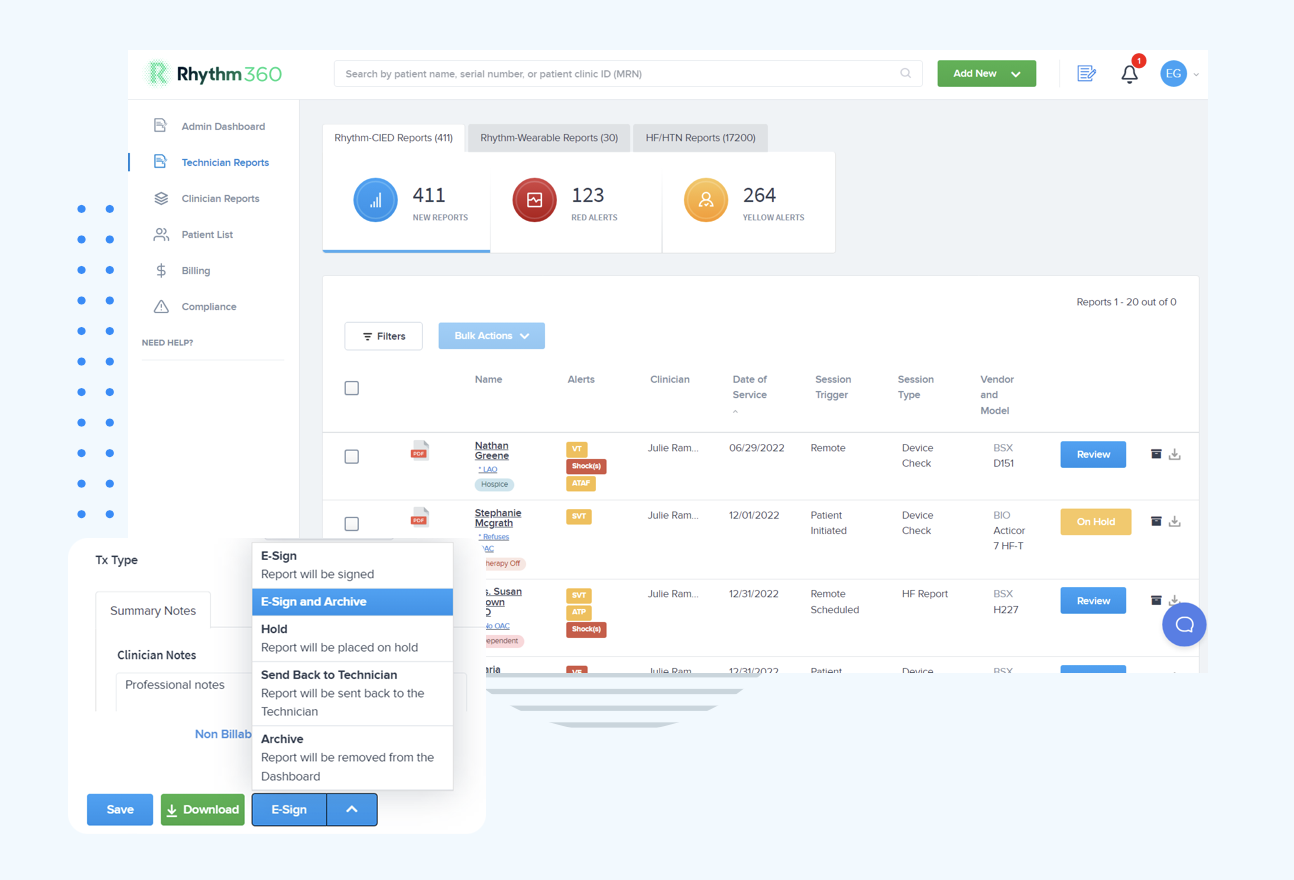
For a deeper look at how these categories interact in cardiology-specific workflows, see our overview of best practices to integrate RCM with cardiology EHR.
Explore Cardiology EHR Integration Best Practices
Because integration architecture depends on the EHR a practice already runs, it helps to understand current market share. Epic is installed in 41.3% of US hospital facilities as of 2025, with Oracle Health/Cerner covering roughly 23% of the US acute care market, and athenahealth serving a large share of independent and mid-size specialty groups. All three appear frequently in large cardiology practices. The more operationally significant consideration is how well an RCM layer integrates with the existing system and whether that integration satisfies the ten requirements below.
Bidirectional integration uses distinct data flows in each direction. ADT messages carry patient demographics and admission, discharge, and transfer events from the EHR to the RCM platform. ORM and ORU messages carry orders and results. DFT segments and X12 837P transactions carry charge and claim data outbound to payers. X12 835 electronic remittance advice and 277CA claim acknowledgments flow back from payers and write into the billing record. Each flow operates on a different cadence and uses a different standard.
HL7 v2 still handles roughly 85% of real-time intra-hospital data exchange globally as of 2026, and most hospital environments run FHIR R4 APIs and HL7 v2 messaging in parallel. The ONC 21st Century Cures Act Final Rule and CMS-0057-F established FHIR R4 as the foundation for federally required interoperability APIs. That regulatory push accelerated adoption across Epic, Oracle Health/Cerner, and athenahealth. FHIR R4 supports GET to retrieve a resource on demand, POST to create a new resource when an event occurs, and PUT to write updates back into the source system. These operations form the technical basis for bidirectional write-back that HL7 v2 alone cannot provide.
Rhythm360 provides bi-directional integration with Epic, Oracle Health/Cerner, athenahealth, eClinicalWorks, and Greenway Health. Onboarding typically takes a few days to a few weeks and includes bi-directional testing and validation. As University of Chicago Medicine noted after implementing Rhythm360: "We have improved billing and accountability for our patients after the integration."
Remote monitoring billing for cardiac devices operates on two distinct cycles. Confusing these cycles is one of the most common sources of denials.
For pacemakers and ICDs, the 90-day cycle applies. Code 93294 is the professional component for pacemaker monitoring, 93295 is the professional component for ICD monitoring, and 93296 is the shared technical component covering remote data acquisition and technician review for both device types. Per CMS coverage article A56602, the device monitoring billing clock resets from the last billable interrogation, not from the start of a calendar quarter; billing early causes a denial, and a period that is never billed is permanently lost.
For implantable cardiovascular physiologic monitors and subcutaneous cardiac rhythm monitors, the 30-day cycle applies. Code 93297 covers implantable cardiovascular physiologic monitors such as CardioMEMS. Code 93298 covers subcutaneous cardiac rhythm monitors and implantable loop recorders. Each of these is a device-specific code, billable once per 30 days. Depending on which component the billing entity performed, each can be billed global, with modifier -26, or with modifier -TC. A common denial results from swapping these codes: 93297 applied to a loop recorder or 93298 applied to a physiologic monitor causes the claim to deny.
For remote physiologic monitoring, the CY 2026 Physician Fee Schedule Final Rule sets national average rates of approximately $22 for 99453 (one-time device setup), $52 per month for 99454 (16–30 days of data), $52 per month for 99457 (first 20 minutes of treatment management), and $41 per month for 99458 (add-on for each additional 20 minutes). Missing the 16-day data transmission threshold is the single most common reason for 99454 claim denials.
The most frequent billing errors in remote monitoring programs are billing outside the required monitoring interval, missing the technical component alongside the professional component, and documentation that fails to support medical necessity. Rhythm360 addresses each of these before submission. The platform tracks device-specific CPT pairings, prevents device-type mismatch denials, and captures unbilled technical components. Automated documentation checks flag interval violations and modifier errors before a claim is submitted.
After a cardiology merger or acquisition, each payer treats the billing identity, defined by TIN rather than practice name, as a distinct entity. Payer enrollment takes roughly 60 to 120 days or more per payer, while acquisition timelines often move faster. A new TIN requires a new CMS-855 enrollment application rather than a simple field correction, and claims should be routed by payer-specific date-of-service tables rather than a single organization-wide cutover date.
Rhythm360 supports multi-entity billing mapping so merged or acquired groups can route claims under the correct TIN and NPI combination while consolidating data from multiple EHRs into a single platform. Analytics segmented by TIN, location, provider, and payer give revenue cycle teams the visibility needed to manage the transition without losing billable events.
See How Rhythm360 Handles Multi-TIN Billing
When a practice implants devices from multiple OEMs, staff must log into a separate proprietary portal for each manufacturer, including Medtronic, Boston Scientific, Abbott, and Biotronik, to retrieve and reconcile transmission data. That fragmentation creates data silos, increases administrative burden, and produces revenue leakage when billable events are missed.
Rhythm360 ingests and normalizes data from all major device manufacturers via APIs, HL7, XML, and PDF parsing with computer vision, providing a single source of truth. The platform achieves greater than 99.9% data transmissibility through redundant data feeds and AI-powered extrapolation. Centralized ingestion helps capture billable events and reduces delays, which directly increases revenue a practice can recover from its existing patient population.
As University of Chicago Medicine observed after deploying Rhythm360: "Decision support, including AI-assisted decision support, will become increasingly important as data volumes grow."
Implementation timelines vary significantly by platform type, and the gap between deployment models often determines whether a group experiences a smooth transition or months of billing disruption. The table below shows how go-live timelines compare across deployment models so leaders can weigh integration speed against other tradeoffs.
| Platform Type | Typical Go-Live Timeline | Source |
|---|---|---|
| AI-native RCM layered on existing EHR | 4–8 weeks | QuickIntell RCM Comparison, 2026 |
| Integrated EHR+RCM platform | 2–6 months | QuickIntell RCM Comparison, 2026 |
| Enterprise EHR (e.g., Epic, Oracle Health) | 12–36 months | QuickIntell RCM Comparison, 2026 |
| Outsourced RCM transition | 3–6 months for initial transition, with 12 or more months to reach optimal performance | QuickIntell RCM Comparison, 2026 |
Rhythm360 onboarding, including EHR integration, typically takes a few days to a few weeks. The process includes interface inventory, bi-directional testing, parallel billing validation, and reconciliation against measurable acceptance criteria before full cutover. EHR integration projects at health systems typically take three to six months from kickoff to live patient data. That timeline includes security reviews, BAA negotiations, and IT coordination. For practices that cannot afford extended billing disruption, a platform with established EHR connectors provides a material advantage.
Software-only platforms give practices direct control over billing data, workflow configuration, and reporting. Outsourced RCM services transfer operational responsibility to a third party, which can reduce internal staffing burden but often limits visibility into claim-level detail and reduces customization options. Outsourced RCM transitions commonly take 3–6 months initially, with 12 or more months to reach optimal performance.
Rhythm360 is a software platform that integrates with existing clinical and billing teams rather than replacing them. The platform automates data ingestion, CPT code tracking, documentation generation, and EHR write-back while billing decisions, payer relationships, and workflow ownership remain with the practice. Other platforms exist in the cardiac monitoring space. Rhythm360’s vendor-neutral architecture and bi-directional EHR integration serve practices that need to preserve existing workflows while adding automation.
Yes. Rhythm360 provides bi-directional integration with Epic via HL7 v2.x and FHIR R4, alongside Oracle Health/Cerner, athenahealth, eClinicalWorks, and Greenway Health. Onboarding that includes EHR integration typically takes a few days to a few weeks and includes bi-directional testing and validation before go-live. Epic integrations involve coordination between the clinic, the monitoring platform, and Epic’s technical teams. Rhythm360’s established connector framework reduces the configuration burden on the practice’s IT staff.
Rhythm360 supports multi-entity billing mapping so practices that have merged or acquired other groups can route claims under the correct TIN and NPI combination. The platform consolidates data from multiple EHRs into a single environment and applies payer-specific date-of-service routing logic so claims are submitted under the billing identity each payer has on file. Analytics segmented by TIN, location, provider, and payer give revenue cycle directors the visibility needed to manage enrollment transitions without losing billable events to timely-filing deadlines.
Rhythm360 supports the full range of cardiology remote monitoring codes. For the 90-day pacemaker and ICD cycle, the platform supports 93294 for pacemaker professional, 93295 for ICD professional, and 93296 for pacemaker and ICD technical. For the 30-day cycle, the platform supports 93297 for implantable cardiovascular physiologic monitors such as CardioMEMS and 93298 for subcutaneous cardiac rhythm monitors and implantable loop recorders. Each of these 30-day codes is billable once per 30 days and can be billed global, with modifier -26, or with modifier -TC. For remote physiologic monitoring, the platform supports 99453, 99454, 99457, and 99458. Rhythm360 automatically tracks device-specific CPT pairings, validates billing intervals, and flags documentation gaps before submission.
Rhythm360’s implementation process, including EHR integration, typically takes a few days to a few weeks. The process includes interface inventory, data mapping, bi-directional testing, parallel billing validation, and reconciliation against acceptance criteria before go-live. For context, enterprise EHR deployments like Epic and Oracle Health often run 12 to 36 months, and outsourced RCM transitions commonly require several months before reaching optimal performance. Rhythm360’s shorter timeline provides a significant operational advantage for practices that need to maintain billing continuity during a platform transition.
Large cardiology practices that manage RCM-EHR integration with multiple point solutions face compounding complexity. Teams juggle separate OEM portals, disconnected billing systems, manual CPT code tracking, and fragmented views across TINs and locations. Operationally resilient groups adopt a unified platform that handles bi-directional EHR integration, vendor-neutral device ingestion, automated CPT code capture, and multi-TIN billing mapping in a single environment.
Rhythm360 is built for this architecture. The platform helps practices reduce critical alert response times by up to 80% and increase revenue capture by up to 300%. These outcomes reflect the combined effect of eliminating data silos, preventing denials at the point of submission, and capturing every billable event across a high-volume device population. As the University of Chicago Medicine example above shows, the platform scales to the demands of a large, multi-site cardiology program.
For practices evaluating RCM software for large cardiology EHR integration in 2026, the ten requirements above provide a technically precise framework to use in vendor conversations, RFP responses, and CIO briefings. Rhythm360 satisfies each of these requirements today.
See The Rhythm360 Integration Framework In Action





