

Last updated: October 2, 2026
Talk With Rhythm360 About Your EP Workflow
Four core capabilities separate true EP workflow automation from basic data display. These pillars give you concrete criteria to test in a live demo.
Vendor-neutral ingestion means the platform ingests and normalizes data from all major CIED manufacturers and specialized sensors, including CardioMEMS pulmonary artery monitors, into a single source of truth. The HL7 CardX CIED Implementation Guide defines the Implantable Device Cardiac Observation (IDCO) profile, which specifies the workflow, nomenclature, and format used to exchange in-clinic and remote CIED device interrogations, and shows that true interoperability relies on structured, standards-based data exchange.
Start by asking which OEMs the platform supports, because limited manufacturer coverage leaves gaps in your patient population. Then ask how the data arrives, such as API, HL7, XML, or PDF parsing, since the method determines how structured and usable the data becomes. Finally, confirm that redundant data feeds exist, because a single manufacturer server outage can otherwise stall your entire monitoring workflow. Rhythm360 addresses all three and achieves greater than 99.9% transmissibility through redundant data feeds, computer vision, and AI-powered extrapolation across all major OEMs.
AI alert triage uses artificial intelligence to filter non-actionable transmissions and prioritize clinically significant events such as new-onset AFib, ventricular tachycardia, lead malfunction, and low battery ERI or RRT indicators. The April 2026 HRS Scientific Statement on Artificial Intelligence Integration Framework into Clinical Electrophysiology Workflows identifies AI-driven remote monitoring triage as a key EP use case, noting that advanced AI analytics capable of separating actionable alerts from noise can significantly reduce clinical workload while increasing detection of clinically significant arrhythmias. The statement also affirms that AI should support and extend clinical judgment.
Ask vendors how alerts are triaged, whether optional oversight by certified cardiac technicians (CCTs) is available, and how they measure response times. Rhythm360 reduces critical alert response times by up to 80%, with optional 24/7/365 CCT oversight supervised by physicians.
Bi-directional EHR integration means the automation platform and the EHR send and receive data using standards such as HL7, FHIR, and SMART on FHIR. The CardX CIED guide defines two primary actors: a Device Observation Data Producer, typically a remote monitoring platform or middleware, and a Device Observation Data Consumer, typically an EHR or device clinic management application. Genuine bi-directionality means finalized reports push into the patient chart without manual entry, and the platform pulls discrete EHR data such as hospitalizations, diagnosis codes, and medications to give clinicians context during review.
Ask for named EHR integrations and confirm that the connection operates in both directions. Rhythm360 offers deep, bi-directional integrations with Epic, Oracle Health/Cerner, athenahealth, eClinicalWorks, and Greenway Health via HL7, with additional systems supported. Onboarding, including EHR integration setup, typically takes a few days to a few weeks.
Automated CPT capture tracks and documents billable remote monitoring events using device-specific CPT codes. For pacemakers and ICDs on a 90-day cycle, the relevant codes are 93294 for pacemaker professional, 93295 for ICD professional, and 93296 for pacemaker or ICD technical. For implantable cardiovascular physiologic monitors such as CardioMEMS, 93297 applies on a 30-day cycle. For subcutaneous cardiac rhythm monitors and implantable loop recorders, 93298 applies on a 30-day cycle. Both 93297 and 93298 are device-specific codes, and each can be billed global, with a -26 modifier, or with a -TC modifier.
Confirm how the platform handles 90-day and 30-day billing cycles, how it prevents device-type mismatch denials, and whether it supports professional and technical component billing. University of Chicago Medicine reported improved billing and accountability for patients after integrating Rhythm360. Rhythm360 automates CPT code capture and documentation, helping practices capture up to 300% more revenue.
The following numbered list functions as a repeatable RFP test. Ask any vendor to demonstrate each workflow live in the platform. The workflows a platform performs on demand in a demo reflect what it will perform in production.
This list converts abstract integration claims into observable, verifiable outcomes. For a broader look at the best platforms for automating EP clinic workflows, additional platform roundups are available.
See These 10 Workflows in a Live Rhythm360 Session
The RFP test above assumes you are evaluating EP-specific automation. That distinction matters because CIED remote monitoring workflow automation and general remote patient monitoring address different clinical problems, use different device data, and bill under different CPT code families.
EP clinic automation centers on device data generated by CIEDs such as pacemakers, ICDs, implantable loop recorders, CRT and CCM devices, and specialized sensors such as CardioMEMS. Remote monitoring of CIED patients was first introduced in the early 2000s and has since become the standard of care, and the 2015 HRS Expert Consensus Statement established it as such. The data these devices produce, including battery status, lead impedance, arrhythmia logs, and delivered therapies, requires device-specific interpretation and documentation. Billing follows 90-day cycles for pacemakers and ICDs with codes 93294, 93295, and 93296 and 30-day cycles for physiologic monitors with 93297 and loop recorders with 93298, with professional and technical component billing available.
General RPM typically focuses on chronic condition monitoring such as hypertension, diabetes, and heart failure fluid status using patient-facing connected devices such as blood pressure cuffs and weight scales. The relevant CPT codes are 99453 for initial setup, 99454 for device supply and data transmission, and 99457 for treatment management. CMS has proposed policy changes for the RPM code family in the CY 2027 Physician Fee Schedule proposed rule, including requirements around established patients and initiating visits, which reflects continued regulatory attention to this category.
Practices evaluating profitability should recognize that CMS reimbursement for both CIED monitoring and general RPM is structured around documented, qualified review within defined timeframes. Revenue outcomes depend on billing capture rates, documentation accuracy, and cycle compliance, and automation directly affects each of these factors. Rhythm360 offers distinct but integrated service lines for Rhythm-CIED and HF or HTN RPM, allowing practices to manage both populations from a single platform. For a detailed look at cardiac workflow automation for device clinics, additional resources are available.
Rhythm360 is a vendor-neutral, cloud-based, HIPAA-compliant platform built for the operational complexity of electrophysiology and cardiology practices. It ingests and normalizes data from Medtronic, Boston Scientific, Abbott, and Biotronik via API, HL7, XML, and PDF parsing using computer vision. Redundant data feeds support greater than 99.9% transmissibility.
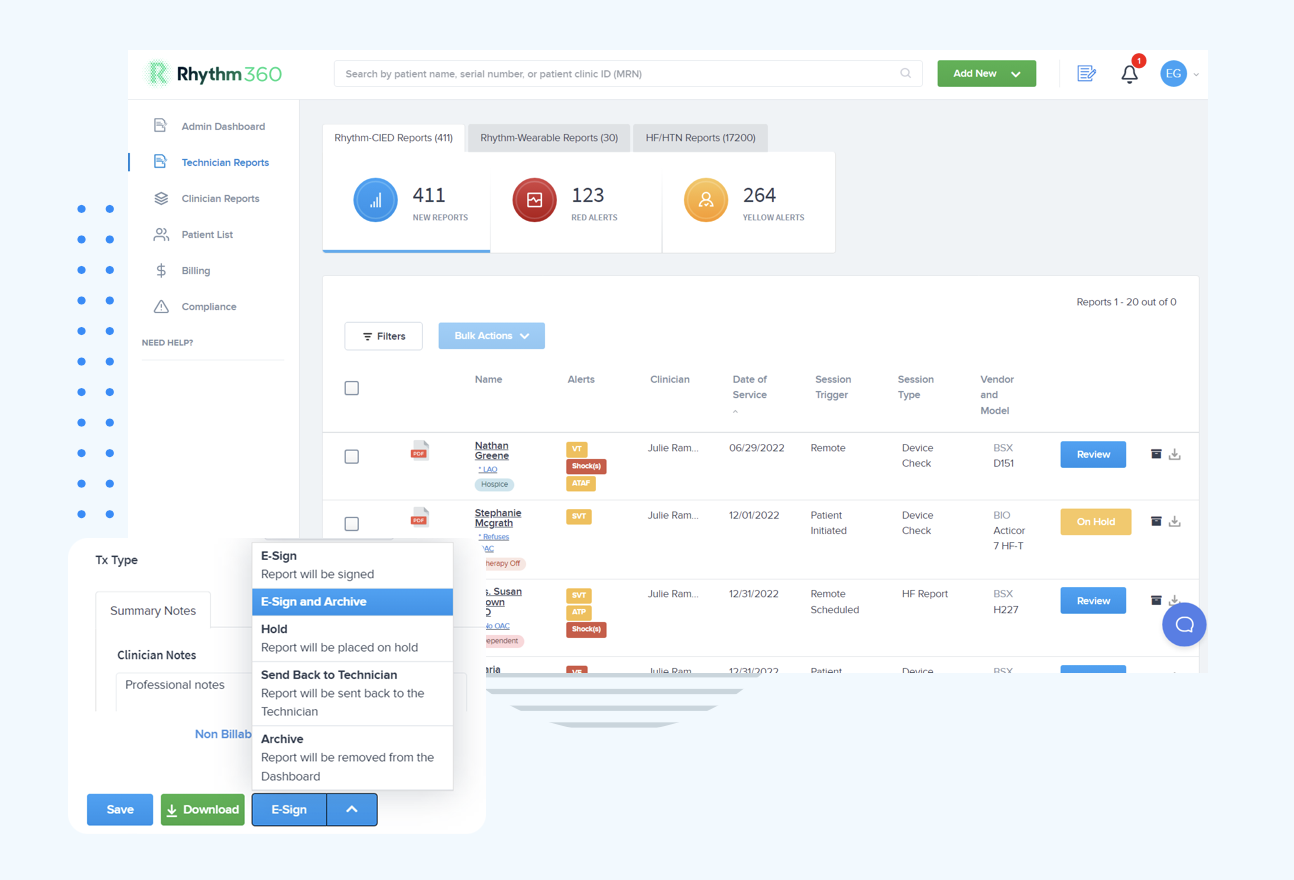
Bi-directional EHR integrations with Epic, Oracle Health/Cerner, athenahealth, eClinicalWorks, and Greenway Health via HL7 eliminate manual data transcription and support the full documentation workflow from transmission receipt to signed report. The same AI-powered alert triage described earlier, with optional CCT oversight, drives the documented improvement in response times. Automated CPT capture covers 93294, 93295, 93296, 93297, 93298, 99453, 99454, and 99457, with support for professional and technical component billing. A secure, HIPAA-compliant mobile app allows clinicians to review transmissions, sign reports, and coordinate care from anywhere.
University of Chicago Medicine reviewed more than 73,000 reports annually through Rhythm360 in calendar year 2025, averaging more than 18,000 reports per quarter. This volume provides documented evidence of the platform’s scalability in a high-volume academic EP environment. As noted in that implementation, “decision support, including AI-assisted decision support, will become increasingly important as data volumes grow.”
Several platforms operate in this space, including Murj, Implicity, Rhythm Management Group, and Octagos. Because each uses a different data model and integration approach, the 10-workflow RFP test above offers a reliable way to compare them against your own requirements.
Explore How Rhythm360 Fits Your EP and RPM Strategy
Vendor-reported percentage improvements are not independently verified and are not directly comparable across platforms. A claim of reduced response times or increased revenue capture reflects a specific implementation context, including patient volume, device mix, EHR environment, and staffing model, which may differ substantially from your practice.
Before signing a contract, request references from clinics with a similar EHR, device mix, and staffing structure. Ask how long those clinics have been live on the platform and whether they have experienced EHR integration issues after deployment.
Run the 10-workflow RFP test described above in a live demo environment rather than a pre-recorded walkthrough. A platform that cannot demonstrate automated CPT cycle tracking, bi-directional EHR filing, and AI alert triage in a live session is unlikely to deliver those capabilities reliably in production.
Rhythm360’s approved outcome claims include an up to 80% reduction in critical alert response times and an up to 300% increase in revenue capture and profitability. These figures reflect documented client outcomes and should be evaluated against your practice’s current baseline.
Medical device integration in an EP clinic means a software platform ingests, normalizes, and acts on data transmitted by cardiac implantable electronic devices from multiple manufacturers such as Medtronic, Boston Scientific, Abbott, and Biotronik within a single, unified workflow. True integration means structured data flows into the EHR, alerts are triaged by clinical priority, and billing documentation is generated automatically. Platforms that deliver this capability use a combination of API connections, HL7 messaging, XML parsing, and computer vision to handle the varied data formats each OEM produces.
Rhythm360’s onboarding process, including EHR integration setup, typically takes a few days to a few weeks, depending on the complexity of the EHR environment and the number of OEM data feeds being connected. The implementation model is designed to minimize disruption to existing clinical workflows and avoid prolonged deployment timelines often associated with legacy and rules-based platforms.
Rhythm360’s secure, HIPAA-compliant mobile app allows clinicians to review transmissions, sign reports, and coordinate care from anywhere. This capability is particularly relevant for on-call electrophysiologists and cardiologists who need to respond to critical alerts such as new-onset AFib or ICD therapy delivery outside of normal clinic hours. All actions taken through the mobile app are logged with a full audit trail within the patient record.
Fragmented OEM portals, alert fatigue from non-actionable transmissions, and billing leakage from incomplete CPT documentation define many EP clinic operations today. Each problem is solvable with the right platform, provided that platform can demonstrate the solution in a live environment before a contract is signed.
Rhythm360 is built for this category, with vendor-neutral ingestion from all major CIED manufacturers, AI-powered alert triage with optional CCT oversight, bi-directional EHR integration with Epic, Oracle Health/Cerner, athenahealth, eClinicalWorks, and Greenway Health, and automated CPT capture across the full range of device-specific and RPM billing codes. The University of Chicago Medicine’s review of more than 73,000 reports annually through Rhythm360 shows what the platform delivers at scale.
The 10-workflow RFP test in this guide exists because demonstrated capability provides the most reliable proxy for production performance. Run it with every vendor you evaluate.
Request a Live Rhythm360 Workflow Walkthrough





