Medicare reimburses remote heart failure monitoring services under specific RPM CPT codes when your documentation and billing meet CMS requirements. CMS's 2026 Physician Fee Schedule introduces two new RPM CPT codes that expand reimbursement flexibility for heart failure monitoring, including CPT 99445 for shorter monitoring periods and CPT 99470 for brief clinical management.
Medicare covers remote heart failure monitoring when you collect physiologic data such as weight, blood pressure, and CardioMEMS pulmonary artery pressures. The service requires a provider order, patient consent, and documented medical necessity for chronic heart failure management.
CPT Code | Description/HF Example | Medicare Reimbursement | Frequency |
99453 | Initial setup and patient education | ~$22 | Once per episode |
99454 | Device supply, 16+ days (weight scales, BP monitors) | ~$47 | Monthly |
99445 | Device supply, 2-15 days (new 2026) | ~$47 | Monthly |
99457 | Clinical management, first 20 minutes | ~$52 | Monthly |
99458 | Additional management, each 20 minutes | ~$41 | As needed |
99470 | Brief management, first 10 minutes (new 2026) | ~$26 | Monthly |
RPM services are not subject to Medicare telehealth restrictions because they are non-face-to-face services, which supports stable coverage for heart failure monitoring programs.
Practices that want to scale HF RPM can automate Medicare billing and reduce manual work. Schedule a demo to see how Rhythm360 streamlines heart failure monitoring compliance.
Accurate Medicare billing for remote heart failure monitoring starts with a clear, repeatable workflow and consistent documentation.
1. Verify Patient Eligibility
Confirm a chronic heart failure diagnosis with appropriate ICD-10 codes and active Medicare Part B enrollment. Medicare RPM eligibility includes congestive heart failure as a covered condition for physiologic monitoring services.
2. Capture Patient Consent and Provide Education
Document informed consent for RPM services in the medical record and educate patients on device use and expectations. Patients must opt in to RPM services before you order the device, and new patients require a clinical evaluation.
3. Order and Set Up Monitoring Devices
Prescribe FDA-cleared medical devices that collect physiologic data such as weight, blood pressure, or pulmonary artery pressure. New CPT 99445 covers device supply with daily recordings for 2-15 days, which supports intermittent monitoring needs.
4. Select the Correct CPT Codes
Choose 99454 for 16 or more days of device data or 99445 for 2-15 days, based on the monitoring period. You cannot bill 99445 and 99454 in the same month for the same patient.
5. Document Clinical Time and Interventions
Record all clinical staff time spent on data review, patient outreach, and care plan changes. Use 99457 for 20 or more minutes of management time or new 99470 for 10-19 minutes.
6. Submit Claims with Correct Modifiers and Codes
Maintain HIPAA-compliant data transmission and avoid duplicate billing with cardiac device interrogation codes such as 93298. All RPM codes apply to physiologic parameters like weight, blood pressure, and respiratory flow rate that are relevant for heart failure monitoring.
7. Monitor Compliance and Audit Regularly
Track data transmission days, patient adherence, and documentation quality to prevent denials and protect ongoing reimbursement.
Medicare covers remote cardiac monitoring through RPM services when you document medical necessity for chronic heart failure management. Medicare payments for RPM surpassed $500 million in 2024, which shows strong program growth.
Medicare guidelines require physiologic data from FDA-cleared devices, secure HIPAA-compliant transmission, and clear documentation of clinical necessity. Heart failure monitoring often uses weight scales for fluid status, blood pressure monitors for cardiovascular trends, and CardioMEMS sensors for pulmonary artery pressure.
Medicare telehealth flexibilities extend through December 31, 2027, and RPM services keep separate coverage rules that do not include telehealth geographic limits.
Medicare Part B covers RPM services for eligible beneficiaries, with nearly 1 million Medicare enrollees using RPM services in 2024. This adoption reflects growing comfort with remote monitoring in routine care.
Rhythm360 offers a vendor-neutral platform that automates heart failure RPM billing and clinical workflows for cardiology teams. The platform unifies data from major manufacturers, including weight scales, blood pressure monitors, and CardioMEMS sensors, into a single dashboard.
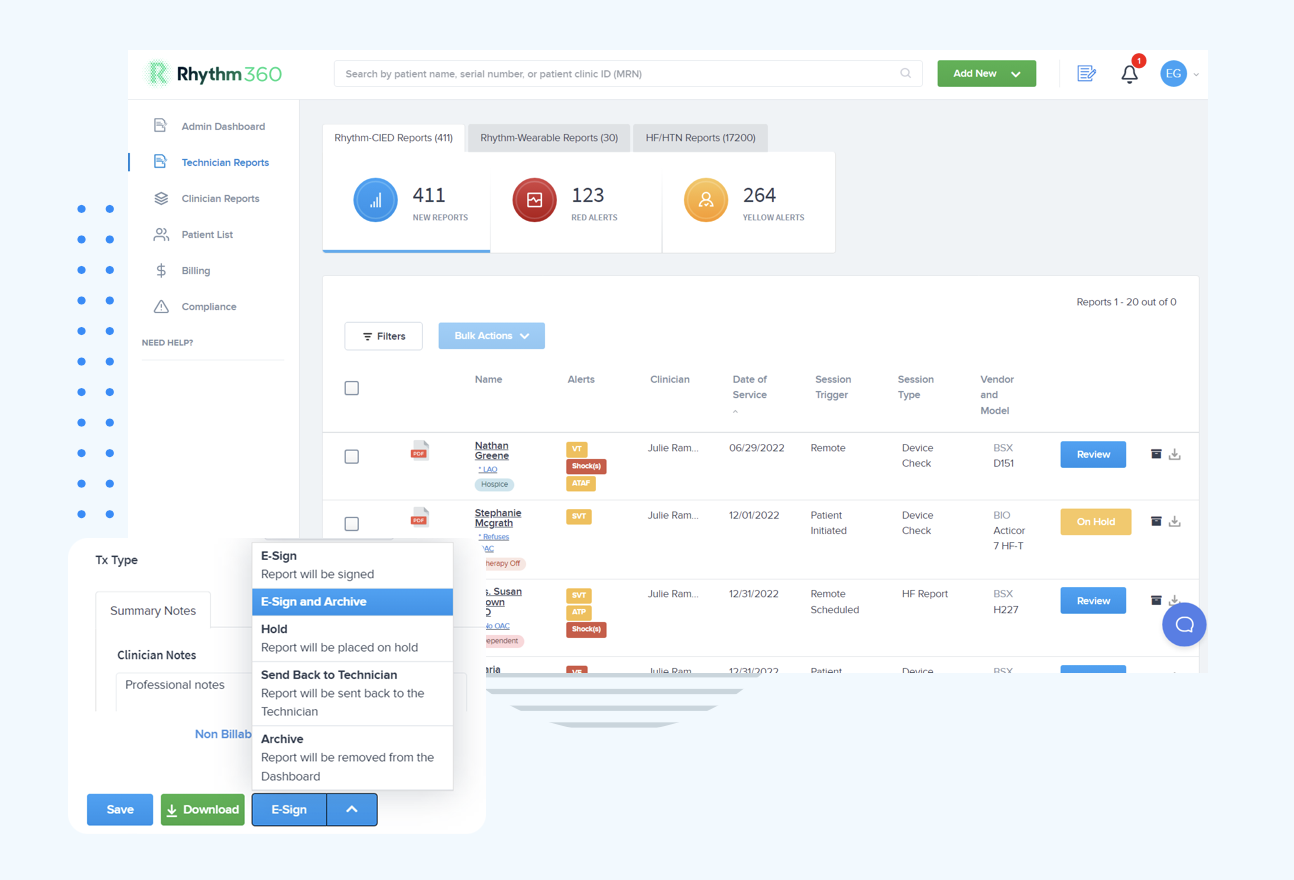
The system captures physiologic data with more than 99.9% transmissibility using redundant data feeds and AI-based gap filling. Automated CPT code documentation supports compliant billing for 99453, 99454, 99445, 99457, 99458, and 99470, and AI-driven alert triage can reduce critical response times by 80%.
Key Rhythm360 features include:
Practices using Rhythm360 report revenue increases up to 300% through more complete billing capture and expanded RPM services. Case studies show urban ACOs monitoring 500 CHF patients achieved $2 million annual ROI through reduced readmissions and higher reimbursement revenue.
Your team can transform heart failure monitoring with automated Medicare billing and streamlined workflows. Schedule a demo to see how Rhythm360 can increase RPM revenue by up to 300%.
Common billing mistakes include too few data transmission days, missing consent documentation, and weak clinical time tracking. 2026 RPM updates make many previously unmonitored heart failure patients eligible, including those with recent exacerbations or inconsistent data transmission.
The new 2026 codes close gaps where patients with intermittent monitoring needs did not qualify for reimbursement. New codes support reimbursement for long-term maintenance patients with fewer readings, who were previously ineligible under the 16-day requirement.
Revenue projections show strong upside. With average reimbursements of $150-200 per patient per month across all CPT codes, a practice monitoring 50 heart failure patients could generate $90,000-120,000 each year in additional Medicare revenue.
Medicare reimburses heart failure RPM through CPT codes 99453 for setup at about $22, 99454 for 16 or more days of device supply at about $47, new 99445 for 2-15 days of device supply at about $47, 99457 for 20 or more minutes of management at about $52, 99458 for each additional 20 minutes at about $41, and new 99470 for 10-19 minutes of management at about $26. These codes cover physiologic monitoring such as weight, blood pressure, and specialized cardiac sensors.
CardioMEMS pulmonary artery pressure monitoring is covered under Medicare RPM codes when medically necessary. Practices typically bill CPT 99454 for device supply, and clinical management of CardioMEMS data qualifies for CPT 99457 or 99470, depending on documented time.
Medicare RPM reimbursement rates for 2026 include about $22 for initial setup with 99453, $47 for device supply with 99454 or 99445, $52 for the first 20 minutes of clinical management with 99457, $41 for each additional 20 minutes with 99458, and $26 for brief 10-19 minute management with 99470. These figures represent national averages and can vary by region.
Medicare covers remote cardiac monitoring through RPM codes when you document medical necessity for chronic conditions such as heart failure. Some Medicare Advantage plans may apply extra restrictions, but traditional Medicare fee-for-service maintains broad RPM coverage for chronic heart failure when clinical necessity is clear.
Medicare Part B pays for remote patient monitoring equipment and clinical services when billed with the correct CPT codes. Patients remain responsible for standard Medicare deductibles and coinsurance. The provider usually supplies the monitoring devices and bills Medicare directly for both equipment and clinical management.
Medicare reimbursement for remote heart failure monitoring, strengthened by new 2026 CPT codes, creates meaningful revenue opportunities for cardiology practices. A Health Affairs study showed Medicare revenue increased by about 20% for practices adopting RPM, which confirms the financial impact.
Successful HF RPM programs follow a structured approach to enrollment, device management, clinical workflows, and billing compliance. The addition of CPT 99445 and 99470 expands eligibility to patients who previously did not qualify, and automated platforms like Rhythm360 help capture every eligible dollar through accurate documentation and efficient operations.
Practices ready to grow Medicare heart failure RPM revenue and improve outcomes can act now. Schedule a Rhythm360 demo today to see how the platform can increase practice revenue by up to 300% while supporting better patient care.