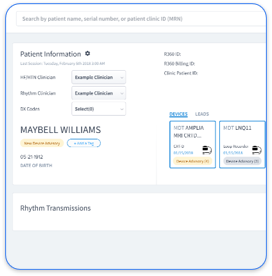
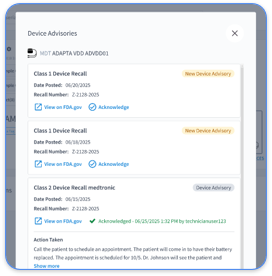
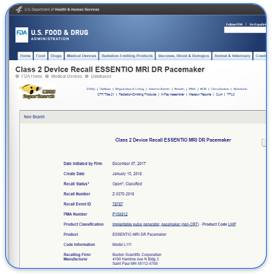
Medicare claim denials for CIED evaluations most often result from frequency violations, such as billing a device interrogation before the required interval, or from documentation that fails to support a medically necessary exception. CMS claims processing guidelines require that documentation in the medical record support the frequency of services billed and that any service exceeding routine intervals be tied to a specific clinical indication.
Practices that implant devices from more than one manufacturer face a compounding problem. Medtronic, Boston Scientific, Abbott, and Biotronik each operate separate, non-interoperable portals. Staff log into each system independently, reconcile transmission dates manually, and then map those dates to CPT-specific 90-day windows. A single miscalculation, such as billing CPT 93295 on day 88 of a 90-day cycle, triggers an automatic denial. Across a population of hundreds of ICD patients, these errors accumulate into material revenue loss and audit risk.
To prevent these costly errors, practices need a clear view of the exact frequency limits Medicare enforces for each device type and evaluation modality. The table below summarizes Medicare coverage for pacemaker and ICD evaluations under remote and in-clinic modalities, along with the applicable CPT codes and key documentation requirements. These reflect CMS Local Coverage Determinations governing cardiac device evaluations and CMS Change Request transmittals applicable to CIED monitoring policy.
| Device / Modality | CPT Code | Covered Frequency | Key Documentation Requirement |
|---|---|---|---|
| Pacemaker — Remote | 93294 / 93296 | often covered at routine intervals | Signed physician interpretation; transmission date in record |
| Pacemaker — In-Clinic | 93288 | often covered at routine in-clinic intervals | In-person evaluation note; device parameters documented |
| ICD — Remote | 93295 / 93296 | often covered at routine intervals | Signed physician interpretation; alert documentation if applicable |
| ICD — In-Clinic | 93289 | often covered at more frequent routine intervals | In-person evaluation note; therapy history reviewed |
Alert- or symptom-driven evaluations that fall outside routine intervals may be covered when the medical record documents the specific clinical trigger, such as a new arrhythmia episode, lead integrity alert, or patient-reported symptoms, along with the treating physician’s clinical rationale for the additional evaluation. Federal regulations governing Medicare Part B claims require that all services be medically reasonable and necessary, with supporting documentation retained in the beneficiary’s record.
The Rhythm360 platform turns a raw device transmission into a billable, documented evaluation through a defined, stepwise process. First, the platform ingests data from all connected OEM portals simultaneously through API, HL7, XML, and AI-powered PDF parsing using computer vision, then normalizes those formats into a single structured record. Second, the AI alert triage engine filters non-actionable transmissions and surfaces clinically significant events, such as ventricular tachycardia episodes or lead impedance changes, for prioritized clinician review.
Third, the system cross-references the transmission date against the patient’s CPT-specific frequency window and flags any submission that would fall outside the covered interval. Fourth, automated report generation produces a compliant evaluation note that is pre-populated with device parameters, alert findings, and a physician interpretation field ready for signature. Fifth, the completed documentation flows to the EHR through bi-directional integration, and the billing queue updates with the appropriate CPT code and supporting data. This end-to-end automation removes the manual reconciliation steps where frequency errors most often occur.
Manual frequency tracking forces staff to maintain a separate log, often a spreadsheet or calendar, for each patient’s last transmission date per CPT code and to update that log every time a new transmission arrives from any OEM portal. In a practice with 300 ICD patients across three manufacturers, that workflow creates up to 1,200 individual 90-day windows to monitor at the same time. Staff turnover or a missed portal login can allow windows to lapse unbilled or to be billed too early.
Automated tracking calculates and displays each patient’s next eligible billing date in real time, generates worklists sorted by upcoming due dates, and blocks out-of-window claims before submission. The operational difference is substantial, and practices using Rhythm360 have documented up to a 300% increase in captured revenue and an 80% reduction in critical alert response times compared with prior manual workflows.
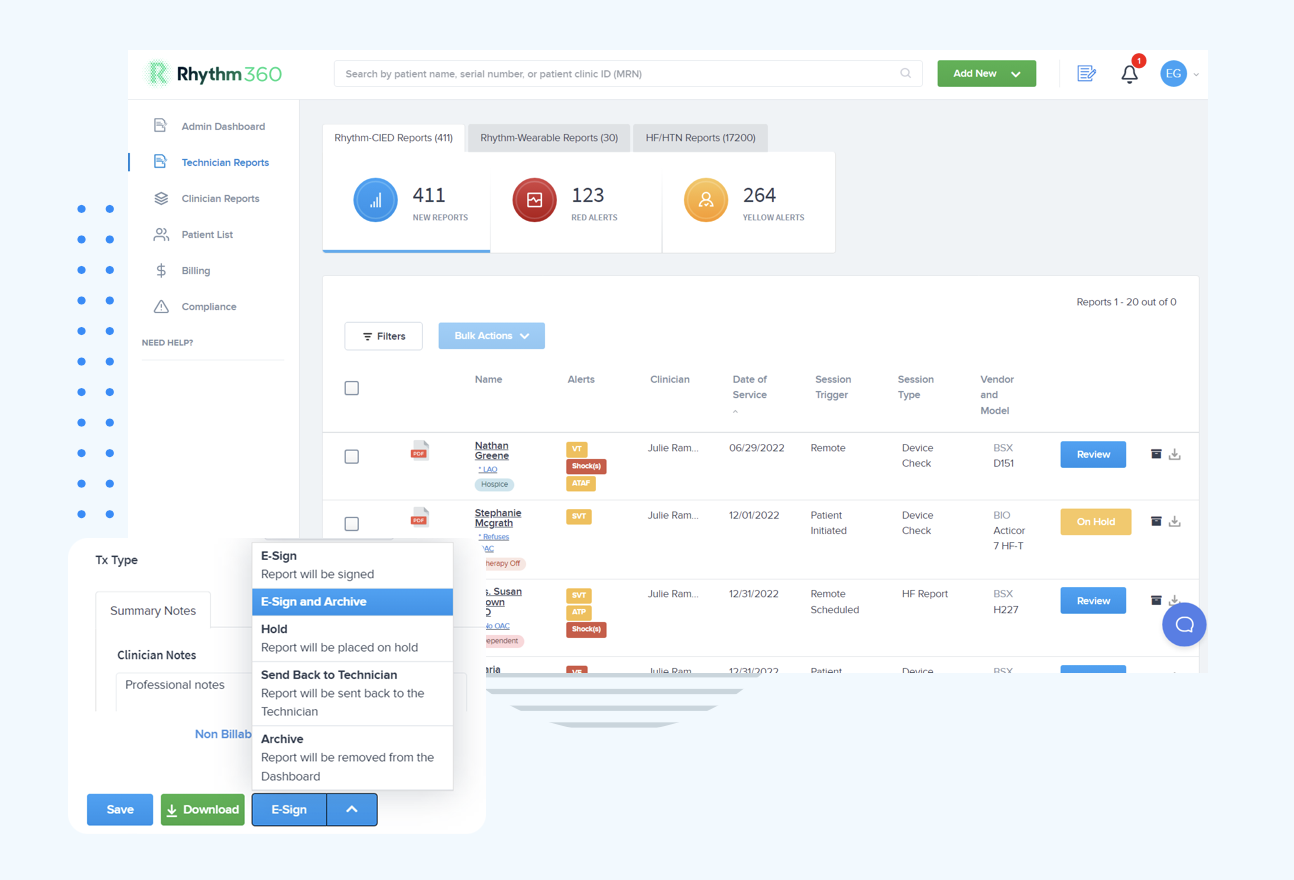
See the real-time frequency tracking dashboard in action, and explore how Rhythm360 manages mixed pacemaker and ICD populations.
Practices that evaluate a unified monitoring platform benefit from a structured readiness assessment across four related dimensions, each addressing a different source of friction. First, device population size determines the volume of concurrent frequency windows the system must manage, and practices with more than 50 active CIED patients usually reach the point where manual tracking becomes unsustainable.
Second, multi-portal burden measures how many OEM systems staff access each day, and every additional portal multiplies the reconciliation time identified in the population-size review. Third, billing alignment examines whether the current revenue cycle workflow captures alert-driven evaluations as distinct billable events or folds them into routine visit documentation, which can leave reimbursement unclaimed and magnify the impact of population size and portal burden.
Fourth, EHR integration needs determine whether automated documentation can flow directly into the existing clinical record system, and Rhythm360 supports Epic, Cerner, Athenahealth, eClinicalWorks, Greenway Health, and other platforms through HL7. Implementation, including EHR integration setup, typically finishes within a few days to a few weeks and keeps disruption to active clinical operations low.
Payer policies effective in 2026 continue to enforce strict frequency edits on CIED evaluation codes, with claims submitted before the minimum interval automatically denied at adjudication. The most common denial triggers include billing a remote interrogation code before 90 days have elapsed from the prior billable transmission and submitting an in-clinic ICD evaluation, CPT 93289, more than twice in a calendar year without documented clinical justification.
Other frequent issues include failing to include a signed physician interpretation with the technical component claim and omitting the specific clinical trigger when billing an alert-driven evaluation outside the routine schedule. Reimbursement guidance for cardiac device evaluations consistently identifies incomplete documentation of the physician’s review and interpretation as a leading cause of post-payment audit recoupment. Provider manuals for 2026 also specify that cross-device tracking, which maintains separate frequency records for each implanted device when a patient carries both a pacemaker and an ICD, is required to avoid duplicate billing edits.
Medicare covers remote pacemaker interrogations under CPT codes 93294 and 93296, and in-clinic pacemaker evaluations under CPT 93288. Additional evaluations require documented clinical justification, such as a device alert, new symptoms, or a change in the patient’s cardiac status, to qualify for coverage.
Medicare covers remote ICD interrogations under CPT codes 93295 and 93296, and in-clinic ICD evaluations under CPT 93289. ICDs receive more frequent in-clinic coverage than pacemakers because of the added complexity of shock therapy history review, lead integrity assessment, and defibrillation threshold considerations. Alert-driven evaluations are covered when the clinical record documents the specific triggering event.
Medicare Part B covers both remote and in-clinic pacemaker evaluations when they fall within the covered frequency limits and include compliant documentation, including a signed physician interpretation. The technical component, which covers device data retrieval and report generation, and the professional component, which covers physician review and interpretation, are billed separately under the applicable CPT codes. Practices must document both components and confirm that the service date falls within the covered interval to avoid denial.
Clinics can bill for evaluations that fall outside the standard 90-day remote interval when a specific clinical circumstance justifies the additional service. Qualifying triggers include device-generated alerts for arrhythmias, lead integrity issues, battery status changes, or patient-reported symptoms that prompt an unscheduled evaluation. The medical record must document the clinical indication clearly, and the claim should include a diagnosis code that supports medical necessity. Routine or administrative convenience does not qualify as sufficient justification for exceeding standard frequency limits.
A unified platform like Rhythm360 addresses frequency compliance at the system level rather than relying on individual staff vigilance. By consolidating transmission data from all OEM portals into a single dashboard, the platform calculates each patient’s next eligible billing date per CPT code in real time and prevents premature claim submission. Automated documentation generation ensures that every billable evaluation includes a complete, signed physician interpretation and the relevant device data, which are the elements most often cited in denial and audit findings.
For alert-driven evaluations, the platform captures the triggering event in the patient record automatically and supplies the clinical justification documentation required for out-of-cycle claims. This approach creates a compliance posture that scales with patient population size without proportional increases in administrative staff.
Medicare frequency rules for pacemaker and ICD evaluations are precise, payer-enforced, and directly tied to practice revenue. The 90-day remote window, the different in-clinic schedules for pacemakers and ICDs, and the documentation requirements for alert-driven exceptions leave almost no room for manual tracking errors across a mixed-device population. Rhythm360 closes that gap by automating frequency calculation, alert capture, documentation generation, and EHR integration within a single vendor-neutral platform, which converts a fragmented, error-prone process into a reliable, auditable compliance workflow.
Practices that have implemented Rhythm360 have achieved the revenue recovery and response-time improvements described earlier through optimized CPT code capture and automated alert management. Protect your 2026 evaluation revenue and see how Rhythm360 eliminates frequency tracking errors while supporting compliant billing.