

Last updated: July 14, 2026
CPT 99454 is a recurring device-supply code billed on rolling 30-day cycles, not fixed calendar months. The following rules govern frequency:
The table below maps transmission-day counts to the correct 2026 device-supply code:
| Transmission Days in 30-Day Period | Correct Code | 2026 Medicare Rate (approx.) | Notes |
|---|---|---|---|
| 0–1 days | Neither 99454 nor 99445 | $0 | No device-supply billing permitted |
| 2–15 days | CPT 99445 (new 2026) | ~$47 | Mutually exclusive with 99454 |
| 16–30 days | CPT 99454 | ~$47 | Standard device-supply code; once per 30-day period |
Decision tree for rolling periods:
CPT 99453 covers one-time device setup and patient education. CPT 99454 is the recurring monthly device-supply charge. The two codes serve different functions and may be billed together once every 30 days when the 16-day monitoring threshold is met.
In a cardiology workflow, this typically means:
Understanding when these codes can be billed together starts with a clear grasp of the core requirements that govern CPT 99454. The next section outlines exactly what must be documented to support any 99454 claim.
Physiologic data must be electronically collected and automatically uploaded to a secure location available for analysis by the billing practitioner on at least 16 separate days within the 30-day billing period. A day with no transmission does not count, regardless of whether the device is powered on. When a patient uses multiple devices, readings from all devices are combined, and multiple readings on the same calendar day from different devices typically count as one data day.
The device must be a medical-grade device that automatically uploads data; patient-reported data alone does not qualify. Manual entry of readings into an app, portal, or phone call does not satisfy this requirement. A June 2025 False Claims Act settlement of $1.29 million in the Northern District of Georgia involved non-reimbursable RPM claims submitted to Medicare.
CPT 99454 may be billed only once per patient every 30 days, regardless of the number of RPM devices supplied to that patient. Only one practitioner may bill remote monitoring for a given patient in any 30-day period.
The RPM device ordered must meet the FDA's definition of a medical device as described in section 201(h) of the Federal Food, Drug, and Cosmetic Act. Qualifying device categories include blood pressure monitors, glucometers, pulse oximeters, digital weight scales, and cardiac implantable electronic devices. Consumer wearables requiring manual data entry, including most fitness trackers, do not meet CMS device requirements.
Patient consent must be documented in the medical record before any CPT 99454 billing begins and must include the patient's agreement to participate, acknowledgment that only one practitioner can bill RPM per calendar month, cost-sharing disclosure for Medicare coinsurance, and the right to revoke consent at any time. Written consent with patient signature provides substantially stronger audit protection than verbal consent alone.
Cardiology practices managing patients with pacemakers, ICDs, CRT devices, and implantable loop recorders must understand the boundary between CIED-specific interrogation codes and general RPM codes before submitting concurrent claims.
CPT codes 93294–93298 are device-specific cardiac interrogation codes, while 99453–99454 are general remote physiologic monitoring codes. CIED remote monitoring typically bills under the cardiac-specific codes rather than RPM codes. Concurrent billing of CPT 99454 alongside CIED codes such as 93298 is generally inappropriate because the CIED transmission itself is captured under the device-specific pathway.
For cardiology practices running both CIED and HF/HTN RPM programs, the documentation checklist below applies to each service line separately:
| Documentation Element | CIED (93294–93299) | RPM (99453/99454) |
|---|---|---|
| Device type and manufacturer | Required | Required (FDA clearance on file) |
| Dates of monitoring period | Required | Required (30-day rolling cycle dates) |
| Clinician interpretation note | Required (device function, parameters, findings) | Required (clinical review of transmitted data) |
| Transmission day log | Per interrogation schedule | ≥16 unique days for 99454; 2–15 for 99445 |
| Patient consent | Standard informed consent | RPM-specific consent with cost-sharing disclosure |
| ICD-10 diagnosis codes | Arrhythmia/device-specific | Chronic condition driving RPM need |
Multi-OEM environments, where a single patient may have a Medtronic device alongside Abbott or Boston Scientific equipment, create additional complexity. Staff logging into separate manufacturer portals to retrieve transmission data risk missing qualifying days, miscounting thresholds, and generating inconsistent documentation across service lines.
See how Rhythm360 unifies multi-OEM data into a single auditable workflow across CIED and RPM programs.
CMS finalized new RPM supply code CPT 99445, billable when 2 to 15 days of data are transmitted in a 30-day period, under the CY 2026 Medicare Physician Fee Schedule Final Rule released November 5, 2025, effective January 1, 2026. The code pays at approximately the same rate as CPT 99454 and is mutually exclusive with it.
The clinical rationale for CPT 99445 is significant for cardiology. Prior to the 2026 update, the 16-day minimum threshold created billing gaps when a patient needed intensive monitoring for 10 days after an acute illness. CPT 99445 now covers post-procedure recovery, short-term medication titration, and episodic symptom monitoring, which are all common cardiology scenarios.
Key interaction rules between 99445 and 99454:
Rhythm360 automatically tracks cumulative transmission days throughout the billing period and flags the correct device-supply code at period close, which removes the manual review step that commonly produces miscoded claims.
Failing to meet the 16-day threshold described above is the most common RPM claim denial reason. The table below maps the top denial triggers to corrective actions:
| Denial Trigger | Root Cause | Corrective Action |
|---|---|---|
| Fewer than 16 transmission days | Passive monitoring without mid-cycle adherence review | Implement automated day-count alerts at day 10 and day 20 of each cycle, and bill 99445 if 2–15 days are confirmed at period close |
| Non-automatic transmission | Patient manually entering readings into an app or portal | Provision only devices meeting the FDA definition of a medical device with verified automatic upload capability, and document device serial number and device information on file |
| Missing or incomplete consent | Consent obtained verbally without documentation, or obtained after first billing cycle | Obtain written consent before device provisioning, and include cost-sharing disclosure and single-provider acknowledgment |
| Absent or expired physician order | Order not renewed or never linked to qualifying chronic condition | Require signed order specifying ICD-10 diagnosis and monitoring duration before enrollment, and set renewal reminders |
| Concurrent billing of 99445 and 99454 | Billing system does not enforce mutual exclusivity | Configure claim scrubbing rules to allow only one device-supply code per patient per 30-day period |
| Device that does not meet the FDA definition of a medical device | Consumer wearable used in place of medical-grade device | Maintain an approved device list and audit device assignments quarterly |
Rhythm360 is a vendor-neutral, HIPAA-compliant platform built for cardiology practices managing both CIED populations and chronic disease RPM programs. The platform ingests data from all major device manufacturers, including Medtronic, Boston Scientific, Abbott, and Biotronik, through APIs, HL7, XML, and AI-powered PDF parsing. It then normalizes disparate data streams into a single source of truth without requiring staff to log into multiple OEM portals.
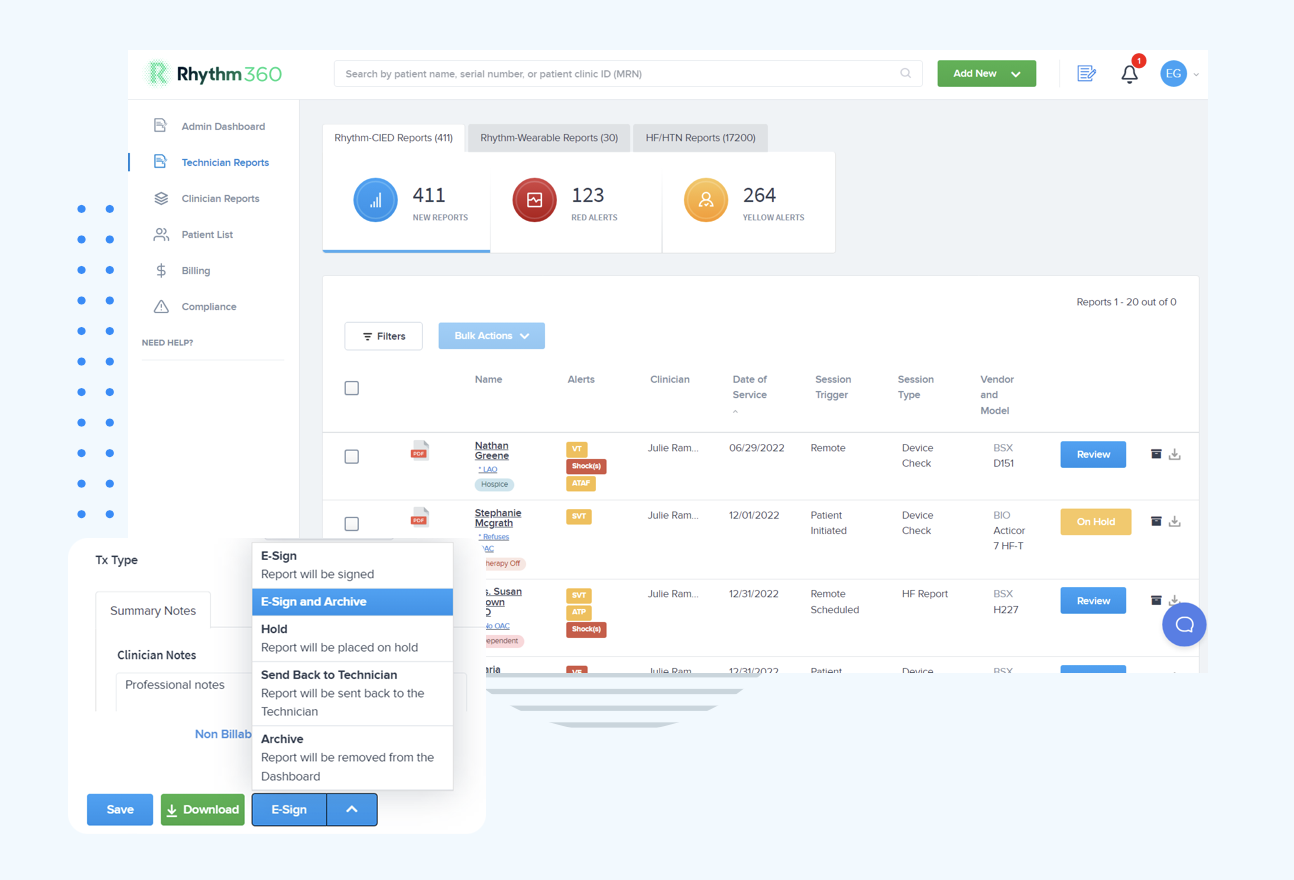
For CPT 99454 compliance, Rhythm360 delivers:
Practices using Rhythm360 have achieved an 80% reduction in response times for critical patient alerts and up to a 300% increase in revenue generation through precise CPT code capture and improved staff efficiency.
Eliminate manual portal chasing and see how Rhythm360 automates CPT 99454 compliance and audit documentation for your cardiology practice.
If a patient transmits physiologic data on 15 days within the 30-day billing period, CPT 99454 cannot be billed. The correct code for that period is CPT 99445, the 2026 device-supply code covering 2 to 15 days of transmission. Both codes reimburse at approximately the same rate, so the revenue loss is minimal, but the claim must use the correct code or it will be denied. Practices should confirm the final day count only after the billing period closes before submitting either code.
Generally, no. CIED remote monitoring is billed under device-specific cardiac interrogation codes such as 93294 through 93299. CPT 99454 is a general remote physiologic monitoring device-supply code. Billing 99454 concurrently with CIED-specific codes for the same monitoring activity is considered inappropriate because the CIED transmission is already captured under the cardiac-specific pathway. However, if a CIED patient is also enrolled in a separate RPM program for a chronic condition such as heart failure or hypertension, using a distinct FDA-cleared device such as a connected weight scale or blood pressure monitor, the two service lines may be documented and billed separately, provided each meets its own independent requirements. Practices should maintain clear documentation distinguishing the two monitoring programs.
No. An in-person office visit during the same 30-day period does not prevent billing CPT 99454, provided the required 16 days of remote device data are met through remote readings. Vitals taken in the office do not count toward the RPM transmission threshold. The 16 qualifying days must come from automatic transmissions by the enrolled FDA-cleared device outside the clinical setting.
Consent must be documented in the medical record before the first RPM claim is submitted. The consent record should include the patient's agreement to participate in remote monitoring, acknowledgment that only one practitioner may bill RPM services per 30-day period, disclosure of Medicare cost-sharing obligations, and the patient's right to revoke consent at any time. Written consent with a patient signature provides the strongest audit protection. Verbal consent is permissible under CMS rules but must be documented with the date obtained, the name of the person who obtained it, and a summary of the disclosures made. Practices should conduct quarterly internal audits reviewing a random sample of active RPM patient records to confirm consent documentation is present and current.
The risk is substantial. A June 2025 False Claims Act settlement of $1.29 million in the Northern District of Georgia involved non-reimbursable RPM claims submitted to Medicare. CMS requires that RPM data be electronically collected and automatically uploaded to a secure location available for practitioner analysis. Manual patient entry, whether typed into an app, reported by phone, or logged on paper, does not satisfy this requirement. Practices must verify that each device meets the FDA definition of a medical device and has automatic transmission capability and retain that documentation on file for audit purposes.
The 2026 Medicare rules for CPT 99454 are precise: 16 or more unique transmission days per 30-day rolling cycle, automatic data upload from an FDA-cleared device, one claim per patient per period, one billing practitioner per patient per period, and documented patient consent on file before the first claim is submitted. The introduction of CPT 99445 for 2 to 15 transmission days closes the prior all-or-nothing billing gap, but the mutual exclusivity between the two codes means billing systems must enforce correct code selection at period close. For cardiology practices managing multi-OEM CIED populations alongside HF and HTN RPM programs, the administrative complexity of tracking these thresholds across fragmented portals creates real exposure to denials, missed revenue, and OIG audit risk.
Rhythm360 addresses that complexity directly by automating transmission-day counts, generating audit-ready documentation, and maintaining distinct workflows for CIED and RPM service lines across all device manufacturers.
Eliminate manual portal chasing and see how Rhythm360 helps cardiology practices meet every 2026 Medicare CPT 99454 requirement.





