Last updated: July 14, 2026
CIED remote monitoring sends device diagnostics, including arrhythmia logs, lead impedance readings, battery status, and therapy records, from an implanted pacemaker, ICD, CRT device, or loop recorder to a clinical review team. Earlier detection of actionable events reduces hospitalizations and improves outcomes. The operational reality is increasingly unsustainable.
The Heart Rhythm Society's white paper on CIED data interoperability documents that expanded indications and better device technology have produced an exponential quantity of data that must be sorted, interpreted, acted upon, and stored. Each manufacturer applies its own proprietary nomenclature and protocols, which makes that data volume even harder to manage. Traditional EHRs, built for narrower data types, aren't equipped to resolve this mismatch, and standalone CIED data products have only partially solved it.
The 2023 HRS/EHRA/APHRS/LAHRS expert consensus statement confirms that rising patient volumes challenge device clinic staff trying to keep pace with higher transmission volumes. Missed alerts and unclear escalation pathways are common, preventable failures in cardiac device programs, particularly in community and hybrid care settings.
Staffing consequences follow directly. Gaurav A. Upadhyay, MD, FACC, FHRS, Director of the Pacing & Defibrillation Device Clinic at the University of Chicago Medicine, put it plainly: "Staffing was always an issue for our center, because our device clinic, like many other medical centers, had struggled with technician turnover and timely weekend coverage."
Vendor-neutral CIED monitoring platforms ingest data from all major device manufacturers, including Medtronic, Abbott, Boston Scientific, and BIOTRONIK. They normalize that data into one structured dataset and present clinicians with a unified alert queue and reporting environment. Instead of logging into four or more separate portals, staff work from a single source of truth across the entire implanted device population.
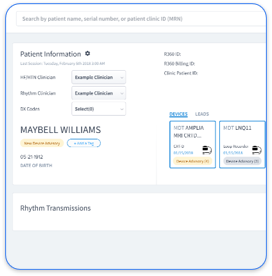
Several vendor-neutral platforms compete in this space, but they differ in how completely they normalize data and how much manual review they still require. Rhythm360 by RhythmScience is built to deliver vendor-neutral data consolidation alongside AI-powered alert triage, a HIPAA-compliant mobile clinician app, automated CPT documentation, and bi-directional EHR integration, all within a cloud-based SaaS architecture.

Any vendor-neutral CIED monitoring platform should be judged against four requirements: how completely it normalizes multi-manufacturer data, how well it triages alerts, whether clinicians can act from a phone, and whether it automates billing documentation. Weak platforms handle one or two of these well; strong platforms handle all four without requiring manual workarounds. The table below shows how Rhythm360 addresses each one.
| Capability | Rhythm360 Approach | Data Standard / Method | Documented Outcome |
|---|---|---|---|
| Multi-manufacturer data normalization | Ingests API, HL7, XML, and unstructured PDFs via computer vision (OCR) and AI mapping | API, HL7, XML, OCR | >99.9% transmissibility with redundant data feeds |
| AI-powered alert triage | Filters non-actionable transmissions, prioritizes clinically significant events, optional 24/7/365 CCT oversight | Machine learning, certified cardiac technician review | Up to 80% reduction in critical-alert response times |
| Mobile clinician access | HIPAA-compliant mobile app for transmission review, report signing, and care coordination | Secure mobile application | "I am more likely to sign off on these while in meetings because I can easily access them on my phone." — Andrew Beaser, MD, UCM |
| CPT billing documentation | Automated capture for codes 93294 through 93298, 99454, and the 2026 addition 99445 | Automated audit trail, transmission logs | Up to 300% increase in revenue generation through optimized CPT capture |
Consolidating CIED data into one platform removes the most time-consuming parts of the daily device clinic workflow. Staff stop authenticating into separate Medtronic, Abbott, Boston Scientific, and BIOTRONIK portals. They stop manually reconciling conflicting data and maintaining parallel documentation systems. This same triage efficiency, the 80% faster response time noted earlier, comes from surfacing prioritized, actionable notifications instead of forcing clinicians to search disconnected queues.
The scale involved is substantial. University of Chicago Medicine reviewed more than 73,000 reports in 2025, averaging over 18,000 per quarter through Rhythm360. That volume would be operationally unmanageable across separate manufacturer portals without significant added staffing.
Schedule a demo to quantify the time savings Rhythm360 can deliver for your device clinic.
Earlier access to normalized, complete device data enables earlier intervention. Andrew Beaser, MD, Associate Professor of Medicine at UCM, described pre-implementation workflows as "a major challenge and incredibly difficult". He noted the change after consolidation: "We are able to address these issues earlier; rather than waiting for a 3-month visit, we can call patients in for evaluation."
Dr. Upadhyay reinforced the value of centralized review: "That was a big piece for us, to have an integrated review of data from trained personnel."
Rhythm360's AI-powered triage filters non-actionable transmissions and escalates clinically significant events, such as new-onset atrial fibrillation, ventricular tachycardia, lead malfunction, and ERI/RRT indicators, to the right clinician in near real time. Optional 24/7/365 oversight by IBHRE-certified cardiac technicians means a critical arrhythmia flagged Saturday morning can lead to anticoagulation initiation or device reprogramming by Saturday afternoon, rather than being discovered at the next scheduled visit.
These clinical gains carry a financial dimension too. The same fragmented workflows that delay alert response also create documentation gaps that cost practices reimbursement. Remote monitoring is only as safe as its response pathway, which requires defined contact timelines and escalation standards, capabilities a unified platform with structured alert routing is built to enforce.
CIED remote monitoring generates billable activity under a defined set of CPT codes, each with its own documentation requirements and monitoring period thresholds. Fragmented workflows create gaps in the audit trail that lead to denied claims and unrealized revenue.
Notice how the monitoring periods and technical-component pairings shift by device type across these six codes:
The 2026 CPT update added CPT 99445 for device supply covering 2 to 15 monitoring days, closing a gap where the 16-day threshold forced clinicians to extend monitoring beyond medical necessity or skip billing entirely. CPT 99445 and 99454 can't both be billed in the same 30-day period.
Properly billed remote monitoring generates substantial recurring revenue, revenue that manual, fragmented workflows routinely fail to capture. Rhythm360 automates transmission logging, generates audit-ready documentation, and tracks billable activity across the device population, helping practices recover lost revenue and increase profitability by up to 300%. Dr. Upadhyay confirmed the impact at UCM: "We have improved billing and accountability for our patients after the integration."
Rhythm360 supports bi-directional integration with Epic, Cerner, Athenahealth, eClinicalWorks, Greenway Health, and other systems via HL7. Device data flows into the EHR, and clinical actions taken in the EHR appear in Rhythm360, eliminating manual transcription in both directions.
Implementation, including EHR setup, typically takes days to a few weeks. That's a sharp contrast to the multi-month deployments common with legacy on-premise systems. Pricing scales with clinic size and usage, avoiding the high upfront licensing fees tied to older architectures.
Fast, low-friction implementation only matters if the platform you choose actually meets your clinical and compliance needs. Here's what to check before you sign a contract.
CIED remote monitoring is the scheduled or continuous wireless transmission of diagnostic data from a pacemaker, ICD, CRT device, or loop recorder to a clinical review team. Transmitted data typically includes arrhythmia logs, device programming parameters, lead integrity measurements, battery status, and therapy delivery records. Clinicians review this data to detect actionable events, adjust device programming remotely where supported, and decide whether an in-person visit is warranted. The Heart Rhythm Society recommends remote monitoring for all eligible CIED patients, and Medicare reimburses these services under the 93294 through 93298 CPT code series.
Yes. Rhythm360 includes a HIPAA-compliant mobile app that lets electrophysiologists, cardiologists, nurse practitioners, physician assistants, and device technicians review transmissions, sign reports, and coordinate care from their phones. Mobile access matters most for on-call and weekend coverage, letting clinicians act on critical alerts, like new-onset atrial fibrillation or a lead integrity issue, without returning to a workstation. Andrew Beaser, MD, at UCM noted that mobile access made him more likely to sign off on reports during meetings, improving turnaround on routine reviews.
Rhythm360 implementation, including bi-directional EHR integration with systems such as Epic, Cerner, Athenahealth, and eClinicalWorks, typically takes days to a few weeks depending on environment complexity and the number of integrations required. The cloud-based SaaS architecture skips the hardware procurement and on-site installation steps that extend legacy deployments. RhythmScience provides onboarding support throughout to minimize workflow disruption.
CIED remote monitoring is billed under the device-specific CPT series 93294 through 93298 rather than the general remote physiologic monitoring codes. CPT 93294 covers pacemaker remote interrogation over a 90-day period. CPT 93295 covers ICD and CRT-D interrogation on the same schedule. CPT 93296 is the technical component billed alongside either. CPT 93297 covers ILR/ICM interpretation per transmission period, and 93298 is its technical component. CPT 99454 applies to device supply for 16 or more days of automatic transmission in a 30-day period, while the 2026 addition CPT 99445 covers 2 to 15 day supply periods. Required documentation includes device manufacturer and model, monitoring period dates, automated transmission logs, a clinician interpretation note addressing device function and actionable findings, and ICD-10 codes tied to the monitored condition. Rhythm360 automates the generation and retention of this documentation to support audit readiness.
Manufacturer-specific portals remain the default entry point for CIED data because each OEM controls its own transmission infrastructure and has no commercial reason to share a common interface. Individual clinics cannot resolve this structural fragmentation through process improvement alone. As the US remote patient monitoring market grows toward $29.1 billion by 2030 and Medicare RPM enrollment keeps expanding, transmission volumes requiring review will only grow, raising the cost of fragmentation each year.
A unified vendor-neutral platform needs multi-manufacturer data normalization at high transmissibility, AI-powered triage that cuts response times sharply, HIPAA-compliant mobile access, automated CPT documentation across the full code set, and EHR integration with a go-live timeline measured in days to weeks. Rhythm360 by RhythmScience is built and validated against each of these requirements, demonstrated by UCM's management of its full annual report volume through the platform, alongside documented gains in billing accountability and earlier clinical intervention.