Last updated: July 14, 2026
Short 24–48 hour Holter monitoring often fails to capture clinically important arrhythmias, even though clinicians still prescribe it widely. Real-world data presented at HRS 2026 showed that a substantial proportion of patients with true AF recurrence were misclassified as false negatives when monitored with short-term Holter devices instead of longer continuous monitoring. In pregnant patients, 60% of arrhythmias and 66.7% of clinically significant arrhythmias were first detected after 48 hours of extended ambulatory ECG monitoring, so standard Holter recordings would have missed most events. Extending from 24-hour Holter to 14-day patch monitoring raises arrhythmia detection rates from about 10–22% to 66–70% for paroxysmal or composite arrhythmias.
Operational burden compounds these diagnostic gaps. Multiple lead wires, an external recording box, and patient discomfort reduce adherence and data quality. Holter monitors caused significantly greater disruption to activities of daily living and sleep compared with patch ECG devices. Practices that also manage patches, MCOT devices, and ILRs from several manufacturers must juggle non-interoperable OEM portals, which require separate logins and workflows for each device type and worsen fragmentation across cardiovascular service lines. The following sections walk through the modern monitoring options that address these gaps and explain how they fit together.
Extended-wear adhesive ECG patches now serve as the most direct replacement for traditional Holter monitoring in ambulatory arrhythmia evaluation. Clinical studies have shown that the 14-day Zio Patch detects more arrhythmias than traditional 24-hour Holter monitors. The single-lead, adhesive design improves comfort and adherence, which supports more complete data capture and a higher diagnostic yield.
Key clinical advantages of extended ECG patches include:
This detection advantage, including the 66–70% yield referenced earlier, comes from longer continuous recording windows, better patient adherence, and fewer artifacts compared with multi-lead Holter systems.
Mobile Cardiac Outpatient Telemetry (MCOT) supports near-real-time ECG transmission to a monitoring center, which enables rapid clinical response when arrhythmias occur. This approach works especially well for patients with infrequent but high-risk symptoms such as syncope. In patients with syncope or collapse, MCOT diagnostic yield for actionable arrhythmias increases as monitoring duration lengthens.
MCOT is appropriate when:
Relevant CPT codes for MCOT services include 93228 and 93229 for external mobile cardiac telemetry with analysis and physician review.
Implantable loop recorders (ILRs) deliver continuous subcutaneous ECG monitoring for months to years, which makes them the standard of care for cryptogenic stroke workup, unexplained syncope, and suspected paroxysmal arrhythmias that evade external monitoring. In the LUX-Dx PERFORM Holter substudy published in Heart Rhythm O2, the LUX-Dx insertable cardiac monitor detected true AF episodes that the extended Holter monitor patch missed during simultaneous monitoring. The same study identified patients whose AF was detected only by the ILR compared with those detected by the extended Holter patch.
ILRs also showed strong sensitivity for pause episodes longer than 3 seconds, capturing pause events that the extended Holter monitor recorded. The ILR system-related complication-free rate remained high across de novo implants in both hospital and clinic settings. Remote transmissions from ILRs are billed under CPT codes 93298 and 93299, which require accurate documentation and timely review to secure full reimbursement.
Consumer wearables such as the Apple Watch, Fitbit, and Oura Ring now appear regularly in cardiology clinics and have reached meaningful regulatory milestones. The Apple Heart Study (N=419,297) reported 84% positive predictive value for PPG-based AF detection. Clinicians still need to qualify these signals carefully before acting on them.
Documented limitations of consumer wearables in clinical cardiology include:
Consumer wearables work well as population-level screening tools and as devices that keep patients engaged with their health. They do not replace prescribed monitoring modalities for diagnosis or treatment decisions, and their data needs structured clinical pathways before it can drive actionable outcomes.
Every monitoring modality described above sends data through a different OEM portal, in a different format, and on a different transmission schedule. Cardiovascular service lines often build discrete fields in Epic for heart failure metrics and device data so that transmissions can land in clinical workflows. This portal fragmentation creates data silos that hide critical events within routine transmissions, and the manual effort required to track data across portals causes practices to miss billable services. Without a consolidation layer, practices face missed critical events and billing leakage across CPT codes 93224–93229, 93298–93299, and the 2026 RPM code set.
Before Rhythm360: A device technician starts the day by logging into separate portals for Medtronic, Boston Scientific, Abbott, and Biotronik devices. Patch transmissions arrive in a separate inbox. ILR alerts require yet another login. Manual transcription into the EHR introduces both error and delay. A typical device clinic processes thousands of transmissions annually, with more than half of alerts being clinically non-relevant, and staff must still review each alert manually. Critical events risk getting buried in non-actionable noise.
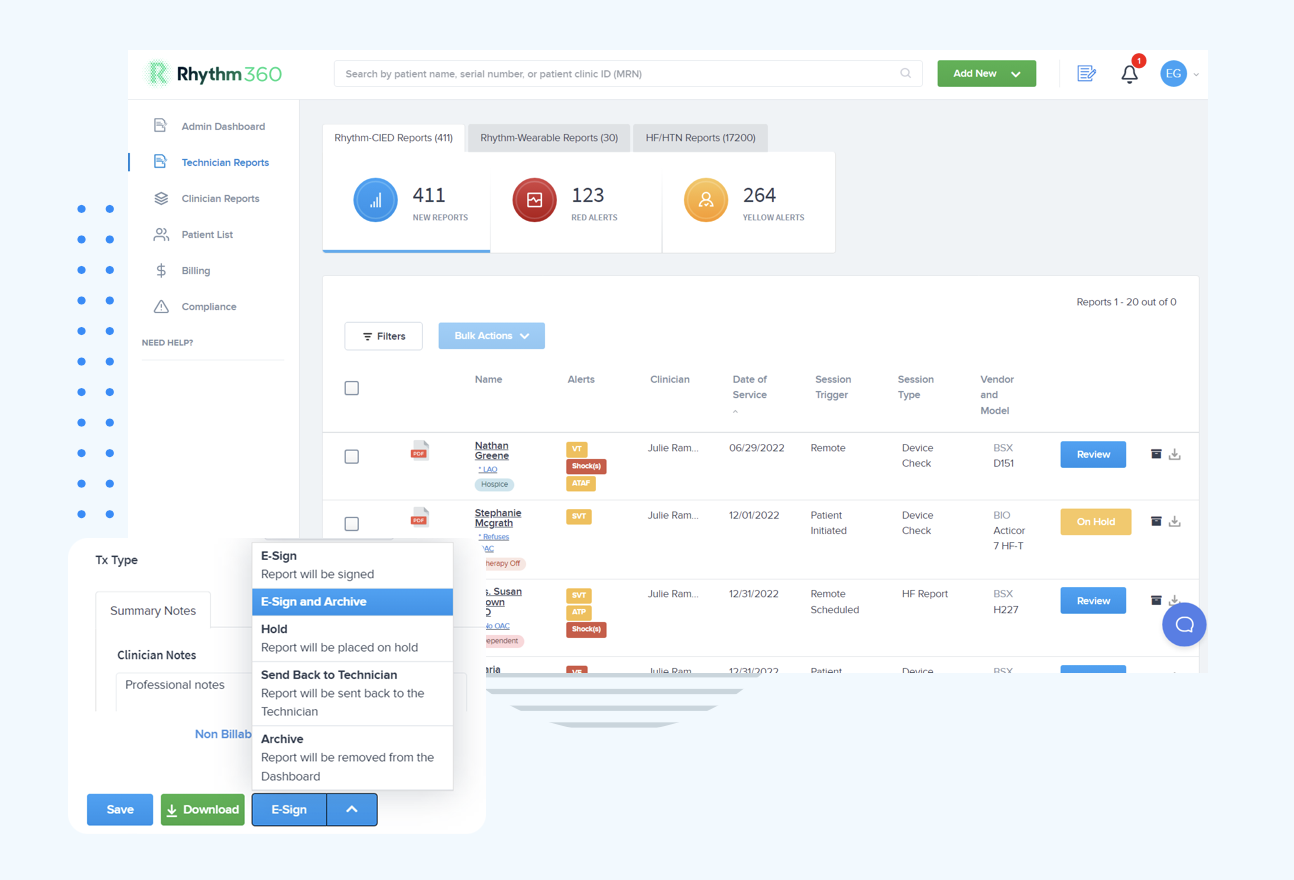
After Rhythm360: All CIED, patch, and RPM data flows into a single vendor-neutral dashboard. AI-powered triage filters non-actionable alerts and highlights clinically significant events. Automated report generation and bi-directional EHR integration remove the need for manual transcription. The platform automatically captures billing documentation for each qualifying transmission. University of Chicago Medicine reviewed more than 73,000 reports annually through Rhythm360 in calendar year 2025, averaging more than 18,000 reports per quarter, which demonstrates scalability in high-volume environments. As Andrew Beaser, MD, Associate Professor of Medicine at UCM, noted, the implementation allowed clinicians to review more transmissions daily and identify more abnormalities. The UCM team also reported, “We are able to address these issues earlier; rather than waiting for a 3-month visit, we can call patients in for evaluation.”
The following table summarizes measured outcomes from Rhythm360 implementations:
| Rhythm360 Feature / Outcome | Measured Result |
|---|---|
| Data transmissibility across all OEM feeds (Medtronic, Boston Scientific, Abbott, Biotronik) via redundant data feeds, computer vision, and AI-powered extrapolation | >99.9% data reliability |
| AI-powered alert triage that reduces non-actionable notifications and prioritizes critical events | 80% reduction in critical alert response time |
| Automated CPT code capture and documentation supporting billing for codes including 93298, 93299, 99453, 99454, 99445, 99457, 99458, and 99470 | Up to 300% increase in revenue generation through improved billing capture and new RPM service lines |
| Annual report volume managed at University of Chicago Medicine (2025) | 73,000+ reports annually, 18,000+ per quarter |
Rhythm360 ingests data via API, HL7, XML, and PDF parsing through computer vision, then normalizes disparate OEM formats into a single source of truth. The platform’s HIPAA-compliant mobile application lets clinicians review transmissions, sign reports, and coordinate care from anywhere, which becomes critical when a Saturday morning ILR transmission flags new-onset ventricular tachycardia that needs same-day intervention. “Decision support, including AI-assisted decision support, will become increasingly important as data volumes grow.”
The 2026 CMS Physician Fee Schedule introduced two new RPM codes that expand billing eligibility to patients with shorter engagement periods. CPT 99445 covers device supply for 2–15 days of monitoring (about $47), and CPT 99470 covers the first 10–19 minutes of treatment management (about $26). Consistent capture of these codes depends on the upstream infrastructure that a unified platform provides. As one cardiovascular service line leader summarized, “At the end of the day, infrastructure wins.”
No single device has universally replaced the Holter monitor, yet several modalities now outperform it for most clinical indications. Extended-wear ECG patches worn continuously for 7–14 days detect substantially more arrhythmias than 24–48-hour Holter recordings, especially for paroxysmal AF and post-ablation surveillance. MCOT devices add real-time transmission and active monitoring center oversight, which suits higher-risk patients or those who need immediate clinical response. For patients with infrequent symptoms over months or years, implantable loop recorders provide continuous subcutaneous monitoring that external devices cannot match. In practice, the appropriate replacement depends on symptom frequency, clinical urgency, and required monitoring duration, and many practices now manage all three modalities simultaneously, which makes a unified platform operationally essential.
Cardiologists increasingly view consumer wearables as useful tools for population-level screening and patient engagement, but they do not treat them as replacements for prescribed diagnostic monitoring. Devices such as the Apple Watch have received FDA clearance for AF detection and sleep apnea screening, and their PPG-based algorithms show acceptable accuracy for AF detection in controlled studies. Accuracy declines during physical activity, automated algorithms struggle with complex arrhythmias, and data interoperability with clinical EHR systems remains inconsistent. Cardiologists usually treat wearable-generated alerts as prompts for formal diagnostic evaluation, such as ordering an extended ECG patch, MCOT, or ILR, rather than as standalone diagnostic evidence. The clinical value of consumer wearables reaches its potential when their data flows into a structured monitoring workflow with clear escalation pathways.
The best device depends on the specific clinical question. For patients with daily or near-daily symptoms, a 24–48-hour Holter monitor can still be appropriate. For patients with symptoms several times per week, a 7–14-day extended ECG patch significantly increases diagnostic probability. For syncope evaluation or post-ablation monitoring that requires both extended duration and real-time transmission, MCOT usually serves as the preferred modality. For cryptogenic stroke workup or suspected paroxysmal arrhythmias that evade external monitoring, an implantable loop recorder provides the longest and most sensitive surveillance window. In 2026, the more practical question for cardiology practices focuses on how to manage data from all of these devices, across multiple manufacturers, without creating administrative overload, alert fatigue, or billing leakage. A vendor-neutral platform that consolidates multi-modality data into a single workflow addresses that challenge directly.
The 2026 CMS Physician Fee Schedule updated and expanded the remote cardiac monitoring code set. For external cardiac event monitoring, CPT codes 93224–93229 cover Holter and extended monitoring services. For implantable cardiac device remote monitoring, CPT codes 93298 and 93299 apply to ILR and CIED transmissions. For remote physiological monitoring programs, the 2026 code set includes CPT 99453 (initial setup, about $22), CPT 99454 (device supply, 16–30 days, about $52), new CPT 99445 (device supply, 2–15 days, about $52), CPT 99457 (first 20 minutes of treatment management, about $52), CPT 99458 (each additional 20 minutes, about $41), and new CPT 99470 (first 10–19 minutes of treatment management, about $26). Consistent capture of these codes requires compliant documentation, timely transmission review, and at least one live interactive patient contact per month for treatment management codes. Automated billing documentation tools that integrate with clinical workflows help practices avoid revenue leakage that occurs when teams track these requirements manually.
Evidence from 2025–2026 across multiple patient populations and arrhythmia types supports moving beyond 24–48-hour Holter monitoring. Extended ECG patches, MCOT, ILRs, and consumer wearables each address specific diagnostic gaps that traditional Holter recordings cannot close. The central operational challenge for cardiology practices in 2026 involves managing this multi-modality, multi-vendor ecosystem without fragmenting workflows, overwhelming staff with non-actionable alerts, or leaving reimbursement uncaptured across an expanded CPT code set.
Rhythm360 delivers vendor-neutral, AI-powered infrastructure that connects these modalities into a single clinical and administrative workflow. The platform ingests data from all major OEMs, triages alerts with AI, automates documentation, and integrates bidirectionally with Epic, Cerner, Athenahealth, and other EHR systems. The impact is measurable: greater than 99.9% data transmissibility, an 80% reduction in critical alert response time, and up to 300% improvement in revenue generation through improved billing capture and new RPM service lines.