Last updated: July 14, 2026
Fragmented device portals and manual coding cost cardiology practices real revenue. This table shows exactly where legacy systems break down and how Rhythm360 closes each gap.
| Dimension | Legacy / Fragmented Approach | Rhythm360 (RhythmScience) |
|---|---|---|
| Device data ingestion | Separate logins per OEM portal. Manual reconciliation. | Vendor-neutral ingestion from Medtronic, Boston Scientific, Abbott, Biotronik, and others via API, HL7, XML, and AI-powered PDF parsing. Over 99.9% transmissibility |
| CPT code selection (2026) | Manual selection. Frequent misapplication of legacy 16-day and 20-minute thresholds generating mutual-exclusivity denials | Automated code selection enforcing 2026 thresholds for CPT 99445 (2-15 days), 99470 (10-19 min), 99457, 99458, 93298, and 93299 |
| Pre-submission claim scrubbing | Post-service manual review. Errors identified after submission. | Pre-submission scrubbing against payer-specific rules and NCCI edits. AI-coded claims filed hours after service |
| Critical-alert response time | Manual triage. Delayed weekend and after-hours coverage. | Up to 80% reduction in critical-alert response time. Optional 24/7/365 CCT oversight. |
| Revenue impact | 25% net revenue leakage spike documented in 2025 | Up to 300% revenue lift through optimized CPT capture and new RPM service lines |
| EHR integration | Manual data re-entry. 3-7 day lag from service to claim submission. | Bi-directional integration with Epic, Cerner, Athenahealth, eClinicalWorks, and others. Claim lag reduced to 1-2 days |
| Implementation timeline | Months-long legacy system migrations | Days to weeks from contract to go-live |
288 new CPT codes took effect January 1, 2026, including substantive changes to remote patient monitoring thresholds. Practices still billing against the prior 16-day minimum for device data transmission, or the prior 20-minute management threshold, generate avoidable denials under the updated fee schedule.
A Kodiak Solutions report documented a 25% spike in net revenue leakage at hospitals in 2025, tied directly to insurer AI algorithms that auto-deny claims. Cardiology practices face disproportionate exposure because their billing complexity runs high. Device checks for pacemakers and ICDs require multiple modifiers (26, TC, 59, 25) and payer-specific Local Coverage Determinations that increase denial risk in fragmented systems.
CIED-specific leaks compound this problem. When a practice manages devices from more than one manufacturer, staff must log into separate, non-interoperable portals. Andrew Beaser, MD, Associate Professor of Medicine at the University of Chicago Medicine, described pre-implementation workflows as "a major challenge and incredibly difficult." Gaurav A. Upadhyay, MD, FACC, FHRS, Professor of Medicine and Director of the Pacing & Defibrillation Device Clinic at UCM, added: "Staffing was always an issue for our center, because our device clinic, like many other medical centers, had struggled with technician turnover and timely weekend coverage."
A September 2024 OIG review found that about 43% of Medicare enrollees who received RPM services in 2022 did not receive all three required components: device supply, data transmission, and treatment management. Fragmented workflows routinely fail to close the billing loop.
A vendor-neutral RPM platform ingests data from all major device manufacturers without requiring staff to navigate separate OEM portals. Rhythm360 connects to Medtronic, Boston Scientific, Abbott, Biotronik, and others through API, HL7, XML, and AI-powered computer vision parsing of unstructured PDFs. A redundant data feed system acts as a fail-safe when an OEM server goes down, sustaining the transmissibility rate described earlier.
Third-party vendors for Holter monitors, MCTs, loop recorders, and FDA-approved wearables add further fragmentation, since each new input requires its own login and workflow. Rhythm360 consolidates these streams into a single dashboard. This eliminates redundant logins and removes the manual data transcription that generates compounding errors at each handoff between clinicians, coders, and billers.
AI-assisted coding platforms achieve high accuracy across many medical coding tasks, and that accuracy translates directly into financial returns. Organizations implementing AI medical coding automation typically see 200-400% ROI within the first year, according to MGMA 2024. Rhythm360 applies this same capability to cardiology-specific documentation, automatically suggesting CPT codes based on device transmission data, time logs, and clinical notes.
As a result, Rhythm360 clients have achieved up to 300% revenue lift by capturing previously missed codes, including 93298, 93299, 99454, 99457, and the new 2026 codes 99445 and 99470. Adding RPM service lines for heart failure and hypertension generates an additional $100-$150 per patient per month in reimbursement.
MIT Sloan Management Review 2025 research reported that AI-assisted documentation reduced undercoding rates by 12-15%. Rhythm360's automated charge capture applies the same principle to CIED and RPM billing, flagging billable events that manual review routinely misses.
Incomplete or inconsistent documentation remains the single most common reason for RPM and RTM denials in 2026, according to CMS Physician Fee Schedule guidance. Audits frequently find missing consent records, vague enrollment notes, or monthly summaries that fail to tie monitoring activity to clinical decisions.
Rhythm360 addresses this through pre-submission scrubbing that checks claims against payer-specific rules and NCCI edits. Practices implementing this kind of AI-driven billing automation typically cut claim denials by 60-70% and reduce care management administrative time by 50%. The platform also enforces consent documentation, capturing date, time, and staff name, and flags claims where the data type does not match the code category. This prevents a common error: using physiologic data to justify RTM codes, or behavioral data to justify RPM codes.
Medicare's 2026 Physician Fee Schedule introduced CPT 99445, which reimburses physiologic monitoring from as few as 2 to 15 days of readings in a 30-day period, and CPT 99470, which covers the first 10-19 minutes of management time when at least one real-time patient interaction occurs. These codes replace the prior 16-day and 20-minute thresholds that made partial adherence non-billable.
Legacy billing engines built around those old cliff thresholds now generate revenue leakage. Practices forfeit reimbursement whenever their billing system cannot recognize these shorter qualifying windows.
Rhythm360 logs every qualifying interaction with date, time, and personnel identifiers, then automates time tracking and code selection. Clinical review for RPM billing must include at least 20 minutes of data review and communication monthly for 99457, or 10 minutes for 99470. Rhythm360 enforces these thresholds in real time and alerts staff when a patient approaches, but has not yet met, a billing milestone. Staff can intervene before the billing window closes.
CIED billing leaks originate at the data ingestion layer. When transmission reports arrive as unstructured PDFs from OEM portals, manual abstraction introduces errors that propagate through coding and claim submission. Rhythm360's computer vision and AI extrapolation normalize these reports into structured data, eliminating the transcription step.
The University of Chicago Medicine implemented Rhythm360 to solve exactly this problem. UCM reviewed more than 73,000 reports in calendar year 2025, averaging over 18,000 per quarter, with stable dismissal rates that demonstrate scalable monitoring at high volume. Dr. Upadhyay observed: "We have improved billing and accountability for our patients after the integration."
Dr. Beaser added: "Decision support, including AI-assisted decision support, will become increasingly important as data volumes grow." UCM's implementation let clinicians review more transmissions daily and catch more abnormalities, a direct result of removing the manual bottleneck that fragmented OEM portals create.
Rhythm360 offers an optional hybrid managed services layer where certified cardiac technicians, supervised by physicians, provide 24/7/365 oversight of the monitoring queue. This model delivers the 80% reduction in critical-alert response time noted earlier and directly addresses the weekend coverage gap Dr. Upadhyay identified as a persistent problem for device clinics. Practices can scale outsourced components up or down with patient volume, without adding fixed overhead.
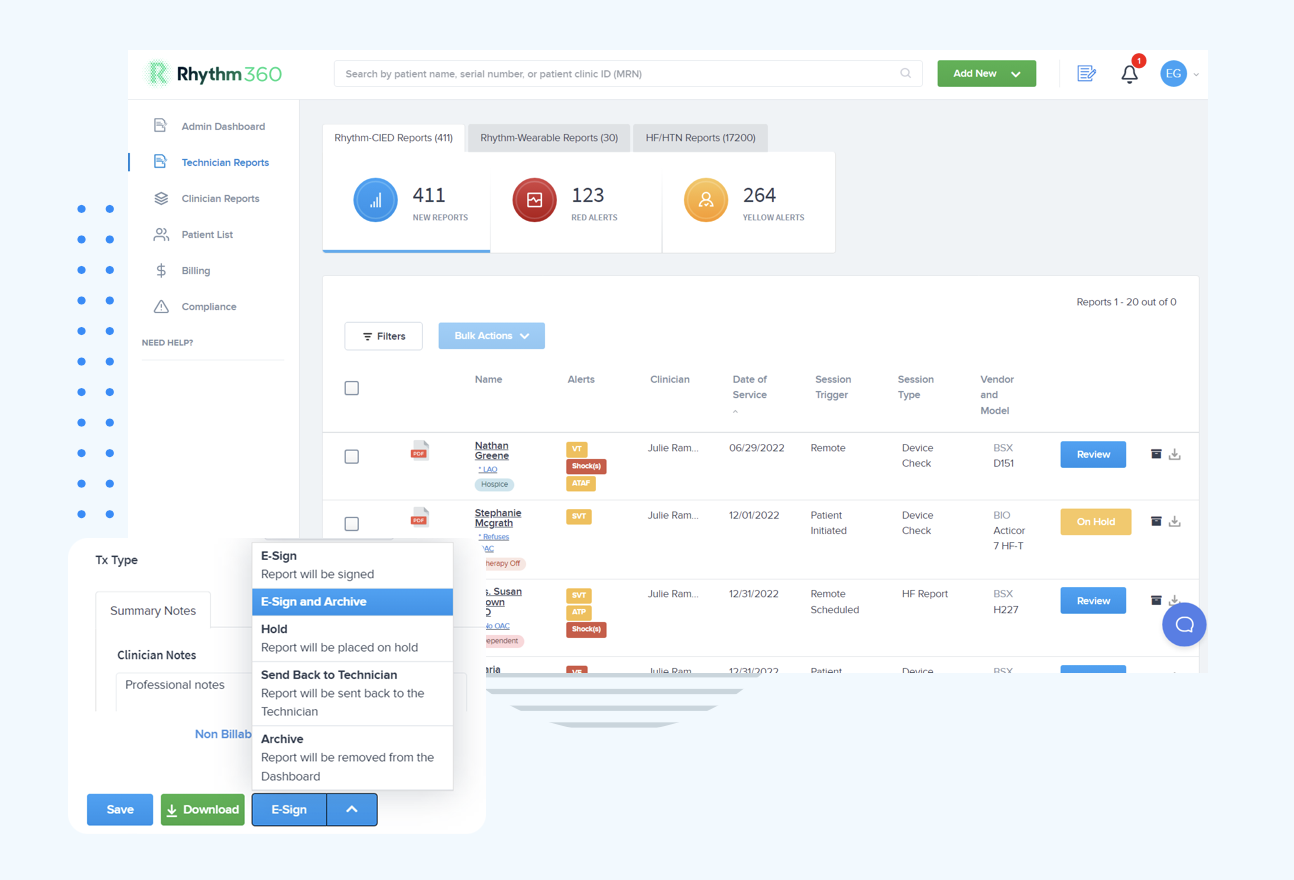
That same oversight layer feeds directly into Rhythm360's reporting tools. The administrative dashboard gives practices real-time visibility into patient compliance, critical alerts, and captured versus potential revenue based on CPT code requirements. Real-time dashboards flag patients falling behind mid-month on transmission thresholds, enabling intervention before the billing window closes. Practices get a single source of truth for population health metrics, device compliance rates, and billing performance, without reconciling data across disconnected systems.
By 2030, CMS aims to have all Medicare beneficiaries enrolled in accountable, value-based care programs. Cardiology practices need to prepare now, because the Ambulatory Specialty Model launches in 2027 as a mandatory CMS program targeting cardiology directly. It ties reimbursement to 30-day readmission rates, ejection fraction improvement documentation, medication adherence, and care coordination metrics.
The stakes are real: one cardiology group using remote patient monitoring achieved a 50% reduction in hospital readmissions through continuous monitoring and timely interventions. Rhythm360 supports MIPS tracking and ACO reporting by capturing the episode-level outcome data that value-based performance measurement requires, linking clinical workflow documentation directly to financial reporting.
This groundwork on data capture and coordination sets up the practical question of how quickly a practice can actually get Rhythm360 running.
Rhythm360's onboarding process minimizes disruption to clinical operations. The typical sequence from contract execution to go-live spans days to weeks:
Cardiology practices evaluating vendor-neutral RPM and billing automation platforms in 2026 should assess candidates against these criteria:
Bring this checklist to a Rhythm360 consultation and get answers specific to your practice.
The typical implementation timeline runs from a few days to a few weeks, depending on the number of EHR systems being integrated and the size of the device population being migrated. The process covers EHR bi-directional integration, OEM data feed activation, historical data normalization, and staff training. Practices with straightforward EHR environments and a single-site device population generally reach go-live faster than large multi-site health systems managing thousands of CIED patients. RhythmScience provides dedicated implementation support throughout the process to minimize disruption to clinical operations.
Rhythm360 automates CPT code selection based on the exact data-day counts and time thresholds that 2026 CMS rules require. The platform tracks each patient's days of readings and minutes of qualifying management time within every 30-day billing window, then selects the correct code, such as 99445 for 2-15 days of transmission or 99470 for 10-19 minutes of management time, without manual calculation. Pre-submission scrubbing checks each claim against payer-specific rules and NCCI edits before submission, catching mutual-exclusivity errors and documentation gaps that commonly trigger denials. Consent documentation, including date, time, and staff name, is captured and linked to each billing record to satisfy audit requirements.
Rhythm360 consolidates all CIED and RPM data into a single dashboard, eliminating the need for staff to log into separate OEM portals for each manufacturer. Automated report generation, AI-powered alert triage, and bi-directional EHR integration remove the manual data transcription steps that consume significant technician time in fragmented workflows. The platform's AI-driven alert filtering prioritizes clinically significant events and suppresses non-actionable notifications, reducing alert fatigue. Optional 24/7/365 oversight by certified cardiac technicians is available for practices that want to extend coverage without adding permanent headcount, addressing the staffing continuity challenges many device clinics face with weekend and after-hours coverage.
Rhythm360 captures the episode-level clinical and outcome data that MIPS scoring and ACO reconciliation require, including readmission events, device alert responses, and care coordination documentation. The platform's integrated analytics dashboard provides real-time visibility into population health metrics that map to value-based performance measures, such as timely follow-up rates and chronic disease management outcomes for heart failure and hypertension patients. By linking clinical workflow documentation directly to financial reporting, Rhythm360 helps practices translate monitoring activity into the performance data that CMS uses for MIPS payment adjustments and ACO shared savings calculations.
Rhythm360 includes a secure, HIPAA-compliant mobile application that allows clinicians to review transmission reports, sign off on alerts, and coordinate care from a smartphone or tablet. This matters most for on-call electrophysiologists and cardiologists who need to respond to critical alerts, such as new-onset atrial fibrillation, ventricular tachycardia, or device malfunction, outside standard clinic hours. The mobile app maintains a full audit trail of all actions taken, ensuring remote clinical decisions are documented in the same compliant environment as workstation-based reviews.
Fragmented OEM portals, manual charge capture, and billing engines built around pre-2026 CPT thresholds generate measurable revenue leakage and clinical risk. The 2026 CMS Physician Fee Schedule changes, including CPT 99445 and 99470, reward practices that can track partial-month transmission windows and shorter management time tiers. Manual workflows cannot reliably deliver that.
Rhythm360 closes these gaps through the vendor-neutral ingestion approach described earlier, automated CPT code selection that enforces 2026 thresholds, pre-submission claim scrubbing, and bi-directional EHR integration that compresses claim submission lag. UCM's experience reviewing tens of thousands of reports annually with improved billing accountability shows what a unified platform delivers at scale. Practices that invest in this infrastructure now position themselves to capture the revenue and outcome advantages that value-based care models will increasingly reward.
Ready to see the numbers for your own practice? Connect with Rhythm360 to get started.