Last updated: July 14, 2026
Administrators and EP directors should evaluate cardiac device data management platforms against seven specific capabilities.
The sections below show how Rhythm360 by RhythmScience delivers against each criterion, starting with the foundation: multi-OEM data ingestion.
See how Rhythm360 delivers these seven capabilities in your EHR environment.
Rhythm360 supports all major CIED manufacturers, including Medtronic, Boston Scientific, Abbott, and Biotronik, through direct APIs, HL7 feeds, XML parsing, and AI-powered computer vision (OCR) applied to unstructured PDF reports. This multi-modal ingestion approach prevents dependence on any single OEM data format or server.
The Heart Rhythm Society’s white paper on CIED data interoperability documents that each manufacturer uses proprietary nomenclature, technical standards, and communication protocols. Cross-vendor data reconciliation therefore becomes a persistent structural challenge for clinics that implant devices from more than one OEM. Rhythm360’s redundant data feed architecture acts as a fail-safe when an OEM server is offline and maintains data continuity across the entire device population.
Coverage extends beyond pacemakers and ICDs to implantable loop recorders, CRT and CCM devices, and CardioMEMS pulmonary artery monitors. This breadth supports the full spectrum of devices in a multi-vendor electrophysiology practice.
Rhythm360 offers certified bi-directional integrations with Epic, Cerner, Athenahealth, eClinicalWorks, Greenway Health, and additional systems via HL7. Device transmissions and clinical reports populate the patient record automatically, and encounter data from the EHR feeds the platform’s billing and compliance workflows.
Modern CIED data platforms use a mixed integration architecture that combines HL7 v2 over MLLP for high-volume system traffic with FHIR R4 for the app and mobile layer. No single standard covers every workflow edge. Rhythm360 follows this pattern and uses proprietary API connections when vendor-specific workflow depth, such as automated charge capture, requires it.
A January 2026 scientific statement from the Heart Failure Society of America and the American Association of Heart Failure Nurses recommends integrating patient-generated data from remote monitoring and implantable devices into EHR dashboards. This approach supports clinical decision-making and streamlines workflows, which matches the integration model Rhythm360 delivers. Automated device-to-EHR data entry reduces transcription error rates from 1–5% with manual entry to near zero, improving patient safety and billing accuracy in high-volume device clinics.
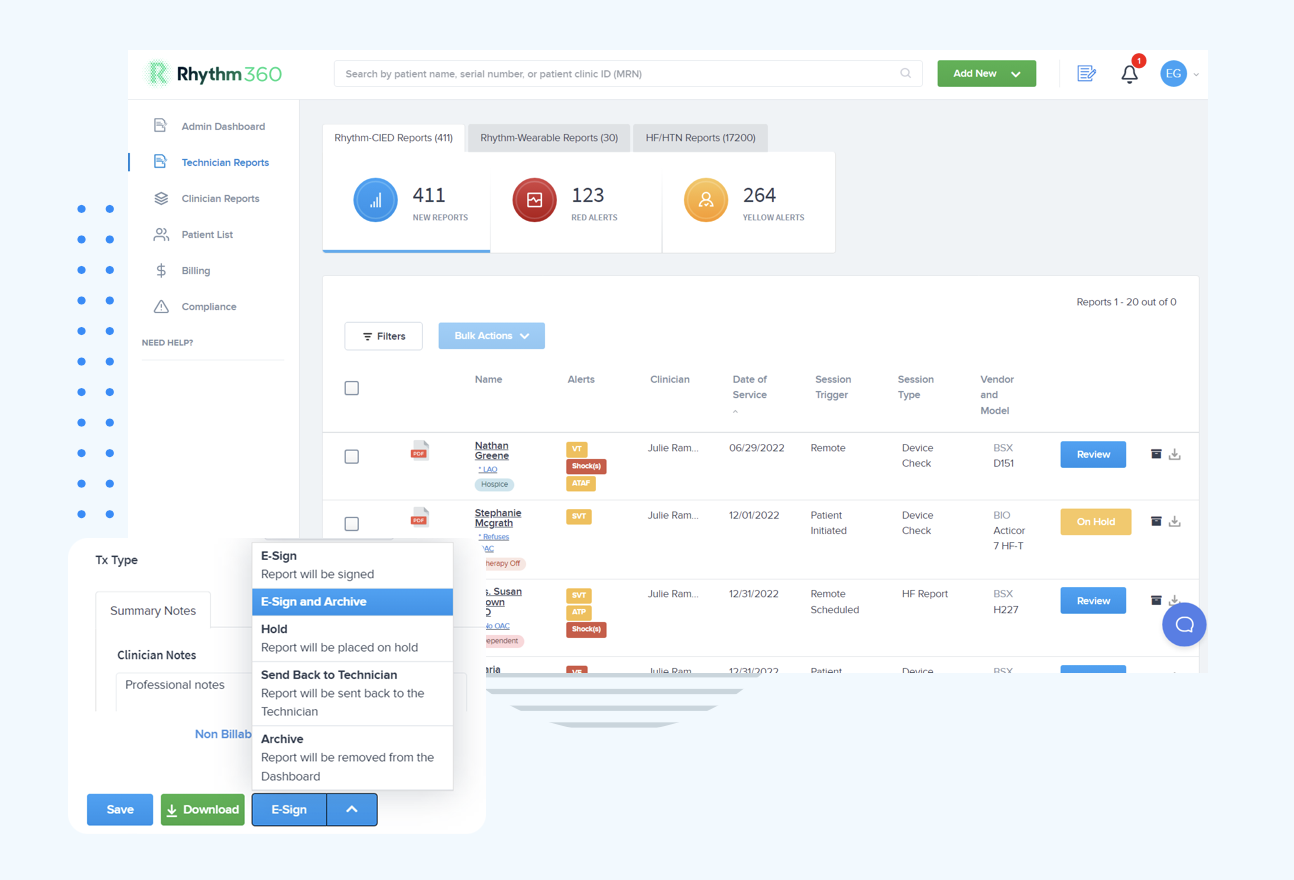
Rhythm360 automates CPT code capture and documentation generation for the full set of remote monitoring codes used in CIED and RPM programs, including 93298, 93299, 99453, 99454, and 99457. The platform tracks billable events in real time, generates compliant documentation tied to each transmission, and surfaces captured and potential revenue on the administrative dashboard.
Clinics without a centralized billing documentation system often experience claim rejections and missed revenue on complex remote monitoring codes. Rhythm360 clients have documented revenue increases of up to 300% through improved CPT code capture and higher staff efficiency. As Gaurav A. Upadhyay, MD, FACC, FHRS, Director of the Pacing & Defibrillation Device Clinic at the University of Chicago Medicine, reported after implementing Rhythm360, “We have improved billing and accountability for our patients after the integration.”
Best practice for multi-vendor cardiology billing documentation requires documenting data lineage. That lineage traces the path from source device capture to payer-facing output and supports audit defense. Rhythm360 maintains this audit trail automatically within each patient record.
Rhythm360’s implementation process, including EHR integration setup, typically completes in a few days to a few weeks for most clinic configurations. The migration sequence follows three phases.
Data safeguards throughout migration address three distinct risk vectors. Encryption protects protected health information at rest and in transit against unauthorized access. Signed Business Associate Agreements establish legal accountability for all parties that handle PHI. Role-based access controls then limit data exposure during the transition period so authorized users see only what their role requires. Proposed 2026 HIPAA Security Rule updates include enhanced security requirements across all systems accessing ePHI, so early adoption creates a compliance advantage.
Rhythm360 uses a SaaS-based pricing model that scales with clinic size and platform usage and avoids the large upfront licensing fees associated with on-premise legacy systems. Total cost of ownership includes the platform subscription, EHR integration setup, and ongoing maintenance, with no separate per-OEM portal fees.
The financial case for consolidation rests on labor savings and recovered revenue. Staff hours currently spent logging into multiple OEM portals, manually transcribing data, and chasing billing documentation represent a direct labor cost that a unified platform removes. Most healthcare facilities recover medical device-to-EHR integration costs within 18–24 months through reduced complications, fewer readmissions, and improved staff efficiency. Practices that capture up to 300% more revenue through automated CPT code documentation often see an even shorter payback period.
Rhythm360 serves the full range of cardiology provider organizations.
| Capability | Rhythm360 Metric | Source |
|---|---|---|
| Data transmissibility | >99.9% | RhythmScience platform specifications |
| Critical alert response time reduction | Up to 80% | RhythmScience client outcomes |
| Revenue improvement through CPT code optimization | Up to 300% | RhythmScience client outcomes |
| Annual report volume (University of Chicago Medicine, 2025) | >73,000 reports per year / >18,000 per quarter | UCM white paper |
| EHR integrations | Epic, Cerner, Athenahealth, eClinicalWorks, Greenway Health, and others via HL7 | RhythmScience platform specifications |
| Implementation timeline | A few days to a few weeks | RhythmScience platform specifications |
| HIPAA compliance | Encryption at rest and in transit, full audit trail, BAA coverage | RhythmScience platform specifications; 2026 HIPAA NPRM guidance |
The table below maps the most common operational pain points reported by multi-vendor cardiology clinic leaders to the specific Rhythm360 capability that addresses each one.
| Pain Point | Rhythm360 Solution | Documented Outcome |
|---|---|---|
| Multiple OEM portal logins consuming staff time | Single unified dashboard aggregating all manufacturer data | Elimination of redundant logins and manual data transcription |
| Alert fatigue from non-actionable notifications | AI-powered alert triage with optional 24/7/365 CCT oversight | Up to 80% reduction in critical alert response times |
| Missed CPT billing events and rejected claims | Automated CPT code capture and compliant documentation generation | Up to 300% revenue improvement |
| Clinician inability to act on alerts outside the office | HIPAA-compliant mobile app for transmission review and report signing | Continuous care coordination from any location |
| Technician burnout and turnover | Centralized workflow automation that reduces manual burden | Reduced reliance on single super-users and improved staff retention conditions |
| Data gaps when OEM servers are unavailable | Redundant data feeds with AI-powered gap extrapolation | >99.9% data transmissibility |
Walk through your clinic’s specific pain points with a Rhythm360 specialist.
A genuinely vendor-neutral platform ingests data from all major CIED manufacturers, including Medtronic, Boston Scientific, Abbott, Biotronik, and others, without separate OEM portal access or manual data reconciliation. True vendor neutrality in 2026 also means the platform does not depend on a single OEM’s API availability. Redundant data feeds, AI-powered gap extrapolation, and computer vision OCR applied to unstructured PDF reports maintain data continuity even when an individual manufacturer’s server is offline. Rhythm360 reaches the transmissibility rate mentioned earlier through this multi-modal ingestion architecture, which distinguishes a unified platform from a simple portal aggregator.
Rhythm360 is a HIPAA-compliant platform that encrypts protected health information at rest and in transit. The platform maintains a full audit trail of every data access and exchange event within each patient record, supports role-based access controls, and operates under signed Business Associate Agreements with all parties that handle PHI. These controls align with the proposed 2026 HIPAA Security Rule updates, which are expected to mandate enhanced security standards, multi-factor authentication, and stronger BAA oversight across all systems accessing ePHI. Clinics that adopt Rhythm360 position themselves ahead of the anticipated regulatory baseline instead of scrambling to retrofit compliance after finalization.
Rhythm360 automates documentation and billing support for the full set of remote monitoring CPT codes used in CIED programs. Supported codes include 93298 and 93299 for remote interrogation of implantable cardioverter-defibrillators and pacemakers, as well as RPM codes 99453, 99454, and 99457 for chronic condition monitoring programs such as heart failure and hypertension. The platform tracks billable events in real time, generates compliant documentation tied to each transmission, and surfaces both captured and potential revenue on the administrative dashboard. Practices that previously lacked a centralized system for tracking these events have documented revenue improvements of up to 300% after implementing Rhythm360.
For most clinic configurations, Rhythm360’s implementation process, including EHR integration setup, completes in a few days to a few weeks. The timeline depends primarily on the number of EHR systems that require integration, the volume and quality of existing patient data, and the complexity of current OEM portal connections. Rhythm360’s implementation team manages discovery, data mapping, integration configuration, and validation, which reduces the internal IT burden on the clinic. A defined stabilization window after go-live allows parallel monitoring of legacy and new workflows before full cutover and minimizes disruption to clinical operations during the transition.
Managing CIED data across multiple OEM portals creates structural clinical risk, staff burnout, and revenue leakage that compound as a practice’s device population grows. Andrew Beaser, MD, at the University of Chicago Medicine, described pre-implementation multi-vendor workflows as “a major challenge and incredibly difficult” before the institution consolidated onto Rhythm360, a description that matches the experience of many device clinic administrators.
Rhythm360 delivers a single source of truth for multi-vendor CIED data, including the transmissibility standard established earlier, up to 80% reduction in critical alert response times, automated CPT code documentation, bi-directional EHR integration with Epic, Cerner, Athenahealth, eClinicalWorks, Greenway Health, and others, and a HIPAA-compliant mobile application that extends clinical reach beyond the office. As Andrew Beaser, MD, noted, “Decision support, including AI-assisted decision support, will become increasingly important as data volumes grow.” Rhythm360 is built for that trajectory.
See how Rhythm360 consolidates your multi-vendor device population and reduces clinical workload.