How to Optimize Cardiac Telemetry Revenue & Billing
Last updated: July 13, 2026
Key Takeaways
Cardiology practices can protect 2026 telemetry revenue by capturing every eligible CPT code through automated, auditable documentation across all device manufacturers while preventing denials from missed thresholds or duplicate billing.
The 2026 CPT landscape expanded with new RPM codes 99445 and 99470, retained codes with updated thresholds, and CIED-specific codes 93294–93298, all governed by strict mutual-exclusivity and documentation rules that directly affect revenue.
Fragmented OEM portals, missed transmission-day thresholds, manual charge capture, incorrect modifiers, and absent audit trails drive 5–10% revenue leakage and denial rates of 8–15% for cardiac monitoring programs.
Rhythm360 replaces manual workflows with a vendor-neutral, automated charge-capture pipeline that ingests data from all major OEMs, enforces CPT mapping and mutual-exclusivity rules, and integrates bi-directionally with EHR systems.
2026 CPT Codes That Drive Cardiac Telemetry Revenue
The 2026 CPT landscape for cardiac telemetry and remote physiologic monitoring (RPM) expanded significantly with two new codes finalized under the CY 2026 Medicare Physician Fee Schedule Final Rule, and these changes directly affect how practices capture revenue from every enrolled patient. These updates introduce new billing opportunities along with new compliance risks, so selecting the right code for each patient-month becomes the first step in eliminating the 5–10% revenue leakage most practices experience.
New 2026 RPM codes:
CPT 99445 – Remote physiologic monitoring device supply, 2–15 days of data transmission in a 30-day period. Reimbursed at approximately $47–$52, matching the rate for 99454.
CPT 99470 – First 10–19 minutes of RPM treatment management per calendar month. Reimbursed at $26.05.
Fragmented OEM portal workflows. Practices managing devices from Medtronic, Boston Scientific, Abbott, Biotronik, and others must log into separate, non-interoperable portals. This fragmentation creates data silos and delays charge capture, so billable transmission days often go unrecorded.
Manual charge capture. Manual workflows bill 99457 and 99454 on only a portion of eligible patient-months, which leaves significant reimbursement uncaptured.
Absent audit trails. A 2024 HHS OIG report found that many Medicare enrollees in RPM programs had no claim for at least one of the three main service components, which signals systemic documentation failures rather than isolated errors.
The revenue leakage and denial patterns described above share a common root cause: manual workflows cannot enforce day-by-day transmission tracking and mutual-exclusivity rules at scale. An automated charge-capture workflow closes this gap by ingesting device data in real time, applying CPT mapping rules at the point of transmission, and pushing completed documentation directly into the billing system.
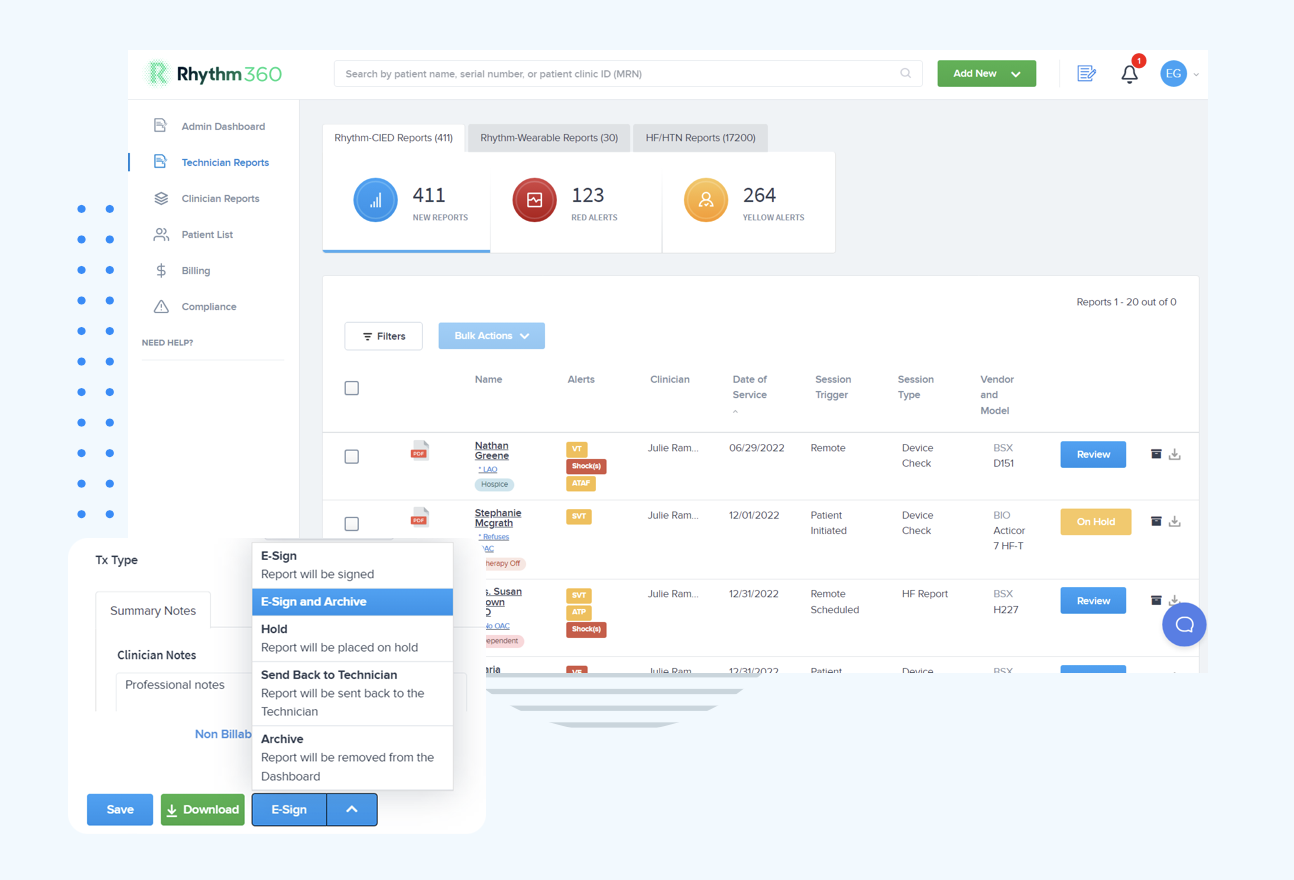
Rhythm360 replaces manual, portal-dependent workflows with a real-time automated charge-capture pipeline. The platform ingests data from all major OEM device manufacturers, including Medtronic, Boston Scientific, Abbott, and Biotronik, via API, HL7, XML, and PDF parsing through computer vision, then normalizes these disparate data streams into a single source of truth.
Rhythm360
The steps for implementing an automated charge-capture workflow with Rhythm360 are:
Onboard all device populations. Connect every OEM data feed to Rhythm360’s vendor-neutral ingestion layer. Redundant data feeds and AI-powered extrapolation maintain greater than 99.9% data transmissibility even when an OEM server experiences downtime.
Configure CPT mapping rules. Rhythm360’s AI maps each transmission event to the correct CPT code, such as 99445, 99454, 93294, or 93296, based on device type, transmission days, and monitoring duration.
Activate bi-directional EHR integration. Rhythm360 integrates with Epic, Cerner, Athenahealth, eClinicalWorks, Greenway Health, and others via HL7, pushing completed documentation directly into the patient record and pulling encounter data back for reconciliation.
Enable automated report generation. Routine interrogation reports and urgent alerts are generated in near-real time, which eliminates manual transcription. Because reports are created automatically as transmission data arrives, documentation is available at the time of billing rather than days later when a clinician manually reviews the portal.
Review the compliance dashboard daily. The administrative dashboard surfaces captured versus potential revenue, transmission compliance percentages, and pending charges requiring sign-off, so revenue-cycle staff can act before billing windows close.
Preventing Threshold and Duplicate-Billing Errors
The 2026 code set introduced new mutual-exclusivity requirements that manual workflows cannot reliably enforce. Rhythm360 addresses this gap through centralized transmission-day logging and automated rule enforcement.
Mutual-exclusivity enforcement. The platform blocks simultaneous submission of 99445 and 99454, or 99470 and 99457, for the same patient in the same month.
Frequency-limit alerts. For CIED codes, Rhythm360 flags claims that would violate the once-per-90-days frequency limit for 93294 or 93295 or the 30-day minimum monitoring window before professional evaluation is billable.
Duplicate-claim blocking. Centralized logging across all OEM data streams prevents the same transmission event from generating duplicate charges under different code families.
Managing Split-Billing Modifiers and Multi-Provider Scenarios
Split billing occurs when the technical and professional components of a remote monitoring service are performed by different entities. For CIED monitoring, CPT 93296 represents the technical component billed by the entity operating the monitoring platform, while 93294 or 93295 represents the professional interpretation billed by the supervising physician.
Key rules for multi-provider scenarios:
Only one practitioner, such as a physician, NP, PA, or CNS, may bill remote monitoring services, including CPT 99454, for a given patient in any 30-day period. When multiple providers in a group practice participate, the billing entity must be designated in advance and documented consistently.
Modifier 26, for the professional component, and modifier TC, for the technical component, must be applied correctly when a single entity does not perform both components of a global service.
Modifier 25 is required on an E/M service performed the same day as a cardiology procedure to indicate a significant, separately identifiable evaluation. Without this modifier, the payer bundles the E/M into the procedure payment.
Rhythm360’s centralized audit trail logs which provider performed each component of a monitoring service, which supports accurate modifier assignment and reduces split-billing denials.
KPI Dashboard Metrics That Expose Revenue Leakage
A revenue-integrity dashboard for cardiac telemetry monitoring should surface the following metrics in real time so leaders can see exactly where money is leaking:
Denial rate – Target below 5%. Industry benchmarks for cardiology denial rates often place the top quartile under 5%, with averages ranging from 8% to 15%.
Captured vs. potential revenue – Compares charges actually submitted against the maximum billable amount based on enrolled patients and transmission days.
Transmission compliance percentage – Percentage of enrolled patients meeting the 2-day minimum for 99445 or the 16-day minimum for 99454 each month.
Critical-alert response time – Tracks time from alert generation to clinical acknowledgment.
The following table presents Rhythm360’s documented platform capabilities and verified outcomes:
Rhythm360 Capability
Verified Outcome
Redundant OEM data feeds with AI-powered extrapolation and computer vision (OCR)
>99.9% data transmissibility
AI-driven alert triage filtering non-actionable notifications and prioritizing critical events
80% reduction in critical-alert response time
Automated CPT code capture, documentation, and bi-directional EHR integration across all OEM device populations
Up to 300% increase in revenue generation
Centralized transmission-day logging with mutual-exclusivity enforcement for 99445/99454 and 99470/99457
Elimination of threshold and duplicate-billing errors
HIPAA-compliant mobile application for remote report review and sign-off
Continuous care coordination from any location
Real-time administrative dashboard with denial rate, AR days, and captured vs. potential revenue metrics
Immediate visibility into revenue leakage across the patient population
Vendor-Neutral Platform Requirements for 2026 Compliance
The capabilities described above, including multi-OEM data normalization, automated CPT capture, and bi-directional EHR integration, function as baseline requirements for 2026 compliance rather than optional features. The 2026 CPT code changes and OIG audit focus require a platform that meets the following technical and compliance specifications:
Multi-OEM data normalization. The platform must ingest and standardize data from all major device manufacturers via API, HL7, XML, and unstructured PDF formats without requiring manual portal logins.
Greater than 99.9% transmissibility. The platform must achieve the 99.9% transmissibility standard through redundant feeds and AI-powered gap-filling, which ensures no transmission day goes unrecorded and protects threshold compliance for 99445 and 99454.
Automated CPT capture with mutual-exclusivity enforcement. The platform must apply 2026 code-set rules, including the 99445 and 99454 as well as 99470 and 99457 mutual-exclusivity requirements, without manual intervention.
HIPAA-compliant mobile access. Clinicians must be able to review transmissions, sign reports, and coordinate care from any device so critical alerts receive timely responses regardless of location.
Full audit trail. Every transmission event, charge capture decision, and provider action must be logged with timestamps to support OIG documentation requests and payer appeals.
Rhythm360 meets all of these requirements as a cloud-based, vendor-neutral platform, with onboarding and EHR integration typically completed within a few days to a few weeks.
8-Step Revenue Optimization Roadmap for Cardiac Telemetry
The following roadmap outlines how to improve cardiac telemetry monitoring revenue and billing in 2026 using Rhythm360’s automated infrastructure.
Audit your current CPT code capture rate. Pull three months of claims for 99445, 99454, 99457, 99458, and 93294–93298, then compare submitted charges against enrolled patient counts and transmission logs. The audit establishes your baseline leakage figure, which is the dollar gap between what you currently capture and the $300,000–$500,000 potential outlined earlier. Measurable outcome: Identified dollar gap between current and potential revenue.
Unify all OEM data feeds into Rhythm360. Connect Medtronic, Boston Scientific, Abbott, Biotronik, and any other manufacturer portals to Rhythm360’s ingestion layer. Redundant feeds and AI extrapolation maintain greater than 99.9% transmissibility. Measurable outcome: Elimination of manual portal logins and data silos.
Configure 2026 CPT mapping rules. Program Rhythm360’s AI to apply the correct device-supply code, choosing 99445 or 99454 based on actual transmission days at the close of each 30-day period, and the correct management code, choosing 99470 or 99457 based on logged clinical staff time. Measurable outcome: Zero mutual-exclusivity violations on submitted claims.
Integrate bi-directionally with your EHR. Complete HL7 integration with Epic, Cerner, Athenahealth, or your current system so documentation flows automatically into the patient record and encounter data returns to Rhythm360 for reconciliation. Measurable outcome: Reduction in manual transcription time and documentation defect rate.
Activate automated alert triage. Enable Rhythm360’s AI-powered alert prioritization to filter non-actionable notifications and surface clinically significant events, including new-onset AFib, ventricular tachycardia, device malfunction, and ERI or RRT indicators, to the appropriate clinician in real time. Measurable outcome: Up to 80% reduction in critical-alert response time.
Deploy the HIPAA-compliant mobile application. Equip on-call clinicians with Rhythm360’s mobile app so transmissions can be reviewed and reports signed from any location, which prevents weekend and after-hours alert delays. Measurable outcome: Consistent response times regardless of care setting or time of day.
Monitor the KPI dashboard weekly. Monitor the KPI dashboard weekly, tracking denial rate, AR days, transmission compliance percentage, and captured versus potential revenue. Use these metrics to identify which patient cohorts or billing workflows underperform. A net collection rate above 95% and an initial denial rate below the 5% threshold cited earlier are the 2026 benchmark targets for high-performing practices, and these targets become achievable when you can see exactly where revenue is leaking in real time. Measurable outcome: Denial rate trending toward the top-quartile target of under 4%.
Expand to RPM service lines for HF and HTN. Use Rhythm360’s integrated HF and HTN RPM service line to enroll chronic disease patients under 99453, 99445 or 99454, and 99457 or 99470. A basic RPM-only cardiology program with 200 patients generates $110,400 per year. Measurable outcome: New recurring revenue stream with up to 300% total revenue lift across the practice.
No single CPT code covers all cardiac telemetry monitoring, because the correct code depends on device type, monitoring duration, and whether the service is inpatient, ambulatory, or remote. For remote physiologic monitoring of chronic conditions using connected devices, the primary 2026 codes are 99445, which covers device supply for 2–15 days of transmission per month, and 99454, which covers device supply for 16–30 days. Treatment management time is billed under 99470 for 10–19 minutes or 99457 for 20 or more minutes.
For cardiac implantable electronic devices such as pacemakers and ICDs, remote interrogation is billed under 93294 for pacemakers, professional component, 93295 for ICDs, professional component, and 93296 for the technical component for both. Implantable loop recorders use 93297 for the professional component and 93298 for the technical component. Ambulatory cardiac monitoring services such as mobile cardiac outpatient telemetry use 93228 and 93229. Selecting the wrong code family, such as billing RPM codes for a CIED patient, remains a leading cause of claim denials and compliance exposure.
How do you prevent missed billing thresholds in remote cardiac monitoring?
Practices prevent missed thresholds by using automated, day-by-day tracking of data transmissions for every enrolled patient. Under the 2026 CPT code set, the device-supply code selection, choosing 99445 for 2–15 days or 99454 for 16 or more days, must be based on actual transmission days logged within the 30-day billing period.
Manual tracking across fragmented OEM portals makes this process error-prone. A single missed transmission day can shift a patient from the 99454 tier to 99445 or cause a claim to be submitted before the minimum threshold is met. Rhythm360 addresses this risk by ingesting transmission data from all connected device manufacturers in real time, maintaining a centralized transmission-day counter per patient, and automatically selecting the appropriate code at the close of each billing cycle.
The platform also enforces the once-per-90-days frequency limit for CIED interrogation codes and the 30-day minimum monitoring window required before professional evaluation under 93294 and 93295 is billable. Practices using Rhythm360 eliminate the manual reconciliation step entirely and replace it with an auditable, automated record that supports both billing accuracy and OIG documentation requests.
Can one platform handle both CIED and RPM billing?
One platform can handle both CIED and RPM billing when it maintains separate compliance logic for each code family while presenting a unified operational view. Rhythm360 is purpose-built to manage both CIED remote monitoring, using CPT codes 93294–93298, and remote physiologic monitoring, using CPT codes 99445, 99454, 99457, 99470, and related codes, within a single vendor-neutral platform.
The two code families operate under different billing rules. CIED codes are device-specific, tied to interrogation periods and frequency limits, and billed separately from general RPM codes. RPM codes are threshold-driven, based on transmission days and clinical staff time. Rhythm360 maintains distinct rule sets for each family while presenting both within a unified administrative dashboard.
This unified approach matters operationally because many cardiology and EP practices manage patients who qualify for both CIED monitoring and RPM services, such as a heart failure patient with an ICD who also uses a connected weight scale and blood pressure cuff. Rhythm360’s integrated service lines for Rhythm-CIED and HF or HTN RPM allow practices to capture the full billable value of each patient relationship without separate platforms, separate staff workflows, or separate documentation systems.