These eight evidence-based strategies target the main revenue leaks in cardiac device and RPM monitoring and build on each other to create a complete revenue cycle. Start with automated capture and unified data, then layer in AI, EHR connectivity, denial recovery, RPM expansion, data reliability, and mobile access.
Automated CPT capture closes the largest revenue gap in cardiac monitoring. CPT 93296 covers remote device interrogation for pacemakers or ICDs and requires a documented “interpretation and report” for compliance. The 2026 updates clearly separate device interrogation, device programming, and follow-up evaluation that includes interpretation and report.
Automated systems capture billable events in real time and prevent the common situation where device transmissions occur but no billing documentation is created. As noted earlier, practices lose significant revenue through missed interrogations. For a practice monitoring 200 CIED patients, missing just 25% of monthly interrogations translates to $30,000 in annual losses (200 patients × 12 months × 25% × $50 average reimbursement).
To prevent these losses, deploy automated event detection that flags billable transmissions, generates compliant documentation templates, and queues claims for review. Platforms like Rhythm360 support this full workflow through vendor-neutral data ingestion and AI-powered documentation generation.
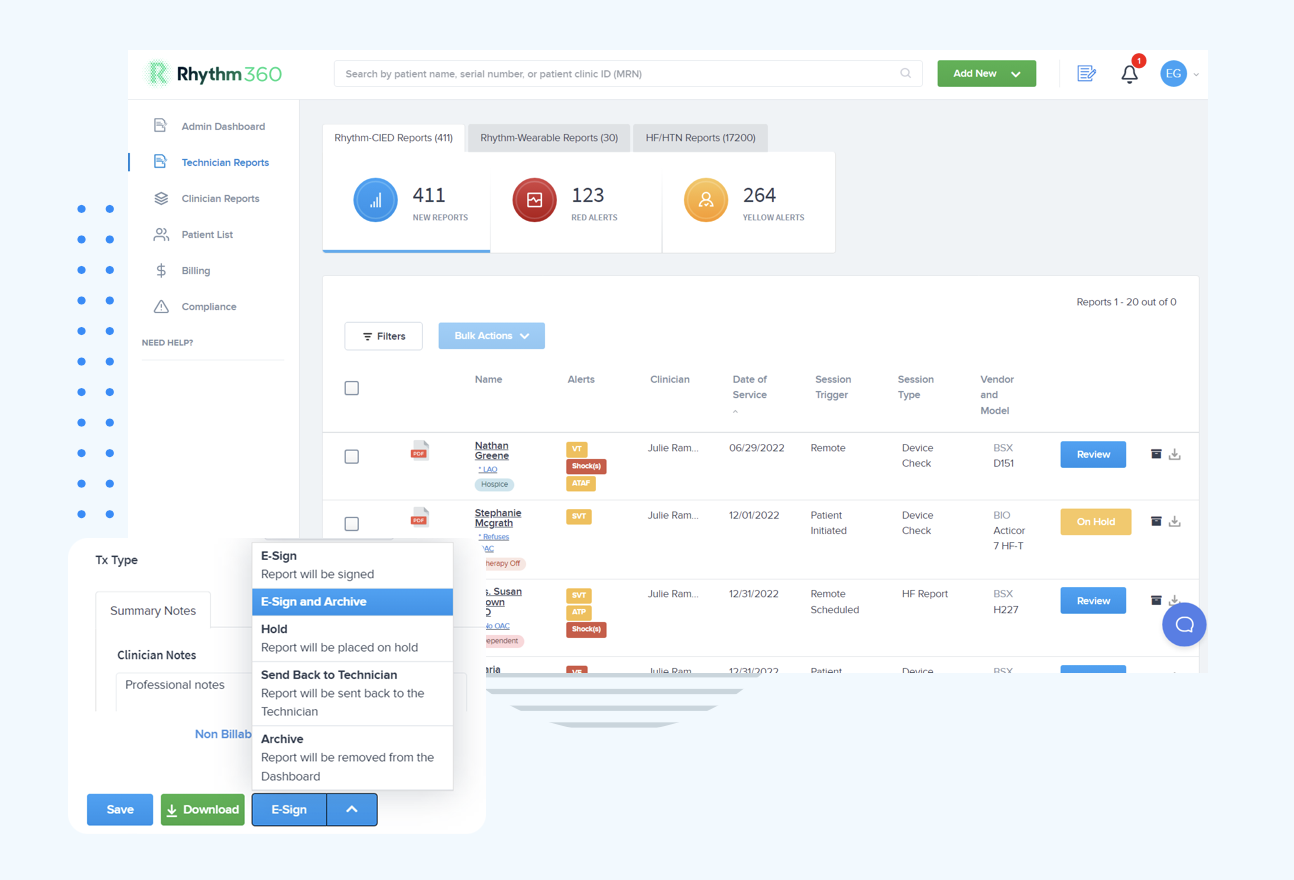
Unified OEM data management reduces administrative chaos and closes billing gaps. Staff often spend 2-3 hours each day logging into separate Medtronic CareLink, Abbott Merlin.net, and Boston Scientific LATITUDE portals to retrieve patient data. This fragmented approach delays responses, leaves documentation incomplete, and causes missed charges.
Vendor-neutral platforms pull data from all manufacturers into a single dashboard. This consolidation cuts staff time by about 70% and helps ensure that no billable events are missed across device types.
For a 100-patient mixed-device practice, this improvement typically recovers about $25,000 annually through better capture rates and lower administrative overhead. The time savings alone usually cover platform costs within 3 to 4 months. See how unified OEM data management would work in your practice.
AI alert triage reduces alert fatigue so clinicians can focus on the events that matter. Traditional systems generate 10-15 alerts per patient each month, yet only 15-20% need immediate action. This poor signal-to-noise ratio slows responses and increases clinical risk.
AI-powered triage reviews transmission patterns, patient history, and clinical context to highlight truly urgent events. Organizations using automation report 60% reductions in processing time for routine tasks, which frees clinical staff to focus on high-value care.
Effective implementation uses intelligent filtering that groups alerts by urgency, auto-handles routine notifications, and escalates critical events with full clinical context. This approach cuts response times by about 80% while helping ensure that life-threatening arrhythmias are not missed.
Bi-directional EHR integration reduces documentation gaps that trigger denials. Cardiology practices benefit from smart EHR templates that prompt all required fields, since missing details often cause auditors to classify services as “not rendered.”
Integrated workflows send device data directly into the EHR and update billing information automatically. This connection removes manual data entry, reduces errors, and ensures that each billable event has matching documentation.
Automated documentation includes key elements such as interrogation timestamps, clinical interpretations, and correct ICD-10 codes. These details cut denial rates by 40-50% and support audit readiness. For mid-size practices, improved first-pass acceptance often recovers more than $40,000 each year.
Focused denial audits convert unworked claims into recovered revenue. Denials should be grouped by CARC and RARC codes for root-cause analysis, with standardized appeal templates to fix recurring issues. Many practices leave 15-25% of denied cardiac monitoring claims unresolved, which represents a large pool of recoverable dollars.
Structured denial analysis highlights patterns such as missing modifiers, weak medical necessity documentation, or timing conflicts with device interrogations. A TSI case study reported a 35% drop in denial rates and an 18% increase in net collections in one year through automated denial management.
The recovery process includes reviewing six months of cardiac monitoring denials, identifying correctable claims, and submitting systematic appeals with complete documentation. Practices with 150 or more monitored patients often recover $15,000-$30,000. Platforms like Rhythm360 support this work with denial analytics and automated appeal generation.
HF and HTN RPM programs create new revenue streams using existing patient relationships. Medicare’s national average reimbursement for CPT 99457 is $51.77 per patient in 2026, and CPT 99454 pays $52.11 per patient per month with at least 16 days of readings. These codes reward consistent monitoring and documented management.
RPM expansion uses your current cardiac population while addressing chronic disease management. A practice that adds RPM for 50 heart failure patients can generate about $62,000 in new annual revenue (50 patients × $103.88 monthly reimbursement × 12 months).
Successful programs use devices that meet FDA criteria and send daily physiological data through HIPAA-compliant systems. Staff document patient consent, device setup, and at least 20 minutes of clinical time each month for CPT 99457 billing.
High data reliability protects both revenue and patient safety. Single-feed monitoring breaks down when OEM servers go offline or connectivity fails, which creates missed transmissions and billing gaps. Missing only 5% of transmissions can cost a 200-patient practice about $15,000 each year.
Redundant data architecture keeps monitoring active through multiple ingestion paths. When primary APIs fail, backup systems that use computer vision and alternative data sources maintain >99.9% capture rates.
This multi-layered approach requires platforms that combine redundant data feeds, automated gap detection, and AI-powered extrapolation to fill transmission voids. These capabilities usually recover 10-15% additional revenue from events that previously went unbilled.
Learn how guaranteed reliability protects your revenue.
Mobile access closes after-hours gaps in both care and billing. Critical cardiac events often occur outside business hours, yet many systems require desktop access for review and documentation. This delay slows clinical response and leaves urgent interventions undocumented.
Mobile-enabled platforms let clinicians review transmissions, sign reports, and coordinate care from smartphones. This flexibility supports 24/7 billing capture and faster clinical decisions.
Mobile access typically increases billable event capture by 20-25% through better after-hours documentation. For practices with on-call coverage, this improvement often adds $20,000-$35,000 in annual revenue. Clinical benefits include faster AFib detection, stroke prevention, and fewer hospitalizations through earlier intervention.
Clear visibility into 2026 reimbursement and denial triggers helps teams submit cleaner claims and avoid preventable revenue loss. The table below links key cardiac monitoring and RPM codes to their expected payment and the most common denial reasons.
CPT Code | Description | 2026 Reimbursement | Common Denials |
93296 | Remote device interrogation (technical) | 0.95 RVU (~$32) | Missing interpretation report |
93298 | Interrogation device evaluation | ~$45 | Insufficient medical necessity |
99454 | RPM device supply (30 days) | $52.11 | <16 daily readings |
99457 | RPM treatment management (20 min) | $51.77 | Undocumented time |
To stay compliant, verify interpretation reports for all device interrogations, document medical necessity with accurate ICD-10 codes, track 16-day cycles for RPM billing, and maintain detailed time logs for treatment management. Practices should also keep clear patient consent records. Rhythm360 supports these requirements with integrated workflows, prompts, and audit trails that keep documentation complete and consistent.
The most commonly missed charges include CPT 93298 for device evaluation when alerts are reviewed but not documented, same-day billing when multiple services occur, RPM setup fees (99453) for new device patients, and technical component billing (93296) when only professional components are billed.
These gaps usually create 20-30% revenue leakage, with practices losing $25,000-$50,000 annually per 100 monitored patients. Automated capture systems surface these opportunities in real time so teams can bill for all services provided.
AI reduces denials by predicting high-risk claims before submission and generating documentation that includes all required elements. Real-time coding checks compare claims against payer-specific rules, while intelligent appeals workflows streamline follow-up on denied claims.
Machine learning models review historical denial patterns and flag issues such as missing modifiers, weak medical necessity language, or timing conflicts. This proactive approach can cut denial rates by 40-60%, improve first-pass acceptance, and speed up cash flow.
Rhythm360 stands out in vendor-neutral cardiac device monitoring through broad OEM integration, AI-driven alert triage, automated CPT capture, bi-directional EHR connectivity, and mobile access. The platform maintains >99.9% data transmissibility with redundant feeds and computer vision while reducing alert fatigue by about 80% and increasing revenue by up to 300%. Unlike point solutions that address only one step, Rhythm360 supports the full cardiac monitoring revenue cycle from data ingestion to denial prevention.
Key 2026 RPM changes include revised codes 99453 and 99454 with new shorter-duration options (99445 and 99470), tighter documentation rules for data frequency and device classification, and stronger medical necessity standards for chronic disease management. CMS now requires explicit patient consent records, at least 16 days of data collection for monthly billing, and detailed time tracking for treatment management. These updates expand cardiovascular monitoring coverage while raising the bar for documentation and compliance.
Most practices see 200-300% ROI within 12-18 months when they automate heart rhythm monitoring workflows. Gains come from recovered missed billing opportunities ($30,000-$60,000 annually), reduced staff time for administrative work equal to 0.5-1.0 FTE, lower denial rates that save $15,000-$25,000 in rework, and new RPM revenue of $50,000 or more. Together, automated capture, unified workflows, and stronger compliance create durable revenue growth while improving patient outcomes and staff satisfaction.
These eight strategies, when implemented through a comprehensive platform like Rhythm360, turn cardiac monitoring into a reliable profit center. Revenue growth comes from eliminating manual gaps, capturing events that previously went unbilled, and expanding services without adding proportional staff.
Explore how Rhythm360 can transform your cardiac monitoring revenue cycle and join practices already achieving these results.