

Last updated: July 14, 2026
Revenue leakage in CIED remote monitoring is structural, not incidental. Transmissions received but not billed within the applicable 90-day cycle are permanently lost. There is no retroactive claim pathway once the window closes. For a practice managing 200 CIED patients, properly billed remote monitoring using CPT codes 93294, 93295, and 93298 can generate $80,000–$120,000 in annual recurring revenue. Practices that rely on manual workflows routinely leave a significant portion of that revenue uncaptured.
The primary structural cause is single-OEM portal reliance. As soon as a practice implants devices from more than one manufacturer such as Medtronic, Boston Scientific, Abbott, or Biotronik, staff must log into separate, non-interoperable portals to retrieve data. Device clinics often struggle with staffing levels and structured performance measurement of remote monitoring programs. Manual transcription errors compound the problem. CIED follow-up visits are often billed without verifying device interrogation documentation completeness, which triggers CO-18 duplicate denials or outright rejections. These billing failures create rework cycles that add to an already overwhelming alert volume.
Alert fatigue accelerates staff burnout and turnover. The University of Chicago Medicine white paper on cardiovascular remote monitoring redesign noted that staffing was always an issue, because their device clinic, like many other medical centers, had struggled with technician turnover and timely weekend coverage. These compounding pressures prevent practices from scaling chronic-care service lines in 2026. At the same time, 2026 CMS code updates expand billing eligibility for patients transmitting remote monitoring data between 2 and 15 days per month. Practices need robust upstream infrastructure to capture that financial potential.
Rhythm360 is a vendor-neutral, HIPAA-compliant remote monitoring platform built for the operational and financial realities of cardiology and electrophysiology practices. It ingests data from all major OEMs such as Medtronic, Boston Scientific, Abbott, and Biotronik via API, HL7, XML, and computer-vision PDF parsing. The platform normalizes these disparate data streams into a single, auditable source of truth. Redundant data feeds sustain greater than 99.9% transmissibility even when an OEM server experiences downtime.
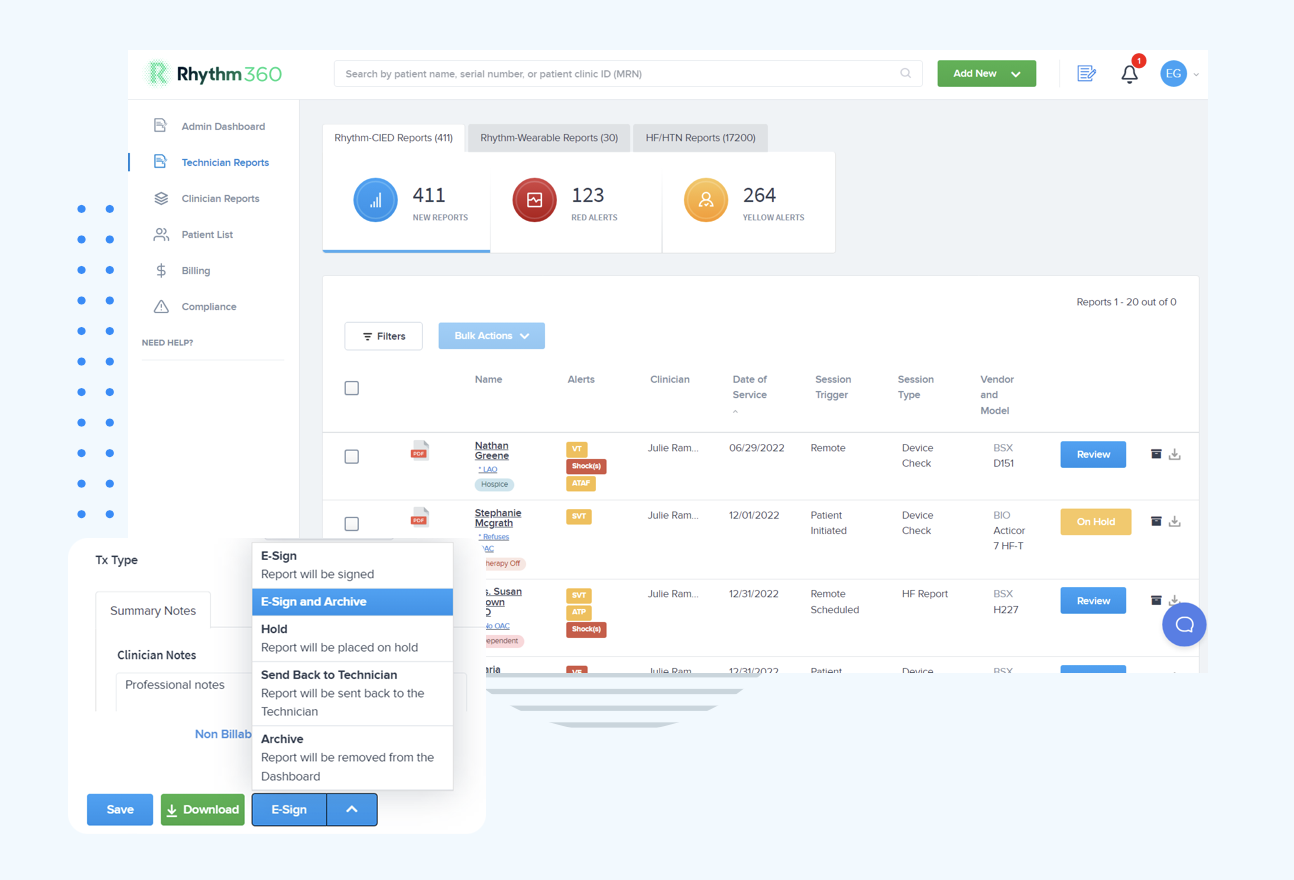
The platform’s core capabilities include:
The University of Chicago Medicine reported that after implementing Rhythm360, billing and accountability for patients improved after the integration, managing over 73,000 reports annually with stable dismissal rates at scale.
Schedule a demo to see how Rhythm360 ingests your CIED data into a single compliant workflow.
The first 30 days establish a clear baseline for enrollment and denials. Without measurable benchmarks, improvement efforts lack direction. The primary targets for this phase are a 90–95% patient enrollment rate across all active CIED patients and a denial rate below 5% on remote monitoring claims.
The staffing-ratio checklist for this audit phase should confirm the following:
Rhythm360’s real-time compliance dashboard surfaces enrollment gaps, overdue 90-day cycles, and patients at risk of transmission lapse before the billing window closes. Standardized workflows should address the three most burdensome tasks identified in an international survey of device clinics: managing disconnected patients, initial transmission review, and patient phone calls. These tasks mirror the operational pressures that drove the University of Chicago Medicine’s redesign.
Pro Tip: Single-OEM portal reliance is the most common audit finding. If your practice implants devices from more than one manufacturer and staff log into separate portals, every hour spent on manual reconciliation replaces time that could support billable review. Rhythm360’s unified ingestion layer removes this redundancy on day one. For patients whose home monitors have gone offline, Rhythm360’s automated patient messaging via Twilio sends reconnect prompts before the monitoring period lapses. This automation reduces the manual phone-call burden on clinical staff.
Once the audit baseline is clear, Phase 2 focuses on closing enrollment gaps and stabilizing data connectivity. Rhythm360’s redundant data feed architecture ensures that if an OEM server experiences downtime, a secondary feed maintains transmission continuity. This design sustains the platform’s greater than 99.9% transmissibility benchmark. Computer-vision normalization converts unstructured PDF reports from legacy OEM portals into structured, queryable data without manual transcription.
A study published in the Journal of Cardiovascular Electrophysiology showed that guideline-based reprogramming of device alerts can reduce non-actionable alerts by 74% without increasing adverse outcomes. Rhythm360’s AI triage layer applies this principle at scale. The system filters manufacturer-default alert thresholds against clinical context instead of forwarding every transmission as an equivalent priority notification.
The measurable success criterion for Phase 2 is achieving the 80% response-time reduction noted earlier. The University of Chicago Medicine’s implementation demonstrated this outcome directly. The practice became able to address issues earlier, calling patients in for evaluation rather than waiting for a 3-month visit.
Pro Tip: Manual transcription errors are the leading cause of documentation-based denials. When staff re-key device model numbers, transmission dates, or programmed parameters from a PDF into an EHR, transcription errors create discrepancies that trigger CO-18 duplicate flags or fail CMS LCD documentation requirements. Rhythm360’s computer-vision parsing and bi-directional EHR integration remove the manual re-entry step entirely.
Phase 3 converts the operational improvements from Phases 1 and 2 into verified, compliant revenue. The CPT code framework governing CIED remote monitoring has specific timing and documentation requirements that must be met precisely to avoid denials. Distinct billing periods apply to different device types, and mixing a 30-day ILR cycle with a 90-day pacemaker cycle can trigger immediate denials.
The following table summarizes the primary remote monitoring codes and their billing cycles:
| CPT Code | Device Type | Billing Period | Key Documentation Requirement |
|---|---|---|---|
| 93294 | Single/dual-chamber pacemaker | Once per 90 days | Physician interpretation note, 30-day minimum monitoring period |
| 93295 | ICD / CRT-D | Once per 90 days | Physician interpretation note, cannot bill 93294 on the same date for the same patient |
| 93296 | Pacemaker or ICD (technical) | Billed with 93294 or 93295 | Platform infrastructure for receiving and processing transmission data |
| 93297 / 93298 | ILR / subcutaneous cardiac rhythm monitor | Once per 30 days | Physician interpretation |
Submitting claims for remote monitoring codes before the required monitoring period can trigger CO-18 duplicate denials. Rhythm360’s compliance dashboard maintains a patient-by-patient calendar of when each remote code becomes reportable, which prevents premature claim submission. Required documentation per CMS LCD policies includes the device manufacturer and model, the date of transmission, a summary of the interrogated data, the physician’s interpretation, and any clinical action taken. Rhythm360 auto-populates each of these fields from ingested transmission data and generates a compliant interpretation note ready for physician signature.
Role-segregated AI alert triage in this phase ensures that critical events such as new-onset atrial fibrillation, ventricular tachycardia, lead malfunction, and ERI or RRT indicators reach the appropriate clinical role immediately. Routine transmissions move into a queue for scheduled review. Practices implementing this workflow have achieved up to 300% revenue lift through recovered CPT codes that were previously missed, combined with the addition of RPM service lines for heart failure and hypertension patients using codes 99453, 99454, and 99457.
Rhythm360’s onboarding process, including EHR integration with systems such as Epic, Cerner, Athenahealth, eClinicalWorks, and Greenway Health, typically takes from a few days to a few weeks. The exact timeline depends on practice size and existing infrastructure. The platform is designed to minimize disruption to active clinical workflows during the transition. Because Rhythm360 ingests data from all major OEM portals simultaneously, practices do not need to phase out existing device connections before going live. Both systems can run in parallel during the initial enrollment period.
CO-18 duplicate denials for remote monitoring codes almost always come from two errors. Practices either submit a claim before the required lookback window has elapsed or submit the same code twice within the same monitoring period for the same patient and device. For pacemakers and ICDs, codes 93294 and 93295 are reportable once per 90-day period. For ILRs and subcutaneous cardiac rhythm monitors, codes 93297 and 93298 are reportable once per 30-day period.
Beyond timing, CMS LCD policies require that each claim include documentation of the device manufacturer and model, the transmission date, a summary of interrogated data, the physician’s interpretation, and any clinical action taken. Rhythm360 maintains a patient-by-patient billing calendar and auto-generates documentation that satisfies these requirements. This approach reduces denial risk at the source rather than at the appeals stage.
Rhythm360 is a HIPAA-compliant, cloud-based platform with a full audit trail for every data ingestion event, clinical action, and patient communication. The platform applies consistent security controls across all manufacturer data streams. All patient communications facilitated through the integrated Twilio framework are logged within the patient record, which creates a documented chain of custody for every interaction. The platform’s bi-directional EHR integration uses HL7 standards so that data exchanged between Rhythm360 and the practice’s EHR meets established interoperability and security requirements.
Rhythm360 includes a dedicated service line for heart failure and hypertension remote physiological monitoring that supports CPT codes 99453, 99454, and 99457. Practices can launch this service line within the same platform environment used for CIED monitoring. A separate vendor relationship or additional portal is not required. The platform provides patient onboarding checklists, automated billing support, and the same AI-powered alert triage applied to CIED transmissions. These capabilities extend to physiological data such as weight, blood pressure, and pulmonary artery pressure from devices like CardioMEMS. This integrated approach allows practices to generate new, recurring revenue from their existing chronic-disease patient population while managing all monitoring activity from a single dashboard.
The 90-day path from fragmented CIED data to CPT-compliant, higher revenue is a sequenced operational problem, not a clinical one. Phase 1 establishes the enrollment and denial-rate baseline. Phase 2 closes connectivity gaps and removes manual transcription. Phase 3 converts compliant documentation into captured revenue and scales alert triage to protect both patients and staff. Infrastructure wins, and practices that invest in unified data workflows now are positioned to capture financial gains that fragmented programs cannot reach.
Rhythm360 functions as the single source of truth across every phase of this playbook. The platform ingests data from all OEMs, automates CPT-aligned documentation, maintains billing calendars that prevent CO-18 denials, and triages alerts with speed and accuracy that manual workflows cannot sustain. The University of Chicago Medicine’s experience confirms the outcome. Having an integrated review of data from trained personnel was a defining factor in their program’s success. Practices implementing Rhythm360 have achieved the response-time and revenue outcomes detailed throughout this playbook without proportional headcount growth.





