

PaceArt, originally developed by Medtronic and later acquired by PaceMate, functions as a long-standing on-premise database for cardiac implantable electronic device data. The platform does not include a native mobile application. Clinicians access data through desktop or web-based portals, and the PaceMateLIVE successor platform still has not introduced a purpose-built smartphone interface for real-time transmission review.
Clinicians can technically access pacemaker and ICD transmission data through legacy web portals, yet the architecture of on-premise systems like PaceArt creates meaningful barriers. Single-vendor dependency means a clinic managing Medtronic, Boston Scientific, Abbott, and Biotronik devices must juggle separate logins across non-interoperable OEM portals. Clinicians see no unified alert queue, no AI-assisted triage, and no bi-directional EHR synchronization.
These architectural limitations become even more problematic when measured against modern compliance standards. Today’s remote CIED access requirements extend far beyond simple portal logins and now include comprehensive security controls. HHS guidance on remote use and mobile device security requires covered entities to implement encryption, device management, session timeout, remote wipe, and logging controls when clinicians access electronic protected health information remotely. A January 2026 OCR Cybersecurity Newsletter further addresses system hardening requirements for mobile ePHI access. Legacy desktop-only systems were not architected to meet these evolving standards in a mobile context.
The HIPAA Security Rule at 45 CFR Part 160 and Subparts A and C of Part 164 requires covered entities to implement appropriate administrative, physical, and technical safeguards that protect the confidentiality, integrity, and availability of electronic protected health information. This standard applies directly to any mobile solution that handles CIED data.
Clinic administrators and electrophysiologists often look for a smartphone app that supports CIED monitoring. Availability depends entirely on the chosen platform. PaceArt and the PaceMateLIVE transition do not provide a native mobile app for clinicians. Teams remain dependent on browser-based access, which lacks push notification infrastructure, biometric authentication, and the offline resilience that a purpose-built application delivers.
Adoption of RPM among U.S. clinicians has grown substantially in recent years, and that growth has outpaced the mobile readiness of many legacy platforms. Modern remote cardiac monitoring platforms use secure communication protocols with encrypted, HIPAA-compliant data transmission via Bluetooth, Wi-Fi, LTE or cellular, or device-specific telemetry channels to cloud platforms. These architectures enable true smartphone-first workflows that legacy systems cannot easily replicate.
Rhythm360 provides a secure, HIPAA-compliant mobile application that allows electrophysiologists and device technicians to review transmissions, sign reports, and coordinate care from any location. Andrew Beaser, MD, at the University of Chicago Medicine, noted, “I am more likely to sign off on these while in meetings because I can easily access them on my phone.”
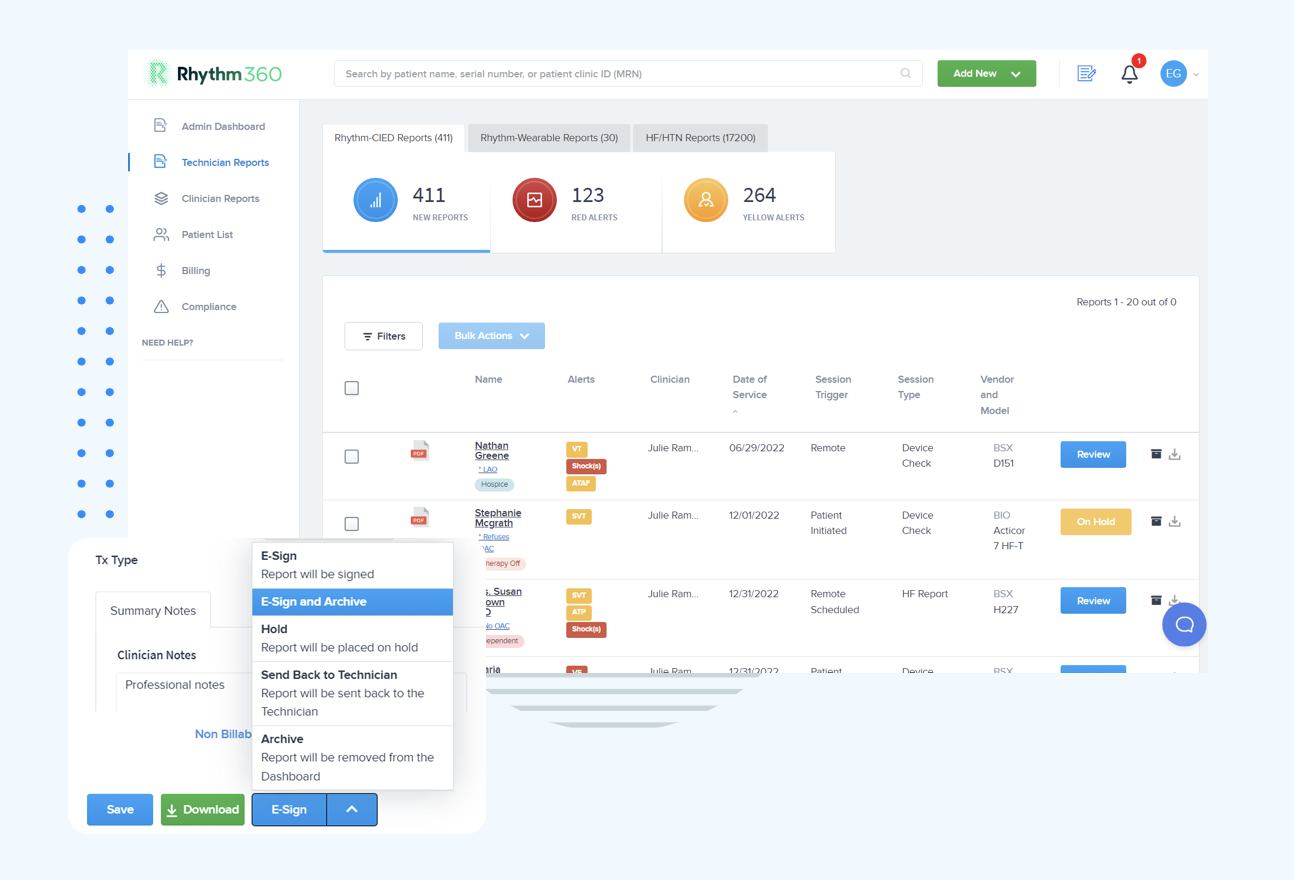
The table below compares Rhythm360 against legacy PaceArt and PaceMateLIVE across four operational dimensions. All figures come from cited sources or verified company data.
| Capability | Rhythm360 | PaceArt / PaceMateLIVE | Notes |
|---|---|---|---|
| Native Mobile Access | Yes, HIPAA-compliant smartphone app with push alerts, biometric login, and report signing | No native app, browser-based portal access only | Rhythm360 company data; PaceArt architecture per product documentation |
| Multi-OEM / Vendor-Neutral Support | Yes, Medtronic, Boston Scientific, Abbott, Biotronik, and others unified in one dashboard via API, HL7, XML, and computer vision PDF parsing | Primarily Medtronic-centric, separate OEM portals required for other manufacturers | RPM devices often collect data in proprietary formats, making vendor-neutral design a key differentiator |
| Critical Alert Response Time | Up to 80% reduction in response times through AI triage and 24/7 CCT oversight | Manual review workflows, no AI-assisted prioritization reported | Rhythm360 company data; UCM white paper documents earlier interventions post-implementation |
| Automated CPT Billing Documentation | Yes, automated capture for 93298, 93299, 99454, and related codes with audit-ready documentation | Manual billing workflows, no automated CPT documentation | UCM reported improved billing and accountability post-Rhythm360 integration |
Remote CIED monitoring generates billable events under several CPT codes, including 93298 for remote interrogation of an implantable cardioverter-defibrillator with analysis and report, 93299 for remote interrogation of an implantable loop recorder, and 99454 for remote physiological monitoring device supply with daily recordings. Accurate capture of these codes requires auditable documentation tied to each transmission review. Manual, portal-based workflows frequently miss steps or lose documentation, which leads to underbilling.
Practices that cannot document compliance with transmission review timelines and clinical response requirements face claim denials and revenue leakage. Rhythm360 automates CPT code capture and generates audit-ready documentation at the point of review. Clinics use this automation to recover previously lost revenue and, in some cases, increase profitability by as much as 300%.
On the security side, a January 2026 OCR Cybersecurity Newsletter addresses system hardening and protecting ePHI. That guidance reinforces that mobile access solutions must meet current encryption, access control, and audit logging standards. The FDA’s SaMD framework also requires organizations to evaluate whether AI-driven alert triage within a CIED platform constitutes regulated software functionality. Vendor compliance documentation therefore becomes an essential procurement consideration in 2026.
Clinics that move from a legacy PaceArt environment to Rhythm360 follow a structured onboarding path that minimizes workflow disruption. Implementation, including EHR integration with Epic, Cerner, Athenahealth, eClinicalWorks, or Greenway Health via HL7, typically completes within a few days to a few weeks. The checklist below outlines the core migration steps.
Post-implementation, practices achieve greater than 99.9% data transmissibility through redundant data feeds, computer vision, and AI-powered extrapolation. Beyond these clinical improvements, migration also removes the substantial resources that healthcare organizations spend each year maintaining legacy systems that hinder effective integration. This shift makes the transition financially defensible even before teams account for clinical outcomes.
Request a custom migration roadmap and timeline for your specific PaceArt environment.
Several cloud-based platforms now serve as alternatives to PaceArt for CIED data management. Options include PaceMateLIVE, which functions as the direct successor following PaceMate’s acquisition of PaceArt from Medtronic, along with Murj, Implicity, Octagos, PrepMD OMNI, and Rhythm360. Rhythm360 stands out through its native mobile application, vendor-neutral multi-OEM data unification, AI-powered alert triage, bi-directional EHR integration, and automated CPT billing documentation. Practices evaluating alternatives should confirm that a platform supports all device manufacturers in their patient panel, provides HIPAA-compliant smartphone access, and automates billing workflows for codes such as 93298, 93299, and 99454.
A vendor-neutral platform ingests data from each OEM’s transmission infrastructure using a combination of direct APIs, HL7 feeds, XML parsing, and computer vision-based PDF extraction. Rhythm360 normalizes these disparate data formats into a standardized schema and then surfaces the unified patient record through a single dashboard accessible on both desktop and mobile. Clinicians see one alert queue, one patient timeline, and one report interface regardless of whether the underlying device comes from Medtronic, Boston Scientific, Abbott, or Biotronik. This approach removes the need for separate portal logins and ensures that a clinician reviewing transmissions on a smartphone after hours has access to the same complete data set available at a clinic workstation.
For Rhythm360, the full implementation process includes EHR integration, OEM data feed activation, alert configuration, and staff training. Most clinics complete this work within a few days to a few weeks, depending on the complexity of the existing infrastructure and the number of EHR and OEM integrations required. RhythmScience manages onboarding end-to-end, covering workflow configuration, data migration support, and go-live validation. Practices with existing HL7-capable EHR systems generally experience the fastest onboarding timelines.
Rhythm360’s AI-powered alert triage system filters non-actionable transmissions and prioritizes clinically significant events, such as new-onset atrial fibrillation, ventricular tachycardia, lead malfunction, or ERI and RRT indicators, before they reach the on-call clinician. This reduction in alert fatigue, including the 80% improvement in response times noted earlier, occurs without suppressing events that require clinical action. All triage decisions are logged with a full audit trail, which preserves the documentation required for HIPAA compliance and CPT billing. As Andrew Beaser, MD, at the University of Chicago Medicine observed, AI-assisted decision support will become increasingly important as data volumes grow, a reality already evident in high-volume device clinics that manage tens of thousands of annual transmissions.
PaceArt’s desktop-only architecture and the incremental improvements offered by PaceMateLIVE leave cardiology clinics without the smartphone-first, vendor-neutral, AI-assisted workflow that 2026 clinical and compliance demands now expect. On-call clinicians remain tethered to workstations, multi-OEM practices continue managing fragmented portal logins, and revenue leaks through undocumented billable events.
Rhythm360 addresses each of these gaps through a single, HIPAA-compliant platform. The solution combines a native mobile app for anywhere access, unified multi-OEM data ingestion with greater than 99.9% transmissibility, AI triage that improves critical response times, automated CPT documentation, and bi-directional EHR integration deployable within days to weeks. Gaurav A. Upadhyay, MD, at the University of Chicago Medicine, confirmed, “We have improved billing and accountability for our patients after the integration.”





