

On-premise systems are bound by the physical capacity of the hardware installed at deployment. As CIED patient panels expand and remote monitoring transmission frequency increases, local databases accumulate data faster than hardware refresh cycles allow. On-premise data warehouse environments require capital hardware investment and planned upgrade cycles to accommodate growth, so performance degradation becomes a matter of timing, not possibility.
Wearables and newer cardiac monitoring devices generate data volumes and transmission frequencies that exceed the throughput capacity of integration infrastructure designed five or more years ago for lower-volume, periodic device feeds. A PaceArt installation sized for 500 patients in 2019 cannot support the continuous, high-frequency transmission cadence expected of a 1,500-patient panel in 2026 without major hardware upgrades.
Multi-site on-premise deployments drive cost growth because every new clinic requires its own hardware, licensing, and IT support. Infrastructure, hardware, and support costs accumulate with each additional location, and each server becomes another environment to maintain.
On-premise solutions often carry higher overall costs than cloud-based alternatives, across both one-time and ongoing expenses. For cardiology groups managing multiple sites, annual silo-related costs from data fragmentation can be significant. Analyst teams may spend many hours each week on manual reconciliation across systems and locations. On-premise platforms create complex maintenance burdens that grow with multi-location expansion, and 78% of U.S. hospitals, health systems, and physician groups have approved significant cloud investments to be completed by mid-2026.
Legacy system incompatibility is the most common EHR integration challenge because many systems predate FHIR and do not support modern APIs, which forces the use of middleware adapters or custom transformation layers. PaceArt’s on-premise architecture compounds this friction. Data extracted from a local database must be mapped, transformed, and transmitted to an EHR through custom pipelines that clinical IT teams are frequently understaffed to maintain.
Cardiology EHR data migration from legacy systems commonly encounters inconsistent date and time formats, missing structured fields for device data, duplicate patient records, and proprietary data structures that require custom extraction logic. These issues intensify as vendors shift support from HL7 v2 to FHIR, which leaves legacy-only environments increasingly isolated during new EHR integrations and upgrades.
A cardiac monitor and an EMR built by different vendors do not communicate out of the box, which forces organizations to build and maintain custom connections that become unsustainable as patient volumes grow. When PaceArt operates as a standalone silo, device transmission data does not flow automatically into the patient chart. An echo system or diagnostic device that sends data to a separate silo instead of the patient chart creates ongoing manual re-entry workflows for cardiology clinic staff.
Predictive analytics applications require continuous device data arriving at scale and frequency that older on-premise integration implementations were never architected to handle. This constraint limits clinical decision support in high-volume CIED environments and keeps teams in reactive mode.
Major incidents affecting on-premise systems take an average of 17 days to fully resolve, with U.S. healthcare organizations losing $1.9 million per day to downtime from ransomware attacks. Each on-premise server represents a separate attack surface that requires patching, backup management, and physical security. These responsibilities increase directly with site count.
On-premise ERP licenses typically cost around $10,000 upfront, though enterprise implementations often exceed $500,000 depending on scope. Practices also absorb server hardware costs and ongoing annual IT support and upgrade fees. As organizations add locations and devices, this model creates growing financial and operational exposure.
The operational symptoms of PaceArt scalability problems appear in response time, data reliability, revenue capture, and staff hours. The pattern across all metrics stays consistent. Legacy on-premise systems create measurable delays, rising manual workload, and revenue leakage, while cloud platforms remove these barriers through automation and centralized access. The table below quantifies these differences across four operational dimensions.
| Metric | Legacy On-Premise (PaceArt) | Cloud Platform (Rhythm360) | Source |
|---|---|---|---|
| Critical alert response time | Delayed by manual retrieval, workstation-dependent access | Up to 80% reduction in response time via AI-powered triage and mobile access | RhythmScience platform data |
| Annual multi-site data silo costs (2–5 sites) | Significant costs from data fragmentation and manual reconciliation | Consolidated single-platform model removes per-site duplication costs | Improvado Healthcare Data Silos Report |
| Revenue capture from CPT billing | Manual documentation, missed billable events due to fragmented workflows | Up to 300% increase in revenue through automated CPT code capture and documentation | RhythmScience platform data |
Cardiology practices evaluating a transition from PaceArt to a cloud-based platform gain clarity from a structured assessment before they commit to a migration timeline. EHR migration follows a multi-stage process that includes data inventory, workflow mapping, data classification, batch extraction, verification, and rollout planning. The checklist below applies that framework to CIED platform migration.
Cloud-based solutions let organizations reduce capital expenditures by shifting from hardware-heavy on-premises infrastructure to flexible pay-as-you-go models, which can lower costs compared to legacy systems. A vendor-neutral cloud platform removes the per-site hardware burden, centralizes data access across all locations, and scales transmission capacity without a hardware refresh cycle.
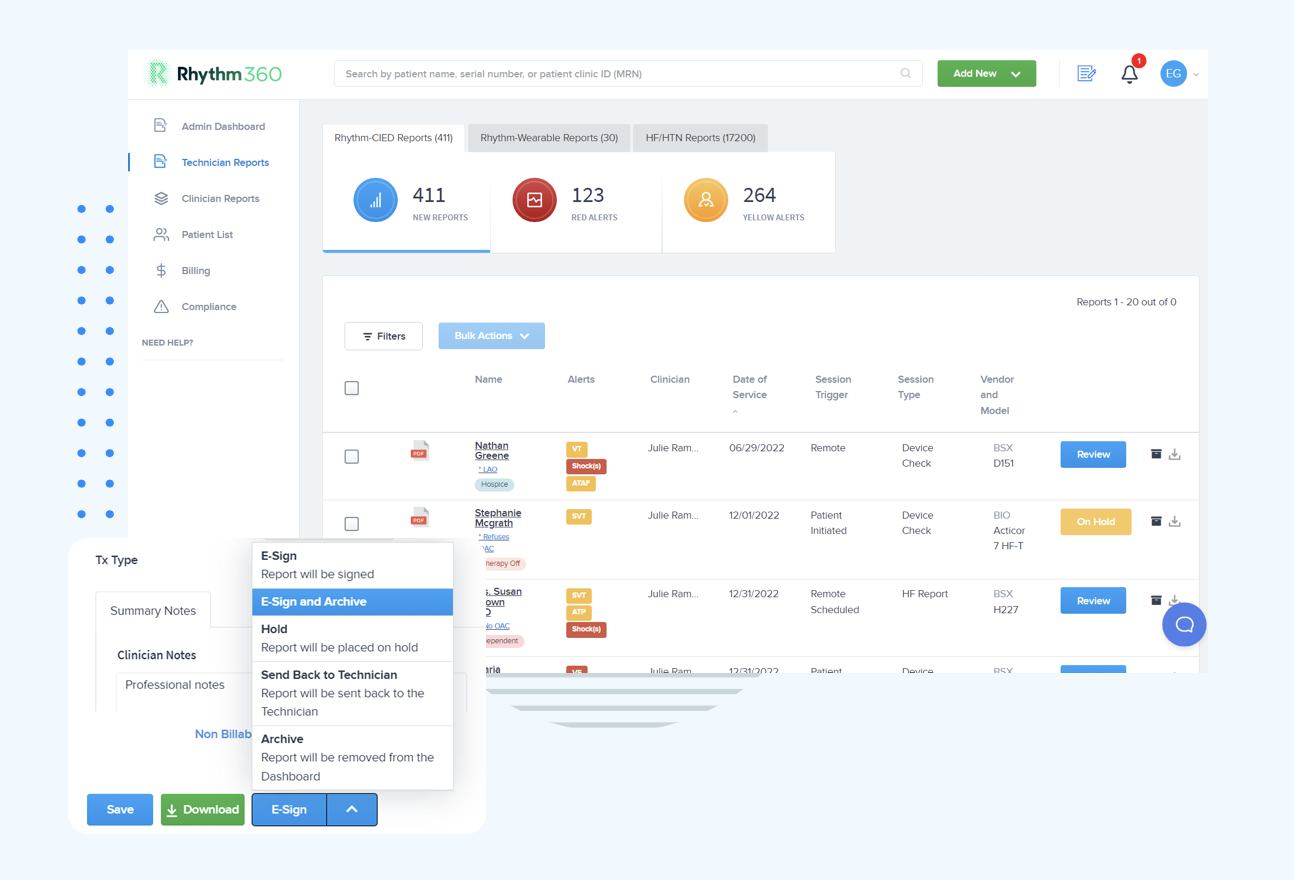
Rhythm360 ingests data from all major CIED manufacturers, including Medtronic, Boston Scientific, Abbott, and Biotronik, into a single dashboard. This approach removes the multi-portal login burden that grows with every new device type added to a practice’s implant mix. Its AI-powered alert triage filters non-actionable transmissions and surfaces clinically significant events in near real time, which staff can access through a HIPAA-compliant mobile application from any location. Bi-directional EHR integration with Epic, Cerner, Athenahealth, eClinicalWorks, and other platforms via HL7 and FHIR removes the brittle custom middleware dependencies that limit legacy on-premise integration at scale.
PaceArt’s on-premise architecture does not have a published universal threshold, and performance degradation ties directly to the physical capacity of the server hardware installed at each clinic. As patient panels grow beyond the hardware’s original sizing, report generation slows, database queries take longer, and concurrent user access becomes constrained. These issues often appear when transmission volumes increase due to expanded remote monitoring schedules or the addition of new device types. Practices that grow from a few hundred to more than a thousand CIED patients without a hardware refresh commonly report noticeable slowdowns, especially when multiple staff members attempt simultaneous access during busy EP lab review periods.
On-premise systems like PaceArt require a separate installation, server, and often a separate license at each physical location. Every new clinic site added to a cardiology group triggers a new round of capital expenditure that includes server hardware, software licensing, IT setup, and ongoing maintenance contracts. Cloud SaaS platforms usually charge per patient or per user regardless of site count, while on-premise deployments create a cost structure that scales linearly or worse with geographic expansion. Groups that acquire smaller practices also face the burden of integrating disparate legacy installations, which can generate significant wasted integration costs and months of operational disruption when architectures do not align.
Integration friction peaks when the EHR and the cardiac platform use incompatible data standards. Legacy cardiac systems that output data only in proprietary formats or older HL7 v2 structures face the most friction when connecting to modern EHRs like Epic and Cerner, which increasingly expect FHIR-compliant data exchange. Smaller or older EHR platforms, including some versions of eClinicalWorks and Greenway Health, may lack the API infrastructure needed for automated bidirectional data flow. This gap forces manual export and import workflows. The friction compounds in multi-site groups where different locations may run different EHR versions, which requires the same cardiac platform to maintain several custom integration pathways at once.
Implementation timelines for migrating from an on-premise CIED platform to a cloud-based alternative vary based on patient panel size, the number of EHR integrations required, and the complexity of historical data migration. For most cardiology practices and EP labs, a structured migration that includes data inventory, EHR integration setup, staff training, and go-live can be completed in days to a few weeks when the receiving platform is purpose-built for rapid onboarding. Revenue impact usually turns positive within the first billing cycle. Automated CPT code capture closes manual documentation gaps that cause claim rejections and missed billable events. Practices migrating to Rhythm360 have documented up to a 300% increase in revenue generation through improved CPT code capture and the addition of new RPM service lines for heart failure and hypertension management.
PaceArt scalability problems reflect structural limits of on-premise architecture meeting the realities of 2025–2026 CIED monitoring demand. Hardware ceilings constrain database growth. Multi-site deployments multiply costs without multiplying capability. EHR integration relies on custom middleware that breaks under volume. Alert triage bottlenecks delay clinical response. Security and maintenance burdens grow with every additional location. For cardiology practice administrators and EP lab directors managing expanding patient panels, the financial and clinical cost of inaction now exceeds the cost of migration.
A vendor-neutral, cloud-based platform addresses each of these failure points with elastic scalability without hardware investment, unified multi-site access from a single dashboard, native EHR integration via HL7 and FHIR, AI-powered alert triage, and a SaaS pricing model that scales with practice growth rather than against it.





