

CVE-2023-31222 is a critical remote code execution vulnerability in Medtronic Paceart Optima. An unauthenticated remote attacker can send a specially crafted message to the service and achieve arbitrary code execution at the system level. Successful exploitation allows the attacker to delete, steal, or modify patient data. The attacker can also use the compromised Paceart host as a pivot point for broader network penetration.
| Attribute | Detail | Reference | Impact |
|---|---|---|---|
| CVE ID | CVE-2023-31222 | CVE.org | Critical |
| CVSS v3.1 Score | 9.8 | CVE.org | Full confidentiality, integrity, availability loss |
| Affected Versions | Paceart Optima 1.11 and earlier | CVE.org | All on-premise installations at or below 1.11 |
| Vulnerability Class | Remote Code Execution | CVE.org | Unauthenticated remote code execution |
The CISA advisory underscores the severity of this issue. It states: "Successful exploitation of this vulnerability could allow an unauthorized user to cause data to be deleted, stolen, or modified on the Paceart Optima system or to use the Paceart Optima system for further network penetration."
EP lab administrators now face a practical decision. The practice must determine whether existing IT resources and patching cadence can sustain ongoing manual mitigation of this critical vulnerability on an on-premise system, or whether the exposure profile justifies a move to a cloud-based alternative.
Medtronic’s official guidance addresses CVE-2023-31222 through two tracks: a temporary operational workaround and a permanent software update.
Temporary workaround: Disable the Paceart Optima messaging service (MSMQ component) until the permanent patch can be applied. This action removes the immediate attack vector but also suspends any messaging-dependent workflows within Paceart. During this period, staff must rely on manual process substitutions to keep clinical operations running.
Permanent remediation: Upgrade Paceart Optima to a version above 1.11 that incorporates Medtronic’s patch addressing the unsafe deserialization flaw. Medtronic advises customers to contact their Paceart representative to obtain the update. Practices should follow internal change-management procedures and test the update in a controlled window before full deployment.
Supplementary network controls recommended alongside patching:
First, isolate the Paceart server on a network segment with strict firewall rules that limit MSMQ port exposure. This step reduces the attack surface by restricting unauthorized network access to the vulnerable service. Once network isolation is in place, apply the principle of least privilege to all accounts with access to the Paceart host so that any compromised credentials have minimal reach.
To detect and investigate suspicious activity that bypasses preventive controls, enable comprehensive audit logging on the host operating system. This approach supports breach investigation and aligns with HIPAA audit-control requirements under §164.312(b). Finally, conduct a full asset inventory to confirm no additional Paceart instances exist on the network. Many healthcare organizations lack complete IoT and connected-device inventories, which leaves hidden systems unprotected and undermines other security efforts.
Patching resolves the immediate CVE, but it does not address the structural limitations of on-premise architecture. Manual update cycles, limited audit logging, and the absence of continuous vulnerability monitoring remain. Each practice must decide whether a patched legacy system meets its long-term security and operational requirements.
See how Rhythm360 automates updates and monitoring for cardiac device data management without on-premise patching.
The security and operational differences between on-premise Paceart deployments and cloud-native platforms are structural, not incidental. Traditional on-premise SaMD relies on manual updates and faces slower update cycles along with reduced interoperability. Cloud-connected platforms enable controlled, traceable over-the-air updates that align with regulatory documentation and reduce the window of exposure.
| Dimension | Paceart Optima (On-Premise) | Cloud-Based Platform (e.g., Rhythm360) | Source |
|---|---|---|---|
| Patching cadence | Manual, requires IT scheduling and change management, CVE-2023-31222 required customer-initiated upgrade | Controlled OTA updates, zero-downtime deployment | CitrusBits |
| Remote access | Typically restricted to on-site workstations, remote access requires VPN configuration | Secure, authenticated access from any device via HIPAA-compliant mobile and web interfaces | Company context |
| Data encryption | Dependent on local IT configuration, legacy devices often lack native encryption | AES-256 at rest, TLS 1.2+ in transit, customer-managed key options | Us2.ai deployment model |
| Audit logging | Dependent on host OS configuration, many legacy medical devices lack robust centralized logging | Continuous, automated audit trails, full communication logs per patient record | Censinet / Company context |
| Vendor-neutral interoperability | Medtronic-centric, separate OEM portals required for other manufacturers | API-driven EHR integration via HL7/FHIR, all major OEMs unified in one dashboard | CitrusBits / Company context |
The 2022 FBI report warned of risks from unpatched and outdated medical devices but did not report any percentage of devices with critical vulnerabilities. For practices evaluating their risk posture, the structural patching gap between on-premise and cloud architectures represents a material compliance consideration.
Compare Rhythm360’s security model to your current setup in a live session tailored to your environment.
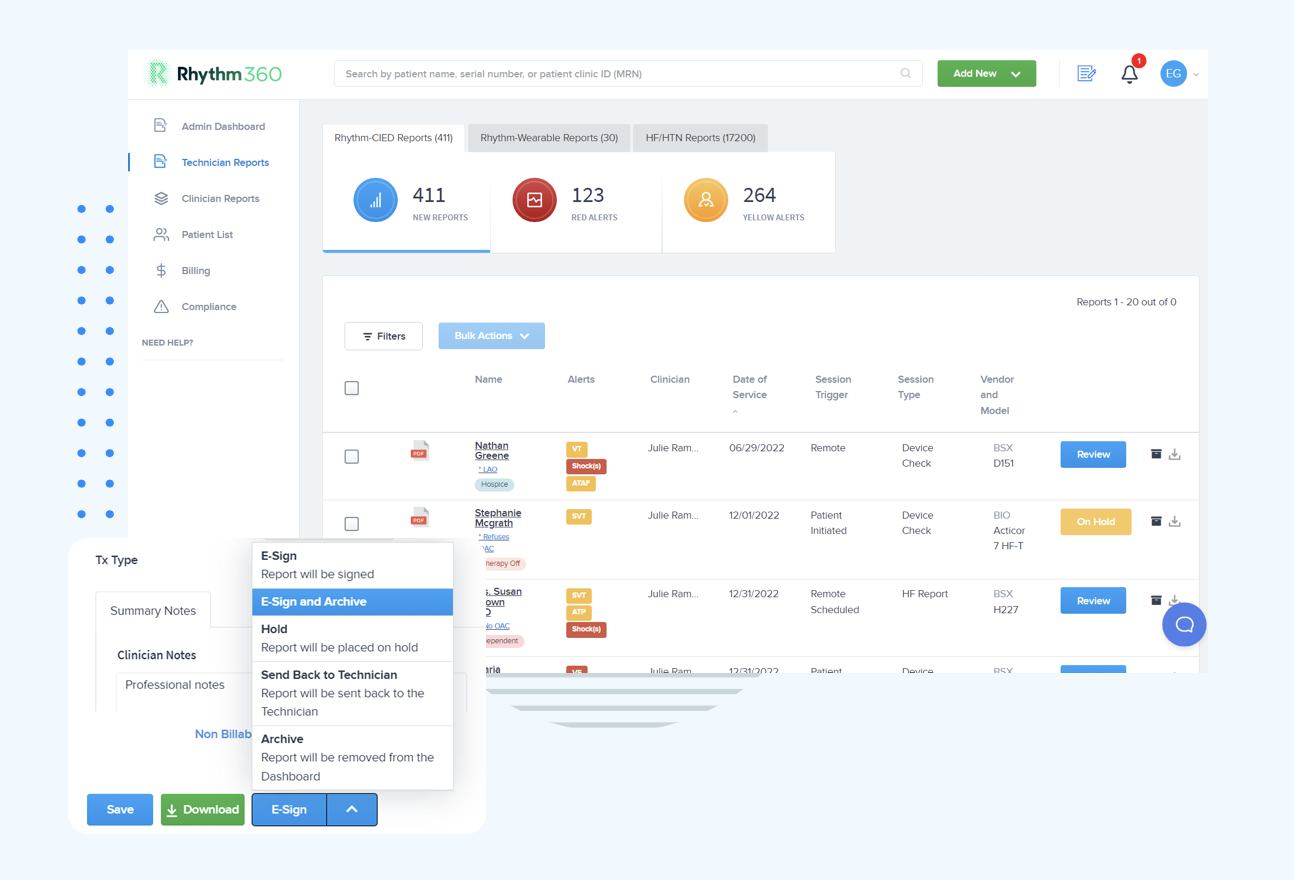
The upgrade-versus-migrate decision rests on four operational dimensions: security posture, EHR integration requirements, staff capacity, and revenue cycle continuity. The following checklist provides a structured evaluation framework that teams can work through week by week.
Migration evaluation checklist:
Practices that have completed this migration to Rhythm360 have documented an 80% reduction in critical-alert response times and revenue increases of up to 300% through optimized CPT code capture and the addition of HF and HTN RPM service lines. These results align with broader industry trends. More than 85% of health systems are increasing their spend on digital health and information technology projects, with cybersecurity and electronic health record modernization topping the list. This investment pattern reflects broad recognition that legacy system migration is now a strategic priority rather than a discretionary project.
The key decision framework asks whether applying the CVE-2023-31222 patch today gives the upgraded Paceart system enough capability for the next three to five years of security, interoperability, alert response, and revenue capture. If not, the data already supports a planned migration path.
Migration timelines vary by practice size and EHR complexity, but most implementations of modern cloud platforms, including EHR integration and staff training, complete within a few days to a few weeks for smaller practices. Larger health systems with complex Epic or Cerner integrations and multi-site device populations may require six to twelve weeks for full go-live. Many teams use a phased approach, running the cloud platform in parallel with Paceart during a transition window to maintain CPT billing continuity and prevent data loss.
A properly managed migration to a HIPAA-compliant cloud platform reduces compliance risk rather than increasing it. The transition period requires a signed Business Associate Agreement with the new vendor, documented data transfer procedures, and confirmation that all ePHI is encrypted in transit and at rest throughout the migration. Remaining on an unpatched or under-monitored on-premise system carries its own HIPAA exposure. The HHS Office for Civil Rights has issued settlements for breach-related failures, nearly all requiring corrective action plans that include comprehensive security risk analysis. A cloud platform with continuous audit logging, role-based access control, and automated vulnerability monitoring typically strengthens the practice’s compliance posture relative to a legacy on-premise deployment.
Most practices can migrate historical Paceart data without losing clinical records. Modern cloud platforms designed as Paceart successors support data migration from Paceart’s export formats and can ingest structured and unstructured data, including PDFs, HL7 messages, and XML device reports. Rhythm360 uses AI-powered computer vision and data normalization to process diverse data types, achieving greater than 99.9% transmissibility. Practices should conduct a full data inventory before migration, validate a sample dataset in the new environment, and retain a read-only Paceart archive for any records that fall outside the active monitoring window.
Billing disruption is the most common concern during platform transitions and is avoidable with proper planning. Key steps include confirming that the new platform auto-generates compliant documentation for all active CPT codes (93298, 93299, 99454, 99457, and others), running a parallel billing cycle for at least one full billing period, and training billing staff on any new documentation workflows before cutover. Rhythm360’s automated CPT code capture and documentation is designed specifically to prevent revenue leakage during and after transition, and practices have reported revenue increases of up to 300% following full implementation.
CVE-2023-31222 presents a CVSS 9.8 remote code execution risk to every cardiology practice running Paceart Optima version 1.11 or earlier. The immediate remediation path is clear: implement the MSMQ workaround and apply Medtronic’s official patch as outlined above. The longer-term evaluation carries greater strategic weight. On-premise systems carry structural limitations, including manual patching cycles, constrained audit logging, limited interoperability, and no native remote access, and a single patch does not resolve these issues.
Cloud-based, vendor-neutral platforms address these limitations at the architectural level. Continuous OTA updates, AES-256 encryption, automated audit trails, and API-driven EHR integration replace the manual controls that on-premise deployments require. For practices where operational and financial evidence already supports migration, including faster critical-alert response, recovered CPT revenue, and reduced administrative burden, the CVE-2023-31222 bulletin serves as a concrete catalyst to act on that evaluation now.
Schedule a Rhythm360 migration readiness consultation to review a side-by-side security and operational comparison for your practice and receive a tailored migration plan.





