Paceart Optima’s on-premises architecture restricts remote access, multi-site coordination, and business continuity for cardiology practices.
Manual multi-OEM data aggregation creates workflow bottlenecks, non-billable staff hours, and CPT code leakage that limit revenue growth.
Legacy Paceart deployments require ongoing Windows-server patching and network hardening, which increases HIPAA compliance risk and IT overhead.
Without AI-powered alert triage, high volumes of non-actionable transmissions cause alert fatigue and delay responses to critical clinical events.
Rhythm360 removes these risks with a vendor-neutral, AI-powered cloud platform, and you can schedule a demo to modernize your CIED workflow.
On-premises architecture. Data lives on a local Windows server, which makes remote access, multi-site coordination, and business continuity structurally difficult.
Limited scalability. The system was not designed to handle the volume or variety of transmissions generated by multi-OEM device populations across multiple clinic locations.
Manual data migration and normalization. Moving or consolidating records requires manual export and import workflows that introduce data-quality risk and delay onboarding.
Documented network security exposure. Legacy on-premises deployments require active patching and network hardening to address known exploit vectors, which creates ongoing IT overhead.
Workflow bottlenecks and alert fatigue. Without AI triage, staff must manually sort high volumes of non-actionable alerts, which slows response to clinically significant events.
Paceart Optima stores CIED data on a local Windows server, so every clinician who reviews a transmission must sit at that workstation or connect through a VPN. For practices that operate across multiple sites, such as a main hospital campus, a satellite clinic, and an on-call cardiologist working remotely, this architecture creates immediate access barriers.
Multi-site access issues compound quickly. A device technician at a satellite office cannot pull a real-time transmission from the main server without IT-managed remote-access infrastructure, and any server downtime takes the entire system offline. The deployment has no redundant data feed, no automatic failover, and no mobile-native interface.
Rhythm360 removes these constraints with a cloud-native architecture that delivers greater than 99.9% data transmissibility through redundant data feeds, computer vision, and AI-powered extrapolation. Clinicians access the full platform, including transmissions, reports, and alerts, from any device, anywhere, without VPN dependency or single-server risk.
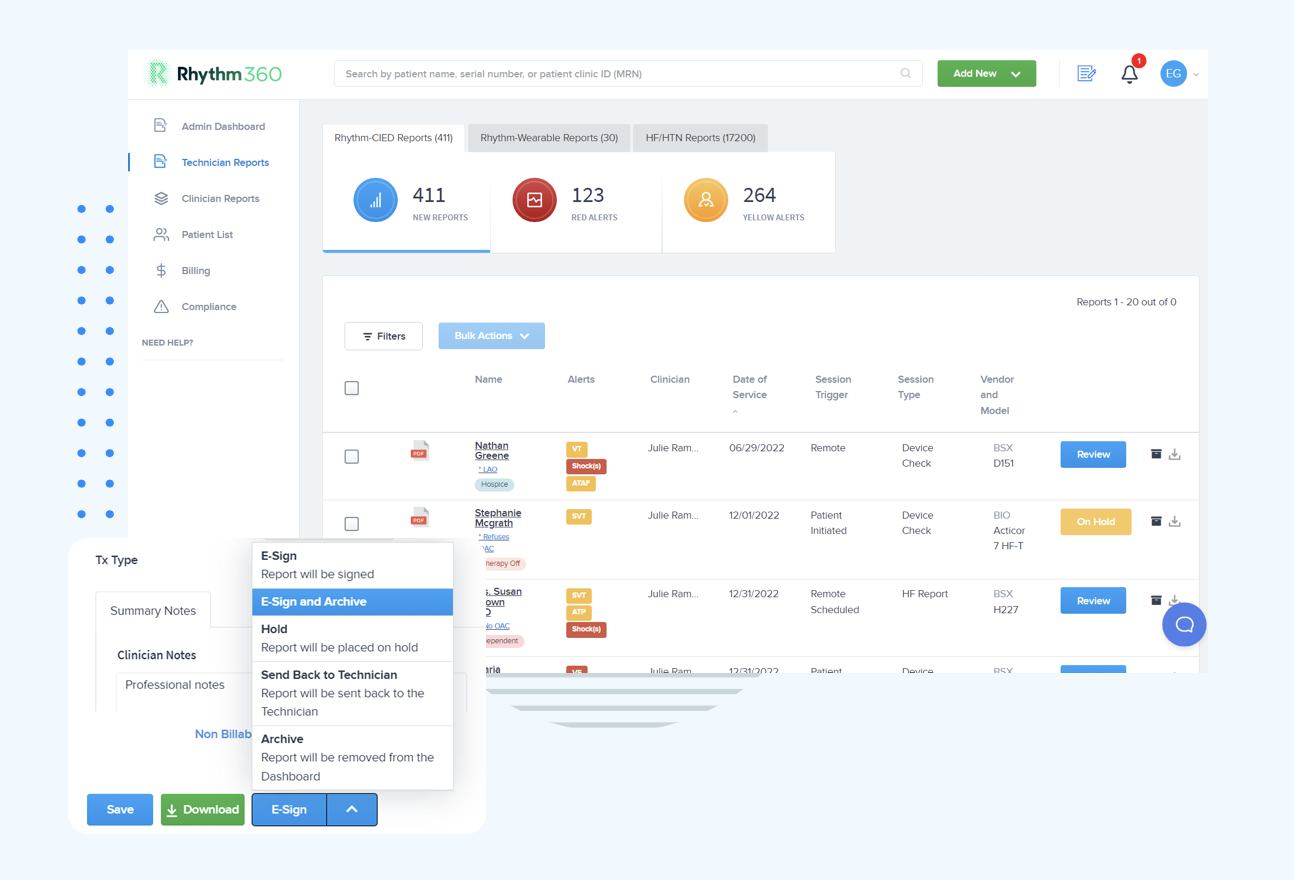
Paceart functions as an organizational database rather than a high-throughput remote monitoring engine. As practices add devices from multiple OEMs such as Medtronic, Boston Scientific, Abbott, and Biotronik, staff must log into each manufacturer portal, retrieve data manually, and then reconcile it inside Paceart. Fragmented data workflows across non-interoperable systems are a recognized barrier to scalable remote patient monitoring in cardiology settings.
This manual aggregation model does not scale. A practice that manages 500 CIED patients across three OEMs may require multiple full-time staff hours per day just to retrieve and organize data. Those hours generate no billable output, and revenue leakage accelerates as transmission volumes grow and CPT code documentation falls behind.
Rhythm360’s vendor-neutral ingestion layer connects directly to all major OEM data feeds via API, HL7, XML, and PDF parsing through computer vision, which removes the multi-portal workflow entirely. Practices that migrate to Rhythm360 have reported up to a 300% increase in revenue generation through stronger CPT code capture and the addition of new RPM service lines for heart failure and hypertension management.
Transitioning away from Paceart requires extracting years of structured and unstructured CIED records from a proprietary on-premises database. Paceart does not offer a native cloud export pathway, so practices usually rely on manual CSV exports, vendor-assisted data pulls, or third-party migration tools. Each option introduces data-quality risk, including duplicate records, missing transmission histories, and broken audit trails.
Data normalization creates a parallel challenge. Records from different OEM portals arrive in different formats, and reconciling them into a clean, unified patient record demands significant staff effort or custom scripting.
Rhythm360’s onboarding process addresses both issues. The platform ingests data using the same multi-format approach described in the scalability section and normalizes disparate formats into a single source of truth. EHR integration with Epic, Cerner, Athenahealth, eClinicalWorks, and Greenway Health is included, and the full implementation process, including data migration and EHR setup, usually finishes within a few days to a few weeks rather than months.
On-premises medical software that runs on Windows server infrastructure carries an inherent and ongoing security maintenance burden. Paceart installations require network segmentation, regular OS and application patching, and active monitoring for exploit attempts. These responsibilities fall entirely on the practice’s internal IT team or a managed service provider.
Healthcare organizations adopting AI and cloud infrastructure have cited legacy on-premises systems as a primary source of compliance risk and IT overhead in 2026. For cardiology practices, a compromised CIED database is not only a HIPAA violation. It also becomes a patient safety event if alert data is corrupted or inaccessible during a critical window.
Rhythm360 operates as a HIPAA-compliant cloud platform with enterprise-grade security controls, which removes the local server attack surface entirely. Practices no longer manage Windows server patching, local database segmentation, or a single point of failure that an attacker can exploit to take the system offline.
Paceart does not include AI-powered alert triage. Every transmission, whether a routine device check, a minor parameter change, or a critical arrhythmia, enters the same queue and requires manual clinical review to prioritize. In a practice that manages hundreds of active CIED patients, this pattern creates alert fatigue. Clinicians spend significant time processing non-actionable notifications, which raises the probability that a critical event will be delayed or missed.
The downstream consequences are measurable. A missed new-onset atrial fibrillation alert on a weekend can result in a stroke before Monday’s clinic opens. A delayed ventricular tachycardia notification can mean the difference between an outpatient device adjustment and an emergency hospitalization.
Rhythm360’s AI-powered alert triage system filters non-actionable noise and surfaces clinically significant events in priority order. When practices add optional 24/7/365 oversight by certified cardiac technicians, the platform reduces critical-alert response times by up to 80%.
Paceart Shortcoming | Operational / Financial Impact | Rhythm360 Capability | Metric |
|---|---|---|---|
On-premises, single-server architecture | No remote access, full outage on server failure | Cloud-native with redundant data feeds | >99.9% data transmissibility |
Manual multi-OEM portal aggregation | Hours of non-billable staff time daily, CPT code leakage | Vendor-neutral ingestion using the multi-format approach noted above | 3x revenue growth (as noted above) |
No AI alert triage | Alert fatigue, delayed response to critical events | AI-powered prioritization with optional CCT oversight | 80% faster critical-alert response |
Local Windows-server security surface | Ongoing patching burden, HIPAA exposure | HIPAA-compliant cloud with no local server dependency | Eliminates on-premises attack surface |
Manual data migration and no cloud export | Data-quality risk, slow transitions | Structured onboarding with EHR integration | Implementation completed within the onboarding window |
Practices that evaluate a move from Paceart to a cloud platform should plan for four workstreams: data extraction and normalization, EHR integration, CPT code continuity, and staff training. These workstreams keep the project organized and reduce surprises during go-live.
EHR integration usually requires the longest lead time, so it should drive the overall migration schedule. Rhythm360 supports bi-directional integration with Epic, Cerner, Athenahealth, eClinicalWorks, and Greenway Health through HL7, and the RhythmScience implementation team manages the technical configuration. Most practices complete full EHR integration within the same onboarding window mentioned earlier.
CPT code continuity remains a common concern. Rhythm360’s automated billing documentation covers the full range of CIED remote monitoring codes, including 93298, 93299, and 99454. The platform’s compliance framework is designed to maintain or improve capture rates starting on day one of go-live.
Workflow disruption stays low because of Rhythm360’s intuitive single-dashboard design. Staff who previously navigated multiple OEM portals and a local Paceart database consolidate all activity into one interface. This consolidation reduces training time and removes the “super-user dependency” that makes legacy system transitions risky.
2026 Status Update: As of June 2026, Paceart Optima remains an on-premises product with no announced native cloud migration path. Practices that continue to operate on legacy on-premises CIED management software face compounding risks as device populations grow, OEM data formats evolve, and HIPAA enforcement of security controls intensifies.
Schedule a demo to review a migration timeline tailored to your practice’s device population, EHR environment, and go-live goals.
Frequently Asked Questions
How long does it take to migrate from Paceart to Rhythm360?
The full onboarding process, which includes data migration, EHR integration, and staff training, usually follows the few-days-to-few-weeks timeline discussed above. Exact duration depends on practice size, the complexity of the existing Paceart database, and the EHR system in use. RhythmScience’s implementation team manages the technical configuration, so internal IT involvement stays minimal.
How much data cleanup is required before migrating off Paceart?
Rhythm360’s ingestion capabilities, detailed in the scalability section above, handle most normalization automatically. Practices with years of legacy Paceart records do not need to manually clean or reformat data before migration. The platform maps and standardizes records during onboarding, which reduces pre-migration preparation to a review of active patient lists and device assignments.
Does Rhythm360 support all major CIED manufacturers?
Yes. Rhythm360 is fully vendor-neutral and supports devices from Medtronic, Boston Scientific, Abbott, Biotronik, and other major OEMs. All manufacturer data feeds flow into a single dashboard, so staff no longer log into separate OEM portals. The platform also supports CardioMEMS pulmonary artery monitors and wearable RPM devices for heart failure and hypertension management.
Can clinicians access Rhythm360 outside the office?
Yes. Because Rhythm360 is cloud-native, clinicians can review transmissions, sign reports, and coordinate care from any device with an internet connection. A HIPAA-compliant mobile application provides full platform access on smartphones, which is particularly valuable for on-call cardiologists and device technicians who must respond to critical alerts outside clinic hours.
What is the revenue impact of switching from Paceart to Rhythm360?
Practices that migrate to Rhythm360 have reported up to a 300% increase in revenue generation. This improvement comes from three sources: automated CPT code capture for CIED remote monitoring, including 93298, 93299, and 99454, reduced staff hours spent on non-billable data retrieval, and the ability to launch new RPM service lines for heart failure and hypertension patients that generate recurring monthly revenue under codes such as 99453, 99454, and 99457.
Schedule a demo to see Rhythm360’s unified dashboard, AI alert triage, and automated billing documentation in a live walkthrough built around your practice’s specific device population and workflow.