Paceart Optima is Medtronic's long-standing, on-premise cardiac device data management system. It organizes data from cardiac implantable electronic devices (CIEDs) and has supported many device clinics for years. In 2024–2025, PaceMate acquired PaceArt from Medtronic, creating a transition period with uncertainty around long-term support, documentation updates, and training continuity for existing users.
Paceart Optima requires deep, role-specific training. Administrators must learn billing workflows, while CCTs focus on interpreting device transmissions. Each role follows a different learning curve. Staff turnover, which occurs frequently in device clinics, restarts onboarding from the beginning and consumes time and budget that most practices struggle to absorb.
The structural limitations of on-premise cardiac data systems create compounding training demands. Legacy infrastructure creates persistent interoperability gaps through incompatible data standards, such as older HL7 messaging frameworks coexisting with newer FHIR-based APIs, and vendor lock-in that restricts unified data access. These gaps fragment clinical data across systems and force staff to reconcile records manually. In multi-vendor device environments, where a single clinic may manage Medtronic, Boston Scientific, Abbott, and Biotronik devices, staff must log into separate, non-interoperable OEM portals in addition to navigating Paceart itself.
For administrators, this fragmentation produces three concrete problems. They face redundant manual data entry, billing documentation gaps for complex CPT codes such as 93298, 93299, and 99454, and dependence on a single super-user whose departure can destabilize an entire clinic's workflow. As Dr. Gaurav A. Upadhyay, MD, FACC, FHRS, Professor of Medicine and Director of the Pacing & Defibrillation Device Clinic at the University of Chicago Medicine, noted, "Staffing was always an issue for our center, because our device clinic — like many other medical centers — had struggled with technician turnover and timely weekend coverage."
For clinical users, the pain centers on alert fatigue and workstation dependency. When technology disrupts existing clinical workflows or creates new administrative burdens, clinician adoption becomes a major obstacle and directly increases training complexity in multi-vendor environments. Being tethered to a specific workstation to access patient data, especially during on-call hours, raises clinical risk and expands the retraining burden when staff rotate.
| Dimension | Paceart On-Premise | Single-Vendor Cloud | Multi-Vendor Cloud (Rhythm360) |
|---|---|---|---|
| OEM Portal Logins Required | Multiple (per OEM) | Reduced but not eliminated | One unified dashboard |
| EHR Integration | Manual or limited | Partial, often one-directional | Bi-directional (Epic, Cerner, Athenahealth, others) |
| Alert Triage | Manual review required | Basic rule-based filtering | AI-powered prioritization, up to 80% faster critical response |
| Mobile Access | Not available | Limited or browser-only | Full HIPAA-compliant mobile app |
Rhythm360 is a vendor-neutral, HIPAA-compliant, cloud platform built for cardiac remote monitoring. Staff no longer need to master a separate system for each OEM. Rhythm360 ingests and normalizes data from Medtronic, Boston Scientific, Abbott, Biotronik, and others into a single, intuitive dashboard. Onboarding, including EHR integration setup, typically takes days to weeks instead of the extended timelines common with on-premise deployments.
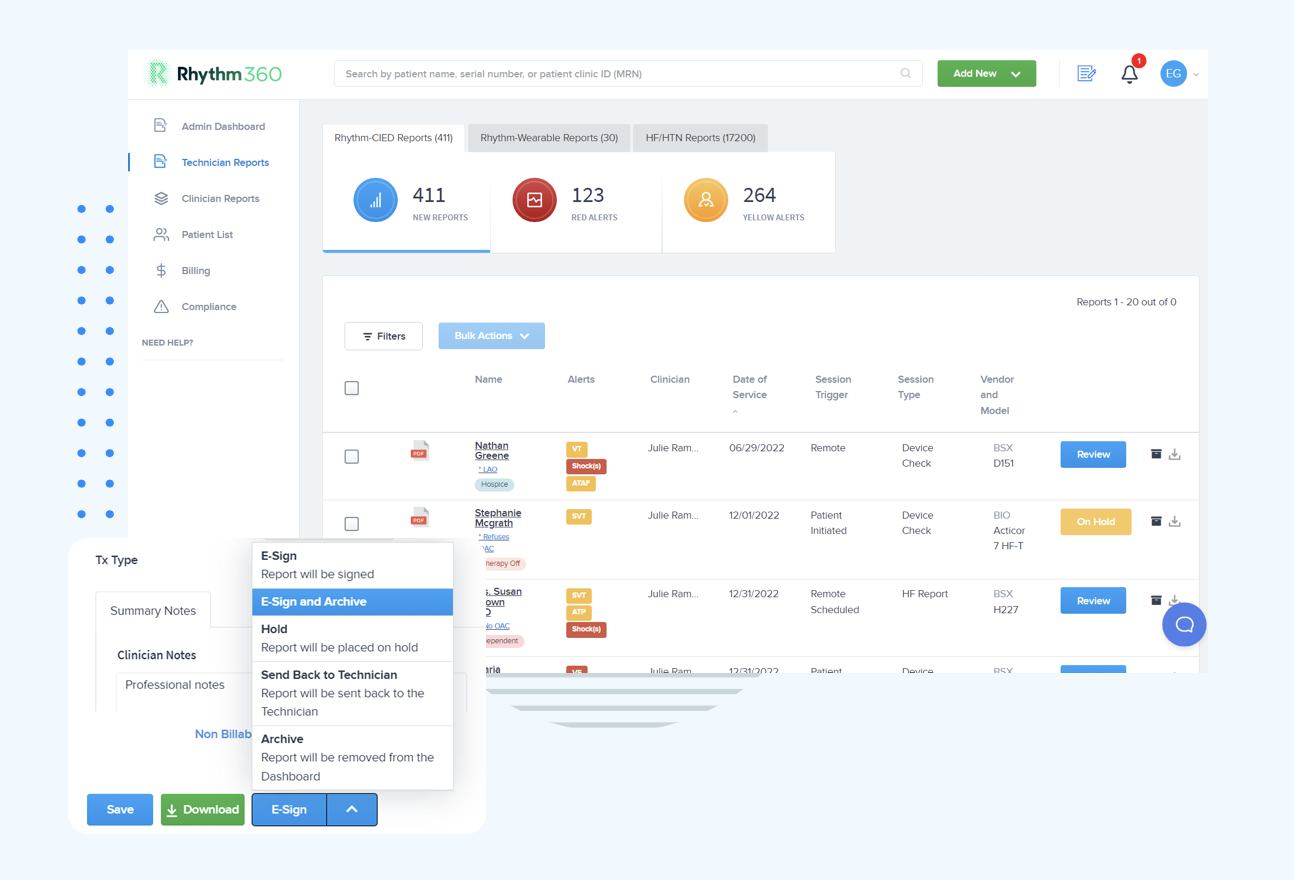
Hybrid environments that mix older and newer systems increase implementation complexity and make standardized training harder across teams. Rhythm360 removes this hybrid burden by serving as the single source of truth from day one. Teams avoid maintaining parallel workflows during transition, which keeps training focused and shorter.
Dr. Andrew Beaser, MD, Associate Professor of Medicine at the University of Chicago Medicine, described pre-implementation workflows as "a major challenge and incredibly difficult". That description matches the experience of many device clinics still operating on legacy infrastructure.
See how Rhythm360 onboards your team in days. Schedule a demo.
Practice administrators managing multi-vendor device populations face a billing compliance problem that training alone cannot fix. When data lives in separate OEM portals and staff must reconcile it manually before documenting CPT codes, billing errors and missed charges become structurally inevitable. Rhythm360 automates data ingestion, report generation, and CPT code capture, enabling practices to recover previously lost revenue through the automated CPT capture mentioned earlier.
The centralized administrative dashboard shows patient compliance status, outstanding alerts, and captured versus potential revenue based on CPT code requirements. Administrators no longer need to train staff on multiple portals or manual tracking of billable events. Dr. Upadhyay confirmed the downstream effect at the University of Chicago Medicine, stating, "We have improved billing and accountability for our patients after the integration."
Poor communication between systems produces administrative burdens, increased troubleshooting demands, and greater needs for ongoing staff education. Rhythm360's bi-directional EHR integrations with Epic, Cerner, Athenahealth, eClinicalWorks, and Greenway Health remove the manual transcription step that drives much of this ongoing education burden.
For electrophysiologists, NPs, PAs, and CCTs, the most acute training-adjacent problem involves managing alert volume from legacy systems that fail to separate actionable events from noise. Rhythm360's AI-powered alert triage filters non-actionable transmissions and surfaces clinically significant events first. This design delivers the dramatic response time improvements outlined earlier.
The secure, HIPAA-compliant mobile application lets clinicians review transmissions, sign reports, and coordinate care from any location. A critical arrhythmia flagged on a Saturday morning can receive attention by Saturday afternoon without requiring the clinician to sit at a workstation. This mobile-first approach also reduces role-specific retraining. The interface remains consistent across devices and locations, so staff do not need to learn separate workflows for in-clinic and on-call scenarios.
Dr. Upadhyay summarized the clinical value of centralized, trained data review, stating, "That was a big piece for us, to have an integrated review of data from trained personnel."
Reduce alert fatigue for your clinical team. Schedule a demo with Rhythm360.
Clinics moving from Paceart to a cloud platform can reduce onboarding friction by following a clear transition sequence. The checklist below outlines steps that accelerate time-to-productivity on a modern platform.
| Workflow Area | Paceart On-Premise | Rhythm360 Cloud | Documented Outcome |
|---|---|---|---|
| Annual Report Volume (scalability) | Limited by on-site infrastructure | Scales to enterprise volume | UCM managed 73,000+ reports annually (18,000+ per quarter) in 2025 |
| Critical Alert Response Time | Manual triage, variable | AI-prioritized, mobile-accessible | Up to 80% reduction in response time |
| Revenue Capture | Manual CPT documentation, gap-prone | Automated CPT capture and audit trail | Up to 300% increase in revenue generation |
| Data Transmissibility | Dependent on single OEM feed reliability | Redundant feeds, computer vision, AI extrapolation | >99.9% transmissibility |
The 2024–2025 acquisition of PaceArt by PaceMate has raised valid questions about the continuity of Medtronic-era support resources, documentation updates, and training materials for existing Paceart Optima users. Practices that rely on Medtronic Academy resources and on-premise documentation now face potential support gaps as ownership and development priorities shift.
Rhythm360 addresses data reliability through a different architecture. Instead of depending on a single OEM's server availability, the platform uses redundant data feeds as a fail-safe. If one manufacturer's server experiences downtime, patient data continuity remains intact. Combined with computer vision-based PDF parsing and AI-powered data extrapolation, this architecture achieves greater than 99.9% transmissibility across the full device population. Interoperability gaps between legacy and modern systems remain a persistent challenge in cardiovascular data management, and Rhythm360's multi-feed redundancy specifically targets those gaps.
Clinics comparing alternatives to Paceart Optima can use the following criteria as a vendor-neutral framework.
Paceart Optima is an on-premise cardiac device data management system developed by Medtronic. Device clinics, electrophysiology practices, and hospital-based cardiology departments use it to organize and track data from cardiac implantable electronic devices. Device technicians (CCTs), electrophysiologists, and clinic administrators are the primary users. In 2024–2025, PaceMate acquired PaceArt from Medtronic, which introduced uncertainty around long-term support and training resource availability for existing Paceart users.
Paceart Optima training timelines vary by role and clinic complexity. The structural challenge comes from on-premise systems that require staff to learn both the platform and the separate OEM portals it does not replace. When a clinic manages devices from multiple manufacturers, staff must stay proficient across several non-interoperable systems at once. As noted earlier, staff turnover resets the entire training cycle because on-premise systems require learning both the platform and separate OEM portals simultaneously. Updates and configuration changes often require additional training sessions, which makes a stable, low-maintenance training baseline difficult to achieve.
Cloud platforms like Rhythm360 consolidate all OEM data into a single dashboard, so staff no longer train on multiple portals. Bi-directional EHR integration removes the manual transcription step that drives a large share of ongoing retraining. AI-powered alert triage reduces cognitive load on clinical staff by filtering non-actionable transmissions before they appear in the queue. Clinics see a shorter initial onboarding period, measured in days to weeks, and a lower ongoing retraining burden because the platform updates automatically without forcing staff to relearn reconfigured workflows.
Rhythm360 supports automated documentation and capture for the primary remote monitoring CPT codes used in CIED management and chronic disease monitoring, including 93298, 93299, 99453, 99454, and 99457, among others. The platform generates auditable documentation automatically as qualifying events occur. This reduces manual tracking for billing staff and lowers the risk of missed or rejected claims. Practices implementing Rhythm360 have reported revenue increases of up to 300% through improved CPT code capture and better staff efficiency.
Yes. Rhythm360 offers deep, bi-directional integrations with Epic, Cerner, Athenahealth, eClinicalWorks, Greenway Health, and additional EHR systems via HL7. Bi-directional integration means data flows from the EHR into Rhythm360 and from Rhythm360 back into the EHR. This eliminates duplicate entry and keeps the patient record in both systems aligned. Integration setup occurs during onboarding, which typically completes within a few days to a few weeks.
Paceart user training functions as a recurring operational burden, not a one-time project. The burden scales with staff turnover, OEM complexity, and the rising volume of remote monitoring transmissions. Legacy on-premise workflows create fragmented logins, manual billing documentation, workstation dependency, and alert fatigue that additional training cannot fully resolve. Clinics need a platform that removes the conditions that make constant retraining necessary.
Rhythm360 delivers vendor-neutral, cloud-based cardiac remote monitoring with AI-powered alert triage, bi-directional EHR integration, automated CPT capture, and a HIPAA-compliant mobile application. Teams access all of this through a single, intuitive dashboard that onboards in days to weeks. The University of Chicago Medicine's experience, managing more than 73,000 reports annually through Rhythm360 in 2025 with improved billing accountability and earlier clinical interventions, shows what a modern platform can deliver at scale.