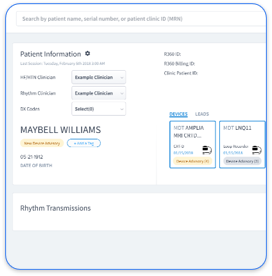
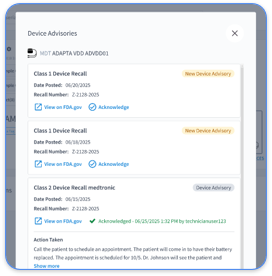
Remote pacemaker monitoring connects four operational layers: OEM infrastructure, the clinic EHR, payer billing rules, and the care team. Each OEM, including Medtronic (Carelink), Boston Scientific (Latitude), Abbott (Merlin.net), and Biotronik (Home Monitoring), maintains a proprietary portal that stores transmission data in a distinct format. Clinicians log into each portal separately, extract reports, and manually enter findings into the EHR, which multiplies effort with every additional manufacturer in the device population.
Care-team roles map to distinct workflow steps. Device technicians and certified cardiac technicians (CCTs) handle initial triage. Electrophysiologists or cardiologists complete the clinical review and sign reports. Revenue-cycle managers convert signed reports into billable CPT events. When these roles operate across disconnected systems, handoff errors accumulate and billable events go uncaptured.
Centralized monitoring models reduce staff workload compared with portal-by-portal review because a single normalized queue replaces parallel logins.
Medtronic Carelink is the largest single-manufacturer remote monitoring platform and often serves as the reference point clinicians encounter first. Carelink transmits device diagnostics, arrhythmia episodes, and lead integrity data on a scheduled or patient-initiated basis. Carelink data remains accessible only within the Carelink portal and does not natively push structured data into third-party EHRs or vendor-neutral dashboards without an integration layer.
The same architectural constraint applies to Boston Scientific Latitude, Abbott Merlin.net, and Biotronik Home Monitoring. Each portal uses proprietary data schemas, alert nomenclature, and report formats. A practice managing 600 patients across all four manufacturers receives four separate alert queues, four login credentials, and four documentation workflows, none of which share a common audit trail.
The four-portal problem becomes more acute during on-call coverage and weekend triage when clinicians need immediate access without a workstation. Mobile access to CIED data has become a clinical necessity for safe coverage. Manufacturer apps provide patient-facing transmission tools but do not give clinicians a consolidated review interface.
A vendor-neutral mobile application, such as the HIPAA-compliant app included in Rhythm360, allows electrophysiologists, NPs, and PAs to review transmissions, sign reports, and coordinate care from a smartphone regardless of device manufacturer. UCM's Gaurav A. Upadhyay, MD, FACC, FHRS, noted that "staffing was always an issue for our center, because our device clinic, like many other medical centers, had struggled with technician turnover and timely weekend coverage." A mobile-enabled, vendor-neutral platform directly addresses that coverage gap by separating clinical review from a fixed workstation.
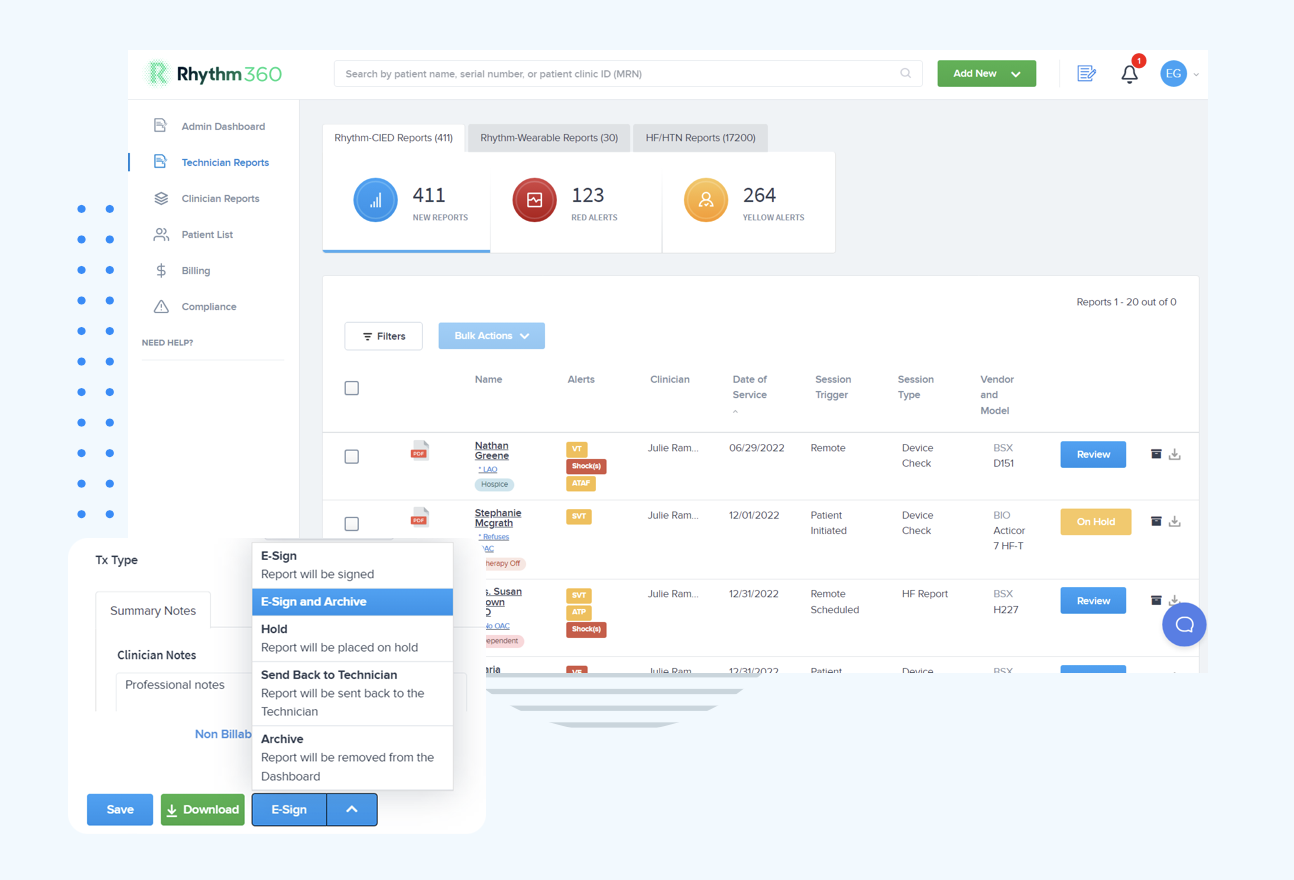
The table below compares the four major OEM remote monitoring portals on dimensions relevant to clinic operations, showing that despite differences in data access methods, all four share one core limitation: none can consolidate data across manufacturers. Reimbursement rates are not included because each manufacturer's portal supports the same CPT codes, and the billing gap arises from workflow execution, not portal eligibility.
| Dimension | Medtronic (Carelink) | Boston Scientific (Latitude) | Abbott (Merlin.net) | Biotronik (Home Monitoring) |
|---|---|---|---|---|
| Data access model | Proprietary portal, no native third-party push | Proprietary portal, limited API availability | Proprietary portal, HL7 export available | Proprietary portal, automatic daily transmissions |
| Alert nomenclature | Manufacturer-specific terminology | Manufacturer-specific terminology | Manufacturer-specific terminology | Manufacturer-specific terminology |
| EHR integration (native) | Limited, requires middleware | Limited, requires middleware | Partial HL7 support | Limited, requires middleware |
| Multi-vendor consolidation | Not supported | Not supported | Not supported | Not supported |
Because each portal uses distinct alert terminology and report formats, a clinic managing all four manufacturers cannot produce a unified audit trail or a single billable-event log without a normalization layer. Vendor-neutral platforms close this structural gap.
Accurate CPT coding forms the financial foundation of any remote monitoring program. The primary codes for CIED remote monitoring include:
For RPM chronic disease management in heart failure and hypertension, applicable codes include 99453 for patient education and setup, 99454 for device supply with at least two readings per 30 days, and 99457 for treatment management during the first 20 minutes monthly.
Remote monitoring codes follow Medicare rules on billing frequency and minimum monitoring periods. Payer policies vary and should be verified prior to treatment for limitations on diagnosis, coding, or site-of-service requirements. Automated documentation platforms enforce these windows programmatically and reduce claim denials from timing errors.
Vendor-neutral platforms introduce several strategic decisions that shape implementation approach and total cost of ownership.
Centralization vs. decentralization. Large health systems may distribute monitoring responsibilities across multiple sites. A vendor-neutral platform supports both models by providing a shared data layer while allowing site-specific alert routing and reporting permissions. This flexibility influences how leadership designs the broader program.
Build vs. buy. Building proprietary integrations with four OEM APIs requires sustained engineering resources and ongoing maintenance as manufacturer schemas change. A SaaS platform absorbs that maintenance burden and scales pricing with clinic volume, which directly affects long-term cost and internal IT workload.
Staffing models. UCM's Upadhyay emphasized, "That was a big piece for us, to have an integrated review of data from trained personnel." Practices can staff internally, use optional CCT oversight services, or blend both models depending on volume and on-call coverage requirements.
Integration complexity. Bi-directional EHR integration with Epic, Cerner, Athenahealth, eClinicalWorks, and Greenway Health via HL7 removes manual transcription and creates a single longitudinal patient record. Integration scope should be defined during vendor evaluation so teams understand timelines and dependencies.
A phased rollout for a vendor-neutral platform typically spans days to weeks, not months. Phase one covers EHR integration configuration and OEM data feed activation. Phase two covers staff training on the unified dashboard, alert threshold configuration, and CPT billing workflow setup. Phase three covers go-live monitoring, alert rule refinement, and revenue-cycle reconciliation.
Readiness criteria include a current device inventory by manufacturer, designated clinical and administrative platform owners, and confirmed EHR integration credentials.
Program performance should be tracked across four KPI categories so leaders can adjust workflows before issues escalate.
Quarterly reviews of these KPIs against baseline help practices identify alert threshold drift, staffing gaps, and billing rule changes before they create material clinical or financial risk. As Upadhyay noted earlier, improved billing accountability translates directly to measurable revenue gains when combined with systematic CPT capture.
Compare your program's performance against Rhythm360 benchmark data in a personalized demo.
Implementation timelines for Rhythm360 range from a few days to a few weeks depending on EHR integration complexity, the number of OEM data feeds activated, and the size of the existing device population. The process follows a phased structure in which data feed activation and EHR integration configuration occur first. Staff training and alert threshold setup follow, then go-live with ongoing optimization support. Practices do not need to pause monitoring during the transition because OEM portals remain accessible until the new platform is fully validated.
Rhythm360 is a HIPAA-compliant, cloud-based platform with end-to-end encryption for data in transit and at rest. All patient interactions, including automated alerts, manual phone calls logged through the integrated communication hub, and clinician report signatures, are stored with timestamped audit trails. Role-based access controls limit data visibility to authorized care-team members. The mobile application uses the same security architecture as the web platform so remote access does not introduce additional compliance risk.
Consolidation redistributes technician effort rather than eliminating it. Staff who previously spent hours logging into multiple OEM portals and manually transcribing data can redirect that time to clinical triage, patient communication, and quality improvement. Practices with high transmission volumes can supplement internal staff with optional 24/7/365 CCT oversight services. The net effect usually includes higher review capacity per technician, reduced burnout from administrative tasks, and improved retention, not headcount reduction.
Revenue impact depends on device mix and patient volume. For ICD-heavy populations, 93295 for the professional component and 93296 for the technical component, both on 90-day cycles, are the highest-frequency codes. For practices with significant ILR or implantable monitor populations, 93297 and 93298 on 30-day cycles generate recurring monthly revenue. Adding RPM service lines for heart failure and hypertension patients using 99453, 99454, and 99457 creates additional recurring revenue streams that do not require CIED implantation. Automated billing-window enforcement ensures that every eligible transmission is captured within the correct reporting period, which is where many manual programs lose revenue.