Last updated: July 13, 2026
The checklist below maps each required documentation element to its associated CPT code family and audit risk level, based on CMS remote monitoring coverage policy, 2026 cardiac remote monitoring CPT guidance, and 2026 RPM compliance benchmarks. Five of the twelve elements carry high audit risk, so focus early audit efforts on these items to reduce denials and OIG exposure.
| Documentation Element | Associated CPT Code(s) | Audit Risk if Missing | Notes |
|---|---|---|---|
| Written patient consent with cost-sharing disclosure and single-provider acknowledgment | All remote monitoring codes | High | Re-affirm annually; store in discrete EHR field |
| Signed physician order specifying qualifying chronic condition and monitoring type | 93294, 93295, 93296, 99454 | High | Annual renewal recommended |
| Device provisioning record: date, device type, serial number, and patient education log | 99453 | High | Required before any supply or management code is billed |
| Patient demographics, device type, and manufacturer on file | 93294, 93295, 93296, 93297, 93298 | Medium | Required for all CIED interrogation code families |
| Monitoring period dates with device-specific billing frequency confirmed (pacemaker: 90 days; ICD: 90 days; ILR: 30 days) | 93294, 93295, 93296, 93297, 93298 | High | Monthly billing of pacemakers/ICDs produces frequency denials |
| Automated transmission logs showing date, reading type, and data receipt for each qualifying day | 99454, 93296 | High | First items auditors request; archive in EHR or secure repository |
| 16-day transmission threshold confirmation for CPT 99454 (or 2–15 days for new CPT 99445) | 99454, 99445 | High | CPT 99445 added in 2026 for shorter monitoring windows |
| Clinician interpretation note addressing device function, programmed parameters, and actionable findings | 93294, 93295, 93297, 93298 | High | Must be signed by eligible provider under supervising NPI |
| Clinical time log with date, duration, and activity entries for treatment management | 99457, 99458, 99470 | High | CPT 99470 added in 2026 for 10–19 minute management windows |
| Interactive communication record (date, mode, summary) — asynchronous texting does not qualify | 99457, 99458 | High | At least one live two-way interaction per billing period required |
| ICD-10 diagnosis codes tied to qualifying condition, billing provider NPI, and 16-day threshold date | 99454 | Medium | Required on every claim submission |
| Single-practitioner rule verification confirming no other provider billed 99453/99454 in the preceding 30-day window | 99453, 99454 | High | OIG flagged multi-practice billing for same patient as a scrutiny pattern |
The quarterly scoring matrix below translates this checklist into measurable targets and clear remediation triggers. The table highlights where your program falls short so you can focus training, workflow changes, and technology support on the right domains.
| Compliance Domain | Target Benchmark | Audit Sample Method | Remediation Trigger |
|---|---|---|---|
| Consent coverage | 100% | Random 10–20% of active patients | Any gap triggers immediate outreach |
| Order currency | 100% | Random 10–20% of active patients | Expired orders halted from billing |
| Time documentation completeness | ≥95% | Random 10–20% of billed management claims | Below 95% triggers staff retraining |
| 16-day transmission achievement rate | ≥80% | All active 99454 patients | Flag shortfalls by day 10 for staff intervention |
| Claim denial rate | <5% | All submitted remote monitoring claims | Root-cause analysis on any denial cluster |
| Overall documentation compliance score | ≥95% | Composite across all 12 checklist elements | Below 95% triggers compliance committee review |
See how Rhythm360 automates this scoring and surfaces compliance gaps in real time.
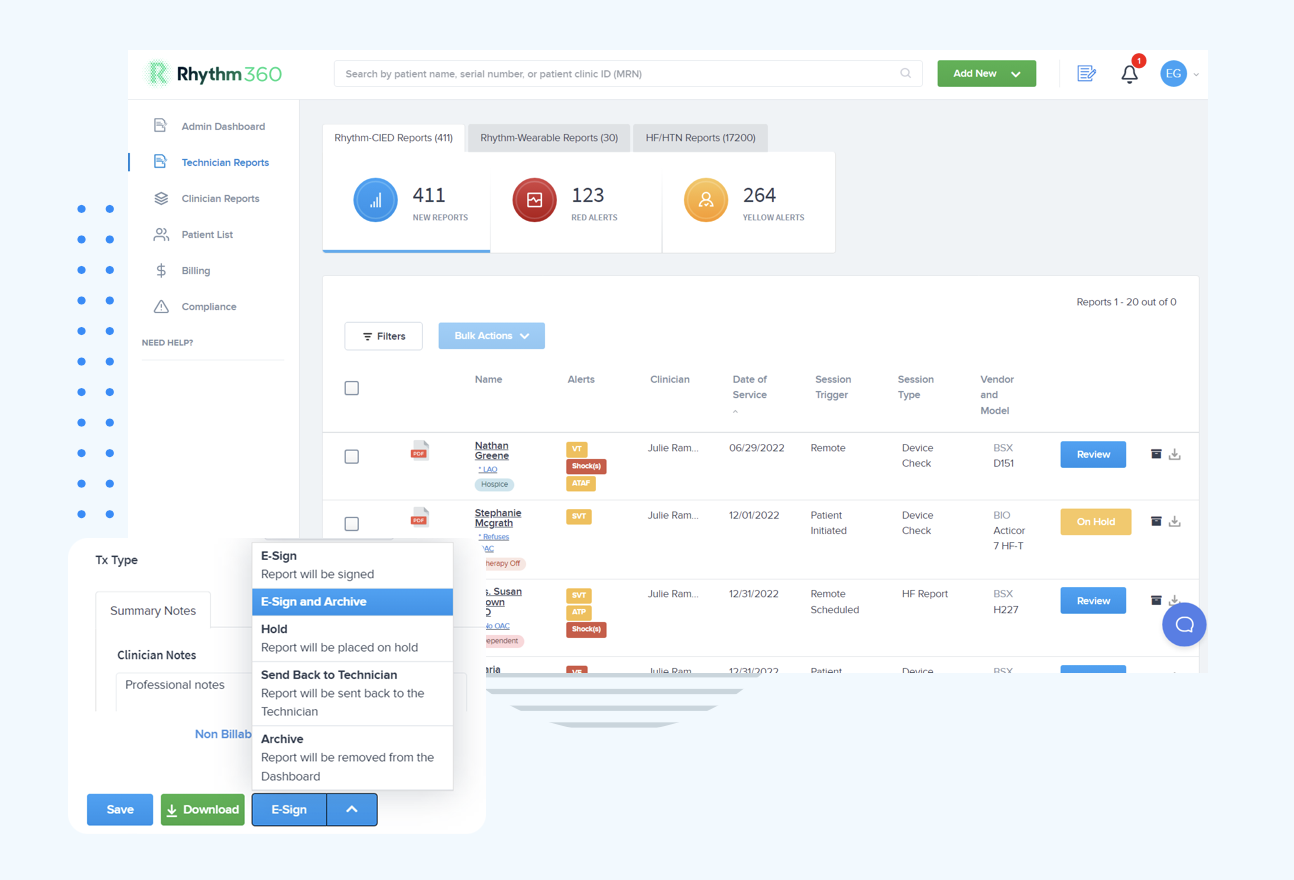
This end-to-end workflow connects EHR data exchange points and consolidates transmissions from Medtronic, Boston Scientific, Abbott, and Biotronik portals into a single auditable record.
Walk through this workflow with a Rhythm360 specialist and see how each step runs inside a single platform.
The HHS OIG’s enforcement activity highlights recurring gaps in remote CIED monitoring programs. OIG’s September 2024 evaluation report found that 43% of Medicare beneficiaries receiving RPM services between 2019 and 2022 did not receive all three required service components: patient education and setup, device supply, and monthly treatment management. These four patterns, missed transmissions, incomplete reports, consent gaps, and billing errors, account for most service-component failures identified in that report.
Missed transmissions and sub-threshold transmission days:
Incomplete device interrogation reports:
Missing or expired patient consent:
Billing documentation gaps and code misapplication:
Strong programs track outcomes that go beyond transmission volume and raw workload. Many clinics still focus on counts alone, which hides quality issues. The indicators below provide a more complete operational picture while using the same benchmarks and thresholds defined in the audit framework above.
| Metric | Industry Benchmark | Measurement Frequency |
|---|---|---|
| Claim denial rate | <5% | Monthly |
| 16-day transmission achievement rate | ≥80% of active patients | Monthly |
| Critical alert response time | Up to 80% reduction achievable with platform automation | Continuous / real-time |
| Patient transmission compliance rate | Target well above 16-day minimum; ideally 20+ days per period | Monthly per patient |
| Time documentation completeness | ≥95% (aligned with quarterly audit benchmark) | Monthly |
| Consent coverage | 100% | Quarterly audit |
| Overall documentation compliance score | ≥95% across all 12 checklist elements | Quarterly audit |
University of Chicago Medicine, operating on Rhythm360, reviewed more than 73,000 reports annually in calendar year 2025, averaging more than 18,000 reports per quarter, which shows that these metrics remain achievable at high volume with the right infrastructure. As noted in that implementation review, “We have improved billing and accountability for our patients after the integration.”
Explore Rhythm360’s quality dashboard in a live demo and see these metrics across your entire CIED population.
Multi-vendor device clinics face a core compliance challenge: fragmented data. Each CIED manufacturer has developed proprietary nomenclature, technical standards, and communication protocols to describe similar if not identical features and functionalities, and traditional EHRs are not well suited to managing CIED data. Clinics managing Medtronic, Boston Scientific, Abbott, and Biotronik devices simultaneously must otherwise log into separate, non-interoperable portals, which creates documentation silos and raises the risk of missed transmissions.
Rhythm360 addresses this challenge through a multi-layer data ingestion architecture. The platform connects to all major OEM portals via API, HL7, and XML feeds, and applies computer vision (OCR) to parse unstructured PDF reports where structured feeds are unavailable. An AI-powered gap-filling layer cross-references data for fidelity and identifies connectivity issues before they become documentation deficiencies. A redundant data feed system acts as a fail-safe when an OEM server experiences downtime. The result is greater than 99.9% transmissibility across the full device population, a reliability level that supports the continuous audit trail required under CMS remote monitoring coverage policy and the 2023 HRS/EHRA/APHRS/LAHRS consensus statement.
All data handling occurs within a HIPAA-compliant infrastructure. Vendor contracts include HIPAA business associate agreements, and the platform maintains SOC 2-aligned security controls covering access management, data integrity, and breach notification protocols consistent with HIPAA Privacy, Security, and Breach Notification Rule requirements for remote patient monitoring.
Clinics must maintain documentation compliance even outside business hours. Rhythm360’s secure, HIPAA-compliant mobile application allows electrophysiologists, cardiologists, nurse practitioners, and physician assistants to review incoming transmissions, evaluate AI-prioritized alerts, sign interpretation reports, and coordinate care from any location. All actions taken through the mobile interface are timestamped and written to the patient audit trail, which satisfies the interactive communication documentation standard required under CPT 99457 and 99458.
Asynchronous texting does not satisfy the interactive communication standard, so the mobile platform supports audio and video encounters that are automatically logged into the EHR encounter record.
Billing frequency for remote CIED monitoring is device-specific and not uniform across device types. Pacemakers are billed every 90 days using CPT 93294 for the physician interpretation and report component and CPT 93296 for the technical component. ICDs follow a similar cycle using CPT 93295 and 93296. Implantable loop recorders and cardiac monitors require monthly billing, with coding that varies by payer. Applying a monthly billing cycle to pacemakers or ICDs produces frequency-based claim denials. The 2026 HRS/AHA/APHRS/EHRA/IDSA/LAHRS/PACES/STS expert consensus statement establishes mandatory remote monitoring as a clinical standard, meaning these billing cycles are not optional and represent the minimum follow-up cadence for compliant care.
CMS and OIG guidance require that raw transmission logs, signed interpretation reports, consent records, physician orders, and billing documentation be retained and accessible for auditor review. Best practice is to maintain an audit binder containing policies and procedures, vendor contracts with HIPAA business associate agreements,