Talk with Rhythm360 About Remote Monitoring
The table below reconciles the three schedules that govern pacemaker follow-up so you can see which interval and documentation apply to each visit type.
| Visit Type | Interval | Source | Documentation Requirement |
|---|---|---|---|
| Initial check | 2–12 weeks post-implant | HRS/EHRA expert consensus statement | Device type, lead configuration, baseline parameters, programmed settings, battery status, wound assessment |
| Routine remote monitoring | Every 3–12 months | 2023 HRS/EHRA/APHRS/LAHRS consensus; CMS NCD 20.8.1 | Service modality, date range, data reviewed, battery status, lead integrity, arrhythmia log, clinically relevant findings, interpretation, and management plan |
| Routine in-clinic interrogation | Every 6–12 months, may be extended to up to 24 months with continuous remote monitoring, with at least annual in-person | 2023 HRS/EHRA/APHRS/LAHRS consensus; CMS NCD 20.8.1 | Comprehensive diagnostic check including threshold testing, impedance, percent pacing, arrhythmia log review, programming changes with rationale, medical necessity statement |
| ERI (elective replacement indicator) | Every 1–3 months | 2023 HRS/EHRA/APHRS/LAHRS consensus | Battery longevity estimate, ERI/RRT status, generator replacement scheduling rationale, escalation trigger documentation |
See How Rhythm360 Reconciles Your Monitoring Schedule
Each interval in the reconciled schedule corresponds to a distinct clinical purpose. The following definitions are drawn from the 2023 HRS/EHRA/APHRS/LAHRS consensus.
The initial post-implant check occurs 2–12 weeks after implantation for patients with a new pacemaker, ICD, or CRT device. This visit establishes baseline lead parameters, confirms appropriate sensing and pacing thresholds, and identifies early complications before the patient enters the routine monitoring cycle.
Scheduled remote transmissions every 3–12 months capture interval battery status, lead impedance trends, and arrhythmia burden between in-person visits. These transmissions support earlier detection of actionable events without requiring the patient to present in clinic.
For pacemakers, consensus guidelines recommend routine in-clinic interrogation every 6–12 months. In real-world practice, the most common frequency is once a year, with every 6 months the second most common. In-clinic interrogation provides comprehensive diagnostic evaluation, including threshold testing and reprogramming capability that remote monitoring cannot replicate. In stable pacemaker patients on continuous daily remote monitoring, in-person visit intervals may extend to 24 months, although at least one in-person consultation per year remains recommended and coverage rules may still require annual visits.
Once the elective replacement indicator is reached, remote transmission frequency increases to every 1–3 months as a pacemaker approaches elective replacement. In-person follow-up occurs every 3 months once battery status reaches One-Year-Remaining. Generator replacement should be scheduled promptly.
The clinical intervals above describe what is medically appropriate, and coverage rules add a second layer that governs payment. CMS coverage rules approach pacemaker follow-up from that perspective.
CMS NCD 20.8.1 assigns scheduling authority to the treating physician. The decision about how often a patient’s pacemaker should be monitored rests with that physician, who can account for the patient’s individual condition and circumstances. The NCD also directs Medicare Administrative Contractors to include frequency data on both clinic visit monitoring and transtelephonic monitoring when they evaluate the reasonableness of monitoring services. CMS therefore audits the combined schedule across modalities rather than either modality alone.
The clinical schedule in the 2023 HRS/EHRA/APHRS/LAHRS consensus is interval-based and patient-specific, and it permits extension to 24 months for stable patients on continuous remote monitoring. CMS coverage criteria are evaluated in aggregate across both modalities and are assessed for reasonableness instead of strict adherence to a fixed calendar.
The resolution for audit defense is to document both the clinical rationale for the interval chosen and the coverage criteria for the visit billed. A note that records only the transmission date without a medical necessity statement satisfies neither standard. This gap is why practice administrators defending a scheduling protocol in an audit need documentation that answers two questions at once: why this interval was clinically appropriate, and why this visit type was billed.
The following clinical triggers override the routine schedule and require escalation, per the 2023 HRS/EHRA/APHRS/LAHRS consensus:
The battery-longevity trigger is the most operationally specific. According to the 2023 HRS/EHRA/APHRS/LAHRS consensus, remote transmission frequency increases to every 1–3 months as a pacemaker approaches elective replacement, and in-person follow-up occurs every 3 months once battery status reaches One-Year-Remaining. Manufacturer instructions for use specify the same threshold. For example, Boston Scientific’s instructions for use for the ACCOLADE family specify that the next in-person follow-up should be scheduled every 12 months, or every 3 months once battery status reaches One-Year-Remaining.
Device alerts provide the operational signal for most of these triggers. Red alerts, including low battery voltage, pacemaker in safety mode, pacing impedance out of range, and signs of lead damage, require rapid intervention. Yellow alerts, including battery replacement recommendation, pacing thresholds out of range, and elevated AF burden, permit deferred but scheduled response. The escalation framework should appear in the clinic’s remote monitoring protocol and should be referenced in the patient record when a trigger is acted upon.
Remote monitoring captures battery status, lead impedance trends, arrhythmia burden, and device-detected events between scheduled visits. Transmissions arrive either on a scheduled basis or as alert-driven events when pre-specified thresholds are crossed. Per the 2023 HRS/EHRA/APHRS/LAHRS consensus, remote monitoring is the recommended follow-up method for patients under manufacturer safety advisory status because it enables accurate, efficient, and timely identification of abnormal parameters without repeated in-person visits.
In-office interrogation provides capabilities that remote monitoring cannot replicate. These visits allow comprehensive diagnostic evaluation, direct threshold testing, pacing impedance measurement in both unipolar and bipolar modes, and reprogramming. For devices that cannot automatically measure pacing threshold and intracardiac signal amplitude remotely, these parameters must be obtained in person using a programmer.
Remote monitoring supplements in-person evaluation rather than replacing it when threshold testing, reprogramming, or a comprehensive diagnostic evaluation is clinically required. The 2023 HRS/EHRA/APHRS/LAHRS consensus specifies that at least one in-person evaluation per year is required even when continuous remote monitoring is in place.
Each visit type maps to a distinct code cycle, and documentation must support the full monitoring period. Pacemakers and ICDs use a 90-day cycle:
Per CMS cardiac rhythm device evaluation billing guidance, these codes describe services furnished over a monitoring period of up to 90 days rather than payment for each individual transmission. Scheduled and alert transmissions within the same period are not separately reported.
Physiologic monitors and loop recorders use a 30-day cycle:
For in-person interrogation without programming, CPT 93288 applies to dual-lead pacemakers. When documentation supports a true programming evaluation, CPT 93280 is selected instead. Before reporting both remote and in-person evaluations during the same monitoring cycle, verify current CPT instructions, National Correct Coding Initiative edits, and payer-specific billing policies.
For detailed code-level education, contact the Rhythm360 team.
Get Help with CPT Billing for Device Monitoring
The in-person visit cadence follows the reconciled schedule and the escalation triggers described above. For stable patients on continuous remote monitoring, the 2023 HRS/EHRA/APHRS/LAHRS consensus permits extending the in-clinic interval to 24 months, although at least one in-person evaluation per year remains the standard. Remote monitoring supplements that annual in-person visit rather than replacing it. When any escalation trigger is present, the in-person interval shortens accordingly, independent of the routine schedule.
Device clinic teams field recurring patient questions, and clear, consistent answers support both safety and satisfaction.
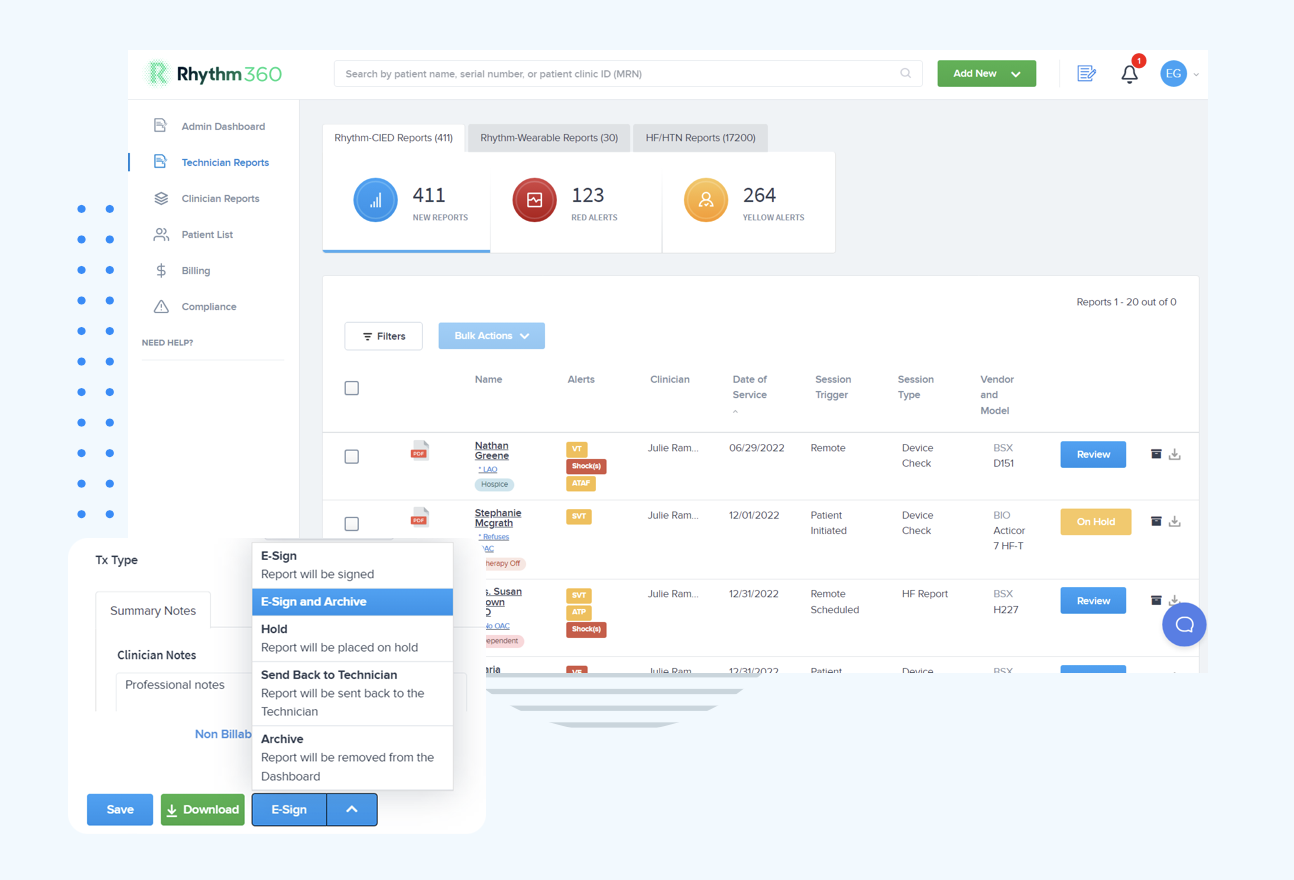
Rhythm360 is a vendor-neutral, HIPAA-compliant, cloud-based remote patient monitoring platform that unifies CIED data from all major manufacturers into a single source of truth. The platform ingests and normalizes data across manufacturers instead of requiring device clinic staff to log into separate OEM portals for each patient. It parses API, HL7, XML, and PDF feeds through computer vision, and redundant data feeds keep transmissibility above 99.9%.
The platform automates data ingestion, report generation, and billing documentation. Its AI-powered alert triage system filters non-actionable transmissions and prioritizes clinically significant events, including low battery alerts, impedance changes, and arrhythmia burden thresholds. These capabilities reduce critical alert response times by up to 80%. Automated CPT code capture tracks device-specific billing cycles, including the 90-day cycle for pacemakers and ICDs and the 30-day cycle for physiologic monitors and loop recorders, which helps practices capture up to 300% more revenue through improved code capture.
Pacemaker monitoring frequency guidelines sit at the intersection of a clinical guideline, a coverage determination, and a battery clock. The 2023 HRS/EHRA/APHRS/LAHRS consensus establishes the clinical intervals. CMS NCD 20.8.1 governs coverage reasonableness across both remote and in-clinic modalities. The manufacturer battery-longevity schedule sets the escalation trigger when estimated longevity reaches approximately one year. Defending a scheduling protocol in an audit requires documentation that satisfies all three simultaneously, including the clinical rationale for the interval chosen, the coverage criteria for the visit billed, and the device status that determined the monitoring tier.
Rhythm360 supports this work by unifying CIED data into a single platform, automating documentation, and surfacing escalation triggers before they appear as audit findings.
See Rhythm360 in Action for Your Device Clinic