

Last updated: July 14, 2026
Clinic administrators need to quantify the cost of the status quo before evaluating any platform. Three compounding problems define the current landscape.
Factor 1 — Multiple Logins and Staff Burnout
Medtronic CareLink is a closed ecosystem built exclusively for Medtronic devices. Abbott Merlin, Boston Scientific Latitude, and Biotronik's portal work the same way. Once a practice implants devices from more than one manufacturer, staff must maintain separate credentials and workflows for each system. There is no cross-portal data reconciliation, no unified patient view, and no shared alert queue. The administrative burden grows heavier as device populations expand.
Factor 2 — Alert Fatigue and Missed Critical Events
Device clinics process a high volume of transmissions each year, and much of that volume is clinically non-relevant. That noise creates real conditions for a dangerous miss. A cardiac device specialist described the risk this way: "the last thing we want is to expose patients to bad patient care and expose our doctors and our APPs to maybe missing something that's very clinically relevant that could compromise patient care."
Factor 3 — Billing Gaps and CPT Revenue Leakage
Remote CIED monitoring generates billable events under a specific set of CPT codes. The primary codes include 93294 (single/dual-chamber pacemaker, 90-day period), 93295 (ICD, 90-day period), 93296 (technical component), 93297 (implantable loop recorder, 30-day period), and 93298 (subcutaneous cardiac rhythm monitor, 30-day period). Each code carries strict documentation requirements, including patient demographics, device type and manufacturer, dates of the monitoring period, and a clinician interpretation note addressing device function, programmed parameters, and actionable findings. Meeting these requirements manually across a mixed-device population takes significant staff time. That burden is why practices without automated tracking routinely miss billable windows, and why many leave a meaningful share of eligible chronic care revenue unbilled.
Factor 4 — A Single Dashboard Across All Major Manufacturers
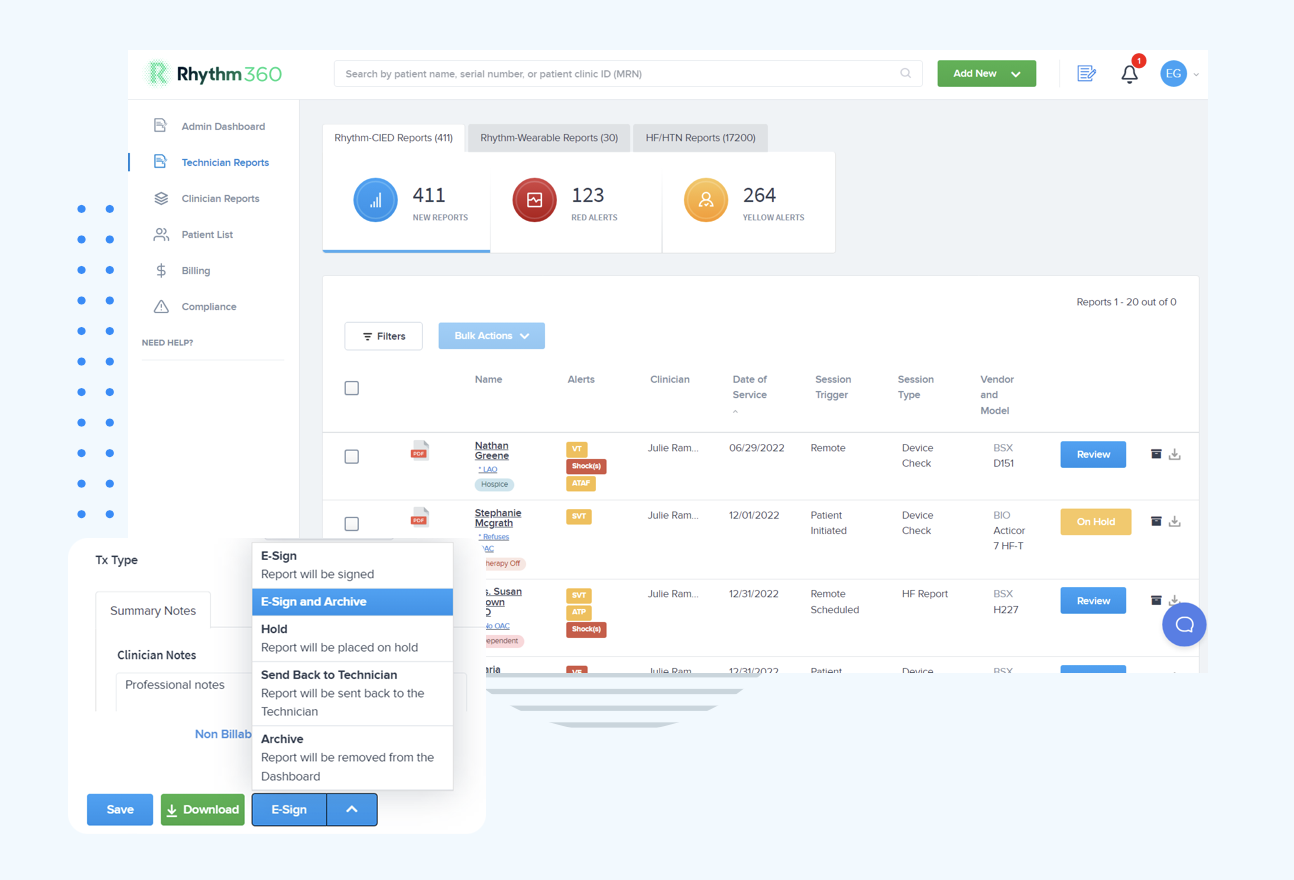
Rhythm360 by RhythmScience is a cloud-based, HIPAA-compliant platform. It ingests data from Medtronic, Abbott, Boston Scientific, Biotronik, and other manufacturers through APIs, HL7, XML, and PDF parsing via computer vision. A device technician logs into one dashboard to view a complete, normalized report for any patient, regardless of implanted device brand. Separate OEM portal credentials are no longer needed. Rhythm360 aggregates all device data into a single source of truth, with bi-directional EHR integration and automated CPT documentation built into the same workflow.
Factor 5 — AI-Powered Alert Triage
Rhythm360's AI-driven alert triage system filters non-actionable transmissions and surfaces clinically significant events, such as new-onset AFib, ventricular tachycardia, lead malfunction, and ERI/RRT indicators, as prioritized notifications. This reduces the noise clinicians must sift through daily. The platform also supports optional 24/7/365 oversight by certified cardiac technicians supervised by physicians, adding a human layer of triage for practices that want it. Andrew Beaser, MD, Associate Professor of Medicine at the University of Chicago Medicine, observed after implementing Rhythm360: "Decision support, including AI-assisted decision support, will become increasingly important as data volumes grow."
The metrics below summarize the clinical and financial gains clinics report after adopting Rhythm360, covering data reliability, alert response speed, and revenue capture.
| Metric | Rhythm360 Performance | How It Is Achieved | Clinical / Financial Impact |
|---|---|---|---|
| Data Transmissibility | >99.9% | Redundant data feeds, computer vision OCR, AI-powered gap extrapolation | Clinicians make decisions on the most complete data available |
| Critical Alert Response Time | Up to 80% faster | AI triage plus optional CCT oversight and mobile app access | Earlier intervention for AFib, VT, device malfunction |
| Revenue Increase | Up to 300% | Automated CPT documentation (93294-93298, 99453-99457), billing compliance tracking | Captures previously lost billable events across the full device population |
| EHR Integration | Bi-directional | Epic, Cerner, Athenahealth, eClinicalWorks, Greenway Health via HL7/FHIR | Eliminates manual transcription; auto-pushes encounter notes and reports |
| Mobile Access | Full HIPAA-compliant app | Secure mobile application for transmission review, report signing, care coordination | Continuous coverage including weekends and after-hours |
| Implementation Timeline | Days to weeks | Streamlined onboarding including EHR integration setup | Minimal disruption to existing clinic operations |
Factor 6 — Automated CPT Documentation and Revenue Lift
Rhythm360 automates the tracking and documentation needed to bill remote CIED monitoring codes correctly. The platform monitors each patient's transmission history against the time-window requirements for codes such as 93294 and 93295 (90-day periods) and 93297 and 93298 (30-day periods). It flags documentation gaps before they become denied claims and generates compliant interpretation notes tied to each billable event.
The revenue impact at the practice level is measurable. A cardiology practice can capture significant annual recurring revenue from remote CIED monitoring once billing under the applicable CPT codes runs smoothly. Practices without systematized billing workflows leave real revenue uncaptured. Rhythm360's automated CPT capture has helped practices achieve revenue gains as noted earlier, up to 300%, through optimized billing, improved staff efficiency, and the addition of RPM service lines for heart failure and hypertension management under codes 99453, 99454, and 99457.
Gaurav A. Upadhyay, MD, at the University of Chicago Medicine, confirmed the billing impact directly: "We have improved billing and accountability for our patients after the integration."
Factor 7 — Weekend Mobile Access and Prevention of Adverse Events
Critical arrhythmias do not occur on a schedule. Rhythm360's HIPAA-compliant mobile application lets clinicians review transmissions, sign reports, and coordinate care from a smartphone at any time. When the platform flags new-onset AFib on a Saturday morning, the treating clinician can start anticoagulation protocols that same day, instead of waiting for Monday's clinic hours or a scheduled 90-day visit.
Andrew Beaser, MD, at UCM described this shift in care delivery: "We are able to address these issues earlier; rather than waiting for a 3-month visit, we can call patients in for evaluation."
The University of Chicago Medicine reviewed more than 73,000 reports annually through Rhythm360 in 2025, averaging over 18,000 reports per quarter. That volume shows the platform can scale for high-acuity academic medical centers without degrading alert quality or response times.
Switching platforms is a legitimate operational concern for clinic administrators. Rhythm360's implementation process, including EHR integration, typically finishes in days to a few weeks, not months. The platform supports bi-directional integration with Epic, Cerner, Athenahealth, eClinicalWorks, and Greenway Health, among others, using HL7 and FHIR protocols. Data flows both ways: patient demographics, device records, and ordering provider data pull into Rhythm360, while encounter notes, alert documentation, time logs, and monthly summary reports push automatically back into the EHR patient chart. This architecture eliminates the manual transcription step that eats up staff time in practices still relying on OEM portals and paper-based workflows.
Once a clinic sees how quickly implementation moves, the next question is usually cost. Rhythm360's pricing structure is built to match that pace of growth.
Rhythm360 uses a SaaS pricing model that scales with clinic size and platform usage. There are no rigid per-seat fees disconnected from actual utilization. As a practice's monitored device population grows, whether from organic patient volume or new RPM service lines for heart failure and hypertension, the pricing structure adjusts accordingly. This model removes the financial barrier to expanding monitoring programs and lets practices capture incremental CPT revenue without a matching spike in platform costs.
Clinics considering this move often have similar questions about scope and fit. The answers below cover the most common ones.
Rhythm360 is a vendor-neutral platform that ingests data from Medtronic, Abbott, Boston Scientific, Biotronik, and other manufacturers. It uses direct APIs, HL7 feeds, XML data streams, and computer vision-based PDF parsing to normalize data from each OEM into one unified dashboard. Practices managing mixed-device inventories skip separate OEM portal logins for routine monitoring, report generation, or billing documentation.
Medtronic CareLink is built for Medtronic devices only and does not aggregate data from other manufacturers. Clinics managing patients across multiple OEMs need supplemental portals for each additional manufacturer, which creates fragmented workflows and separate alert queues. Rhythm360 is designed specifically for multi-vendor environments, consolidating all device data into one platform with unified alerting, automated CPT documentation, bi-directional EHR integration, and a HIPAA-compliant mobile app.
A 200-device practice that fully operationalizes billing under codes 93294-93298 can capture $80,000 to $120,000 in annual recurring remote monitoring revenue. Rhythm360 does not manage a practice's revenue cycle directly. It provides the documentation infrastructure and workflow automation that lets billing staff capture eligible reimbursement accurately and consistently.
Onboarding, including EHR integration, typically takes a few days to a few weeks. Data flows automatically in both directions without manual transcription by clinic staff. This timeline is significantly shorter than enterprise-scale RPM deployments built from scratch, which can require nine to twelve months for full multi-device, multi-condition configurations.
The seven factors above define the decision framework for any EP clinic evaluating remote CIED monitoring platforms in 2026: multiple logins and staff burnout, alert fatigue from irrelevant transmissions, CPT billing gaps, single-dashboard multi-vendor aggregation, AI-powered triage, automated revenue documentation, and mobile clinical access. Medtronic CareLink and other OEM-specific portals were not built to solve these problems for mixed-device populations. Rhythm360 was.
Rhythm360 delivers greater than 99.9% data transmissibility, faster critical alert response times, and a documented track record of revenue improvement up to 300%. That combination gives multi-vendor cardiology practices the operational and clinical infrastructure they need to monitor patients safely, document compliantly, and grow sustainably.
See Rhythm360 in your clinical environment. Schedule a demo.




