Last updated: February 4, 2026
A clear understanding of the 2026 CPT code updates forms the foundation of stronger pacemaker monitoring revenue. CPT 99453 provides about $22 for remote monitoring initial setup and patient education, and CPT 93298 covers interrogation device evaluation for up to 30 days from implanted subcutaneous cardiac rhythm monitors.
CPT Code | Description | 2026 Medicare Rate | Rhythm360 Benefit |
93298 | Remote device interrogation (30 days) | $45 | Auto-capture across all OEMs |
93299 | Remote monitoring evaluation | $32 | AI-powered documentation |
99454 | Device supply with daily recordings | $50 | >99.9% transmissibility |
Key actions include reviewing at least 16 days of data in each 30-day billing cycle, documenting device interrogation clearly, and keeping patient consent records current. Practices that track CPT codes systematically often recover about 30% of previously missed claims. Frequent errors involve misusing modifiers such as -59 and failing to separate remote from in-person evaluations.
A focused workflow audit exposes hidden revenue leakage across multi-OEM environments. Build a checklist that documents portal usage, staff time per device manufacturer, alert response steps, and billing capture rates for each CPT category.
Most audits reveal 20-40% revenue leakage from missed billing, duplicate work across OEM portals, and slow responses to critical alerts caused by manual processes. Staff often spend 3-4 hours each day moving between Medtronic CareLink, Abbott Merlin.net, and Boston Scientific LATITUDE.
Manual spreadsheets frequently miss billable events and lack audit trails for compliance. Rhythm360's bi-directional EHR integration highlights workflow gaps automatically and shows missed revenue opportunities across all device manufacturers in real time.
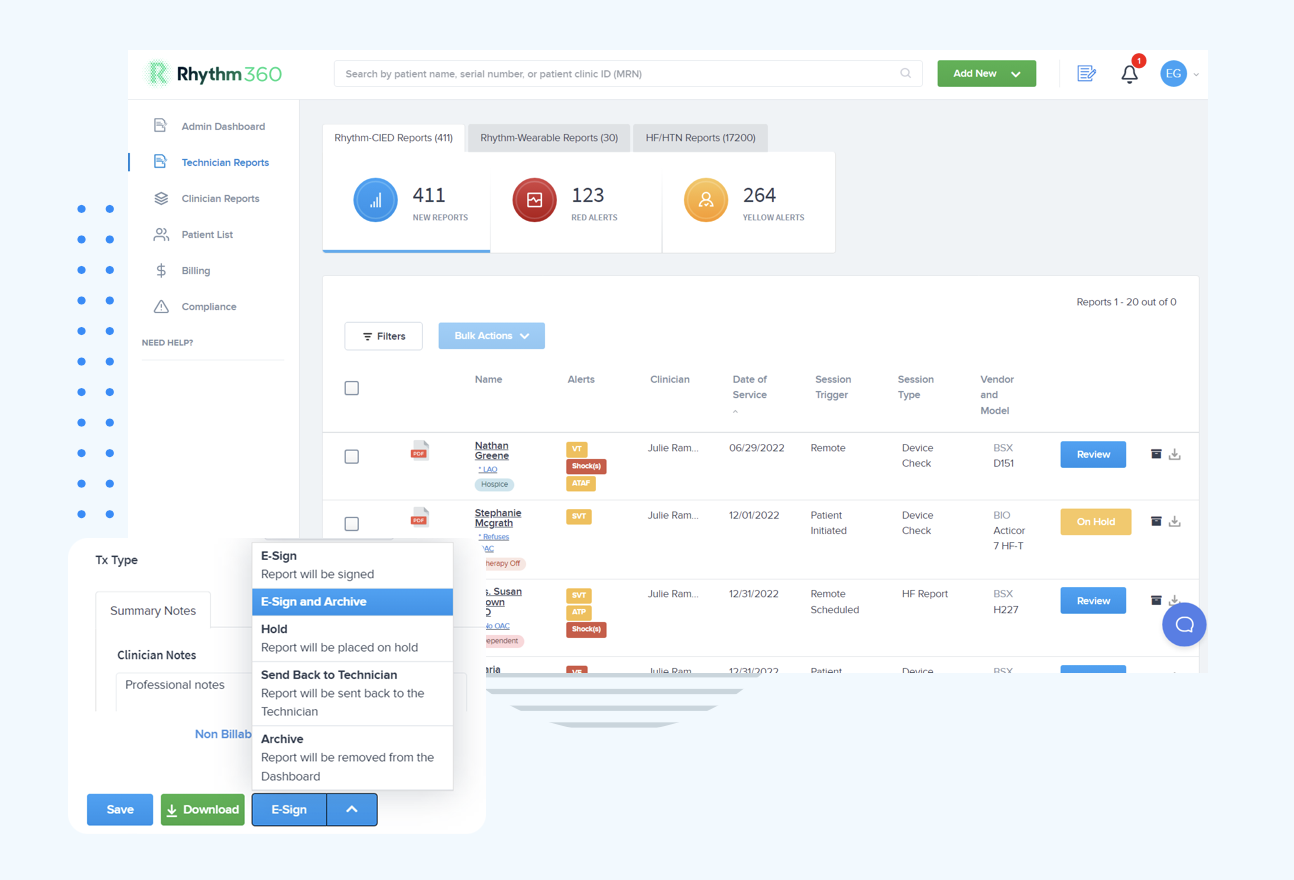
Fragmented vendor portals create the largest operational drag in CIED remote monitoring. Practices that manage several OEMs often lose 50% of administrative time switching between systems that do not share data.
Effective centralization standardizes data from Medtronic, Abbott, Boston Scientific, and Biotronik into consistent clinical reports. This approach removes duplicate data entry, cuts transcription errors, and creates a single, reliable view of device status for every patient.
Results typically include a 50% drop in administrative time, less portal login fatigue, and full visibility across all device types. Manual attempts at consolidation usually add work instead of simplifying it.
Rhythm360's vendor-neutral platform ingests data through APIs, HL7 connections, and computer vision that reads PDF reports. Staff no longer need to open multiple OEM portals, while the system maintains >99.9% data fidelity across all devices.
Automated billing capture strengthens revenue cycle performance by supporting 99% claim approval with consistent documentation and compliance tracking. CPT 93296 documentation must include device type, reason for evaluation, data reviewed, such as battery status and arrhythmias, device changes, consent, and follow-up plans.
Implementation steps include setting automated triggers for 93298, 93299, and 99454 based on transmission patterns, building audit trails for compliance, and creating structured review processes before claim submission.
Practices that automate billing often reach 99% claim approval compared with about 70% using manual workflows. Many see a 25-35% increase in captured billing within the first quarter.
Frequent problems include missing modifiers and shallow documentation that invites denials. Rhythm360 generates compliant documentation with full audit trails, correct modifier use, and clear clinical justification for every claim.
ROI modeling gives leadership a clear financial case for RPM investment and sets a baseline for future gains. MedAxiom data shows median cardiologist compensation at $694,954 in 2024, so even modest revenue lifts have a real impact.
Metric | Baseline | With Rhythm360 | Uplift |
Monthly RPM Revenue | $15,000 | $45,000 | 300% |
Alert Response Time | 4 hours | 48 minutes | 80% reduction |
Administrative Hours | 20 hours/week | 8 hours/week | 60% reduction |
Most practices see a 3-month payback period with sustained 300% revenue growth across the first year. Groups with 500+ CIED patients often add $200,000-$400,000 per year through better billing capture and streamlined workflows.
Schedule a Rhythm360 demo to put these revenue strategies in place and target similar 300% profitability gains in your first quarter.
AI-driven alert triage sharply reduces alert fatigue and protects clinical focus. AI platforms can cut notification workload by 84% by labeling transmissions as safe, caution, or critical.
AI tools prioritize alerts for atrial fibrillation, ventricular tachycardia, and device malfunction while filtering false positives that drain staff time. AI-enhanced monitoring saves about 559 personnel hours per year for every 600 patients through automated sorting and escalation.
Practices often see 80% faster responses to critical alerts and less burnout from information overload. Rhythm360's AI system connects with mobile apps, so clinicians receive urgent alerts immediately, while routine maintenance alerts wait for scheduled review.
Strong enrollment and compliance processes keep RPM revenue stable over time. RPM billing requires patient consent, electronic data from FDA-defined devices, and an established patient relationship for reimbursement.
Effective enrollment includes documented consent, confirmed device connectivity, clear 16-day minimum transmission expectations for each 30-day cycle, and simple education on device use and troubleshooting.
Well-designed onboarding can reach >95% adherence, compared with 60-70% using manual methods. Revenue then stays consistent across enrolled patients with low dropout.
Common issues involve weak connectivity support and limited patient education, which cause data gaps. Rhythm360's redundant data feeds keep transmissions flowing even during OEM outages, protecting both monitoring and billing.
EHR integration removes manual transcription and keeps documentation inside familiar workflows. Bi-directional connections with Epic, Cerner, and other major EHRs allow automatic population of device data, alerts, and billing details.
Teams gain zero manual data entry, automatic note creation, and smooth inclusion of RPM data in the chart. Productivity often rises 40-50% as duplicate documentation disappears.
Deployment usually takes from a few days to several weeks, depending on EHR complexity and IT capacity. Rhythm360's pre-built modules speed this process while preserving HIPAA compliance and data security.
Scaling from CIED monitoring into heart failure and hypertension RPM opens new revenue streams on the same platform. Practices often see 80% faster alert responses, 300% revenue growth, and smooth expansion into CPT 99453 and 99454 for broader chronic care.
Advanced programs add predictive analytics for heart failure risk, medication adherence monitoring, and integrated patient messaging. Practices with 1,000+ chronic disease patients commonly add $150,000-$300,000 per year.
Scaling can stall when teams skip staff training or underestimate patient education for multiple device types. A structured expansion plan supports growth while protecting quality metrics across all RPM services.
Rhythm360's AI triage system cuts response times for critical alerts by up to 80% while keeping >99.9% data transmissibility. Automated documentation reduces denials with full audit trails and correct modifier use. Systematic CPT capture and built-in compliance checks remove common billing pitfalls directly within clinical workflows.
The main CPT codes for pacemaker remote monitoring in 2026 are 93298 for remote device interrogation ($45 Medicare), 93299 for remote monitoring evaluation ($32), and 99454 for device supply with daily recordings ($50). These codes require at least 16 days of data transmission in a 30-day cycle and clear documentation of clinical decisions. Rhythm360 automates capture and documentation for these codes across all major device manufacturers.
A vendor-neutral platform removes data silos between OEM systems and cuts administrative work by about 50%. Practices often reach 300% revenue growth through automated CPT capture, unified workflows that avoid duplicate tasks, and AI triage that speeds clinical responses. Staff can then shift time from portal management to patient care and revenue-producing work.
Frequent problems include billing too often, shallow documentation, incorrect modifiers, and missing the 16-day data requirement. Many practices lose revenue by not separating remote from in-person evaluations or by skipping documentation of device programming changes. Checklists and automated documentation tools prevent these errors and support payer-specific rules.
AI triage reduces alert fatigue by filtering non-actionable notifications and highlighting true emergencies. Strong systems label alerts as safe, caution, or critical and can cut notification volume by 84% while staying sensitive to dangerous arrhythmias. Mobile delivery ensures critical alerts reach clinicians quickly, while routine alerts are grouped for later review.
Most practices see positive ROI within about 3 months and maintain roughly 300% revenue growth across the first year. Early gains come from capturing claims that were previously missed, while long-term benefits include lower administrative costs and better clinical efficiency. Practices with 500+ CIED patients often add $200,000-$400,000 in annual revenue.
Yes. Rhythm360 supports vendor-neutral integration for Medtronic, Abbott, Boston Scientific, Biotronik, and other major manufacturers. The platform maintains >99.9% data transmissibility using redundant feeds, APIs, HL7, and computer vision for PDF reports. Staff no longer need to log into multiple OEM portals, yet still keep full clinical visibility across all devices.
These nine pacemaker monitoring strategies give cardiology practices a clear path from fragmented CIED workflows to efficient, profitable operations. HRS guidelines highlight the value of well-structured remote monitoring workflows for both patient care and long-term practice stability.
Success depends on consistent execution across CPT mastery, workflow centralization, AI alert management, and EHR integration. Practices that follow this framework often see 300% revenue growth, lower administrative load, and better outcomes for patients.
Schedule a Rhythm360 demo today to apply these strategies and turn your pacemaker monitoring program into a high-performing, profitable service line that supports every major device manufacturer.