Remote CIED monitoring covers scheduled and unscheduled interrogation of implanted devices, including pacemakers, ICDs, CRT devices, and implantable loop recorders. Devices transmit data wirelessly to clinic servers for clinical review. Key roles include the Certified Cardiac Device Specialist (CCDS) or Certified Cardiographic Technician (CCT), the supervising registered nurse (RN) or nurse practitioner (NP), and the interpreting electrophysiologist (EP). These roles intersect at three operational layers: workflow, interoperability, and reimbursement. A training program that addresses all three layers at once produces staff who are clinically competent, operationally efficient, and billing-compliant from the outset.
Those three operational layers, workflow, interoperability, and reimbursement, are shaped by evolving industry standards and regulatory requirements. The Heart Rhythm Society (HRS) and the International Board of Heart Rhythm Examiners (IBHRE) define competency standards for device clinic personnel, including pathways to CCDS and CEPS certification. These credentials establish a clinical baseline but do not prescribe day-to-day multi-OEM workflow management or CPT capture protocols.
On the billing side, remote monitoring is billed using device-specific CPT codes, including 93294 for pacemaker interrogation, 93295 for ICD interrogation, 93296 for CRT, and 93298 for implantable loop recorders. Each code requires documentation of device manufacturer and model, transmission date, data summary, physician interpretation, and clinical actions taken. Manual data entry from multiple OEM portals fails the automatic transmission requirement for RPM billing codes such as 99454, triggering denials and compliance risk. The industry shift toward unified platforms addresses this gap by normalizing disparate data streams into a single auditable record.
Step 1 — CIED Fundamentals (Days 1–3). Trainers cover device types, including pacemakers, ICDs, CRT-D, and ILR, along with indications and basic electrogram interpretation. Staff must demonstrate mastery through a baseline competency assessment, with a passing threshold of ≥80 percent that confirms readiness for multi-OEM portal training in Step 2.
Step 2 — Multi-OEM Portal Navigation (Days 4–7). Trainers introduce each manufacturer portal first, then immediately show the unified platform that consolidates them. University of Chicago Medicine reviewed more than 73,000 reports annually through a unified platform, averaging more than 18,000 reports per quarter. That volume is unmanageable through siloed portals alone. The KPI target is time-to-first-login across all OEM portals reduced to under 10 minutes.
Step 3 — Alert Triage Protocols (Week 2). Clinics implement a structured escalation framework that staff can follow consistently. CardiQ's evidence-based framework uses a color-coded RED/YELLOW/GREEN triage algorithm, complete with SOPs, staff training materials, and an interactive metrics dashboard. Teams map RED alerts such as VF, lead fracture, and ERI to immediate physician notification. They route YELLOW alerts such as AF burden and elevated pacing thresholds to same-day review. They assign GREEN alerts, including routine transmissions, to scheduled batch processing. The KPI target is a critical alert response time of 2 hours or less.
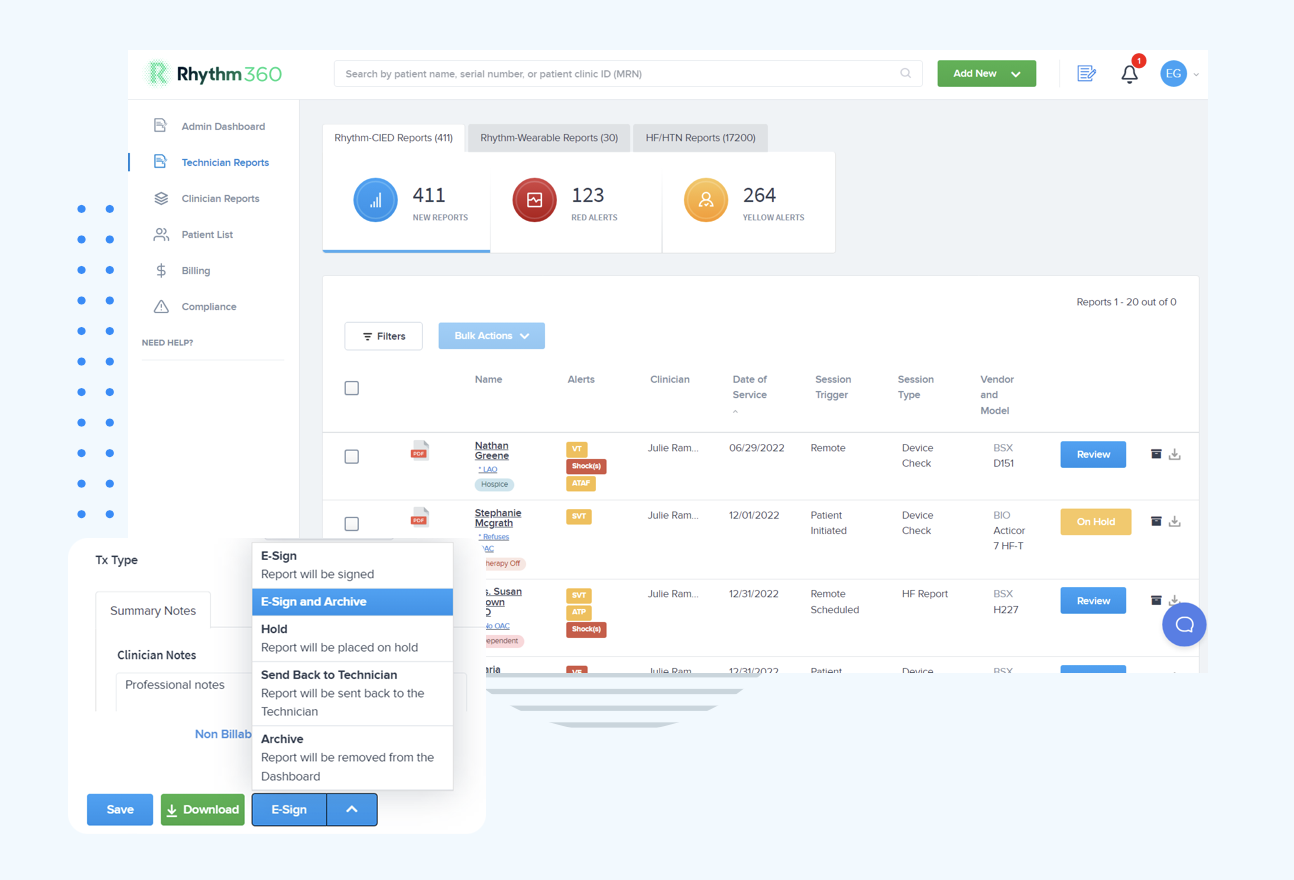
Step 4 — EHR Documentation and Workflow Integration (Week 2–3). Staff learn to generate and sign reports within the unified platform and then push finalized notes to the EHR through HL7 or direct integration. Automated platforms that consolidate OEM data and produce audit-ready transmission logs help clinics capture the full RPM code stack, including 99453, 99454, 99457, and 99458, every eligible month. The KPI target is a documentation completion rate of at least 95 percent within 24 hours of transmission.
Step 5 — CPT Billing Compliance (Week 3). Clinics dedicate focused sessions to billing rules for codes 93294–93299 and 99453–99458. A practice managing 200 device patients can capture approximately $180,000–$384,000 in annual recurring revenue from remote patient monitoring once billing is fully operationalized. Staff learn 90-day versus 30-day billing cycles, required documentation elements, and common denial triggers. The KPI target is a CPT capture rate of at least 90 percent of eligible transmissions.
Step 6 — Connectivity Troubleshooting and Patient Communication (Week 4). Staff learn to identify and resolve transmission failures, including disconnected monitors, OEM server outages, and patient non-compliance. They also document outreach attempts with a full audit trail. The KPI target is a transmission gap rate at or below 5 percent of enrolled patients per month.
Step 7 — Supervised Independent Practice and Competency Validation (Weeks 5–8). Staff manage a live patient panel under preceptor oversight, with structured case reviews and a final competency assessment. As noted at UCM, "that was a big piece for us, to have an integrated review of data from trained personnel." The KPI target is an independent sign-off rate of at least 85 percent on the competency checklist.
Clinics face a build-versus-buy decision when they design training infrastructure. Building in-house curricula requires dedicated instructional design resources and ongoing updates as OEM portals change. Partnering with a platform vendor or third-party service that provides embedded training materials reduces that burden and shortens ramp-up time.
This training infrastructure decision intersects with the staffing model. Leaders must decide whether to build an in-house CCT team, supplement internal staff with outsourced coverage, or rely on third-party specialists. IBHRE-certified remote monitoring specialists using advanced triage protocols and secure EHR access deliver same-day alert reporting with fewer non-actionable transmissions, reducing alert fatigue for clinics. Clinics often choose hybrid arrangements that supplement internal staff with outsourced monitoring coverage for nights and weekends.
Integration complexity, particularly EHR bi-directionality and OEM API access, should be scoped before training begins. Early scoping prevents workflow gaps that frustrate newly trained staff and erode confidence in the program.
| Phase | Weeks | Key Activities | Readiness Gate |
|---|---|---|---|
| Foundation | 1–2 | CIED fundamentals, OEM portal access, unified platform setup, EHR integration testing | All staff credentialed in platform, EHR integration confirmed |
| Protocol Training | 3–4 | Alert triage SOPs, CPT billing rules, documentation workflows, connectivity troubleshooting | Triage protocol signed off by EP, billing template approved by RCM |
| Supervised Practice | 5–6 | Live patient panel under preceptor oversight, case reviews, escalation drills | Zero unreviewed RED alerts during supervised period |
| Independent Operation | 7–8 | Full independent caseload, KPI tracking begins, quarterly review cadence established | Competency assessment ≥85%, CPT capture rate ≥90% |
Single-OEM tunnel vision. Training staff exclusively on one manufacturer portal leaves them unprepared when a patient receives a device from a different OEM. Multi-vendor fluency must be built in from Step 2 so staff can move confidently between systems.
Missing alert-prioritization protocols. Missed alerts and unclear escalation pathways are identified as common preventable system failures in cardiac device programs, particularly in community and hybrid care settings. Without a written, color-coded triage SOP, staff default to ad hoc judgment. That pattern increases both missed events and unnecessary escalations.
Incomplete billing documentation. Staff who understand clinical triage but not CPT requirements generate reports that fail audit review. Many teams still rely on manual workflows that do not meet the automatic transmission standard covered in Step 4, which increases denials and compliance risk. Billing training must be integrated into clinical workflow training, not treated as a separate administrative function.
Technician turnover from burnout. As observed at UCM, "staffing was always an issue for our center, because our device clinic, like many other medical centers, had struggled with technician turnover and timely weekend coverage." Structured training paired with a unified platform reduces the cognitive load that drives burnout and improves retention.
Four metric categories anchor a quarterly review cadence and keep the program on track.
Clinical: Critical alert response time, missed alert rate, and escalation accuracy rate.
Operational: Transmission review turnaround, portal login time, and backlog volume. Clinics using structured monitoring services report clearing backlogs of thousands of transmissions in weeks, not months.
Financial: CPT capture rate per eligible transmission, denial rate, and revenue per enrolled patient. Medicare reimburses for pacemaker remote interrogation with CPT 93294 and ICD remote interrogation with CPT 93295, and these rates compound significantly at scale.
Compliance: Documentation completeness rate, audit-ready report percentage, and HIPAA incident count.
UCM reported "improved billing and accountability for our patients after the integration," showing that measurement and platform alignment reinforce each other. "Decision support, including AI-assisted decision support, will become increasingly important as data volumes grow," so quarterly recalibration of alert thresholds and triage protocols becomes a standing operational requirement.
The path to becoming a cardiac device technician typically takes two to four years. Most entry-level roles require an associate's or bachelor's degree in cardiovascular technology, allied health, or a related field, followed by on-the-job training in a device clinic. Formal certification through IBHRE, either the Certified Cardiographic Technician (CCT) or Certified Cardiac Device Specialist (CCDS) credential, requires documented clinical hours and a passing score on a standardized examination. Some candidates pursue manufacturer-specific training programs as a supplement, though these do not substitute for vendor-neutral competency. The 4–8 week onboarding curriculum in this guide fits staff who already hold or are pursuing these credentials and who need structured clinic-specific training to become operationally independent.
Current HRS consensus guidelines recommend remote monitoring every 3 to 12 months for most pacemaker patients. The specific interval depends on device type, patient risk profile, and implanting physician preference. For billing purposes, CPT code 93294 covers pacemaker remote interrogation over a 90-day period, so a practice can bill this code up to four times per year per patient. ICD and CRT patients are typically monitored more frequently, often every 3 months, given the higher clinical stakes associated with those devices. In addition to scheduled transmissions, most remote monitoring platforms support unscheduled or event-triggered transmissions that fall outside the standard billing cycle but still require the same triage and documentation workflow.
Alert fatigue occurs when clinical staff receive such a high volume of device notifications that they begin to miss, delay, or dismiss alerts because of cognitive overload. In remote CIED monitoring, this pattern usually stems from threshold-based alarm systems that generate notifications for minor parameter deviations that do not require clinical action. The result is a paradox. As a clinic monitors more devices, the risk rises that a genuinely urgent alert, such as new-onset ventricular fibrillation or a lead fracture, is buried under non-actionable noise. Structured training addresses alert fatigue by teaching staff to apply a tiered triage protocol, using RED, YELLOW, and GREEN categories, and by deploying AI-powered platforms that filter non-actionable transmissions before they reach the clinical queue. Rhythm360's intelligent alerting system reduces critical alert response times by up to 80 percent by prioritizing only clinically significant events.
The primary CPT codes for CIED remote interrogation are 93294 for single or dual chamber pacemaker over a 90-day period, 93295 for ICD over a 90-day period, 93296 for CRT device over a 90-day period, and 93298 for implantable loop recorder over a 30-day period. The technical component of each interrogation is billed separately from the professional, or physician interpretation, component using modifier -26 and -TC conventions. For remote physiological monitoring of chronic conditions such as heart failure, the applicable codes are 99453 for device setup, 99454 for daily transmission over a 30-day period, 99457 for the first 20 minutes of clinical staff time, and 99458 for each additional 20 minutes. Each code carries specific documentation requirements, including transmission date, device model, data summary, and clinical actions taken, which staff must capture in the patient record at the time of review to withstand audit scrutiny.
A structured 7-step training curriculum turns new device clinic staff from portal-dependent generalists into vendor-neutral, billing-compliant CIED monitoring specialists within 4–8 weeks. The measurable outcomes, including reduced alert response times, higher CPT capture rates, and lower technician turnover, tie directly to the quality of the training infrastructure and the platform that supports it. Fragmented OEM workflows undermine even well-designed curricula. A unified, AI-powered platform like Rhythm360 provides the operational backbone that makes training investments durable.
By normalizing multi-OEM data, automating documentation, and filtering non-actionable alerts, Rhythm360 allows trained staff to focus on the clinical decisions that matter most. Request a Rhythm360 walkthrough to see how the platform supports your pacemaker monitoring staff training and remote CIED operations.