

The table below maps the dominant manufacturer-specific remote monitoring solutions by the features most relevant to patient-facing transmission. Secondary keywords such as mycarelink heart app, mymerlinpulse app, mylatitude patient app, and BIOTRONIK Home Monitoring each tie to a distinct OEM ecosystem, and none of these ecosystems communicate with the others.
| Feature | Medtronic MyCareLink Heart | Abbott myMerlinPulse | Boston Scientific LATITUDE | BIOTRONIK Home Monitoring |
|---|---|---|---|---|
| Transmission method | Bluetooth to cellular/Wi-Fi via CareLink network | Bluetooth to cellular/Wi-Fi via Merlin.net | Via LATITUDE NXT communicator | Transmits cardiovascular data daily via the GSM mobile network from the implant to the CardioMessenger, which forwards it to the BIOTRONIK Home Monitoring Service Center |
| Patient device required | Smartphones and tablets running iOS or Android | Smartphone or other mobile device | Bedside LATITUDE Communicator | Dedicated home transmitter |
| Clinic portal | Medtronic CareLink | Abbott Merlin.net | Boston Scientific LATITUDE NXT | Home Monitoring Service Center (HMSC) |
| Alert notification lag risk | Standard real-time alerts | Standard real-time alerts | May vary based on firmware and telemetry settings | Standard real-time alerts |
Each of these solutions performs its intended function and reliably sends patient data into its own portal. That technical success creates an operational challenge, because clinics must now manage four separate logins, alert queues, and documentation workflows in parallel. The problem is not the solutions themselves, but the fragmented clinic workflow that emerges when multiple portals run at the same time.
Patients often want to monitor their pacemaker from a phone, and manufacturer apps now make that possible. These apps enable automatic home transmissions through a smartphone or bedside communicator and improve patient compliance. The clinic workload does not shrink, because every transmission still lands in a separate OEM portal that staff must monitor and document.
The operational consequences of managing four portals simultaneously compound across the workflow. Staff log into multiple non-interoperable systems to retrieve data, which creates heavy administrative burden and data silos. Because there is no unified patient list, technicians must cross-reference four separate worklists to confirm transmission status.
This cross-checking requires manual transcription of device data into the EHR, which introduces errors and consumes hours of specialized staff time each week. Dr. Gaurav A. Upadhyay at the University of Chicago Medicine describes technician turnover from this administrative overload as a persistent staffing issue that affects timely weekend coverage. As a result, clinics lose a single real-time view of population-level compliance, device status, and billable activity.
Find out how Rhythm360 consolidates your OEM portals into one workflow.
Fragmented portals create clinical risk, not just administrative friction. When alert queues spread across four systems with inconsistent notification logic, the chance that a critical event is delayed or missed rises sharply.
Watch AI triage prioritize critical alerts in real time.
Remote monitoring of cardiac implantable electronic devices is reimbursable under a well-defined CPT framework. Remote physiologic monitoring services, including cardiac device data, are not considered Medicare telehealth services and are therefore not subject to telehealth geographic or originating-site restrictions. Reimbursement is broadly available, and documentation, not coverage, usually blocks revenue.
Capturing remote monitoring revenue requires meeting specific documentation standards. CPT code 93296 covers remote interrogation device evaluation(s) (technical component) of single, dual, multiple-lead, or leadless pacemaker or implantable defibrillator systems. CMS remote monitoring of implantable cardiac devices uses CPT codes 93297 and 93298 (formerly G2066), while RPM codes 99453, 99454, 99457, and 99458 apply to non-implantable physiologic monitoring such as blood pressure or oxygen saturation.
RPM billing requires documentation of patient consent, a minimum number of daily device readings per month, and at least 10–20 minutes of care-team time, with notes, goals, and next steps recorded in an EHR. Anthem's Clinical UM Guideline CG-MED-91 (reviewed 08/07/2025) further requires that RPM clinical records document the rationale for monitoring across seven specific criteria, including that RPM data is assessed to detect acute changes in clinical status and prompt intervention. When documentation is generated manually across four portals, these requirements become hard to track consistently, billable events go uncaptured, claims lack supporting evidence, and revenue is forfeited.
Dr. Upadhyay at UCM confirmed improved billing and accountability after platform integration, which shows the financial impact of unified documentation.
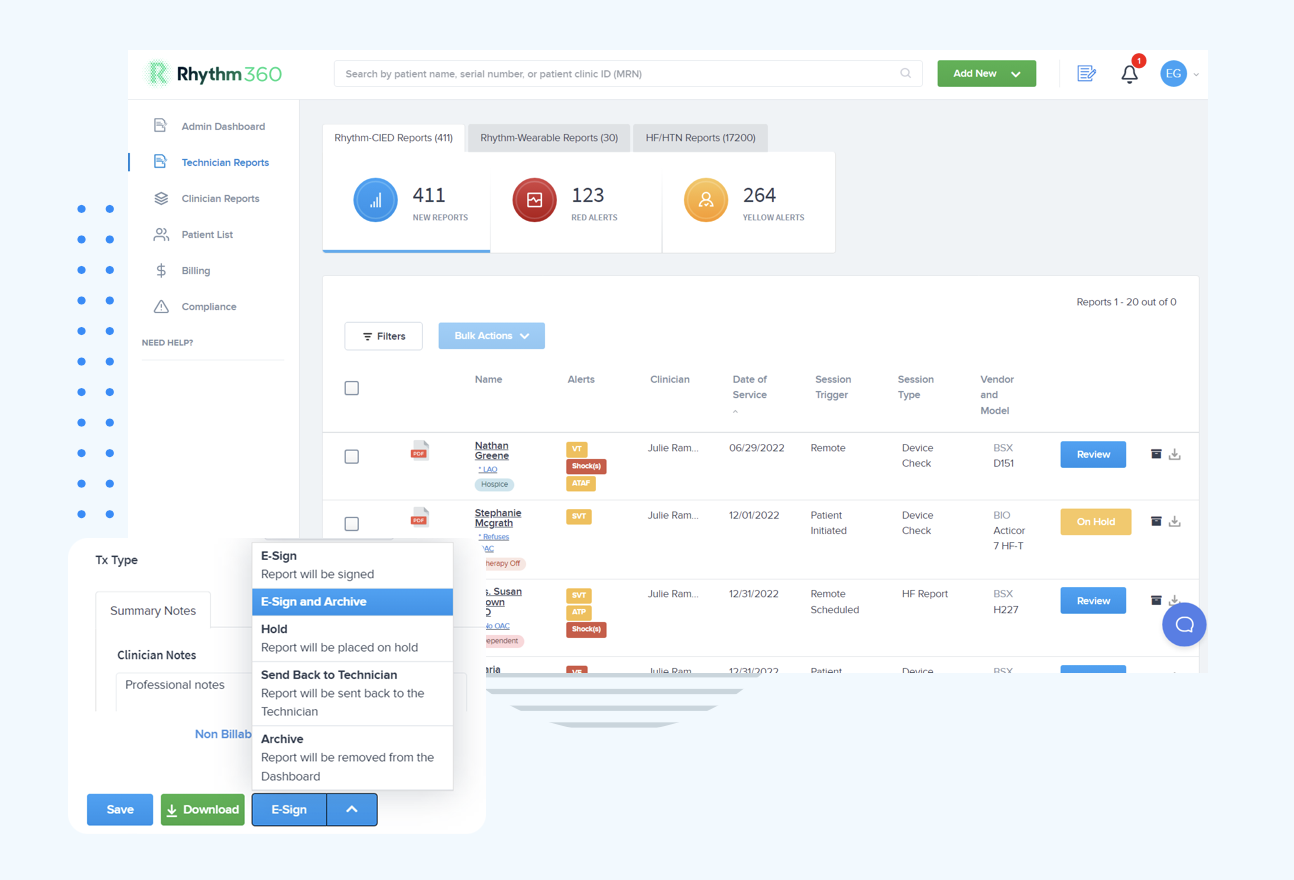
A vendor-neutral cardiac monitoring platform must address every layer of the fragmentation problem, including data ingestion, alert triage, documentation, EHR integration, and mobile access. The table below compares legacy multi-portal workflows against a unified platform on the four metrics that matter most to clinic administrators and electrophysiologists.
| Metric | Legacy Multi-Portal Workflow | Unified Vendor-Neutral Platform (Rhythm360) |
|---|---|---|
| Admin time per transmission review | Multiple logins, manual cross-referencing across 4 portals | Single dashboard, automated data ingestion from all OEMs via API, HL7, XML, and AI-powered PDF parsing |
| Critical alert response time | Delayed by portal fragmentation and manual triage | Up to 80% reduction in response time through AI-powered alert triage and optional 24/7/365 CCT oversight |
| Documentation completeness | Manual transcription, gaps in consent, timing, and clinical rationale documentation | Automated report generation with auditable documentation aligned to CPT 93298, 93299, and 99454 requirements |
| Revenue capture | Missed billable events, rejected claims from incomplete documentation | Automated CPT code capture, with practices reporting up to 300% increases in revenue generation |
Additional platform requirements include:
Explore the unified CIED dashboard that eliminates login fatigue.
Switching platforms affects every clinic that manages an active patient population, so implementation standards matter. A qualified unified CIED monitoring platform should meet the following expectations.
Review Rhythm360's onboarding timeline for your practice.
A unified platform delivers measurable financial and clinical returns. Practices implementing Rhythm360 have documented the following outcomes.
Model the revenue and response-time impact for your own patient population.
The primary disadvantages are operational rather than clinical. Managing remote monitoring across multiple manufacturer portals creates administrative overload, alert fatigue, and documentation gaps that cause missed billable events and rejected claims. Staff burnout from navigating non-interoperable systems contributes to technician turnover. Data transmission failures, such as firmware-related notification lags on specific device models, can create blind spots in patient monitoring. These disadvantages shrink significantly when a clinic consolidates monitoring onto a single vendor-neutral platform with AI-powered triage, automated documentation, and redundant data feeds that maintain greater than 99.9% transmissibility.
Patients can monitor a pacemaker from a phone when they use manufacturer tools. Major manufacturers including Medtronic, Abbott, Boston Scientific, and BIOTRONIK provide patient-facing apps or communicators that transmit device data automatically from the home to the clinic. Medtronic's MyCareLink Heart app, for example, uses Bluetooth over cellular or Wi‑Fi. These tools improve patient compliance with scheduled transmissions. They do not consolidate data for the clinic, because each transmission still arrives in a separate OEM portal, and the clinical and administrative burden of managing those portals remains on the practice.
Remote monitoring of implantable cardiac devices uses CPT code 93296 for the technical component of remote interrogation of pacemaker and implantable defibrillator systems, with CPT codes 93297 and 93298 also applying to remote monitoring services. RPM codes 99453, 99454, 99457, and 99458 apply to non-implantable physiologic monitoring programs. Consistent capture of these codes requires documented patient consent, minimum transmission thresholds, and clinical notes that record the rationale for monitoring and the clinician's response to transmitted data. Automated documentation platforms that generate compliant reports at the point of transmission and integrate those reports directly into the EHR provide the most reliable way to prevent revenue leakage from missed or incomplete billing.
OEM portals serve a single manufacturer's device ecosystem. They do not share data, do not generate unified worklists, and do not produce consolidated billing documentation across device brands. A vendor-neutral platform ingests data from all major manufacturers through APIs, HL7 feeds, XML, and AI-powered PDF parsing, then normalizes that data into a single patient record. The platform applies consistent alert triage logic regardless of device brand. Clinics gain one login, one alert queue, one documentation workflow, and one billing pipeline, whether a patient has a Medtronic pacemaker, a Boston Scientific ICD, or an Abbott loop recorder.
Implementation timelines vary by practice size and EHR complexity, but a well-designed platform should complete full onboarding, including EHR integration with systems such as Epic, Cerner, or Athenahealth, within days to a few weeks. Key factors include the availability of HL7 or API connections to the existing EHR, the number of OEM data feeds to configure, and staff training requirements. Platforms that reduce reliance on a single super-user and provide intuitive interfaces for both administrators and clinicians tend to reach full operational capacity faster and maintain adoption more reliably over time.
Major pacemaker remote monitoring solutions such as MyCareLink Heart, myMerlinPulse, LATITUDE, and BIOTRONIK Home Monitoring each solve the patient-facing transmission problem. None of them solve the clinic-facing workflow problem. Managing multiple separate portals produces alert fatigue, documentation gaps, CPT code leakage, and technician burnout at scale.
Rhythm360 by RhythmScience is a vendor-neutral, AI-powered platform built to eliminate that fragmentation. It ingests data from every major CIED manufacturer, applies AI triage to prioritize clinically significant alerts, automates CPT-compliant documentation for codes 93296, 93297, and 93298, integrates bi-directionally with leading EHR systems, and delivers mobile clinician access for on-call review. Practices using Rhythm360 have documented the response-time and revenue improvements described above, which demonstrates measurable ROI across both clinical and financial dimensions.
Connect with our team and see what one dashboard can do for your practice.





