

Cardiac implantable electronic devices detect atrial fibrillation using atrial high-rate episode algorithms that monitor for irregular heart rhythms above programmed thresholds. When these episodes occur, devices such as pacemakers and defibrillators store electrogram data and send alerts through manufacturer-specific portals like PaceMate, CareLink, or Latitude.
Even advanced device algorithms struggle with accuracy. A 2026 cross-manufacturer study presented at the European Heart Rhythm Association (EHRA) Congress found that 32.9% of episodes in AI-equipped implantable cardiac monitors were classified as non-actionable, while devices without AI algorithms generated even higher false-positive rates at 45.4%. This persistent alert burden creates operational chaos for clinical teams, who must manually review every flagged episode.
Fragmentation intensifies when practices manage devices from multiple manufacturers. Each vendor requires separate portal access, different data formats, and distinct workflow protocols. Dr. Andrew Beaser from University of Chicago Medicine described pre-implementation workflows as “a major challenge and incredibly difficult”, highlighting how disconnected systems create administrative burden that diverts clinical attention from patient care.
See how unified monitoring eliminates these workflow barriers in a personalized demo.
Most cardiology practices now manage an overwhelming volume of device transmissions across multiple manufacturer portals. University of Chicago Medicine processed more than 73,000 reports annually, which shows the scale of data that clinical teams must review, prioritize, and act on.
Staffing challenges magnify these workflow issues. Dr. Gaurav Upadhyay at University of Chicago Medicine noted that “staffing was always an issue for our center, because our device clinic—like many other medical centers—had struggled with technician turnover and timely weekend coverage”. This staffing instability, combined with the cognitive burden of managing multiple portals and high false-positive rates, creates a perfect storm for missed critical events.
The clinical anxiety of potentially missing new-onset atrial fibrillation weighs heavily on practitioners. When a patient develops device-detected AF, rapid anticoagulation initiation can prevent stroke. Delays in alert review and response can have devastating consequences. Dr. Niraj Varma from Cleveland Clinic emphasized that “false-positive alerts remain one of the biggest operational challenges in remote cardiac monitoring” because “every episode flagged by an implantable cardiac monitor must be reviewed by a clinician”.
Effective atrial fibrillation monitoring in 2026 requires five non-negotiable capabilities that legacy systems cannot deliver. These capabilities work together as a single framework rather than as isolated features.
The foundation is true interoperability that consolidates data from all major device manufacturers into a single platform, which removes multiple portal logins and manual data reconciliation. Once data is unified, AI-powered alert triage becomes possible and can filter non-actionable notifications while preserving sensitivity for clinically meaningful events. Advanced algorithms like Implicity’s cloud-based analyzer achieve 98.3% sensitivity for clinically meaningful arrhythmias, showing that sophisticated AI can significantly reduce false-positive burden.
High data transmissibility, exceeding 99.9%, then ensures that critical events are not missed because of connectivity failures or server downtime. Bi-directional EHR integration enables seamless data flow between monitoring platforms and clinical documentation systems so that clinicians work from a single source of truth. Automated CPT code capture and billing documentation complete the framework by maximizing revenue recovery for remote monitoring services.
Rhythm360 meets these requirements through a vendor-neutral platform that ingests data via API, HL7, XML, and PDF formats using computer vision technology. This comprehensive approach allows practices to monitor patients with devices from any manufacturer without workflow disruption or data loss.
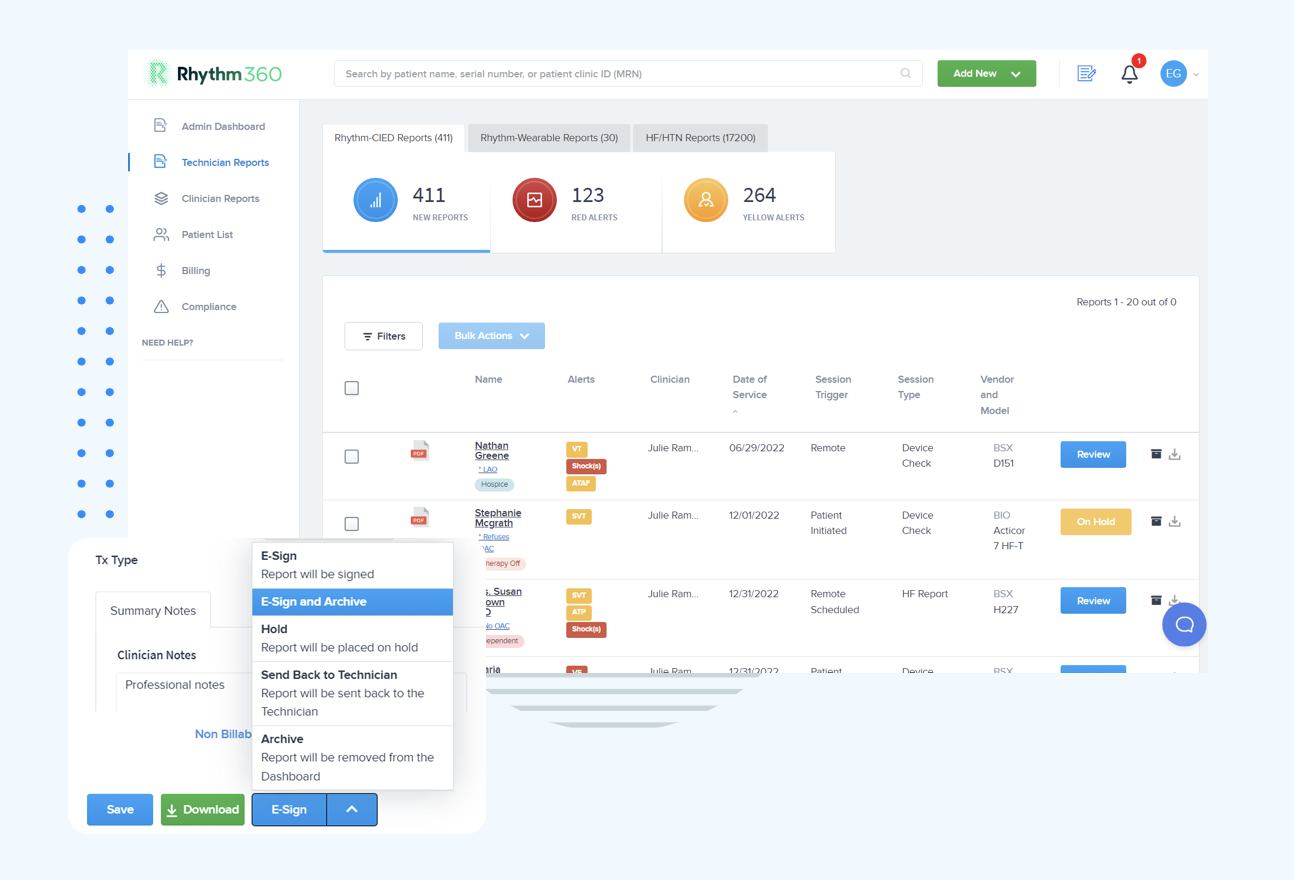
The platform’s AI-powered alert triage system reduces critical response times by up to 80%. It prioritizes clinically significant events and filters routine notifications. Unlike manufacturer-specific algorithms that operate in isolation, Rhythm360’s AI analyzes patterns across the entire patient population and device ecosystem to improve accuracy and reduce false positives.
Data reliability exceeds 99.9% through redundant data feeds and intelligent gap-filling algorithms. When primary data sources experience connectivity issues, the system switches to backup feeds and uses AI to extrapolate missing information. This approach maintains continuous monitoring coverage.
University of Chicago Medicine’s implementation enabled clinicians to “review more transmissions daily and identify more abnormalities”, as noted by Dr. Andrew Beaser. This increased review capacity translates directly to earlier interventions and improved patient outcomes.
Dr. Beaser explained that “we are able to address these issues earlier; rather than waiting for a 3-month visit, we can call patients in for evaluation”. Unified monitoring therefore accelerates clinical decision-making and intervention timing.
Financial benefits match the clinical gains. Dr. Gaurav Upadhyay observed that “we have improved billing and accountability for our patients after the integration”, which highlights how automated documentation and CPT code capture can increase revenue by up to 300% through stronger billing compliance.
Learn how these documented improvements translate to your practice volume and staffing model.
| Capability | PaceMate | Legacy Systems | Rhythm360 |
|---|---|---|---|
| Data Unification | PaceMate’s vendor-neutral platform integrates cardiac device data from all major manufacturers for remote and in-clinic monitoring. | Single-vendor portals | All manufacturers unified in one platform |
| Alert Accuracy | See EHRA study results above | Nearly half of all alerts require manual review | AI-powered triage reduces false positives and surfaces clinically meaningful events |
| Data Transmissibility | Vendor-dependent | Variable reliability | Greater than 99.9% with redundant feeds |
| Billing Support | Manual documentation | Manual processes | Automated CPT capture and audit-ready records |
Modern practices require implementation timelines measured in days to weeks, not months. Rhythm360’s streamlined onboarding process includes EHR integration setup, staff training, and data migration from existing systems while maintaining patient care continuity.
Dr. Andrew Beaser noted that “decision support, including AI-assisted decision support, will become increasingly important as data volumes grow”, which underscores the forward-looking value of AI-powered platforms as device populations expand.
The Heart Rhythm Society’s 2026 Scientific Statement emphasizes data interoperability across devices, platforms, and electronic health records as a core requirement for successful AI integration. This guidance validates the architectural approach that Rhythm360 provides.
Yes, modern pacemakers and defibrillators can detect atrial fibrillation using atrial high-rate episode algorithms. These algorithms monitor atrial electrical activity and identify irregular rhythms that exceed programmed rate thresholds, typically 175 to 180 beats per minute sustained for a specified duration. When the device detects these rhythms, it stores electrogram data and generates alerts through manufacturer portals. Detection accuracy varies significantly, and studies show that even AI-equipped devices generate substantial false-positive rates that require clinical review and confirmation.
Pacemakers treat bradycardia, or slow heart rhythms, by providing electrical stimulation when the heart’s natural pacemaker fails to maintain adequate rates. Atrial fibrillation involves chaotic, rapid electrical activity in the atria that pacing alone cannot correct. Some advanced devices offer atrial anti-tachycardia pacing or atrial fibrillation suppression algorithms, but these features have limited effectiveness. Treatment of atrial fibrillation typically relies on medications, cardioversion, or ablation procedures rather than device-based pacing therapy.
Unified monitoring platforms reduce false positives through several mechanisms. AI algorithms analyze patterns across entire patient populations and multiple device types, which improves accuracy beyond single-vendor algorithms. Cross-manufacturer data correlation helps identify device-specific artifacts and sensing issues that cause false alerts. Advanced signal processing can distinguish true arrhythmias from noise, lead issues, or oversensing problems. Unified platforms also support consistent alert thresholds and clinical protocols across all devices, which reduces variability in detection sensitivity that contributes to false-positive burden.
Modern remote monitoring platform implementations typically require days to weeks rather than months. The process includes initial system configuration, EHR integration setup, staff training sessions, and gradual patient migration from existing portals. Most platforms support parallel operation during transition periods to maintain continuity of care. Key factors that affect the timeline include EHR complexity, staff availability for training, patient population size, and the number of device manufacturers currently in use. Most practices can expect full operational capability within two to four weeks.
AI-powered monitoring improves stroke prevention by accelerating detection and response times for new-onset atrial fibrillation episodes. Advanced algorithms prioritize clinically significant events so that meaningful AF episodes receive immediate attention instead of being buried among routine notifications. Faster alert processing enables earlier anticoagulation initiation, which is critical for stroke prevention. AI can also identify patterns that predict AF progression or increased stroke risk, which supports proactive management decisions. The combination of fewer false positives and faster response times creates a more effective stroke prevention workflow than traditional manual review processes.
Fragmented PaceMate atrial fibrillation detection and legacy monitoring systems create excessive false positives, delayed response times, administrative burden, and missed revenue opportunities. With atrial fibrillation affecting tens of millions of people worldwide and prevalence predicted to rise substantially in the coming decades, practices cannot afford to maintain inefficient, reactive monitoring approaches.
Rhythm360 delivers a unified, AI-powered solution that turns device-detected atrial fibrillation management from a reactive burden into a proactive advantage. By consolidating multi-manufacturer data, reducing critical response times by 80%, achieving greater than 99.9% data transmissibility, and automating CPT code capture, the platform helps practices deliver superior patient care while strengthening operational efficiency and revenue recovery.
The future of cardiac remote monitoring favors platforms that scale with growing device populations, integrate cleanly with clinical workflows, and use AI to separate signal from noise. Practices that continue relying on fragmented legacy systems will face growing disadvantages in both clinical outcomes and financial performance.





