

The PaceMate cardiac technician dashboard forces a multi-step login sequence that starts with portal authentication, then patient queue navigation, and finally individual transmission review. Technicians manually sort transmission alerts, open each patient record separately, and document findings across several screens. A routine daily review often requires 15 to 20 clicks per patient transmission, including login verification, queue filtering, report opening, clinical assessment documentation, and billing code assignment.
This fragmented workflow creates bottlenecks when technicians manage high-volume transmission queues. Each transmission demands manual movement between the alert summary, detailed device data, patient history, and documentation screens. The process becomes especially cumbersome during urgent reviews, because critical alerts can sit among routine transmissions and technicians must manually prioritize with limited dashboard sorting tools.
See how a unified dashboard eliminates the 15–20 clicks per patient that slow down your team.
Cardiac technicians who manage patients with devices from multiple manufacturers often log into separate portals for Medtronic, Boston Scientific, Abbott, and Biotronik systems every day. This fragmentation forces staff to maintain different login credentials, learn distinct user interfaces, and reconcile conflicting data formats across platforms. Cardiac technician job descriptions frequently list multi-vendor portal management as a primary workflow challenge.
Alert fatigue intensifies these challenges. Hospital quality-improvement initiatives show that pulse oximetry monitoring can generate large volumes of alarms, many resolved quickly without clinical deterioration. These findings show that most alerts often create low-value workload for clinical staff.
This volume of non-actionable alerts drives decision fatigue and raises the risk of missing truly critical events. At Mercy Children’s Hospital, 41% of pulse oximeter alarms occurred when oxygen saturation was 88% or higher, which illustrates how threshold settings can flood teams with noise.
See how AI-powered alert filtering cuts non-actionable notifications and protects technician focus.
Manual CPT code tracking creates major challenges for cardiac technicians who use traditional dashboard systems. Technicians must document billable events under codes like 93298 for remote monitoring of pacemaker systems, 93299 for remote monitoring of ICD systems, and 99454 for remote physiological monitoring treatment management services. Because each code has different documentation requirements, technicians must track the 16-day data transmission threshold per patient to determine billing eligibility, then generate audit-ready reports that prove CMS compliance for each code.
Most off-the-shelf RPM platforms handle billing documentation differently, and none align cleanly with a billing team’s existing workflow, which creates measurable revenue leakage compared with unified architectures. The manual nature of this documentation process in systems like PaceMate often results in missed billing opportunities and compliance gaps.
Explore automated CPT code capture and documentation generation that closes these gaps.
Rhythm360 solves these workflow pain points with a vendor-neutral platform that gathers all CIED data into a single interface. University of Chicago Medicine reviewed more than 73,000 reports annually through Rhythm360 in 2025, averaging over 18,000 reports per quarter, which shows the platform’s ability to support high-volume clinical environments. The following comparison highlights how Rhythm360’s unified approach replaces the fragmented workflows that burden traditional systems like PaceMate.
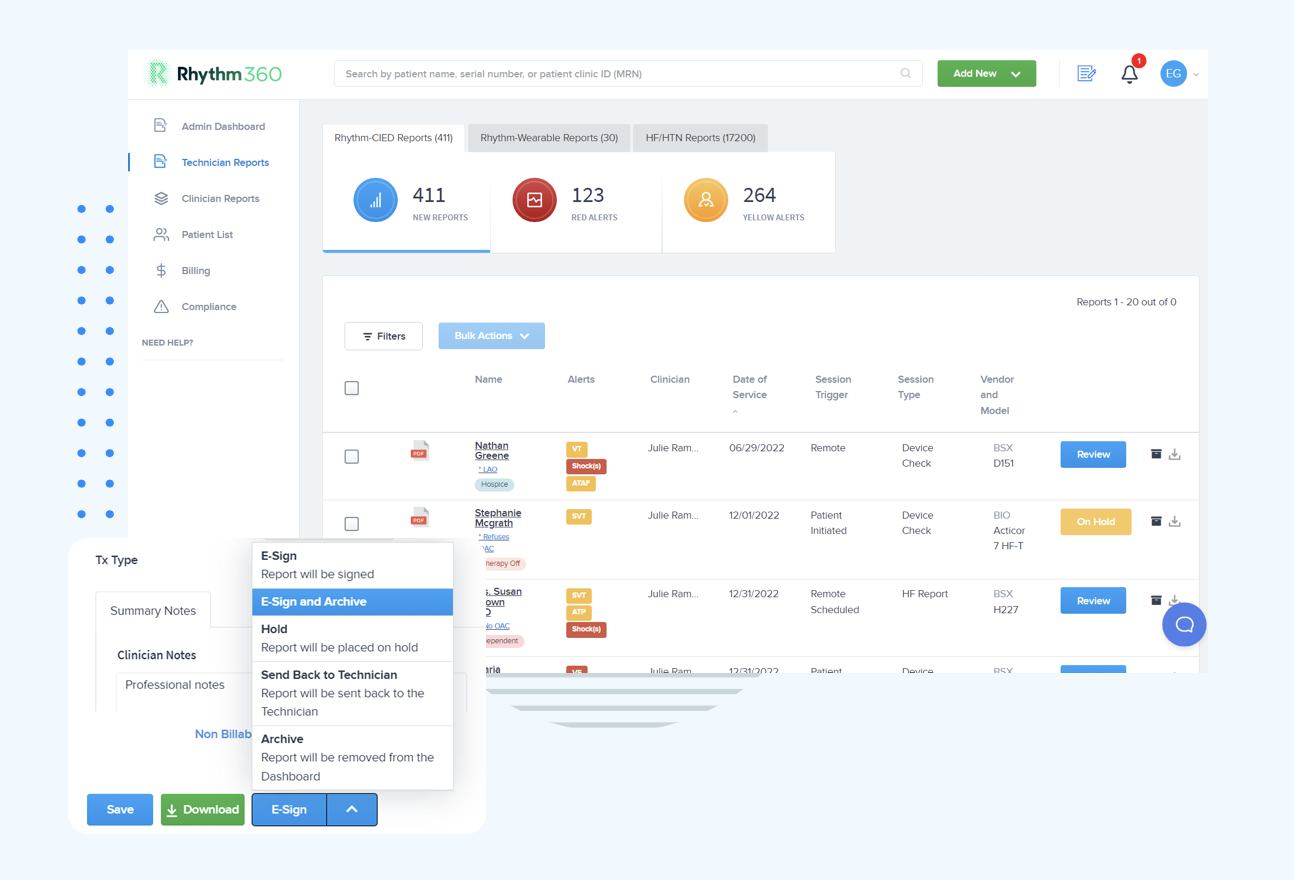
| Metric | PaceMate | Rhythm360 | Impact |
|---|---|---|---|
| Portal Logins Required | Multiple (per OEM) | Single unified dashboard | Eliminates 3–5 daily logins |
| Critical Alert Response | Manual triage | AI-powered prioritization | 80% faster response times |
| CPT Documentation | Manual tracking | Automated billing compliance | 300% revenue increase potential |
| Data Transmissibility | Variable by vendor | >99.9% reliability | Prevents missed transmissions |
Andrew Beaser, MD, at University of Chicago Medicine, reported that the implementation allowed clinicians to “review more transmissions daily and identify more abnormalities” compared with their previous fragmented workflow.
Watch the unified dashboard in a live walkthrough and see how it fits your team’s day-to-day work.
Rhythm360’s AI-powered alert triage system tackles alert fatigue by filtering non-actionable notifications and surfacing clinically significant events. Smart filter strategies use threshold triggering, trend analysis, and normalization to process raw readings and send only clinically meaningful events to the EMR, which reduces data overload and alert fatigue.
The system’s AI algorithms review transmission patterns, patient history, and device parameters to separate routine maintenance alerts from critical clinical events that require immediate attention. This approach cuts the volume of non-actionable alerts that drive technician burnout and keeps genuine emergencies at the top of the queue.
Machine learning models in cardiac monitoring have shown the ability to outperform conventional risk prediction methods, which enables more precise identification of patients who need rapid intervention.
See how AI prioritization reduces alert fatigue in your workflow.
Rhythm360’s secure, HIPAA-compliant mobile application lets technicians and clinicians review transmissions, sign reports, and coordinate care from smartphones and tablets. This mobile access closes a critical gap in traditional dashboard systems that keep users tied to specific workstations.
Gaurav A. Upadhyay, MD, at University of Chicago Medicine, identified “timely weekend coverage” as a persistent staffing challenge, and mobile access directly addresses that need. The mobile platform keeps full functionality for key tasks such as transmission review, alert acknowledgment, and patient communication.
Mobile access proves especially valuable for on-call scenarios where rapid response to critical alerts can prevent adverse events. Andrew Beaser, MD, explained that early intervention capabilities allow teams to “address issues earlier; rather than waiting for a 3-month visit, we can call patients in for evaluation”.
Test the mobile dashboard experience for on-call coverage with your team.
Rhythm360 connects bi-directionally with major EHR systems such as Epic, Cerner, Athenahealth, and eClinicalWorks through HL7 and FHIR R4 APIs. FHIR APIs support vendor-agnostic RPM data integration by mapping readings to the FHIR Observation resource, which allows native EMR display and real-time updates.
The platform automatically generates CPT-compliant documentation for remote monitoring services, tracks billable events, and maintains audit trails for CMS compliance. Custom RPM software requires accurate time tracking, flagging of the threshold mentioned earlier, and generation of audit-ready reports to support compliant CMS billing.
Gaurav A. Upadhyay, MD, reported improved “billing and accountability for patients after the integration” at University of Chicago Medicine, which shows clear revenue cycle gains.
Explore how EHR integration and automated billing work in your environment.
Rhythm360 implementation typically takes from a few days to a few weeks, which includes EHR integration setup and staff training. The platform’s cloud-based architecture removes the need for on-premise hardware installation or maintenance and lowers IT overhead for clinical practices.
Data reliability exceeds 99.9% transmissibility through redundant data feeds, computer vision parsing, and AI-powered gap filling. This reliability addresses connectivity problems that affect single-vendor systems when OEM servers experience downtime or transmission failures.
Staff training needs stay modest because of the platform’s intuitive design and familiar workflow patterns. University of Chicago Medicine transitioned to the platform while keeping their existing clinical protocols, which demonstrates smooth adoption in high-volume environments.
Discuss implementation timelines and requirements with the Rhythm360 team to plan your rollout.
The transition from PaceMate to Rhythm360 follows a structured onboarding process that usually takes one to two weeks. During this period, technicians receive hands-on training with the unified dashboard interface while they keep access to existing systems. The platform’s intuitive design mirrors familiar workflow patterns, which shortens the learning curve. Data migration occurs through API connections and automated parsing of existing transmission histories. Most practices run parallel systems briefly to maintain continuity of patient care before fully switching to the unified platform.
Rhythm360’s mobile application supports on-call coverage through secure, HIPAA-compliant smartphone and tablet access. Technicians can review complete transmission data, acknowledge critical alerts, sign reports electronically, and start patient communication directly from mobile devices. The app includes push notifications for urgent alerts, offline viewing for previously downloaded transmissions, and full audit trail documentation for all mobile activities. Emergency escalation protocols route critical events to on-call personnel with customizable notification preferences and backup coverage assignments.
Rhythm360 tracks billable events and generates CPT-compliant documentation through integrated workflow monitoring and time-based triggers. The system monitors the 16-day transmission threshold required for remote monitoring billing, documents technician review activities with timestamps, and maintains detailed audit trails for each billable service. Automated reports include all required elements for CPT codes 93298, 93299, 99454, and related remote monitoring services. The platform connects directly with practice management systems and EHRs to streamline claim submission and reduce manual documentation errors that often cause claim denials.
Staff training for Rhythm360 includes initial orientation and ongoing support that encourage adoption. The training covers dashboard navigation, alert prioritization workflows, mobile app use, and billing documentation procedures. Most cardiac technicians adapt quickly because the platform follows familiar clinical workflow patterns. Advanced features such as AI alert customization and reporting analytics may require additional sessions for power users. Ongoing support includes online resources, regular check-ins with implementation specialists, and optional refresher training for new staff members.
The PaceMate cardiac technician dashboard introduces workflow friction through fragmented logins, unprioritized alerts, and manual billing documentation requirements. These limitations push technicians to spend excessive time on administrative tasks and raise the risk of missed critical patient events. Rhythm360 addresses these challenges with a unified, AI-powered platform that consolidates all CIED data, prioritizes alerts intelligently, and automates billing compliance.
The measurable benefits include faster response times for critical alerts, removal of multiple portal logins, and the revenue improvements documented earlier through optimized billing capture. Healthcare organizations that want to improve technician efficiency, reduce alert fatigue, and recover lost revenue should evaluate vendor-neutral alternatives to traditional single-vendor dashboard systems.
Experience the Rhythm360 platform in a personalized demo and transform your cardiac monitoring workflow.





