Enterprise cardiac monitoring platforms sit at the intersection of clinical workflow, regulatory compliance, and multi-system data integration. That combination makes a self-serve trial technically and operationally impractical for several reasons.
PaceMate, like most enterprise CIED monitoring vendors, therefore routes prospective customers through a structured sales and implementation process that begins with a scheduled demo.
Enterprise cardiac monitoring demos follow a predictable sequence that starts with discovery and ends at go-live. Many platforms begin with a conversation covering existing workflows, staffing challenges, volume trends, and growth goals. A typical enterprise demo process in this category includes the following steps.
Total elapsed time from first contact to go-live for enterprise platforms in this category typically ranges from several weeks to several months, depending on IT availability and contract complexity. For practices that cannot absorb multi-month evaluation cycles, vendor-neutral platforms provide a faster alternative.
Get a scoped implementation plan with Rhythm360 within days, not months.
Multi-portal workflows carry a measurable cost in staff time, clinical risk, and lost revenue. In cardiology, that burden often concentrates in portal management and manual reconciliation.
Any platform evaluated against PaceMate should be assessed on four non-negotiable capabilities that directly address the multi-portal workflow problems described above. These capabilities work together from data collection through documentation and back into the EHR.
First, vendor neutrality removes the need to log into separate OEM portals by providing native connectivity to all major manufacturers without device-list restrictions. Second, data reliability above 99.9 percent, achieved through redundant data feeds, AI-powered gap-filling, and computer vision parsing of unstructured PDF transmissions, ensures that no critical transmission disappears when an OEM server goes down.
Third, automated CPT documentation captures billable events in real time for codes including 93298, 93299, 99454, 99457, and 99458, which recovers revenue lost to manual reconciliation errors. Finally, bi-directional EHR integration closes the loop by writing encounter data, e-signed reports, and billing information directly back into the practice’s system of record, which eliminates transcription steps entirely.
Eighty-nine percent of healthcare professionals in APAC believe that AI and predictive analytics can save lives by enabling earlier interventions, according to the Philips Future Health Index 2025 APAC Report. Vendor-neutral platforms turn that belief into daily practice through AI triage that filters non-actionable transmissions before they reach the clinical queue.
Rhythm360’s AI-powered alert system reduces response times for critical events such as new-onset AFib, ventricular tachycardia, lead malfunction, and ERI or RRT indicators by up to 80 percent compared with manual multi-portal workflows. Octagos, a comparable vendor-neutral platform, pairs its Atlas AI with IBHRE-certified clinical specialists to deliver more than 99 percent accuracy, sensitivity, and specificity on remote monitoring interpretations. That benchmark illustrates the performance level that consolidated platforms are designed to meet or exceed.
Medicare paid $536 million for RPM services in 2024, a 31 percent increase from 2023, driven by 27 percent year-over-year growth to roughly 1 million enrollees. That market expansion creates a compounding opportunity for practices that can systematically capture reimbursement codes 99453–99454 and 99457–99458 instead of relying on manual documentation.
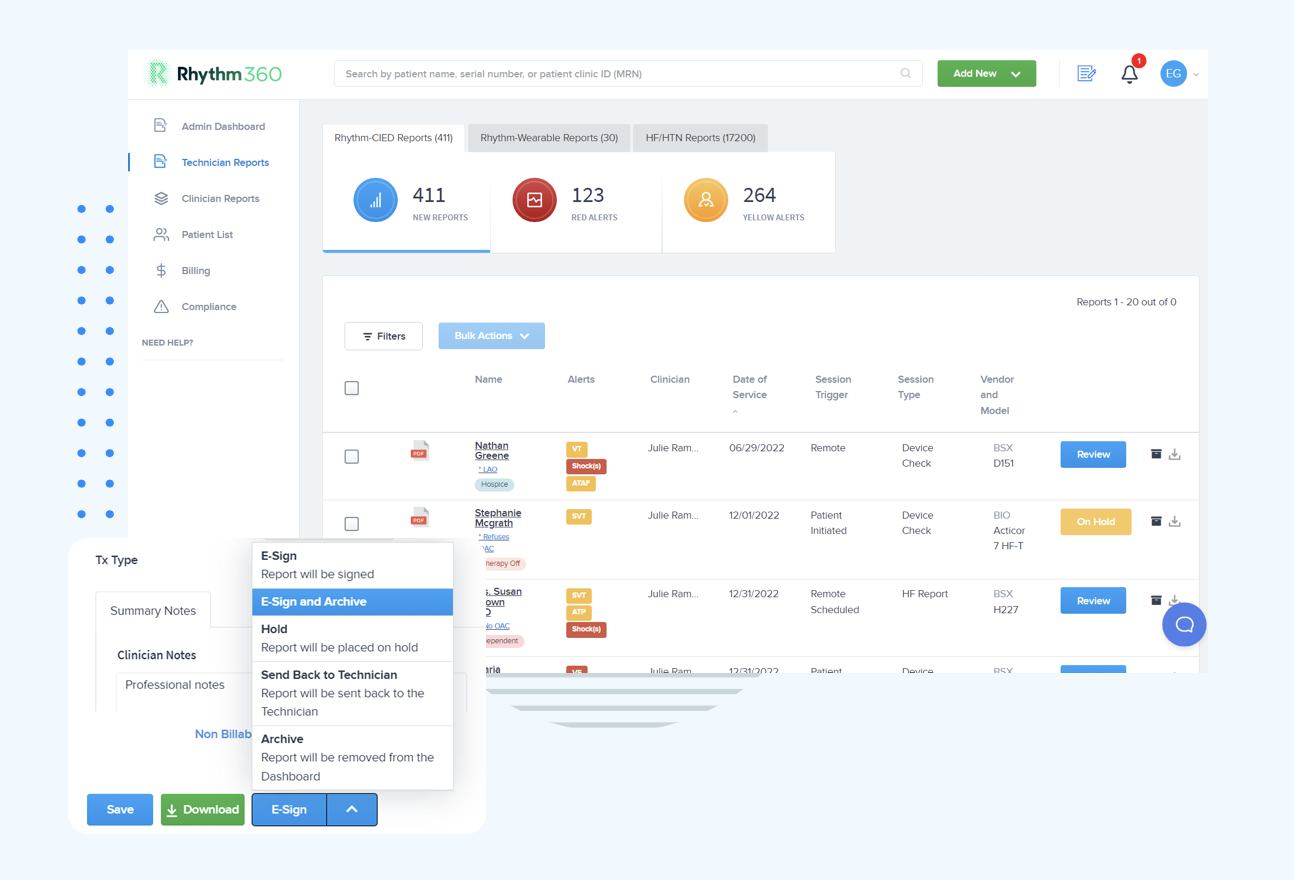
These remote monitoring reimbursement codes create additional revenue opportunities for monitoring service providers by supporting billing for consolidated remote cardiac monitoring services. Rhythm360’s automated CPT code capture converts that opportunity into realized revenue, increasing profitability by as much as 300 percent through improved billing accuracy, better staff efficiency, and the addition of new RPM service lines for HF and HTN management.
Request a revenue projection based on your current patient volume and CPT mix.
Critical alerts arrive around the clock, not just during office hours. A platform that requires workstation access creates coverage gaps on evenings and weekends, when missed events carry the highest clinical risk.
Rhythm360’s HIPAA-compliant mobile application allows electrophysiologists and on-call clinicians to review transmissions, sign reports, and coordinate care from any location. Studies show that telemonitoring of heart failure patients can reduce readmission rates, and those outcomes depend on continuous, location-independent monitoring coverage rather than office-hours-only review.
The following table shows how vendor-neutral platforms compress evaluation and go-live timelines while improving reliability and financial performance across four critical dimensions.
| Criterion | Typical Enterprise Platform (e.g., PaceMate) | Vendor-Neutral Platform (e.g., Rhythm360) | Industry Benchmark |
|---|---|---|---|
| Demo-to-contract timeline | Several weeks to months (discovery, scoping, security review, contracting) | Days to weeks | Most clinics go live within a few weeks after starting the process (PrepMD benchmark) |
| EHR integration go-live | Varies, and complex environments extend timelines significantly | Days to a few weeks | Octagos average EHR integration time is 21 days across over 170 live integrations spanning more than 20 EHR systems |
| Data transmissibility | Dependent on OEM server uptime, with no published redundancy standard | More than 99.9 percent via redundant feeds, AI gap-filling, and computer vision PDF parsing | AI-powered arrhythmia classification platforms such as InfoBionic.Ai MoMe ARC |
| Revenue impact | Dependent on manual billing workflow, with no published CPT capture lift | Up to 300 percent profitability increase through automated CPT capture | The 43 percent compliance gap noted earlier translates directly to uncaptured revenue across the industry |
Use this checklist when you evaluate PaceMate or any competing platform so you can compare capabilities on equal footing.
Rhythm360 answers yes to every item on this list. Verify each capability against your specific workflow requirements with a live Rhythm360 walkthrough.
PaceMate does not offer a self-serve free trial. As an enterprise cardiac monitoring platform, PaceMate relies on a structured evaluation process that begins with a discovery call and continues through scoping, security review, and a guided demonstration. This approach reflects the operational complexity of multi-OEM CIED data integration, EHR connectivity, and regulatory compliance requirements that a self-serve trial cannot meaningfully assess. Practices that need faster evaluation timelines can consider vendor-neutral platforms with streamlined onboarding.
The full cycle from initial contact to a live PaceMate demo typically spans one to several weeks, depending on the availability of IT, compliance, and clinical stakeholders for discovery and scoping. Implementation after contract execution adds additional time, and complex enterprise EHR environments extend go-live timelines further. As outlined in the demo process section above, the main bottleneck usually involves stakeholder availability rather than the platform’s technical capabilities.
A fully functional cardiac monitoring platform requires bi-directional integration with the practice’s EHR, including Epic, Cerner, athenahealth, eClinicalWorks, or others via HL7. It also needs direct data feeds from all OEM remote monitoring networks, including Medtronic CareLink, Boston Scientific Latitude, Abbott Merlin.net, and Biotronik Home Monitoring, along with a compliant communication layer for patient outreach and audit logging. Outbound EHR writes should include encounter creation, e-signed report filing, discrete data elements, and billing information. Rhythm360 supports all of these integration types natively.
Yes. Modern vendor-neutral platforms are built to manage both service lines within a single workspace. Rhythm360 provides distinct but integrated modules for Rhythm-CIED, which covers pacemakers, ICDs, implantable loop recorders, CRT or CCM devices, and CardioMEMS, and for HF or HTN remote physiological monitoring. These modules include patient onboarding checklists and automated billing support for RPM CPT codes such as 99453, 99454, and 99457. Managing both service lines on one platform removes the need for separate vendor contracts, separate staff training, and separate billing workflows.
Data transmissibility above 99.9 percent requires a multi-layered technical architecture. Rhythm360 achieves this level through redundant data feeds that act as a failsafe when an OEM server is unavailable, AI-powered data extrapolation that fills gaps in incomplete transmissions, and computer vision OCR that parses unstructured PDF reports from OEM portals without structured API access. This combination gives clinicians a complete, cross-referenced view of every patient’s device status regardless of upstream technical failures. That capability does not surface in a short self-serve trial and must be evaluated through a live, guided demonstration.
The absence of a PaceMate free trial reflects the genuine complexity of enterprise cardiac monitoring implementation. That complexity does not require a months-long evaluation cycle, however. Vendor-neutral platforms with pre-built OEM connectivity, redundant data infrastructure, automated CPT documentation, and rapid EHR integration deliver measurable outcomes, including up to 80 percent faster critical alert response and up to 300 percent revenue lift, on timelines measured in days to weeks rather than quarters.
The $536 million Medicare RPM market growing at 31 percent annually rewards practices that move decisively. Rhythm360 is built for that speed. Request a workflow assessment and revenue projection tailored to your practice.