PaceMate implementations with full EHR integration typically require 6–12 weeks, driven by discovery, build, validation, configuration, and go-live phases that introduce multiple dependencies.
Enterprise EHR systems like Epic and Cerner add significant delays through security reviews, marketplace approvals, and multi-stakeholder coordination that practices must anticipate.
Common pitfalls such as custom field mapping, FHIR version mismatches, scope creep, and compliance review cycles frequently extend timelines beyond initial estimates.
Practices that complete readiness steps, including BAAs, Security Risk Analyses, and patient ID audits, before integration begins consistently achieve shorter, lower-risk go-lives.
Rhythm360 offers a faster alternative with bi-directional HL7 integration completed in days to a few weeks; contact us to accelerate your rollout.
A remote cardiac monitoring implementation typically unfolds across five phases: discovery and scoping, integration build, data validation, workflow configuration, and training and go-live. Each phase introduces dependencies, including EHR vendor approvals, IT resource availability, and compliance reviews, that compound when not anticipated.
Timeline accuracy matters because a delayed go-live directly delays CPT code capture for remote monitoring services (for example, 93298, 93299, 99454). Delays also strain device technicians who must manage manual workarounds and create gaps in alert coverage for patients with cardiac implantable electronic devices (CIEDs). Practices that enter implementation without a phase-by-phase schedule and defined exit criteria routinely experience overruns that extend the original estimate by weeks.
Modern cardiology practices operate in a multi-OEM, multi-EHR environment. A single clinic may manage devices from Medtronic, Boston Scientific, Abbott, and Biotronik simultaneously, each requiring access to a separate, non-interoperable manufacturer portal. Layered on top of that fragmentation is the EHR ecosystem, including Epic, Cerner (Oracle Health), athenahealth, and eClinicalWorks, each with its own integration architecture, certification program, and change-control process.
The industry has been shifting away from this fragmented portal model toward unified platforms that consolidate device data and write clinical documentation back to the EHR automatically. That shift is operationally sound, but the transition itself carries implementation risk that varies significantly by platform and EHR combination. Understanding this fragmented environment is essential because each layer, including OEM portals, EHR systems, and integration protocols, introduces dependencies that directly affect implementation timelines.
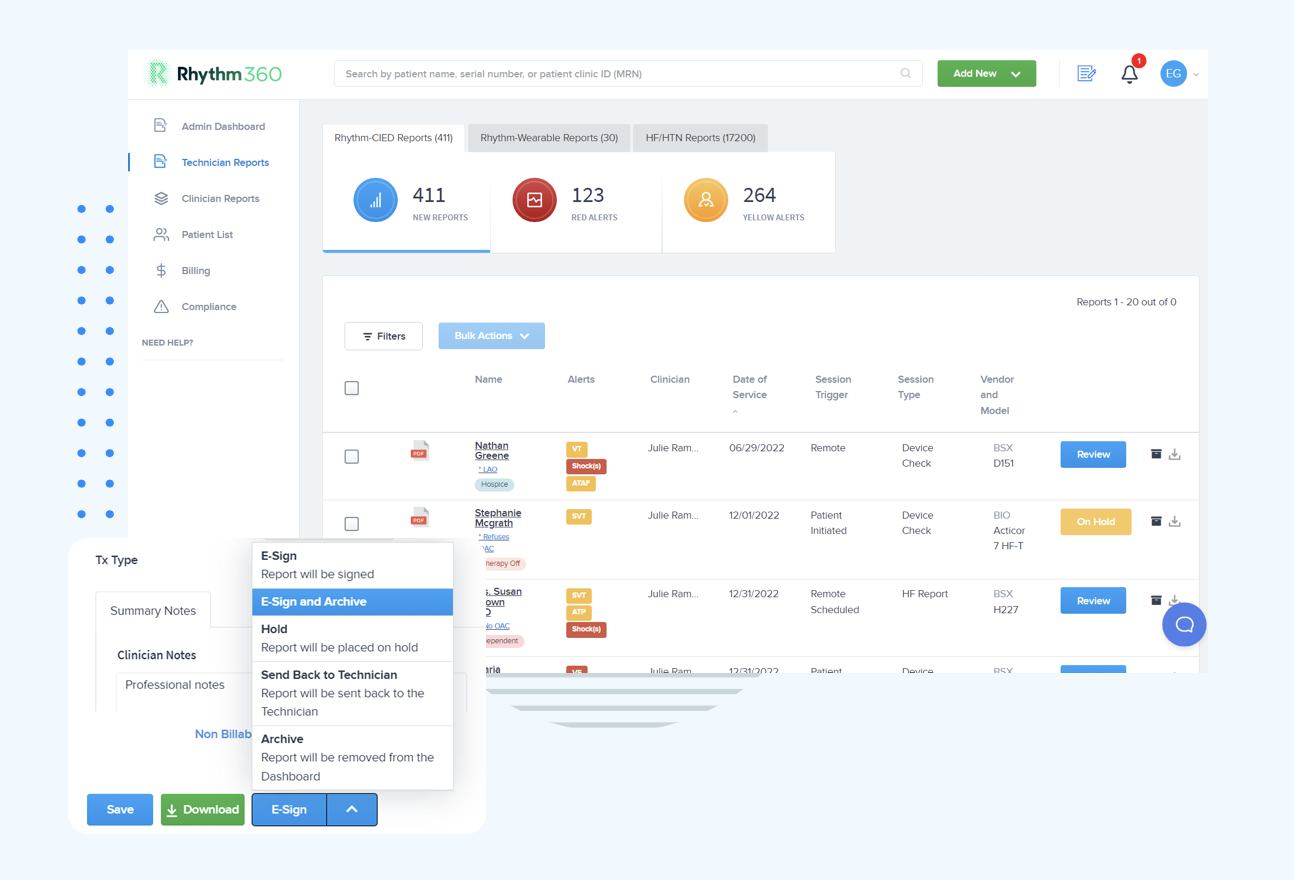
See how Rhythm360 unifies all OEM data streams into a single vendor-neutral dashboard and reduces the friction of this multi-system landscape.
Given the complexity of the multi-OEM, multi-EHR environment described above, a realistic PaceMate implementation timeline for a practice pursuing full EHR integration often spans multiple weeks. The rollout typically follows five sequential phases:
Discovery (Weeks 1–2): Stakeholder alignment, data flow mapping, patient ID strategy, and confirmation of EHR endpoints occur in this phase. Enterprise EHR environments, particularly Epic and Cerner, require security review, privacy attestation, and architectural validation before any connectivity work begins, as documented in Octagos's analysis of 200+ bi-directional cardiac EHR integrations.
Integration Build (Weeks 2–5): Teams stand up secure connections, configure HL7 or FHIR message types, map clinical fields, and establish billing logic. EHR-to-third-party app integrations frequently require custom interface development, testing, and ongoing maintenance, which all add build time.
Data Validation (Weeks 5–7): Teams run end-to-end sandbox testing, reconcile patient records, and verify that inbound demographics, diagnosis codes, and orders match outbound encounter creation and billing data accurately.
Workflow Configuration (Weeks 7–9): Role-based alert routing, report templates, and CPT code capture logic are configured to match the practice's existing clinical workflows. Most EHR deployments carry heavily customized fields and templates that create integration friction at this stage.
Training and Go-Live (Weeks 9–12): Teams complete role-based staff training, production cutover, and a stabilization period with dedicated support. Change resistance and workflow redesign needs can extend this phase, particularly when clinical staff must simultaneously manage legacy portal access during transition.
Before committing to a specific platform, practice administrators should weigh three strategic variables that collectively determine long-term operational sustainability. First, build versus buy decisions set the technical foundation. Custom EHR interface development offers theoretical flexibility but introduces ongoing maintenance liability and version-compatibility risk. EHR upgrades can break existing interfaces if customizations are not carefully managed, creating remediation cycles that delay monitoring continuity and directly affect staffing needs.
The second variable is the staffing model that supports the chosen architecture. A platform that requires a dedicated "super-user" to manage integrations creates a single point of failure. Platforms with automated data ingestion and self-service dashboards distribute operational load more sustainably and reduce reliance on a single specialist.
Both technical architecture and staffing decisions influence the third variable, which is change-management burden. The larger the gap between the current manual workflow and the new platform's automated workflow, the longer the adoption curve. A longer adoption curve extends the period during which billing and alert coverage remain at risk.
Request a demo to assess how Rhythm360's automated workflows reduce change-management burden for your team.
Practices that complete pre-implementation readiness work consistently experience shorter go-live timelines. Key prerequisites include:
Stakeholder alignment: Hospital IT, EHR analysts, security teams, and the EHR vendor must all be engaged before integration build begins. Multi-stakeholder coordination is a documented rollout risk that delays approvals when not managed proactively.
Data quality: Patient ID matching across EHR systems ranks among the most technically challenging integration problems. Demographic data inconsistencies cause mismatched records and can delay validation phases by weeks.
Compliance prerequisites: A documented Security Risk Analysis is required under the HIPAA Security Rule for any system that creates, receives, maintains, or transmits ePHI, and this analysis must identify threats, vulnerabilities, and remediation steps before go-live. Business Associate Agreements must also be executed with the monitoring platform and EHR vendor before any PHI is shared, and missing or incomplete BAAs can delay approval and onboarding timelines.
EHR certification readiness: Epic requires approval via its current marketplace program, such as Showroom, or ONC criteria documentation for third-party apps needing bi-directional EHR access. Cerner requires specific approvals for third-party write access to the EHR. These requirements add multi-stakeholder coordination requirements that are outside the monitoring vendor's direct control.
Several recurring failure points extend PaceMate implementation time beyond initial estimates:
Custom Epic builds: Epic's highly customized deployment model means that generic FHIR support often does not match a specific clinic's EHR configuration, which requires local interface tuning that adds 2–4 weeks to the integration build phase.
FHIR version incompatibilities: Version mismatches between FHIR implementations (DSTU2, STU3, R4, R5) and vendor-supported versions delay development and testing cycles and commonly add 1–3 weeks.
Scope creep: Expanding integration requirements mid-project, such as adding new data elements, additional OEM feeds, or billing logic changes, resets validation timelines and can extend go-live by 2–6 weeks.
Resource contention: Hospital IT teams that manage concurrent EHR upgrade projects frequently deprioritize third-party integration work. Performance and reliability issues at scale, such as slow API response times during clinical workflows, are also common when IT bandwidth is constrained.
Compliance review delays: The HIPAA Security Rule requires reassessment of risks and controls after significant system changes, and a new monitoring platform integration qualifies as such a change. This requirement triggers additional review cycles that can add 1–2 weeks to pre-launch preparation.
Schedule a consultation to learn how Rhythm360's pre-built HL7 integrations reduce the risk of these common delays.
Post-go-live performance should be tracked across four metric categories to validate that implementation objectives are being met:
Clinical: Alert response time, with a target reduction of up to 80 percent from baseline, critical event detection rate, and missed transmission rate.
Operational: Staff hours saved per week on data retrieval and manual entry, reduction in OEM portal logins, and device technician time-to-report.
Financial: CPT code capture rate for 93298, 93299, 99454, and related codes, claim acceptance rate, and revenue per monitored patient per month.
Compliance: Audit log completeness, BAA currency, Security Risk Analysis review cadence, and role-based training completion rates per AccountableHQ's cardiology HIPAA compliance guidance.
The table below compares estimated implementation timelines across three remote cardiac monitoring platforms and four major EHR systems. PaceMate timelines reflect vendor-published estimates where available. Rhythm360 timelines reflect the company's stated onboarding range for bi-directional HL7 integration. Because vendor-published timelines for Murj by specific EHR are not publicly available at a per-system level, the ranges below represent estimates applied uniformly, and practices should request EHR-specific estimates directly from each vendor.
EHR System | PaceMate (Est. Weeks) | Murj (Est. Weeks) | Rhythm360 (Est. Weeks) |
|---|---|---|---|
Epic | 6–12 (per PaceMate) | 8–12 (enterprise certification overhead) | Days to a few weeks (bi-directional HL7) |
Cerner (Oracle Health) | 8–10 (per PaceMate) | 8–12 (enterprise certification overhead) | Days to a few weeks (bi-directional HL7) |
athenahealth | 3-5 days (per PaceMate) | 6–10 | Days to a few weeks (bi-directional HL7) |
eClinicalWorks | Varies (custom field mapping, change-control risk per Emorphis Health) | 6–10 | Days to a few weeks (bi-directional HL7) |
How long does PaceMate implementation typically take?
A full PaceMate implementation with EHR integration varies by the EHR system and can take 6–12 weeks for Epic, 8–10 weeks for Cerner, or 3-5 days for athenahealth, depending on the practice's internal IT bandwidth and how many compliance prerequisites are completed before the integration build begins.
Enterprise EHR environments like Epic and Cerner tend toward the longer end of that range because of approval processes and multi-stakeholder coordination. Practices with well-configured, cloud-hosted EHR instances and dedicated IT resources may complete implementation closer to the lower end of the range.
What EHR-specific factors most commonly delay cardiac monitoring implementations?
Epic integrations require approval via its current marketplace program, such as Showroom, or ONC criteria documentation for third-party apps needing bi-directional EHR access, and Cerner integrations require specific approvals, which adds multi-stakeholder coordination overhead that is outside the monitoring vendor's control. athenahealth and eClinicalWorks integrations are generally faster but still subject to FHIR version incompatibilities, custom field mapping requirements, and change-control processes that can add 1–3 weeks. Across all EHR systems, incomplete Business Associate Agreements, unresolved patient ID matching issues, and pending Security Risk Analyses are the most common pre-launch blockers.
What are the patient safety risks during a cardiac monitoring platform transition?
During the transition period, particularly the integration build and validation phases, practices often run parallel workflows, and staff access both the legacy OEM portals and the new platform simultaneously. This pattern creates alert coverage gaps if critical transmissions are routed to a system that staff are not actively monitoring. Practices should define a clear cutover date, assign explicit alert ownership during the transition, and ensure that the new platform's alert routing is fully validated in a sandbox environment before production go-live.
How does Rhythm360's implementation timeline compare to PaceMate's?
Rhythm360's onboarding process, including bi-directional HL7 EHR integration, is designed to complete in days to a few weeks, which is significantly shorter than the timelines typical of full EHR-integrated PaceMate rollouts. Rhythm360 integrates with Epic, Cerner, athenahealth, eClinicalWorks, Greenway Health, and others via HL7, and its pre-built integration architecture reduces the custom development and certification overhead that extends enterprise EHR timelines for other platforms.
What should a practice do before starting any cardiac monitoring platform implementation?
Before initiating implementation, practices should complete four readiness steps. Teams should execute Business Associate Agreements with the monitoring vendor and EHR vendor. They should complete or update the HIPAA Security Risk Analysis to cover the new platform. They should confirm that hospital IT and EHR analyst resources are available and not committed to concurrent upgrade projects. They should also audit patient demographic data quality to minimize ID-matching failures during integration validation. Completing these steps before the integration build begins is the single most reliable way to avoid timeline extensions.
PaceMate implementation time functions as a genuine operational variable, not a formality. The multi-week EHR integration window carries real financial and clinical risk, including delayed CPT code capture, strained staff workflows, and potential gaps in CIED alert coverage. The factors that extend timelines, such as enterprise EHR approval processes, FHIR version mismatches, compliance review cycles, and resource contention, are well-documented and largely predictable.
Practices that plan for these factors systematically, complete readiness prerequisites before build begins, and select a platform with pre-built EHR integration architecture will consistently achieve faster, lower-disruption go-lives. Rhythm360's bi-directional HL7 integration, vendor-neutral data ingestion, and days-to-weeks onboarding timeline offer a measurable alternative to the extended rollouts that characterize legacy implementation approaches.