

PaceMate is a cloud-based cardiac device management company that acquired Paceart Optima from Medtronic and took over the platform used by thousands of cardiology practices to organize and manage CIED data. PaceMate now serves as the primary vendor for Paceart Optima support, migration, and future development for these clinics. The company positions Paceart as a consolidated hub for cardiac device workflow, yet it still functions as a proprietary system with its own access terms, pricing, and integration roadmap.
Medtronic’s divestiture of Paceart Optima to PaceMate transferred ownership of an on-premise organizational database that many EP labs had relied on for years. For existing Medtronic Paceart users, the acquisition created immediate uncertainty about data access, new support terms, and preservation of legacy configurations.
The transition means that practices previously operating Paceart Optima under Medtronic’s support umbrella now work with PaceMate for licensing, upgrades, and data governance. EHR upgrades, role changes, and template tweaks can break interfaces without strong monitoring and maintenance, and this risk grows when the underlying platform changes ownership mid-cycle. Practices that have not yet migrated face an uncertain support horizon for their existing Paceart configurations.
Beyond support and licensing questions, the acquisition leaves a deeper workflow challenge unresolved for multi-vendor clinics. PaceMate’s acquisition of Paceart Optima does not automatically resolve the longstanding friction between Medtronic and Abbott data ecosystems. Abbott devices still transmit through Merlin.net, a separate proprietary portal with its own data formats, alert thresholds, and access credentials. Achieving a single workflow that seamlessly integrates data from Abbott, Biotronik, Boston Scientific, Medtronic, and Microport requires a purpose-built vendor-neutral platform.
Clinics managing both Medtronic and Abbott CIEDs under a PaceMate-centric workflow still face the core challenge of patient ID matching across MRN, NPI, payer IDs, and device serial numbers, plus aligning encounter and order semantics so the correct billing and signing workflow is preserved. PaceMate’s proprietary architecture does not remove these cross-vendor reconciliation burdens for Abbott device populations.
Reported operational consequences of portal fragmentation include duplicate work such as device specialists re-entering demographics and manually copying report PDFs, stale clinical data such as outdated medication lists or missing hospitalizations that alter transmission interpretation, and missed billing when encounters and signed reports do not flow back automatically.
CIED volumes are growing faster than clinical staff, so without integration every new patient adds linear workload to a team that is already stretched. Because the PaceMate acquisition does not reduce the number of portals a multi-vendor clinic must manage, it only changes who controls one of them, this workload pressure continues. The fragmentation also amplifies audit risk, since reconciling who saw what and when becomes painful in a tightly regulated specialty such as cardiac device management.
Learn how Rhythm360 closes these workflow gaps across every device manufacturer.
| Capability | PaceMate (Paceart Optima) | Rhythm360 (Vendor-Neutral) | Notes |
|---|---|---|---|
| Data Transmissibility | Not publicly benchmarked | >99.9% via redundant feeds, AI, and computer vision | Rhythm360 uses redundant data feeds as a fail-safe when OEM servers are unavailable. |
| Alert Triage | Proprietary, scope not publicly detailed | AI-powered prioritization, with up to 80% reduction in critical-alert response time | Fragmented portals increase alert fatigue and delay triage. |
| EHR Integration | Limited, migration-dependent | Bi-directional with Epic, Cerner, Athenahealth, eClinicalWorks, with go-live in days to weeks | Deloitte 2026 recommends unified digital platforms over disconnected point solutions. |
| CPT Billing Support | Not a stated core feature | Automated CPT capture (93298, 93299, 99454, 99457), supporting revenue growth | Missed billing slips through for months without automated outbound encounter creation. |
| Mobile Access | Not publicly confirmed | HIPAA-compliant mobile app for transmission review, report signing, and care coordination | Mobile access is critical for on-call clinicians managing weekend alerts. |
The financial case for a vendor-neutral platform is concrete for clinics that manage multiple device vendors. Practices using Rhythm360 have reported major improvements in both response times and revenue, driven by optimized CPT code capture and the addition of RPM service lines for heart failure and hypertension management. Unified data consolidated from multiple sources enables advanced analytics, predictive models, and generative AI recommendations that support proactive, coordinated care and improved health outcomes.
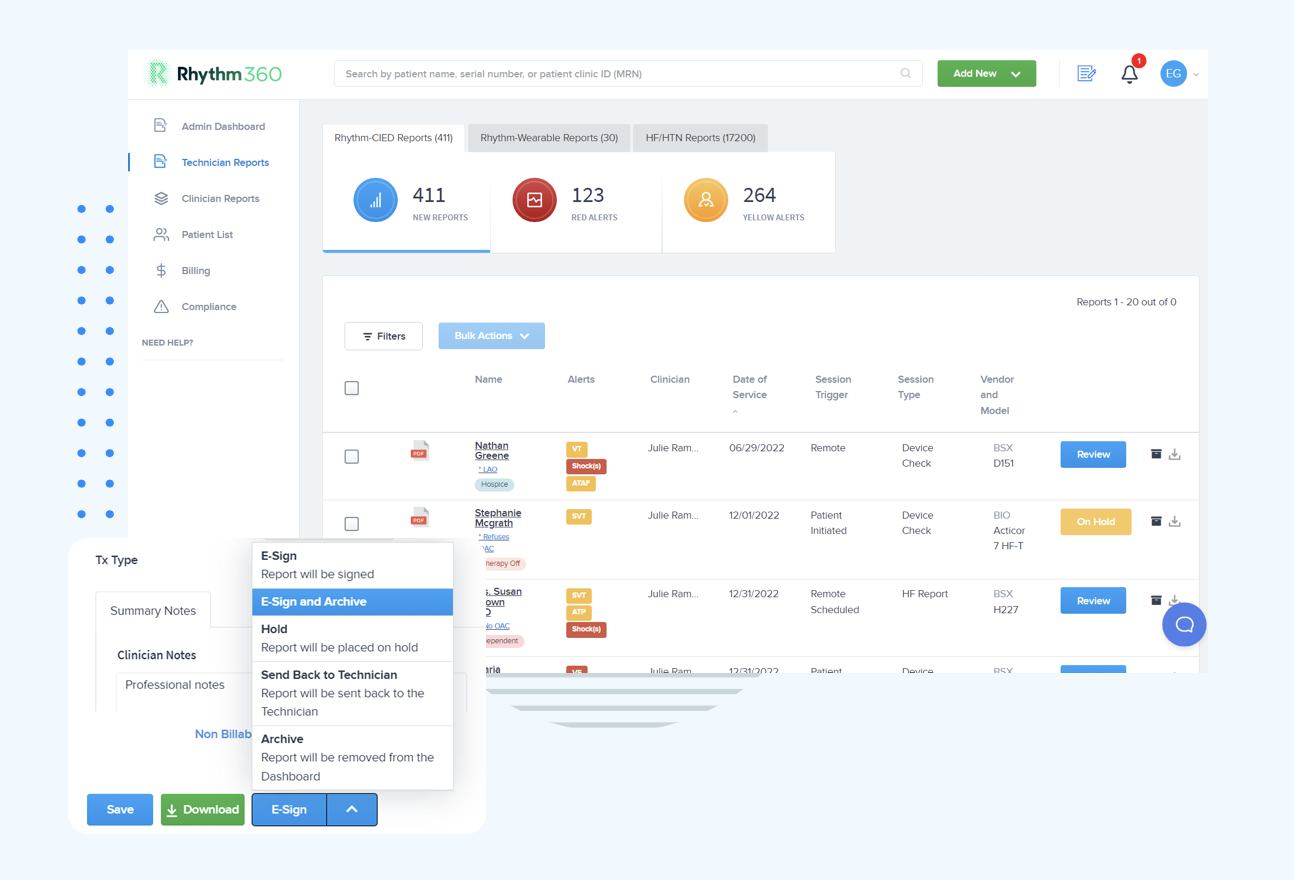
Real-time bi-directional EHR integration requires automatic outbound creation of encounters, e-signed reports, and billing information, and these capabilities directly translate to recovered revenue on CPT codes 93298, 93299, 99454, and 99457 that would otherwise go unbilled.
A common objection to switching platforms centers on implementation disruption and staff burden. Rhythm360’s onboarding process, including EHR integration with systems such as Epic, Cerner, and Athenahealth, typically takes a few days to a few weeks. Implementation of bi-directional EHR integration for multi-vendor CIED workflows follows a structured project plan with discovery and scoping, connectivity and mapping, validation and training, then go-live. The SaaS-based pricing model scales with clinic size and usage and avoids the large upfront costs associated with legacy on-premise systems like the original Paceart architecture.
Use this checklist when evaluating any cardiac monitoring platform in the post-Paceart acquisition environment:
Walk through this checklist with a Rhythm360 specialist.
Clinics that relied on Paceart Optima under Medtronic can move to a vendor-neutral cloud platform instead of migrating into PaceMate’s proprietary environment. Platforms like Rhythm360 consolidate data from Medtronic, Abbott, Boston Scientific, Biotronik, and others into a single dashboard, which removes the need to maintain separate credentials for each OEM portal. The transition typically takes a few days to a few weeks and includes EHR integration setup.
Data ownership terms follow the contract between the clinic and PaceMate as the new platform operator. Clinics should review their service agreements carefully to confirm data portability rights, export formats, and the handling of historical records if they later migrate to a different platform. When evaluating alternatives, clinics should ask each prospective vendor for explicit contractual language on data ownership and portability before signing.
Rhythm360 ingests Abbott CIED data through a combination of API connections, HL7 feeds, XML parsing, and AI-powered computer vision for PDF-based reports. This approach normalizes transmissions from Abbott Merlin.net into the same unified dashboard as Medtronic, Boston Scientific, and Biotronik data. The platform automates the patient ID reconciliation described earlier, which removes the manual burden that multi-vendor clinics currently absorb.
As outlined in the implementation section above, the timeline depends on clinic size and EHR complexity but usually completes in a few days to a few weeks. The process follows the same structured four-phase approach of discovery and scoping, data connectivity and field mapping, validation and staff training, then go-live, with dedicated implementation support throughout.
A well-structured migration to a vendor-neutral platform should not create monitoring gaps. Rhythm360’s redundant data feed architecture ensures that if an OEM server experiences downtime during or after migration, transmissions are still captured through backup channels, which maintains greater than 99.9% data transmissibility. All communications, report signatures, and alert responses are logged with a full audit trail, supporting HIPAA compliance and reducing audit risk throughout the transition period.
The PaceMate acquisition of Medtronic Paceart Optima reshuffles platform ownership but does not solve the central problem facing multi-vendor cardiology practices. Clinics still contend with fragmented data, manual workflows, alert fatigue, and revenue leakage caused by operating across disconnected proprietary systems. Health care organizations are advised to create or join digital platforms with shared capabilities, data, and governance instead of investing in disconnected point solutions.
Rhythm360 provides that unified platform, remaining vendor-neutral and AI-powered while consolidating Medtronic, Abbott, Boston Scientific, and Biotronik data into a single source of truth with greater than 99.9% transmissibility, automated CPT billing, bi-directional EHR integration, and a HIPAA-compliant mobile application. Practices that have made the transition report the response-time and revenue improvements detailed above.
See what unified CIED monitoring looks like in your practice — schedule your demo today.





