PaceMate does not publish a public rate card. The estimates below come from vendor positioning materials, peer benchmarking, and market intelligence gathered through 2025–2026. All figures represent estimated ranges and should be validated directly with PaceMate during a formal sales engagement. Contract terms, patient volume, and integration scope materially affect final quotes.
| Tier | Est. Monthly Cost (per patient) | Support Level | Key Limitations |
|---|---|---|---|
| Starter / Software-Only | ~$8–$14 | Self-service, email support | No managed monitoring, limited EHR integration, manual billing documentation |
| Professional | ~$15–$22 | Business-hours phone and email | EHR integration may carry add-on fees, alert triage is user-managed |
| Enterprise | ~$23–$35 | Dedicated account management | Multi-year contract typically required, custom onboarding timeline |
| Full-Service / Managed | ~$36–$55+ | 24/7 clinical monitoring staff | Highest per-patient cost, post-PaceArt acquisition pricing under revision |
Compare Rhythm360's transparent pricing to see how published SaaS rates stack up against these estimates for your patient volume.
PaceMate is a cloud-based cardiac device data management platform that aggregates remote transmissions from implantable cardiac electronic devices (CIEDs) across multiple original equipment manufacturers (OEMs). PaceMate acquired Medtronic’s Paceart Optima system (later rebranded PaceArt) on August 27, 2024, a Medtronic-owned on-premise database product, and began migrating PaceArt customers to its cloud infrastructure. The combined entity now markets four service configurations that range from a self-service software license to a fully managed clinical monitoring service. This acquisition introduced a period of pricing and service-structure transition that has created uncertainty for existing PaceArt customers evaluating renewal options.
Most cardiology practices implant devices from at least two OEMs, so staff must access separate, non-interoperable manufacturer portals. Manual data reconciliation across Medtronic, Boston Scientific, Abbott, Biotronik, and MicroPort portals forces device specialists to re-enter demographics, look up encounters, and copy report PDFs into the EHR, which creates labor that generates no billable output.
At the same time, CMS has expanded the CPT code set for remote physiologic monitoring. Effective January 1, 2026, the Physician Fee Schedule includes CPT 99445 for 2–15 monitoring days, CPT 99454 for 16 or more monitoring days, CPT 99457 for the first 20 minutes of clinical management time ($51.77), CPT 99458 for each additional 20-minute increment ($41.42), and CPT 99470 for 10–19 minutes of clinical time ($26.05). Platforms that cannot automate documentation for this expanded code set create direct revenue leakage, which makes a platform’s data processing and billing capabilities central to ROI.
PaceMate ingests CIED transmission data from OEM networks, normalizes it into a unified worklist, and generates reports that clinicians sign within the platform. Signed reports are intended to feed downstream billing workflows, either through a native billing module or through EHR export. When encounters and signed reports do not flow automatically back to the EHR, claims can be lost or delayed for months. The depth of EHR integration, and whether it is bidirectional, varies by PaceMate tier and is a primary driver of both implementation cost and ongoing revenue capture.
Software-only models transfer alert triage and billing documentation responsibility to clinic staff, which reduces the platform fee but increases labor cost. Full-service models include clinical monitoring staff but carry the highest per-patient rate and typically require multi-year commitments. Both approaches carry financial risk, and high upfront implementation costs and uncertain ROI represent a key restraint for small and independent practices evaluating remote monitoring platforms, regardless of service tier.
User-seat pricing, onboarding timelines, and EHR integration scope should be negotiated explicitly before signature. EHR integration with systems such as Epic or Cerner using HL7 FHIR standards can add $20,000 to $50,000 per system when not included in the base contract, so practices should confirm whether these costs are bundled or separate.
The acquisition consolidated two previously competing products under one vendor. Practices that licensed PaceArt as a standalone on-premise database are now being transitioned to PaceMate's cloud environment. This migration introduces new per-patient subscription costs for customers who previously paid a flat site license.
Contract terms inherited from PaceArt agreements may not carry forward, so practices should request written pricing continuity guarantees before completing any migration. Market consolidation in the US RPM sector accelerated through 2025, and post-acquisition pricing revisions are a documented pattern across the industry.
The table below compares four platforms across dimensions relevant to cardiology practice administrators. Cost ranges are market estimates, and vendor-specific figures should be confirmed during procurement. Rhythm360 ROI metrics reflect documented client outcomes.
| Criterion | PaceMate | Murj | Octagos | Rhythm360 |
|---|---|---|---|---|
| Est. Monthly Cost (per patient) | ~$8–$55+ (tier-dependent, unconfirmed) | Not publicly disclosed | Not publicly disclosed | SaaS, scales by clinic size and usage |
| Vendor Neutrality | Multi-OEM, PaceArt legacy ties to Medtronic | Multi-OEM | Multi-OEM | Fully vendor-neutral (Medtronic, BSc, Abbott, Biotronik, others) |
| AI Alert Triage | Available in higher tiers | Workflow automation focus | AI-driven non-actionable transmission filtering | AI triage plus optional 24/7 CCT oversight, 80% faster critical alert response |
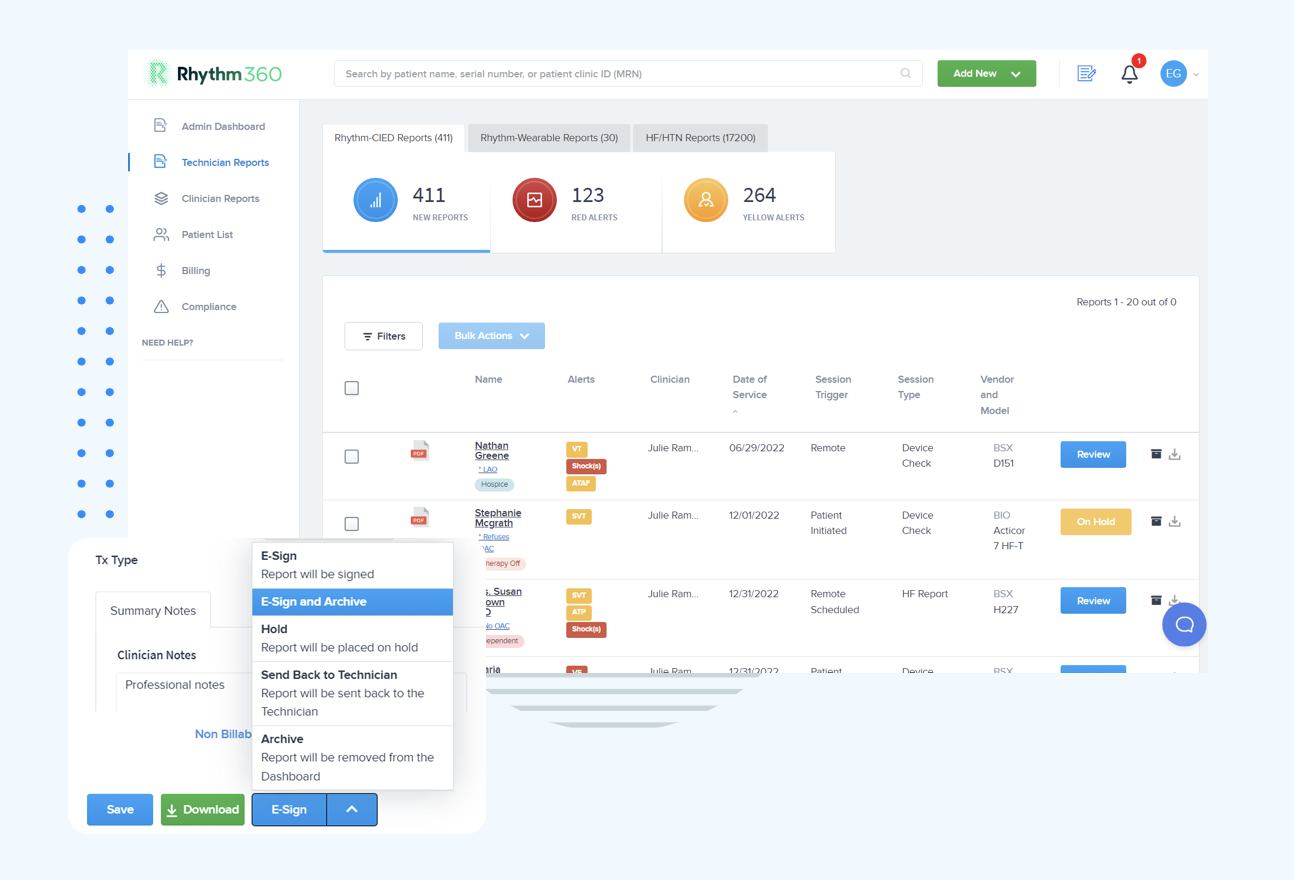
| EHR Integration Depth | Varies by tier, add-on fees reported | Available | Bi-directional EHR integration | Bi-directional with Epic, Cerner, Athenahealth, eClinicalWorks, Greenway via HL7 |
| Published ROI Metrics | Not publicly available | Not publicly available | Not publicly available | 80% reduction in critical alert response time, up to 300% revenue increase |
Rhythm360 achieves >99.9% data transmissibility through redundant OEM data feeds, computer vision OCR, and AI-powered gap extrapolation. No competing platform has published a comparable reliability figure.
Request a custom cost analysis built on your actual patient census.
Hidden costs for remote monitoring platforms frequently include annual maintenance (15–25% of original implementation cost), HIPAA security audits ($5,000–$15,000 per session), and HIPAA-compliant cloud hosting ($500–$2,000+ per month). Per-patient fees that escalate with volume, alert-fatigue costs from non-actionable notifications, and revenue leakage from incomplete CPT documentation are the three most common budget surprises.
Missed billing occurs when encounters and signed reports do not flow automatically back to the EHR, causing claims to be lost or delayed for months. Contracts that exclude bidirectional EHR integration from the base fee effectively transfer this risk to the practice.
Four KPIs determine whether a remote cardiac monitoring platform delivers its contracted value: alert response time, billable event capture rate, staff hours saved per 100 patients per month, and patient compliance percentage. A practical target is under 24 hours for critical events and a high percentage of qualifying transmissions converted to submitted claims.
CPT 99445 and 99454 are mutually exclusive within a 30-day period, so platforms must correctly classify each patient’s transmission frequency to avoid claim denials. Practices should require monthly reporting on all four KPIs as a contract deliverable.
The phrase “what is the cost of a pacemaker device?” often conflates device acquisition cost with ongoing monitoring reimbursement. The device itself is reimbursed through a separate DRG or APC pathway at implant. Remote monitoring of that device after implant is reimbursed through the RPM and CIED code families on a recurring basis.
| CPT Code | Service Description | 2026 Medicare Rate (Non-Facility) | Billing Frequency |
|---|---|---|---|
| 99453 | RPM device setup and patient education | $21.71 | Once per device per patient |
| 99445 | Device supply, 2–15 days of data transmission | $47–$52 | Monthly (mutually exclusive with 99454) |
| 99454 | Device supply, 16+ days of data transmission | $47–$52 | Monthly (mutually exclusive with 99445) |
| 99470 | Clinical staff time, 10–19 minutes | $26.05 | Monthly |
| 99457 | Clinical staff time, first 20 minutes | $51.77 | Monthly |
| 99458 | Clinical staff time, each additional 20-minute increment | $41.42 | Monthly |
Combining RPM, CCM, and APCM services for a Medicare panel can generate significant recurring annual revenue under 2026 rates. Capturing that revenue requires a platform that automates documentation for every qualifying transmission and correctly maps each patient to the applicable code each month.
PaceMate does not publish a public rate card. Based on market intelligence and peer benchmarking, estimated per-patient monthly costs range from approximately $8–$14 for a self-service software-only tier to $36–$55 or more for a fully managed clinical monitoring service. Final pricing depends on patient volume, contract length, EHR integration requirements, support level, and whether the practice is migrating from a legacy PaceArt agreement. Practices should request an itemized quote that clearly identifies any per-patient fees, EHR integration costs, and annual maintenance charges before signing.
PaceMate acquired Medtronic’s Paceart Optima system (later rebranded PaceArt) on August 27, 2024 and is migrating PaceArt customers to its cloud platform. The on-premise PaceArt database is no longer sold as a standalone product. Existing PaceArt licensees are being transitioned to PaceMate's subscription model, which introduces recurring per-patient fees that may not have existed under the prior flat site-license structure. Practices currently on PaceArt should request written confirmation of pricing terms, data migration timelines, and any service continuity guarantees before completing the transition.
Five factors most commonly influence the final contract value: total enrolled patient count, the tier selected (software-only versus full-service managed monitoring), the number of EHR systems requiring integration, contract length (month-to-month versus multi-year), and the number of user seats. Add-on costs for HIPAA-compliant cloud hosting, security audits, and device-specific API integrations are frequently excluded from base-tier pricing and should be identified explicitly during procurement. Practices with multi-OEM device populations and Epic or Cerner EHR environments typically face the highest integration-related costs.
Implementation timelines for remote cardiac monitoring platforms vary by EHR complexity, patient volume, and the number of OEM data feeds requiring configuration. For platforms that require full Epic or Cerner integration, security reviews, privacy attestations, and HL7 interface tuning can extend timelines significantly. Rhythm360's streamlined onboarding process, including EHR integration, typically takes from a few days to a few weeks, which is materially faster than legacy on-premise migrations.
PaceMate's post-acquisition pricing transition, combined with the absence of a published rate card, creates real budget risk for cardiology practices entering or renewing contracts in 2026. The expanded 2026 CPT code set increases the revenue available to practices that can document every qualifying transmission and also increases the cost of platforms that cannot.
Administrators evaluating remote cardiac monitoring contracts should prioritize four criteria: transparent per-patient pricing with no undisclosed add-ons, bidirectional EHR integration included in the base fee, AI-powered alert triage with documented response-time benchmarks, and published ROI metrics from comparable practices. Rhythm360 meets all four criteria with a flexible SaaS model, >99.9% data transmissibility, an 80% reduction in critical alert response times, and documented revenue increases of up to 300% for clients improving CPT code capture across CIED and RPM service lines.
Get your ROI projection with a transparent cost model built on your practice's patient census and current billing performance.