

Cardiology teams that monitor CIED patients across Medtronic, Boston Scientific, Abbott, and Biotronik juggle separate OEM portals every day. Staff log in and out of each portal, pull transmission data, and then re-enter that information into the EHR by hand. This fragmented workflow increases documentation time, introduces transcription errors, and delays billing. Over time, the manual burden fuels staff burnout and leaves revenue on the table.
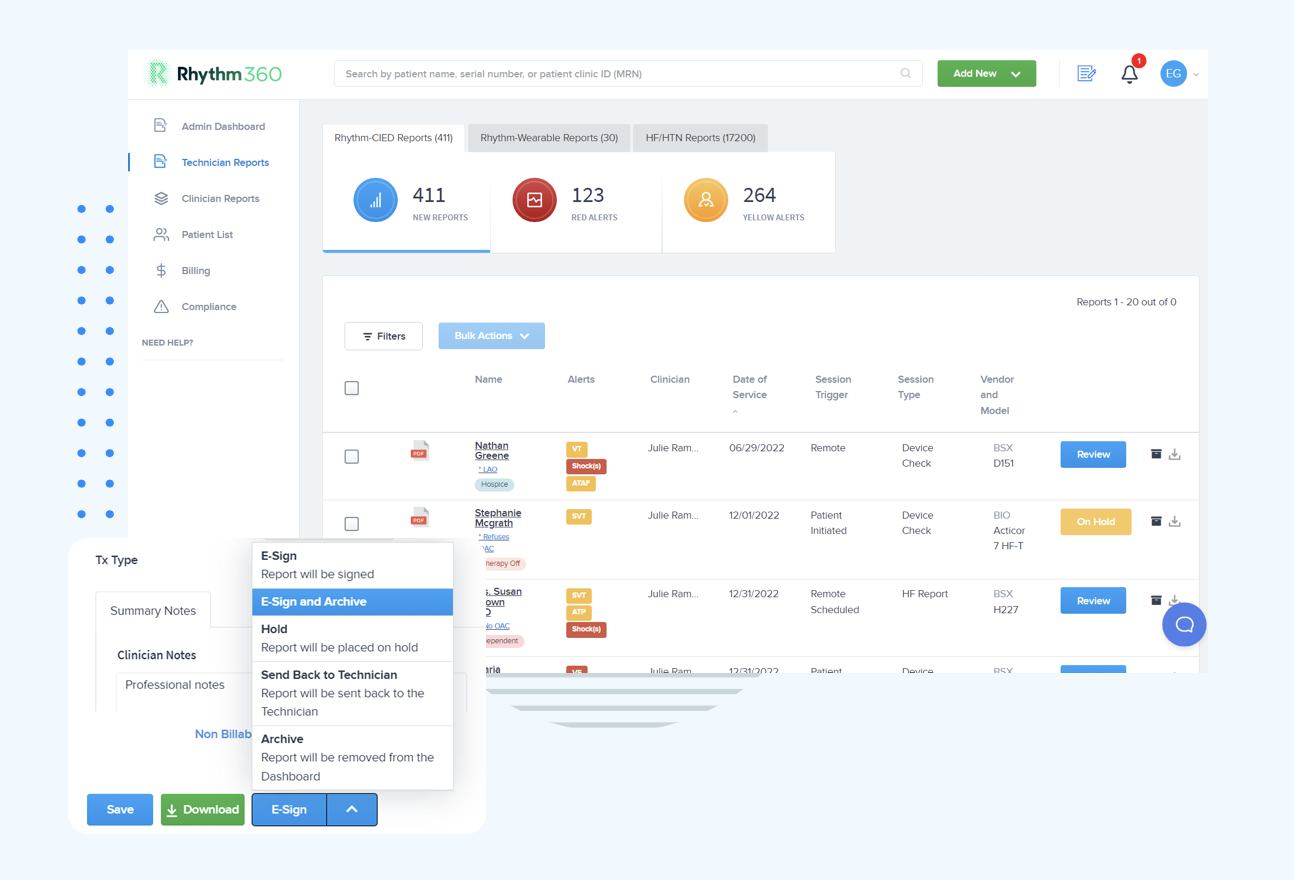
PaceMate reduces manual EHR entry by consolidating transmission data from multiple OEM portals into a single dashboard. This centralized view feeds structured data directly into the EHR via FHIR and HL7 APIs, which removes the transcription step. With data already in the chart, the platform can generate billing codes with one click and organize physician review queues by clinical priority. Auto-triage logic then surfaces critical alerts first so urgent transmissions receive immediate attention while routine checks are batched for efficient review.
Auto-population pulls device transmission data directly from OEM feeds and maps it to EHR fields without manual transcription. Because staff no longer re-key data from each manufacturer portal into the EHR, this removes the most time-intensive step in multi-vendor CIED workflows. The key difference between platforms lies in data source redundancy, where Rhythm360 maintains multiple fallback feeds and AI-powered parsing to keep data flowing even when primary OEM feeds fail.
| Capability | PaceMate | Rhythm360 |
|---|---|---|
| Auto-population source | OEM portal feeds | OEM feeds, redundant feeds, AI/computer-vision PDF parsing |
Bi-directional Epic integration using SMART on FHIR APIs combined with HL7 v2 supports data exchange including orders, demographics, scheduling, medications, discrete data, billing claims, and encounter summaries. Rhythm360 uses the same interoperability stack across Epic, Cerner, Athenahealth, eClinicalWorks, and Greenway Health so practices can move from go-live to full use in a short window. The comparison below highlights how Rhythm360’s implementation timelines align with proven integration benchmarks.
| Integration Metric | Industry Benchmark | Rhythm360 |
|---|---|---|
| Average EHR go-live time | 21 days (200+ integrations) | Days to weeks |
Automated initiation and monthly triggering of remote monitoring billing under applicable codes can generate additional revenue per CIED patient per month and can add substantial revenue for most practices. Rhythm360 automates CPT code capture for 93298, 93299, 99454, and related codes with documentation created at the point of transmission review. Billing teams receive complete, compliant packets instead of piecing together notes from multiple systems.
University of Chicago Medicine reviewed more than 73,000 reports annually through Rhythm360 in 2025, averaging more than 18,000 reports per quarter. Clinicians reviewed more transmissions per day and identified more abnormalities than under prior fragmented workflows. Centralized queues and clear prioritization let physicians focus on interpretation instead of hunting for data.
AI-driven triage filters non-actionable transmissions and surfaces critical alerts such as ventricular fibrillation, lead malfunction, and new-onset AFib ahead of routine checks. Rhythm360 cuts critical alert response times by up to 80% through this prioritization layer combined with optional 24/7/365 oversight by certified cardiac technicians. Practices gain faster intervention for high-risk patients without adding staff.
These five capabilities, including auto-population, API interoperability, one-click billing, streamlined review, and auto-triage, work together to remove manual entry at every stage of the CIED monitoring workflow. A clear view of the complete data path shows how each step supports the next.
PaceMate reduces manual EHR entry by consolidating multi-vendor CIED transmission data into a single cloud-based interface and using structured API connections to write data directly to the EHR. This approach eliminates duplicate logins, manual transcription, and reconciliation of conflicting data across portals. Practices using platforms with these capabilities have moved from higher denial rates to first-pass clean claim rates of 98%, a result of the 40% denial reduction mentioned earlier when specialized coding and automated documentation are applied together. The same workflow also supports faster clinical decisions because complete, structured data appears in the chart without delay.
Automation delivers these outcomes only when the data feed stays uninterrupted. When the primary data source fails, even advanced platforms fall back to manual workflows unless they have built-in redundancy. OEM portal outages are an underreported failure mode in CIED monitoring. When a single-feed platform loses its connection to a manufacturer server, staff revert to manual data retrieval through phone calls, fax, or deferred review, which creates gaps in patient monitoring and documentation. The absence of publicly available uptime SLAs from OEM portals means practices cannot rely on guaranteed availability across all manufacturers at once.
| Failure Scenario | Single-Feed Platform Risk | Rhythm360 Response |
|---|---|---|
| OEM server outage | Transmission data unavailable, manual workaround required | Redundant data feeds activate automatically |
| Unstructured PDF transmission | Manual re-entry into EHR | Computer-vision PDF parsing extracts and maps data fields |
| Data gap from connectivity failure | Missing records, potential missed alerts | AI-powered extrapolation fills gaps, more than 99.9% transmissibility maintained |
Rhythm360’s redundant architecture means no single OEM server failure interrupts monitoring continuity. This structural design gives practices a safety net that single-feed platforms cannot match without a full architectural overhaul.
Quantified outcomes from practices using automated CIED monitoring platforms show consistent revenue recovery and efficiency gains. The pattern across the metrics below highlights how automation improves both financial performance and clinical responsiveness.
| Metric | Baseline (Manual Workflows) | With Rhythm360 Automation |
|---|---|---|
| Claim denial rate | 15–25% | Reduction of up to 40% |
| Monthly RPM revenue added | $0 (uncaptured) | Substantial additional revenue |
| Critical alert response time | Baseline (manual triage) | Up to 80% faster |
| Revenue increase potential | Baseline | Up to 300% profitability increase |
As Gaurav A. Upadhyay, MD, at UCM confirmed after implementing Rhythm360, “We have improved billing and accountability for our patients after the integration.”
Calculate your practice’s revenue recovery potential with a personalized ROI analysis.
Rhythm360 ingests data via API, HL7, XML, and computer-vision PDF parsing across all major device manufacturers, including Medtronic, Boston Scientific, Abbott, and Biotronik, without locking practices into a single OEM ecosystem. The platform’s redundant feed architecture sustains more than 99.9% transmissibility even during OEM server disruptions, a capability that single-vendor or single-feed platforms cannot match by design.
Andrew Beaser, MD, Associate Professor of Medicine at UCM, noted that “decision support, including AI-assisted decision support, will become increasingly important as data volumes grow.” Rhythm360’s AI triage layer is built for that scale and has supported high report volumes at a single academic center without degradation in dismissal rates or review accuracy.
Bi-directional EHR integration writes encounter records, e-signed reports, discrete data fields, and billing claims back to the chart automatically. This closes the documentation loop without requiring staff to log back into the EHR and manually enter report summaries or billing codes, which is the repetitive task that drives staff burnout and revenue leakage in practices still operating across fragmented OEM portals.
Rhythm360’s onboarding process, including EHR integration setup with systems such as Epic, Cerner, Athenahealth, and eClinicalWorks, typically takes from a few days to a few weeks. The platform is designed for minimal disruption to existing clinical workflows, and the implementation team handles data mapping, API configuration, and staff orientation as part of the go-live process.
Bi-directional integration means data flows both into and out of the EHR automatically. Inbound data such as demographics, insurance, diagnosis codes, appointments, medications, and recent hospitalizations populates the Rhythm360 patient record without manual entry. Outbound data such as encounter creation, e-signed reports, discrete structured fields, and billing claims writes directly to the EHR chart after transmission review. This removes the manual transcription step at both ends of the workflow, which is where most errors and staff time occur in multi-portal environments.
Rhythm360 automates documentation and CPT code capture for the primary CIED remote monitoring codes, including 93298 and 93299 for implantable cardioverter-defibrillator and pacemaker remote monitoring, as well as 99453, 99454, 99457, and 99458 for remote physiological monitoring in heart failure and hypertension programs. The platform generates compliant documentation at the point of transmission review, which reduces the manual burden on billing staff and decreases first-pass denial rates.
Practices implementing Rhythm360 have documented an 80% reduction in response times for critical patient alerts, including new-onset atrial fibrillation, ventricular tachycardia, and device malfunction events. Revenue profitability has increased by as much as 300% through optimized CPT code capture, the denial rate improvements detailed in the ROI section, and the addition of new RPM service lines. At the University of Chicago Medicine, implementation enabled clinicians to review more transmissions daily and identify more abnormalities than under prior fragmented workflows while managing tens of thousands of annual reports with stable dismissal rates.
Manual entry in multi-vendor CIED monitoring is not a minor inconvenience; it is a measurable source of revenue loss, staff burnout, and patient risk. Platforms that reduce manual entry through auto-population, FHIR and HL7 bi-directional integration, one-click billing, and AI triage deliver clear outcomes, including lower denial rates, added monthly RPM revenue, and sharply faster critical alert response times.
Rhythm360 extends these capabilities with redundant data feeds, computer-vision PDF parsing, and more than 99.9% transmissibility so no OEM server outage, unstructured transmission, or data gap interrupts monitoring continuity or billing capture. For practices managing patients across multiple device manufacturers, vendor-neutral redundancy forms the foundation of sustainable operational efficiency.
See how Rhythm360 eliminates manual entry in your CIED workflows.





