Cardiology practices evaluating remote patient monitoring platforms in 2026 face a high-stakes decision. They can keep systems that depend on manual workflows and accept ongoing billing leakage and clinical delays. Or they can move to platforms that automate alert triage, documentation, and billing so every clinically significant event and billable encounter is captured.
This comparison uses PaceMate and Rhythm360 as case studies. It gives you a practical checklist for what a credible RPM demo must show and how those capabilities affect clinical care, operations, and revenue.
A credible RPM demo must show four non-negotiable capabilities: two-way EHR integration with zero duplicate documentation, sub-hour critical alert triage, automated CPT code capture for codes including 93298, 99454, and 99457, and HIPAA-compliant mobile access for on-call clinicians. These four capabilities matter because each one fixes a specific failure in legacy RPM workflows: data silos, slow clinical response, missed billing, and after-hours access friction.
Any demo that omits these elements is incomplete for a 2026 purchasing decision.
See these four capabilities in a live Rhythm360 walkthrough.
PaceMate consolidates CIED transmissions into a cloud-based portal, yet practices report that alert triage still depends on manual staff review queues. Without AI-powered prioritization, high-volume environments build alert backlogs that raise the risk of delayed response to clinically significant events such as new-onset atrial fibrillation, ventricular tachycardia, or lead malfunction.
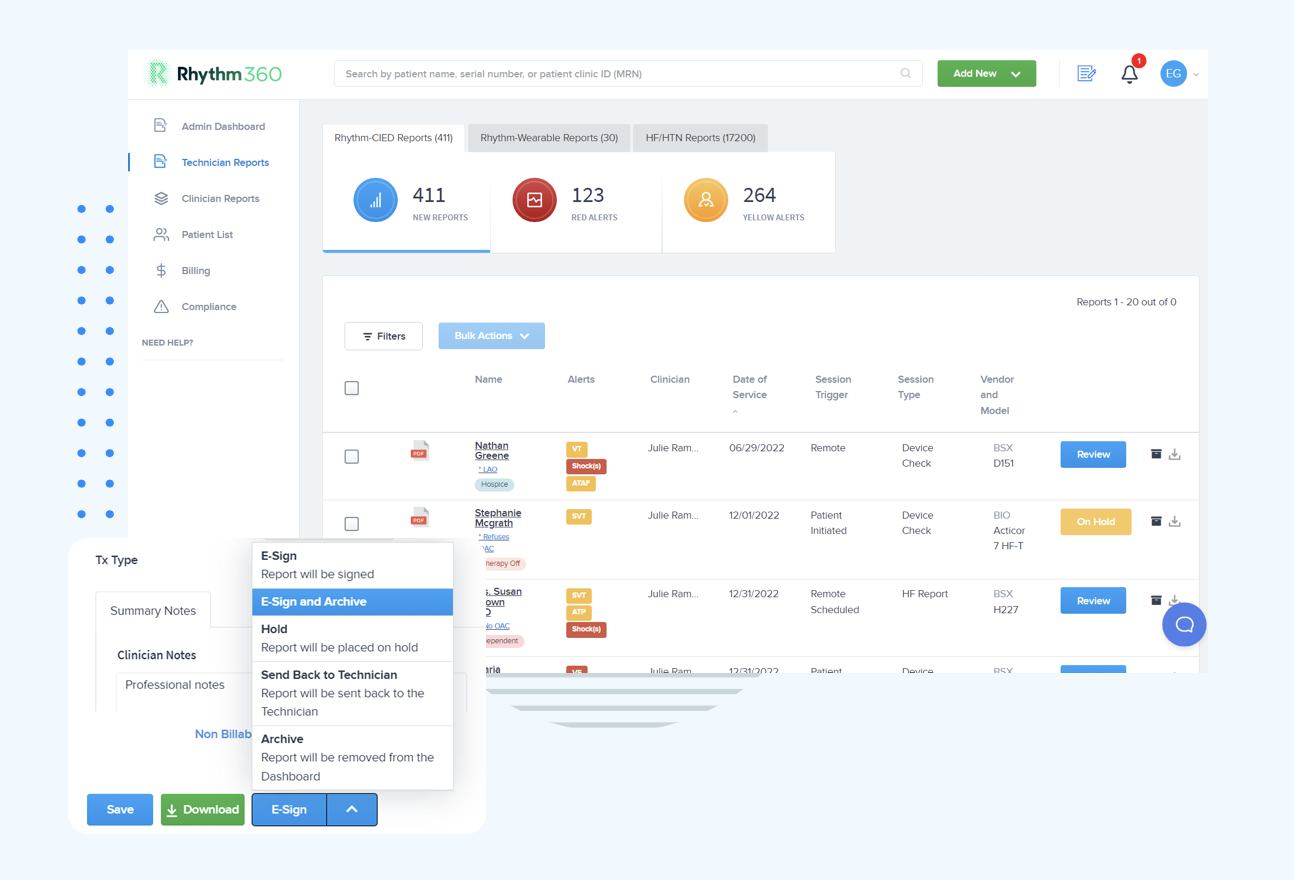
Rhythm360 addresses this problem through a two-layer approach. Its AI triage layer filters non-actionable transmissions and surfaces clinically significant alerts in near real time, which reduces the volume of alerts that need human review and lets staff focus on true clinical events. This filtering effect drives the documented reduction in critical alert response times. For practices that want to remove after-hours delays, the platform also offers optional 24/7/365 oversight by certified cardiac technicians (CCTs) supervised by physicians, so alerts are reviewed and escalated even outside normal business hours.
The following table summarizes key operational differences between PaceMate’s manual triage model and Rhythm360’s AI-driven approach.
| Metric | PaceMate | Rhythm360 | Source |
|---|---|---|---|
| Critical alert response reduction | Not published | Up to 80% | UCM White Paper, 2025 |
| Data transmissibility rate | Not published | >99.9% | RhythmScience platform specs |
| Annual reports managed (UCM) | N/A | 73,000+ | UCM White Paper, 2025 |
| AI-powered alert triage | Not documented | Yes, with CCT oversight option | RhythmScience platform specs |
| Mobile sign-off capability | Browser only | Native HIPAA-compliant app | UCM White Paper, 2025 |
Andrew Beaser, MD, Associate Professor of Medicine at the University of Chicago Medicine (UCM), noted: “We are able to address these issues earlier, rather than waiting for a 3-month visit, we can call patients in for evaluation.”
PaceMate offers EHR connectivity that pushes reports into the record, yet documented workflows still require manual steps for report reconciliation and CPT code documentation. Staff must verify transmission completeness, manually assign billing codes, and re-enter data when portal exports do not map cleanly to EHR fields. This unidirectional pattern creates billing leakage at scale.
Rhythm360 provides two-way EHR integration with Epic, Cerner, Athenahealth, eClinicalWorks, and others via HL7. It automatically posts device readings to the patient chart alongside audit-ready billing documentation with zero duplicate entry. CPT codes 93298, 99454, and 99457 are captured automatically based on transmission data and documented time, which removes the manual reconciliation step entirely.
The 2026 Medicare Physician Fee Schedule expands the number of billable RPM codes, which raises the revenue at risk when manual workflows miss capture opportunities. Under the 2026 Medicare Physician Fee Schedule, reimbursement is available for CPT 99454 for monthly remote monitoring, CPT 99457 for clinical management time, and the new CPT 99445 for shorter monitoring cycles. Automated capture of these codes in a single workflow represents a material revenue opportunity that manual processes routinely miss.
PaceMate’s Epic integration in documented deployments operates mainly in one direction, pushing reports into the EHR but not pulling scheduling, demographic updates, or order changes back into the monitoring workflow. This pattern creates reconciliation gaps when patient records change in Epic but those changes do not appear in the monitoring queue.
Rhythm360 uses HL7 and FHIR to keep demographics, orders, schedules, and results aligned across both systems in real time. FHIR APIs for two-way EHR integration are recognized across the remote cardiac monitoring industry as the standard for synchronizing demographics, orders, schedules, and results. Rhythm360’s implementation of this standard removes the manual reconciliation burden that persists in single-direction integrations.
Request a live demonstration of Rhythm360’s Epic and Cerner sync.
PaceMate provides web-based access that clinicians can open in a mobile browser, yet a purpose-built, HIPAA-compliant mobile application with offline signing and push alerts is not a documented feature. On-call clinicians who rely on browser-based access encounter friction when reviewing transmissions or signing reports outside the office.
Rhythm360’s HIPAA-compliant mobile application is designed for on-call workflows. Clinicians can review transmissions, sign reports, and coordinate care directly from their smartphones. Dr. Beaser also noted: “I am more likely to sign off on these while in meetings because I can easily access them on my phone.” This mobile-first design shortens the gap between alert generation and physician sign-off, which legacy and browser-dependent workflows struggle to match.
These four capabilities together alert triage, EHR integration, Epic connectivity, and mobile access define the 2026 competitive landscape for remote cardiac monitoring.
The 2026 remote cardiac monitoring market includes PaceMate, Murj, Implicity, Octagos, and Rhythm360 as the primary cloud-based platforms. PaceMate competes on brand recognition after its acquisition of PaceArt from Medtronic. Murj focuses on workflow automation. Implicity emphasizes algorithmic alert filtering. Octagos targets AI-driven filtering with EHR integrations.
Rhythm360 differentiates on three dimensions that competitors do not combine in a single platform: vendor-neutral data aggregation across all major OEMs (Medtronic, Boston Scientific, Abbott, Biotronik), near-perfect data transmissibility via redundant feeds and computer vision AI, and integrated chronic disease management service lines for HF and HTN alongside CIED monitoring. These three capabilities universal device support, reliable data capture, and multi-condition monitoring translate into clear operational advantages. Practices can monitor all device types without switching platforms, capture every billable event, and feed all data into one EHR workflow. This positions Rhythm360 as the only platform that addresses CIED monitoring, RPM billing, and EHR automation under one contract.
Billing leakage in CIED monitoring programs usually comes from three sources. Practices miss transmission events that meet CPT thresholds, submit claims with incomplete documentation that payers reject, and fail to bill newly available codes. Each source of loss can be addressed through targeted automation.
Rhythm360’s automated CPT capture and documentation engine has enabled practices to increase revenue generation by up to 300%. Gaurav A. Upadhyay, MD, at UCM confirmed: “We have improved billing and accountability for our patients after the integration.” With 2026 Medicare reimbursement for RPM CPT codes, a practice that misses even 50 billable events per month across these codes can lose substantial recoverable revenue before accounting for 93298 device interrogation codes.
Get a revenue recovery estimate based on your current CPT capture rates.
Revenue recovery only becomes real when implementation does not stall in IT queues. The speed of deployment and integration determines how quickly a practice starts capturing previously missed billing events. The table below highlights where implementation delays typically occur.
| Phase | PaceMate | Rhythm360 | Source |
|---|---|---|---|
| EHR integration setup | Weeks to months (reported) | Days to a few weeks | RhythmScience implementation specs |
| OEM portal consolidation | Partial (select OEMs) | All major OEMs at go-live | RhythmScience platform specs |
| Billing automation activation | Manual configuration required | Included at implementation | RhythmScience platform specs |
| Staff training requirement | Multi-session (reported) | Single unified dashboard | RhythmScience platform specs |
The operational, clinical, and financial differences outlined above naturally raise questions for practices considering a platform switch. The following answers address the most common ones.
A PaceMate RPM demo is a live or recorded walkthrough of PaceMate’s remote patient monitoring platform, usually covering CIED data aggregation, alert management, and EHR connectivity. A complete demo should demonstrate the four capabilities described earlier in this article: multi-vendor data handling, rapid alert triage, automated CPT capture, and mobile clinician access. If a demo does not address all four areas with measurable benchmarks, it is not sufficient for a 2026 procurement decision.
Rhythm360 uses HL7 and FHIR standards to create a synchronized data flow between the monitoring platform and Epic, so patient demographics, orders, schedules, and results stay aligned in both systems without manual reconciliation. This removes duplicate documentation and ensures that updates made in Epic, such as a change in patient status or a new order, appear immediately in the monitoring workflow. PaceMate’s Epic integration, based on available materials, operates mainly in one direction, which creates reconciliation gaps over time.
Rhythm360’s implementation process, including EHR integration setup and OEM portal consolidation, typically takes from a few days to a few weeks, depending on practice size and the number of EHR systems involved. This timeline is shorter than the multi-month implementations commonly reported for legacy and enterprise platforms. The onboarding process includes billing automation activation and staff training on a single unified dashboard, which reduces the change-management burden that often delays go-live for competing platforms.
Revenue recovery is measured by comparing CPT code capture rates before and after implementation across the relevant billing codes: 93298 for remote CIED interrogation, 99454 for RPM device supply and transmission, 99457 for the first 20 minutes of RPM management time, and the new 2026 codes 99445 and 99470 for shorter monitoring cycles. Rhythm360’s administrative dashboard tracks billable events in real time, flags documentation gaps before claims are submitted, and generates audit-ready reports. As documented earlier, practices have achieved substantial revenue increases by capturing previously missed billable events and preventing claim rejections from incomplete documentation.
Legacy workflows built around manual portal logins, one-way EHR connections, and reactive alert management create measurable risk in 2026. Rhythm360 addresses each of these failure points through a unified platform that combines AI-driven triage, true two-way EHR integration, and automated billing capture, all verified at scale by UCM’s management of over 73,000 annual reports on the platform.
For practices evaluating a PaceMate RPM demo or planning a 2026 system upgrade, the operational and financial differences documented here represent measurable, recoverable value that generic demos rarely quantify.
Request a customized workflow and revenue analysis for your practice.