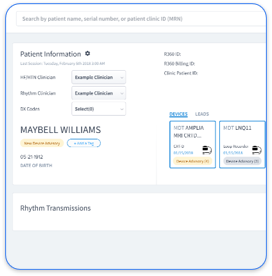
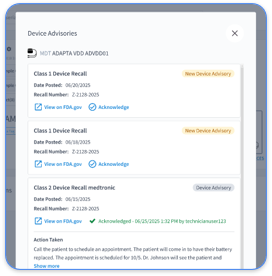
The PaceMate user manual sits inside the PaceMate platform and only credentialed clinical users can view it. Follow these steps to retrieve it:
Once you have the manual, you will see that PaceMate organizes resources by user type. That structure affects where you find future documentation and which staff can access billing and configuration guides. If your practice is evaluating whether a single-vendor portal like PaceMate meets your full operational needs, a unified alternative may be worth exploring. See how Rhythm360 handles data from every major device manufacturer in a live workflow comparison.
PaceMate, like most remote cardiac monitoring platforms, maintains separate resource libraries for patients and clinical staff. The patient-facing portal focuses on transmission schedules, appointment reminders, and basic device education. The clinical dashboard provides transmission reports, alert logs, device interrogation summaries, and billing documentation tools.
Device technicians and electrophysiologists should confirm they are logged into the clinical interface before searching for the user manual or remote monitoring guide. Patient-side resources do not include technical configuration documentation. Administrators who manage billing workflows will also find CPT code documentation templates in the clinical section.
When the user manual does not resolve a technical issue, PaceMate offers several support channels. Clinical users can access live support through the Help Center chat function within the portal, submit a ticket through the support email listed on the PaceMate website, or call the technical support line published in the onboarding documentation provided to your clinic. For urgent transmission failures or data connectivity issues, escalate directly to PaceMate’s clinical support team instead of general customer service. Keep your clinic’s account number and the affected patient’s device serial number available when contacting support to shorten resolution time.
Medicare broadly covers remote patient monitoring for the collection of physiologic data using a wide range of devices, for both chronic and acute conditions. For CIED-specific remote monitoring, CMS permits physicians to report remote electronic analysis of pacemakers and implantable cardioverter-defibrillators when data is obtained via a manufacturer-specific monitor or transmitter and transmitted to a distant receiving station or secure server.
Medicare pays for each of the three main RPM components separately and pays the same rate regardless of the type of device the patient uses or the health data collected. The three components are education and device setup, device supply with collection and transmission of at least two readings every 30 days, and treatment and management based on reviewed data. CMS requires delivery of all three components to prevent fraud, a policy shaped by widespread gaps in patient education and setup assistance.
Remote physiologic monitoring services fall outside the definition of Medicare telehealth services under section 1834(m) of the Act and are not subject to its geographic or originating-site restrictions, meaning practices in any location can bill for these services without telehealth waivers. However, capturing these billable events consistently becomes difficult when staff manage devices across multiple disconnected portals, each with its own interface, alert system, and documentation workflow.
A practice implanting devices from more than one manufacturer immediately inherits a multi-portal problem. Medtronic, Boston Scientific, Abbott, and Biotronik each operate separate, non-interoperable web platforms. Device technicians must maintain distinct credentials for each, navigate different interfaces, and manually reconcile data before documenting it in the EHR. This fragmentation produces data silos, raises the probability of transcription errors, and consumes staff hours that could otherwise support direct patient care.
Alert fatigue compounds this problem. Because each OEM portal generates its own notification volume, clinicians must monitor multiple inboxes at the same time. Without a unified triage layer that separates actionable from non-actionable alerts, every inbox becomes equally noisy. This noise creates conditions where critical events can be delayed or missed. When staff cycle through disconnected systems, a new-onset atrial fibrillation alert in one portal can be buried under routine notifications in another. AI-driven approaches to early detection and management of arrhythmias like atrial fibrillation represent a growing area of clinical focus, which highlights the operational cost of systems that cannot apply intelligent filtering at scale.
Revenue leakage follows the same pattern. Without a centralized system that tracks billable transmission events and generates compliant documentation, practices routinely miss CPT codes 93298, 93299, and 99454. Those missed codes leave reimbursement uncaptured on completed clinical work.
Vendor-neutral platforms address fragmentation by ingesting data from all major OEM sources into a single normalized dashboard. This consolidation works by pulling raw transmission data from each manufacturer’s proprietary format and converting it into a standardized schema. A single alert triage engine can then apply consistent clinical rules across the entire device population, regardless of OEM.
AI-powered alert triage filters non-actionable notifications and surfaces clinically significant events in priority order. Device technicians and clinicians can act on what matters without wading through noise. Automated CPT code capture and documentation tools close the billing gap by flagging completed monitoring cycles and generating compliant records at the point of care.
Bi-directional EHR integration removes manual transcription. When a transmission report is finalized in the monitoring platform, it flows directly into the patient’s Epic, Cerner, or Athenahealth record. This connection reduces duplicate data entry and the errors associated with it. Mobile access extends this capability beyond the clinic, allowing on-call clinicians to review transmissions and coordinate care from any location. The table below summarizes how these capabilities translate into measurable differences between PaceMate and Rhythm360 across the dimensions that most directly affect clinical workflow and revenue capture.
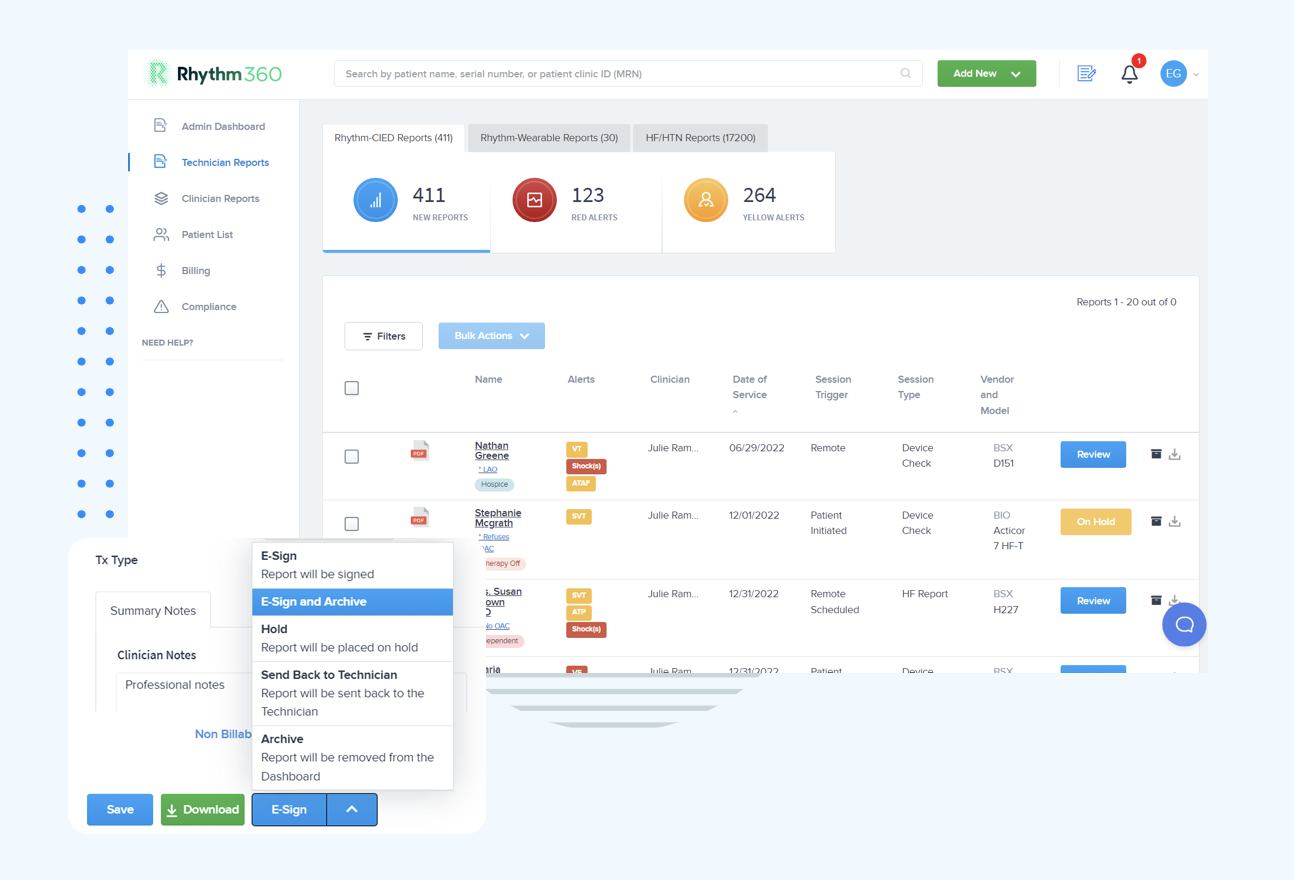
| Feature | PaceMate | Rhythm360 | Clinical Impact |
|---|---|---|---|
| Vendor neutrality | Primarily Medtronic-lineage (acquired PaceArt) | All major OEMs: Medtronic, Boston Scientific, Abbott, Biotronik, and others | Single login for entire device population |
| Alert response time | Standard OEM-dependent workflow | Up to 80% faster critical alert response | Earlier intervention for arrhythmias and device failures |
| Revenue capture | Manual or semi-automated CPT documentation | Up to 300% revenue lift via automated CPT code capture | Reduced billing leakage on 93298, 93299, 99454, and related codes |
| EHR integration | Limited bi-directional capability | Bi-directional with Epic, Cerner, Athenahealth, eClinicalWorks, and others via HL7 | Eliminates manual transcription and duplicate entry |
These outcomes reflect data reported by Rhythm360 clients following platform implementation. The alert response improvement comes from AI triage that surfaces critical events within seconds of transmission. The revenue lift results from automated CPT code capture that flags billable events the moment clinical criteria are met, which removes the manual chart review that causes most billing leakage. PaceMate’s Medtronic lineage reflects its acquisition of PaceArt. Practices with mixed-manufacturer device populations may find coverage gaps that require supplemental portal access.
Ready to see these outcomes applied to your practice’s device population? Walk through a live workflow comparison with a Rhythm360 specialist to evaluate how these metrics translate to your specific device mix.
A practice managing devices from two or more manufacturers faces an immediate operational question about the sustainability of multi-portal workflows. When staff experience burnout, consistent gaps in CPT code capture, recurring delays in critical alert response, or EHR documentation that requires manual reconciliation after every monitoring cycle, the practice has reached the threshold for a unified platform evaluation. The problem intensifies when on-call clinicians cannot access transmission data remotely, because after-hours clinical decisions then wait until the next business day. Onboarding timelines for Rhythm360 range from a few days to a few weeks, including EHR integration setup, which keeps the transition operationally manageable without extended downtime.
The PaceMate user manual is available within the PaceMate clinical portal under the Help Center or Resources section. Log in with your credentialed clinical account, navigate to the support documentation library, and search for “user manual” or the specific device category. If you cannot locate it, contact PaceMate’s technical support team using the contact information provided during your clinic’s onboarding.
Yes. PaceMate is a cloud-based cardiac device management platform that acquired PaceArt from Medtronic. It is used by cardiology and electrophysiology practices for remote monitoring of CIEDs. Practices with multi-manufacturer device populations should evaluate whether its coverage extends to all OEMs represented in their patient panel.
Medicare recognizes CPT codes 93731, 93734, 93741, and 93743 for remote electronic analysis of pacemakers and implantable cardioverter-defibrillators. For broader remote physiologic monitoring services, codes 99453, 99454, and 99457 apply to device setup, data transmission, and treatment management respectively. Documentation must reflect that all three RPM components, education and setup, data transmission, and clinical management, were delivered to support a compliant claim.
CMS does not require that physicians or other qualified health care providers order remote patient monitoring services, nor that the ordering provider’s information appear on the claim. However, the monitoring must be clinically appropriate for a patient with a chronic or acute condition, and the device used must meet FDA medical device definitions and transmit data at least two days every 30 days.
An OEM-specific portal, such as those operated by Medtronic, Boston Scientific, or Abbott, is designed to display data only from that manufacturer’s devices. A vendor-neutral platform like Rhythm360 ingests and normalizes data from all major device manufacturers into a single dashboard. This approach removes the need for multiple logins and supports unified alert management, reporting, and billing documentation across an entire mixed-manufacturer patient population.
Accessing the PaceMate user manual becomes straightforward once a clinician knows where to look within the platform’s Help Center. The deeper operational question for most cardiology and EP practices is whether a single-vendor portal can scale alongside a growing, multi-manufacturer device population. Practices that evaluate unified platforms should prioritize vendor neutrality across all major OEMs, AI-powered alert triage with documented response-time improvements, bi-directional EHR integration, and automated CPT code capture with auditable documentation. These criteria directly address the fragmentation, alert fatigue, and revenue leakage that single-portal workflows create at scale. Compare Rhythm360’s vendor-neutral approach against your current workflow and billing benchmarks in a personalized evaluation.