PaceArt Optima is an on-premises system. Clinics running it carry the infrastructure, update, and IT maintenance burden internally. After the acquisition, PaceMate positioned PaceMateLIVE as the successor platform and has not publicly committed to indefinite PaceArt Optima support.
Clinics with Medtronic-heavy device populations now face a specific dependency. PaceMateLIVE's SessionSync integration moves in-clinic patient data from Medtronic SmartSync iPads directly into the platform. This setup preserves familiar in-clinic workflows. Clinics with significant non-Medtronic device volume should confirm equivalent integration depth before they commit.
Decision criteria: Get written confirmation that PaceArt Optima will receive security patches and regulatory updates through your planned migration window. A missing end-of-life date does not equal a support guarantee.
For clinics that decide migration is necessary, the next step is to understand the timeline and cost structure. PaceMate provides a proprietary PaceArt Historical Data Migration Tool that transfers patient encounter summaries, device advisory details, patient comments, and PDFs directly from PaceArt to PaceMateLIVE without data scraping. Independent migration benchmarks from comparable platforms show that most clinics reach go-live within a few weeks when the vendor manages end-to-end onboarding. That onboarding typically includes workflow configuration, training, integration support, and go-live readiness, as documented by PrepMD for its OMNI platform migrations from legacy PaceArt environments.
| Migration Phase | Typical Duration | Key Dependency |
|---|---|---|
| Data export and validation | 1–2 weeks | PaceArt database size and IT availability |
| EHR integration configuration | 1–2 weeks | Epic, Cerner, or athenahealth FHIR API access |
| Staff training | 3–5 days | Clinic scheduling and staff availability |
| Go-live and parallel run | 1–2 weeks | Vendor support responsiveness |
PaceMate does not publicly disclose cost structures. For comparison, PrepMD offers flexible pricing with no upfront costs for many services including remote monitoring, staffing, training, and the full platform ecosystem. Clinics should request itemized migration cost details from any vendor before signing.
Decision criteria: Require a written migration timeline with milestone dates, a data-validation checklist, and a rollback plan before you execute any contract.
The table below compares four platforms across four dimensions. All data points come from vendor-published documentation or clinic-reported benchmarks cited inline.
| Platform | Deployment Model | EHR Integration | Vendor Neutrality |
|---|---|---|---|
| PaceArt Optima | On-premises | Limited, no documented real-time FHIR API | Medtronic-originated, multi-OEM support limited |
| PaceMateLIVE | Cloud-based | Epic, Cerner, athenahealth via inbound and outbound FHIR APIs | All major ambulatory patch vendors, multi-OEM CIED support |
| Murj | Cloud-based | EHR workflow automation, integration depth varies by contract | Multi-OEM, focused on workflow automation |
| Rhythm360 | Cloud-based, HIPAA-compliant | Epic, Cerner, Athenahealth, eClinicalWorks, Greenway via HL7 and bi-directional API | Fully vendor-neutral: Medtronic, Boston Scientific, Abbott, Biotronik, and others |
Alert management and CPT-code capture depth do not compare cleanly across these platforms using a shared metric. The scorecard section below covers those dimensions.
Decision criteria: Choose platforms that document integration depth for your specific EHR version, not just EHR brand compatibility.
See how Rhythm360 consolidates multi-OEM data in a single dashboard and request a live walkthrough.
Murj and PaceMateLIVE both deliver cloud-based cardiology workflow automation, yet they differ in origin and emphasis. PaceMateLIVE inherits PaceArt's installed base and focuses on historical data continuity, with automated CPT code selection, billing interval tracking, and charge delivery to the EMR for remote monitoring reimbursement. PaceMateLIVE also reports reducing certain clinical workflows to one click.
Murj centers on workflow automation and multi-OEM support but does not publish equivalent click-reduction or billing-automation benchmarks in accessible public documentation. Clinics evaluating Murj should request reference sites with device populations that match their own OEM mix.
PaceMateLIVE's Auto-Triage feature standardizes alerts across all device manufacturers according to clinic preferences and combines device data with real-time EHR data to prioritize critical patients. Alert fatigue remains a documented risk across all monitoring platforms. Most clinical decision support alerts are routinely ignored by physicians, reflecting accumulated distrust in systems that generate excessive false positives.
Decision criteria: Ask each vendor for documented false-positive rates and alert-override rates from live clinic deployments, not controlled pilots.
| Capability | PaceMateLIVE | Murj | Rhythm360 |
|---|---|---|---|
| Multi-OEM CIED support | All major device manufacturers | Multi-OEM, scope varies | Medtronic, Boston Scientific, Abbott, Biotronik, and others |
| Data ingestion methods | FHIR API, PDF migration tool | API-based, PDF handling not publicly documented | API, HL7, XML, PDF via computer vision and AI normalization |
| AI-powered alert triage | Auto-Triage with EHR-combined prioritization | Workflow automation, AI triage depth not publicly benchmarked | AI triage with optional 24/7 CCT oversight, 80% reduction in critical-alert response time |
Rhythm360 reaches greater than 99.9% data transmissibility through redundant data feeds, computer vision, and AI-powered extrapolation. Clinics using Rhythm360 have reported up to a 300% increase in revenue through optimized CPT code capture and the addition of RPM service lines for heart failure and hypertension management.
Industry consolidation introduces three compounding risks for clinics: reduced negotiating leverage, dependency on a single vendor's migration roadmap, and potential gaps in support for non-Medtronic device populations. Rhythm360 is built to remove each of these risks.
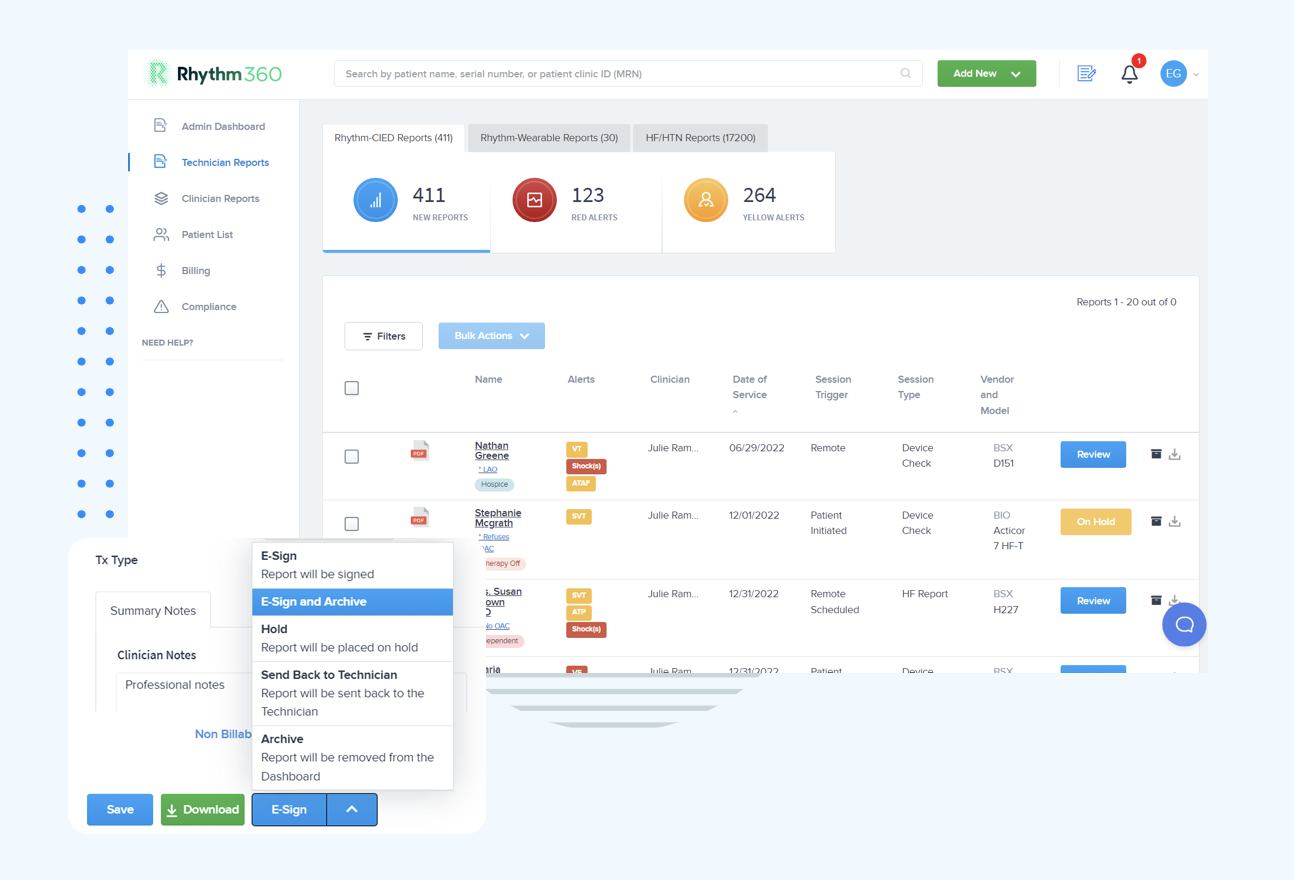
Dependency on a single vendor's roadmap often forces clinics to work with fragmented data across multiple OEM portals. Rhythm360 addresses this problem with a single dashboard that aggregates all CIED and RPM data across every major OEM and removes the need for multiple portal logins. That consolidation also reduces alert fatigue that appears when teams monitor separate notification streams. Rhythm360's AI-driven triage filters non-actionable notifications and surfaces clinically significant events, supported by optional oversight from certified cardiac technicians, using the same approach that drives the response-time improvements and revenue gains detailed in the scorecard above.
Reduced negotiating leverage often leads to revenue leakage when clinics lack the resources to manage billing across fragmented systems. Rhythm360 closes this gap through automated CPT code capture for codes including 93298, 93299, and 99454. Bi-directional EHR integration then delivers documentation directly to Epic, Cerner, Athenahealth, eClinicalWorks, and Greenway.
Onboarding, including EHR integration, usually completes within a few days to a few weeks. The SaaS-based pricing model avoids high upfront infrastructure costs.
The PaceMate acquisition of PaceArt represents a market-consolidation event, not a clinical upgrade mandate. Many clinics have 90 days or fewer in each budget cycle to decide whether PaceMateLIVE, Murj, or an independent vendor-neutral platform best fits their device population, EHR environment, and revenue goals.
The decision framework stays simple. Confirm written support timelines for any legacy system. Require itemized migration cost and timeline disclosures. Validate alert-triage false-positive rates with reference sites. Verify EHR integration depth at the version level. Vendor neutrality functions as a structural protection against future consolidation events, not just a feature on a checklist.
Rhythm360 offers a documented path from fragmented OEM portals to a unified, AI-powered platform. The outcomes include the response-time and revenue improvements highlighted in the scorecard above, which you can review in a live demonstration.
Get a vendor-neutrality assessment tailored to your clinic's device mix and EHR configuration.
PaceArt Optima is an on-premises CIED data management system originally developed and owned by Medtronic. It requires local IT infrastructure and manual updates and does not offer native cloud access or real-time EHR data exchange. PaceMateLIVE is a cloud-based platform that PaceMate developed and that now serves as the designated migration destination for PaceArt users following the 2024–2025 acquisition. PaceMateLIVE provides cloud-based updates, FHIR API integration with major EHR systems, and an automated billing module. The core operational difference is deployment model: on-premises versus cloud, with corresponding differences in IT overhead, update cadence, and remote access capability.
Migration timelines depend on clinic size, database volume, IT team availability, and EHR integration complexity. Based on benchmarks from comparable platform migrations in cardiology environments, most clinics complete the full process within four to eight weeks when the vendor manages end-to-end onboarding. That process includes data export and validation, EHR integration configuration, staff training, and go-live. Clinics with large patient populations or complex multi-OEM device mixes should budget additional time for data validation. Any vendor that cannot provide a written milestone timeline with a rollback plan should be treated as a risk factor in the evaluation process.
Rhythm360 is a fully vendor-neutral platform that ingests and normalizes data from all major CIED manufacturers, including Medtronic, Boston Scientific, Abbott, and Biotronik. Data flows through a combination of direct APIs, HL7 feeds, XML files, and PDF parsing via computer vision and AI normalization. A redundant data feed architecture maintains greater than 99.9% data transmissibility even when an individual OEM server experiences downtime. Clinics with mixed device populations, which describes most active cardiology practices, can manage their entire patient panel from a single dashboard without logging into separate manufacturer portals.
Rhythm360 uses an AI-powered alert triage engine that filters non-actionable transmissions and surfaces only clinically significant events for review. The system cross-references device data with patient history and EHR context to assign priority levels and reduce the volume of alerts that reach clinical staff. Clinics that need additional oversight can add 24/7 monitoring by certified cardiac technicians supervised by physicians. This combined model delivers the critical-alert response-time improvements referenced in the scorecard and supports earlier intervention, such as identifying new-onset atrial fibrillation on a weekend and starting anticoagulation protocols before a potential stroke.
Rhythm360 automates CPT code capture and documentation for the full range of CIED remote monitoring and remote physiological monitoring codes. Supported codes include 93298, 93299, and 99454, along with RPM codes such as 99453 and 99457 for heart failure and hypertension service lines. The platform tracks billing intervals, generates compliant documentation, and delivers charge data directly to integrated EHR systems through bi-directional HL7 or API connections. Clinics that previously managed billing manually or through fragmented OEM portals have reported revenue increases of up to 300% after implementing Rhythm360, driven by recovery of missed billable events and the addition of new RPM service lines.