Last updated: October 1, 2026
A three-tier cardiac device alert triage protocol gives device clinics a clear, written line between immediate action and scheduled review. The list below shows how each tier maps to typical alert types and review timing.
Get the tiered triage protocol template
Start by mapping specific alert types to specific tiers.
Once these mappings are written down, the deliverable is a single tier table your medical director can sign. That document turns the protocol from a verbal understanding into an auditable standard.
Pro Tip: The most common mistake is applying a single review window to all alert types. That approach guarantees either missed critical events or burnout.
Write explicit review windows for every tier so expectations are clear.
The 2023 HRS/EHRA/APHRS/LAHRS consensus statement leaves response timelines to institutional protocol. Your written windows become the defensible artifact. A Saturday-morning new-onset AFib transmission falls to Medium-Priority and must be reviewed same business day, including weekends.
Common Mistake: Many protocols never define what “immediate” means after hours. Spell out the on-call notification path and escalation timing in the written protocol.
Give every tier a named owner and a deadline across these roles.
The test of a working matrix is simple. No alert type should exist without a named owner and a deadline attached to it.
Troubleshooting: The failure to assign a named owner to each tier is the most common reason triage protocols collapse within 60 days.
How to Reduce Critical Alert Fatigue in CIED Monitoring provides additional background on noise-reduction strategies that support this ownership model.
See how Rhythm360 handles tiered triage
Noise reduction depends on two mechanics: threshold individualization and the Rule of 3.
Threshold individualization: Adjust detection windows and thresholds at implant and during follow-up based on patient risk profile and device type. Manufacturer defaults often run too sensitive for a given patient. The 2026 JHRS Expert Consensus Statement recommends refining remote-monitoring alert settings through programming to reduce false-positive events while avoiding unnecessary visits or patient burden. The same consensus notes that implantable loop recorders have a high incidence of false-positive arrhythmia detections, which makes individualized alert programming important.
The Rule of 3: Adjust or deactivate a specific non-actionable alert threshold if it triggers three consecutive times for a patient without clinical consequence. A study of 4,042 Abbott Assert-IQ ICM devices showed that AI-based alert modification logic, which removes an alert when all episodes in a transmission are classified as false positives, reduced AF EGM data burden by 41% and pause EGM data burden by 83%. This result validates the principle of repeat-event suppression.
Keep thresholds for life-threatening arrhythmia detection and battery or lead integrity alerts fixed across patients.
Pro Tip: Over-individualizing thresholds until critical alerts are suppressed creates a different failure pattern. Maintain a written list of alerts that are never adjusted.
Gray-zone alerts, such as a brief VT episode in a non-pacemaker-dependent patient, need a written decision rule instead of ad hoc technician judgment.
The outcome is a written default that removes individual discretion from the technician level and keeps documentation consistent.
Common Mistake: Leaving gray-zone alerts to individual discretion produces inconsistent documentation and inconsistent care, which increases audit exposure.
Every triage decision must be traceable to a dated entry that supports the claim. The documentation requirements differ by code family, so the protocol should specify which fields to capture at the point of review.
When this structure is in place, every triage decision ties back to a dated entry that supports the claim.
Troubleshooting: The documentation gap that leads to rejected claims usually involves a missing dated interpretation or a monitoring period that does not match the billed cycle.
Manual triage starts to fail in predictable ways.
Research published in Heart Rhythm O² found that in some remote monitoring programs, only 7% of alerts were judged to be clinically meaningful. Clinical staff spend most of their review time on transmissions that require no action. A clinic managing 500 CIED patients can expect more than 2,000 scheduled transmissions per year before unscheduled alerts. At that volume, manual triage without a structured protocol and supporting technology becomes unsustainable.
The scenario below shows what the protocol looks like in practice when a Medium-Priority alert arrives on a weekend.
Saturday, October 3, 2026, 7:14 a.m. A new-onset AFib transmission arrives from a 71-year-old ICD patient.
With a written protocol assigning Saturday AFib transmissions to Medium-Priority with a same-business-day window, this event receives timely review. Rhythm360’s prioritized notifications and HIPAA-compliant mobile app make the weekend response operationally executable.
The comparison below shows what changes when that weekend workflow is supported by a triage platform instead of manual portal checks.
Manual triage requires logging into multiple OEM portals: Medtronic CareLink, Abbott Merlin.net, Boston Scientific LATITUDE, and Biotronik Home Monitoring. Each portal has its own alert hierarchy, forcing coordinators to context-switch between systems and manually transfer data to the EHR. After-hours coverage often depends on individual on-call arrangements without a reliable escalation path built into the workflow.
Rhythm360 consolidates CIED and RPM data from Medtronic, Boston Scientific, Abbott, Biotronik, and others into a single vendor-neutral dashboard, so coordinators no longer bounce between OEM portals. On top of that consolidated view, AI-powered alert triage filters non-actionable noise and surfaces clinically significant events in priority order. Because the after-hours escalation path is staffed by certified cardiac technicians supervised by physicians, the weekend workflow described above becomes repeatable. Findings then route directly into the patient record through bi-directional EHR integration with Epic, Cerner, Athenahealth, eClinicalWorks, Greenway Health, and others via HL7. At the point of review, automated CPT code capture links the triage decision to the billing event and removes the need for retroactive reconstruction. A secure, HIPAA-compliant mobile app lets clinicians review transmissions and sign reports from anywhere.
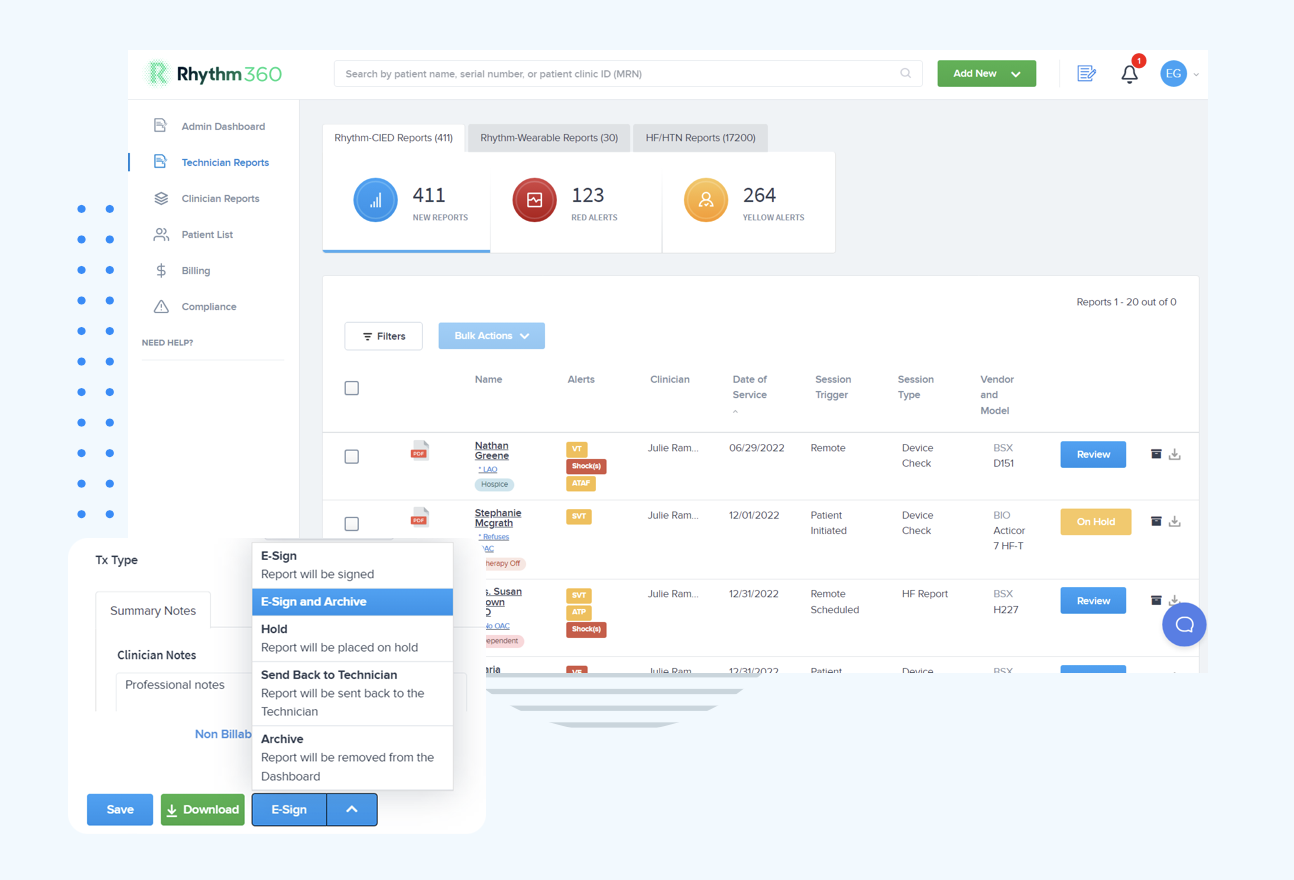
Rhythm360 helps practices reduce response times for critical alerts by up to 80% and increase revenue capture and profitability by as much as 300%. Other platforms in the cardiac device monitoring space include Murj, Implicity, Rhythm Management Group, and Octagos.
Explore Rhythm360 for cardiac alert triage
Device alerts function as monitoring signals, not full heart failure assessments. A weight-gain alert from a CIED or connected scale routes into the Medium-Priority tier for clinical review. The alert does not replace a heart failure assessment, a diagnosis, or the clinical evaluation that follows. Routing the signal correctly through the triage protocol is the operational task, and the clinical evaluation happens after the alert is acknowledged and the patient is contacted.
A functioning three-tier triage protocol produces four verifiable outcomes.
Once those four outcomes are stable, three areas extend the protocol’s value.
Critical alerts involve conditions that may require emergency or semi-emergency response, such as sustained VT, VF, asystole, ERI/RRT, and lead fracture. Medium-Priority alerts require same-business-day clinical review, and Non-Critical/Routine alerts can follow a scheduled cadence. The full tier table appears in Step 1.
Use the windows defined in Step 2: immediate, same business day, and scheduled cadence. The 2023 HRS/EHRA/APHRS/LAHRS consensus statement leaves response timelines to institutional protocol, which means your written windows are what survive an audit.
Apply threshold individualization and the Rule of 3 as described in Step 4. Keep a written list of alerts that are never adjusted and treat that list as a protocol document with medical director sign-off.
The role-and-ownership matrix in Step 3 assigns a named owner and a deadline to every tier. As noted there, protocols without a named owner for every tier tend to collapse quickly.
The gray-zone decision rule in Step 5 assigns adjudication to an EP or designated on-call clinician within a same-business-day window, with documented rationale if deferred. This structure removes ad hoc technician judgment.
Every triage decision requires a dated entry that supports the claim. The documentation fields for each code family are listed in Step 6; the key requirement is that the monitoring period on the transmission record matches the billed cycle.
Undifferentiated alert review, where every transmission appears equally urgent, drives missed critical events, staff burnout, inconsistent documentation, and rejected claims. A written three-tier protocol with named owners, defined review windows, a gray-zone decision rule, and auditable documentation tied to CPT code capture provides a defensible answer. Because it is written down, it can be presented to a medical director for sign-off. Because it assigns owners and windows, it can be executed on the next business day. Because it is tiered rather than flat, it scales as the patient panel grows.
Rhythm360 is the platform that executes this protocol at scale, with vendor-neutral consolidation, AI-powered alert triage, automated CPT code capture, bi-directional EHR integration, and a HIPAA-compliant mobile app for after-hours response. The platform delivers the response-time and revenue improvements described above.
Put the protocol into practice with Rhythm360