Last updated: September 20, 2026
Cardiology practices make better vendor decisions when they first identify which monitoring category they actually need. Remote cardiac monitoring comprises four distinct service modalities, each with its own billing interval, but most practices narrow the decision to three categories:
A practice managing 800 CIED patients across Medtronic, Boston Scientific, Abbott, and Biotronik devices faces a CIED consolidation problem. A practice launching a blood pressure program for 200 hypertension patients faces an RPM problem. These are distinct problems that require different platforms.
The AMA RPM Playbook vendor-selection criteria emphasize clinical workflow fit over feature checklists. They focus on what physiologic data a platform collects, whether devices are FDA-cleared when required, and how missing data are handled. Those principles translate into concrete evaluation dimensions for cardiology practices:
The AMA playbook also recommends mapping CPT documentation needs, escalation protocols, and staff time requirements before signing any RPM contract. It further advises reviewing security, consent, patient onboarding, EHR integration, and data export access for quality reporting.
The table below maps each monitoring modality to the Rhythm360 platform capabilities that matter most for that category.
| Modality | Rhythm360 Primary Focus | Best-Fit Practice Profile | Staffing Options |
|---|---|---|---|
| CIED Consolidation | Vendor-neutral CIED data aggregation across all major OEMs | Multi-OEM device clinics needing a single alert queue and unified documentation | In-house techs, optional 24/7/365 CCT oversight, or fully managed |
| HF/HTN RPM | Integrated RPM workflows for heart failure and hypertension | Practices launching or scaling HF/HTN RPM service lines with recurring revenue goals | In-house clinical staff with optional CCT support for monitoring and escalation |
| System-Level Cardiac Programs | Enterprise deployment across large health systems | Academic or integrated systems managing thousands of CIED and RPM patients | Hybrid staffing models coordinated through a single platform |
Against those modality criteria, Rhythm360 covers both CIED consolidation and HF/HTN RPM in a single system. For cardiology practices that need a unified, vendor-neutral, AI-powered cardiac data management platform, Rhythm360 offers a comprehensive approach across the full CIED and chronic-condition RPM workflow:
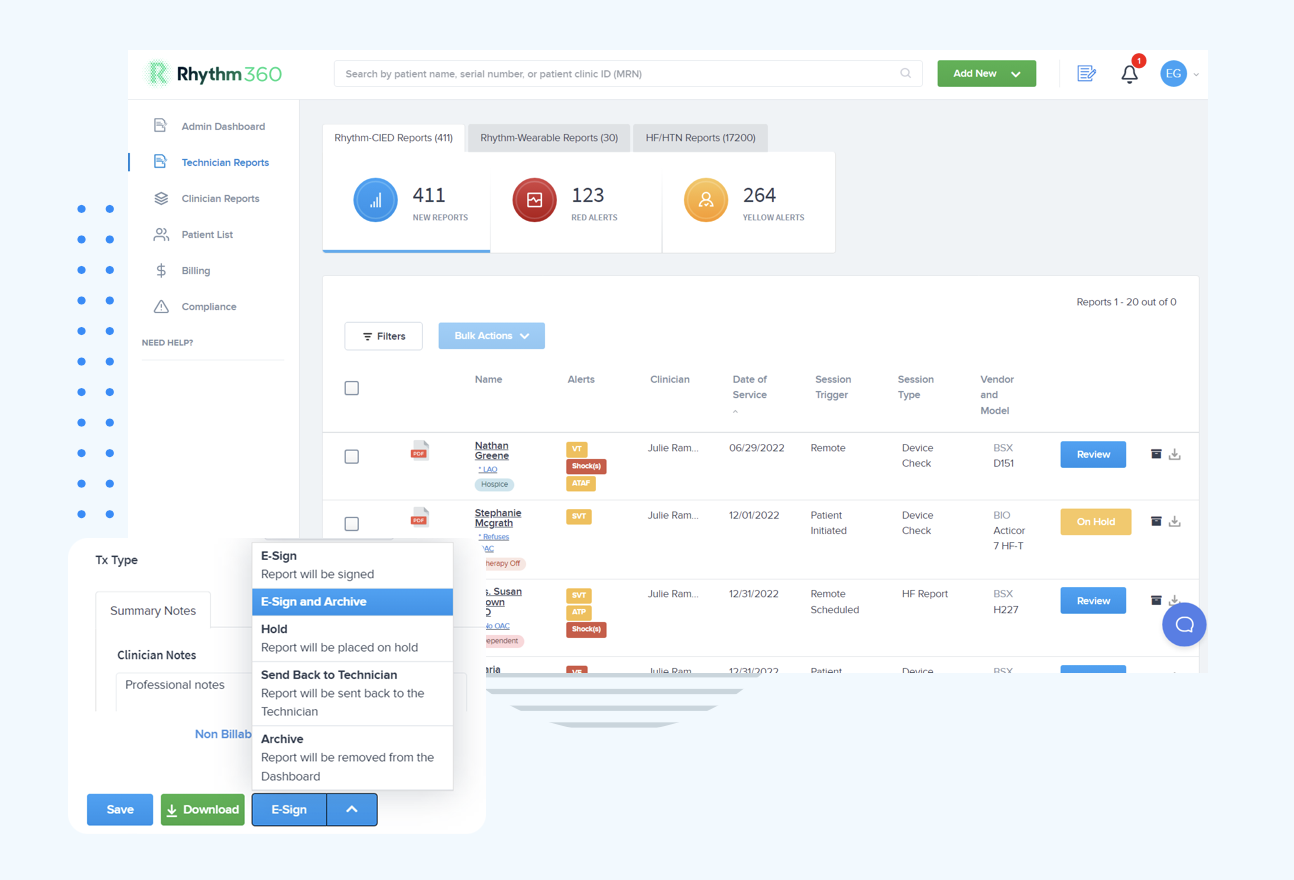
Practices using Rhythm360 have achieved up to an 80% reduction in critical alert response times and up to a 300% increase in revenue capture. University of Chicago Medicine reviewed more than 73,000 reports annually through Rhythm360 in calendar year 2025, demonstrating scalability in a high-volume academic CIED environment.
See How Vendor-Neutral CIED Consolidation Works
Several platforms operate in the CIED consolidation category, including Murj, Implicity, Rhythm Management Group, and Octagos. Practices should align vendor selection with their specific modality needs and request demos and reference calls from platforms that match those requirements.
For ambulatory ECG and MCT, iRhythm, Philips BioTel Heart, and Bardy Diagnostics are category-level vendors. Philips MCOT supports monitoring for up to 30 days and combines continuous external monitoring with human technician review and escalation, which differs from implanted-device alert workflows.
For chronic-condition RPM/CCM focused on hypertension and heart failure, Cadence, HealthSnap, Optimize Health, 1bios, and CCN Health are examples of vendors in that category. Practices can evaluate these platforms against Sensor Bio's six RPM vendor evaluation criteria, including signal quality and research validation, data integration and interoperability, patient adherence design, billing and reimbursement support, clinical workflow integration, and total cost of ownership.
CPT billing for cardiac remote monitoring is device-specific, and errors in code pairing frequently drive claim denials. The mechanics differ by device type and billing cycle.
For pacemakers and ICDs on a 90-day cycle, 93294 (pacemaker) and 93295 (ICD) are professional codes, and 93296 is the pacemaker/ICD technical code.
For physiologic monitors and loop recorders on a 30-day cycle, 93297 and 93298 are device-specific codes that are each billable once per 30 days and can be split into professional (-26) and technical (-TC) components. 93297 applies to implantable cardiovascular physiologic monitors such as CardioMEMS, and 93298 applies to subcutaneous cardiac rhythm monitors and implantable loop recorders. Applying 93297 to a loop recorder or 93298 to a physiologic monitor constitutes a coding error that generates denials.
For HF/HTN RPM, CPT 99453 covers initial setup and patient education (billed once), 99454 covers device supply with data transmitted on 16–30 days per 30-day period, and 99457 covers the first 20 minutes of treatment management per calendar month and requires interactive communication with the patient or caregiver. Two new codes effective January 1, 2026, 99445 (device supply for 2–15 days) and 99470 (first 10–19 minutes of management), fill billing gaps for shorter monitoring intervals that previously fell below reimbursable thresholds.
Rhythm360 automatically tracks device-specific CPT pairings, including the 90-day cycles for pacemakers and ICDs and the 30-day cycles for physiologic monitors and loop recorders. The platform generates auditable documentation that supports compliant billing. Practices using Rhythm360 have reported improved billing accountability, as documented in the University of Chicago Medicine implementation white paper.
The most significant disadvantage of remote patient monitoring for cardiology is a cluster of operational risks that compound when a program lacks the right infrastructure.
Alert Fatigue is the most clinically consequential risk. Across more than 26,000 device patients at 25 centers, 40% of transmissions were alerts, and loop recorders alone generated half of all alerts. Without AI-powered triage, clinical staff spend significant time on non-actionable notifications. That pattern increases the chance that a genuine critical event such as new-onset AF, ventricular tachycardia, or lead fracture is delayed or missed.
Patient Non-Adherence directly weakens clinical yield. High-consistency RPM patients achieved an average blood pressure reduction of 8.53 mmHg versus only 3.54 mmHg among low-consistency patients. That gap shows that monitoring benefit depends on sustained engagement rather than device enrollment alone.
Device Logistics And Connectivity create ongoing staff burden. Maintaining device connectivity above 90% requires recurring staff time for outreach and troubleshooting, which becomes a predictable operational cost.
Reimbursement Documentation Burden remains a persistent source of revenue leakage. The 16-day transmission threshold for 99454, the 20-minute management floor for 99457, and the device-specific CPT pairing requirements for 93297 and 93298 each require accurate, per-period documentation. Common billing mistakes include treating thresholds as targets rather than floors and double-counting minutes across RPM and CCM programs.
Data Fragmentation across multiple OEM portals multiplies all of these risks. A practice logging into separate Medtronic, Boston Scientific, Abbott, and Biotronik portals manages four alert queues, four documentation workflows, and four billing streams simultaneously. A vendor-neutral platform with AI-powered alert triage and automated documentation consolidates these workflows into a single, auditable system and reduces each of the disadvantages described above.
Three practice profiles show how modality and workflow needs drive vendor fit:
A decision matrix for vendor selection can weight four dimensions: modality fit, practice size and patient volume, EHR environment, and staffing model preference. Practices that score highest on CIED consolidation need and EHR integration depth will find Rhythm360's total value of ownership most defensible. That case rests on implementation in days to weeks, no manual data transcription, and automated CPT capture.
Talk With Rhythm360 About Your Modality Mix
This FAQ section addresses common questions that arise once practices start applying a modality-first framework to vendor selection.
The 2026 market organizes around modality rather than a single overall ranking. For CIED consolidation, platforms including Rhythm360, Murj, Implicity, Rhythm Management Group, and Octagos each address elements of the implanted-device workflow. For ambulatory ECG and MCT, iRhythm, Philips BioTel Heart, and Bardy Diagnostics are category-level vendors. For chronic-condition RPM and CCM focused on hypertension and heart failure, Cadence, HealthSnap, Optimize Health, 1bios, and CCN Health are examples of vendors in that space. Practices that need vendor-neutral CIED consolidation combined with integrated HF/HTN RPM in a single platform can evaluate Rhythm360, which supports all major device manufacturers, bi-directional EHR integration with Epic, Cerner, athenahealth, eClinicalWorks, and Greenway Health, and automated CPT billing documentation.
Billing support varies significantly across vendors, but accurate device-specific CPT pairing is the baseline requirement. For CIEDs, that includes 93294 and 93295 for pacemaker and ICD professional components and 93296 for the technical component. For implantable cardiovascular physiologic monitors such as CardioMEMS, 93297 applies, and for subcutaneous cardiac rhythm monitors and loop recorders, 93298 applies, each on its own 30-day billing cycle and splittable into global, -26, or -TC components. For HF/HTN RPM, vendors should track 99453 setup, 99454 device supply and 99445 for shorter 2–15 day periods, and 99457 management time along with 99470 for 10–19 minute months. Rhythm360 tracks these device-specific CPT pairings and generates auditable documentation that helps practices capture revenue and reduce claim denials.
The best wearable device depends on the clinical question. For episodic arrhythmia detection in patients without implanted devices, patch-based ambulatory ECG monitors from vendors such as iRhythm (for example, the Zio and Zio XT monitors) offer continuous single-channel recording for up to 14 days, after which the device will not record further ECG data. For patients with implanted devices, the device itself serves as the monitoring source, and the key decision becomes which software platform consolidates data from all OEM portals into a single workflow. For chronic hypertension and heart failure management, FDA-cleared connected blood pressure cuffs and weight scales that transmit data automatically form the appropriate device class for RPM billing under 99454. The 2025 AHA/ACC blood pressure guideline advises against relying on cuffless devices including smartwatches for clinical decision-making until accuracy improves.
Rhythm360 implementation, including EHR integration setup, typically takes a few days to a few weeks. The timeline depends on EHR environment complexity and patient volume rather than platform limitations. Rhythm360's onboarding process aims to minimize disruption to existing clinical workflows, and the platform's bi-directional integrations with Epic, Cerner, athenahealth, eClinicalWorks, and Greenway Health are designed to go live without extended IT projects. Practices should ask any vendor they evaluate for a realistic implementation timeline specific to their EHR environment and patient panel size before signing a contract.
The core problem for cardiology practices evaluating cardiac remote monitoring vendors in 2026 is the absence of a modality-first framework for choosing among them. A flat vendor ranking forces comparison between platforms that solve fundamentally different problems. Effective evaluation starts with identifying whether the practice needs CIED consolidation, ambulatory ECG/MCT, or chronic-condition RPM/CCM, and then applying AMA-aligned criteria such as workflow fit, FDA clearance, missing-data handling, EHR integration depth, and CPT billing support within that category.
Practices that need vendor-neutral CIED consolidation plus integrated HF/HTN RPM in a single, AI-powered platform with bi-directional EHR integration, automated CPT documentation, and optional 24/7/365 CCT oversight can look to Rhythm360 as a proven option. The University of Chicago Medicine implementation referenced earlier provides a real-world benchmark for performance at scale.
Discuss Your Cardiac Monitoring Strategy With Rhythm360