Last updated: July 14, 2026
RPM revenue cycle management covers every administrative and clinical step needed to turn a monitored patient event into a paid claim. Under 2026 CMS rules, that process spans patient enrollment and consent, device activation, data transmission tracking across a 30-day period, time-based clinical documentation under CPT 99457 (first 20 minutes) and 99458 (each additional 20-minute block), charge capture, claim submission, and denial resolution. Each step carries its own compliance requirement and financial risk when missed.
The 16-day transmission threshold causes more RPM claim denials than any other single factor. Most RPM denials under Medicare are mechanical, stemming from failures in day counts and period boundaries rather than clinical issues. The table below maps each compliance milestone to the responsible team member and the financial consequence of a miss.
| Day | Milestone | Responsible Role | Financial Risk if Missed |
|---|---|---|---|
| Day 1 | Device provisioned; consent documented in EHR | Device technician / MA | Entire month's billing invalidated; OIG audit exposure |
| Day 1-9 | Daily transmission confirmed; patient re-engagement if gap detected | Clinical staff / RPM platform | Trajectory toward sub-16-day miss; lost CPT 99454 (~$50/month) |
| Day 10 | Automated alert flags patients below threshold; staff intervention initiated | RPM platform / billing coordinator | Missed alert means no recovery window; forfeited device supply code |
| Day 15 | Confirm 2-15 days met for CPT 99445 eligibility if full 16 unreachable | Billing manager | Failure to bill 99445 forfeits about $48 per patient, the same amount practices commonly wrote off before this code existed |
| Day 16 | CPT 99454 threshold confirmed; charge capture triggered | RPM platform / billing coordinator | Manual tracking error means a missed ~$50 monthly device supply code |
| Day 20 | 20-minute interactive clinical time documented for CPT 99457 | NP / RN / PA | Incomplete time log means a denied treatment management claim |
| Day 30 | Month-end claim generated with readings count, time logs, and signed care plan | Billing manager / RPM platform | Late or incomplete claim causes delayed payment or denial |
Standard RPM workflows are built for wearables and cellular-connected consumer devices. Cardiology RPM adds a layer of complexity that general-purpose platforms cannot handle. CIEDs, including pacemakers, ICDs, implantable loop recorders, CRT devices, and CardioMEMS pulmonary artery monitors, transmit data through proprietary OEM portals run by Medtronic, Boston Scientific, Abbott, Biotronik, and others. Each portal uses its own data format, alert taxonomy, and transmission schedule.
Rhythm360 reaches >99.9% transmissibility across these sources through redundant data feeds, computer vision, and AI-powered extrapolation. That standard matters because a missed transmission is not just a billing problem. It is a patient safety event, which is why consolidation matters at scale: after integrating a unified remote monitoring platform, the University of Chicago Medicine reported improved billing and accountability while managing over 73,000 reports annually with stable dismissal rates.
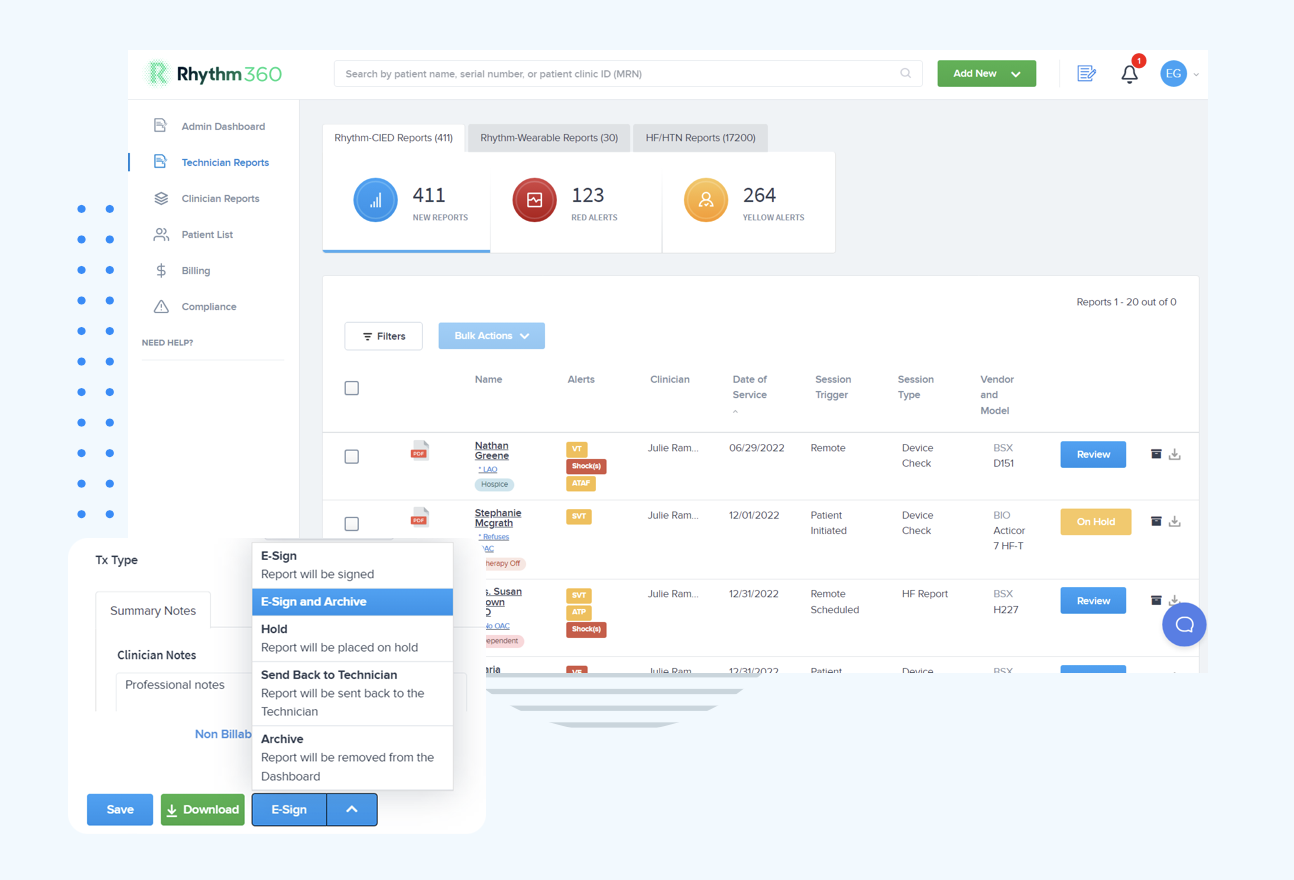
Enrollment is where this reliability starts. Before any device can transmit data, a patient needs to be enrolled and consented correctly, which sets up every billing step that follows.
Patient consent for RPM must be documented in the medical record before any billing begins. It must cover agreement to participate, single-provider acknowledgment, cost-sharing disclosure, and the right to revoke at any time, per 2026 CMS requirements. Consent is not a formality. It is the operational gate that determines whether any downstream billing is valid.
| Task | Legacy Pain Point | Rhythm360 Solution |
|---|---|---|
| Eligibility verification | Manual chart review; duplicate billing risk across providers | Automated payer eligibility check flags patients already billed 99453/99454 by another provider |
| Consent capture and storage | Paper forms filed inconsistently; not retrievable during audit | Digital consent stored in discrete EHR field with date, method, and cost-sharing disclosure logged |
| Physician order creation | Verbal orders not documented; missing medical necessity statement | Structured enrollment workflow generates order with chronic condition, monitoring type, and care plan note |
| Device provisioning record | Device serial numbers tracked in spreadsheets; FDA clearance status unverified | Device inventory linked to patient record with FDA clearance status and provisioning date |
A 2024 micro-costing study of the RPM hypertension program at NYU Langone Health's Cardiology Division found that patient compliance with the 16-day submission requirement averaged only 55%. That gap directly costs practices CPT 99454 reimbursement. Automated day-count tracking with mid-month alerts is the primary lever for closing it.
| Task | Legacy Pain Point | Rhythm360 Solution |
|---|---|---|
| Transmission day counting | Manual spreadsheet tracking; errors common across large panels | Real-time per-patient adherence counter updated with each transmission |
| Day 10 alert | No proactive alert; staff discover misses at month-end | Automated flag at day 10 triggers patient outreach via integrated Twilio messaging |
| 99445 eligibility identification | Patients with 2-15 days written off entirely under prior rules | Platform identifies 99445-eligible patients automatically, capturing that same ~$48 per patient identified earlier as commonly written off |
| Audit trail | Transmission logs not archived; first item auditors request is unavailable | All transmission timestamps stored as FHIR R4 Observation resources with LOINC codes and provenance metadata |
A cardiology practice implanting devices from more than one manufacturer must log into separate, non-interoperable portals to retrieve patient data. A device-agnostic aggregation layer that normalizes formats across manufacturers solves this without locking a practice into a single vendor. Rhythm360 ingests data via API, HL7, XML, and PDF parsing through computer vision, turning disparate OEM formats into a single source of truth.
| Task | Legacy Pain Point | Rhythm360 Solution |
|---|---|---|
| Multi-vendor data retrieval | Staff log into separate Medtronic, Boston Scientific, Abbott, and Biotronik portals daily | Single dashboard aggregates all OEM data; eliminates redundant logins |
| Unstructured PDF parsing | Device reports arrive as PDFs; manual transcription into EHR required | Computer vision (OCR) extracts and maps data fields automatically |
| OEM server downtime | Transmission gaps when OEM servers are unavailable; missed billing events | Redundant data feed system acts as fail-safe, preserving the transmissibility standard noted earlier |
| Data validation | Conflicting values across portals; clinicians reconcile manually | Validation rules catch data quality issues before clinical use and billing |
CMS did not adopt the AMA proposal to lower the time thresholds for CPT 99457 and 99458. Those codes retain their current 20-minute increments in 2026. Accurate, real-time time logging with documented interactive communication remains the standard, and payers increasingly flag vague time entries.
| Task | Legacy Pain Point | Rhythm360 Solution |
|---|---|---|
| Time tracking | Staff log time retrospectively; entries lack date, duration, and interaction detail | AI-assisted clinician timer logs content, duration, and interactive communication confirmation with manual-edit audit trail |
| 99458 add-on identification | Additional 20-minute blocks not captured; revenue left on table | Platform flags when cumulative time crosses each 20-minute threshold and prompts add-on code |
| Interactive communication verification | Asynchronous texting does not satisfy the interactive communication standard for 99457/99458; practices bill incorrectly | Communication type (phone, video, in-person) logged per encounter; asynchronous-only sessions flagged before claim submission |
| EHR documentation | Time logs stored outside EHR; documentation gaps cause denials | Bi-directional EHR integration pushes time logs and review notes directly into patient record |
A regional cardiovascular group integrated device telemetry feeds into automated billing software and captured additional compliant recurring RPM revenue without adding administrative tasks for front-desk staff. Real-time alert-to-billing workflows made that outcome repeatable, because each alert automatically triggers the documentation and code selection needed to bill it correctly.
| Task | Legacy Pain Point | Rhythm360 Solution |
|---|---|---|
| CPT code selection | Billing staff manually select codes; 99445 vs. 99454 distinction missed | Platform auto-selects correct code based on confirmed transmission day count at month-end |
| Claim generation | Manual EDI 837P preparation; readings count and time logs assembled separately | Automated claim includes readings count, time logs, clinician identity, and signed care-plan documentation |
| CCM/RPM bundling | Concurrent billing opportunities missed; time not tracked separately per program | Platform logs time distinctly against RPM and CCM activities; supports concurrent billing when documentation supports separate services |
| Pre-submission validation | Claims submitted with missing consent dates or incomplete day counts | Four-point pre-submission check: data volume, time threshold, interactive communication, and global period status |
Even with automated charge capture in place, claims can still be denied for reasons rooted earlier in the workflow. The OIG's 2024 report on 2022 Medicare data found that 43% of RPM enrollees did not receive all three required components: education/setup (99453), device supply (99454), and treatment management (99457/99458). That gap is both a denial risk and an audit trigger. Preventing it requires root-cause analysis at the claim level, not just tracking an aggregate denial rate.
| Task | Legacy Pain Point | Rhythm360 Solution |
|---|---|---|
| Denial root-cause tagging | Denials categorized only by payer remark code; systemic issues not identified | Platform tags denials by root cause (day count, time threshold, consent gap, duplicate billing) for pattern analysis |
| Payer-specific rule enforcement | Commercial payer rules differ from Medicare; staff apply wrong criteria | Payer-specific rule sets applied at pre-submission validation; flags payer-specific exclusions |
| CCM/RPM bundling compliance | Clinical staff time for RPM and CCM cannot overlap; manual tracking causes overbilling risk | Separate time buckets enforced at the platform level; audit trail documents distinct service activities |
| Quarterly self-audit support | Random sample audits conducted manually; inconsistent methodology | Platform supports quarterly review of 10-20% random RPM patient samples with exportable consent, transmission, and time documentation |
Fixing denials at the root only works if a practice can see problems before they compound. Practices using AI-driven chronic care billing automation increase chronic care revenue by catching missed eligible services, and they reduce claim denials through automated time threshold verification. A real-time KPI dashboard gives staff visibility into these numbers every month, not just at audit time.
| KPI | Target Benchmark | What It Measures | Action if Below Target |
|---|---|---|---|
| 16-day transmission achievement rate | 80%+ of enrolled patients | Share of patients meeting CPT 99454 threshold each month | Increase day-10 outreach cadence; review device connectivity issues |
| Overall claim denial rate | Under 5% | Claims denied as a share of total claims submitted | Run root-cause analysis by denial tag; update payer rule sets |
| Days to payment | Under 30 days | Average time from claim submission to payment posting | Audit pre-submission validation; check clearinghouse rejection logs |
| Billable events captured | 100% of eligible patients billed at correct code tier | 99445 vs. 99454 accuracy; 99457/99458 add-on capture rate | Review month-end code selection logic; retrain billing staff on 2026 tiers |
| Staff hours per 100 patients | Reduction vs. prior period baseline | Administrative burden of RPM program operations | Identify manual steps not yet automated; expand EHR integration scope |
| Consent documentation coverage | 100% of active patients | Share of enrolled patients with valid, dated consent on file | Flag and resolve missing or expired consents before next billing cycle |
Implementation typically takes a few days to a few weeks, depending on EHR integration complexity and the number of OEM device portals being connected. Rhythm360 supports bi-directional integration with Epic, Cerner, Athenahealth, eClinicalWorks, Greenway Health, and others via HL7. The onboarding process minimizes disruption to existing clinical workflows, and RhythmScience provides implementation support throughout setup.
Rhythm360 automatically tracks each patient's transmission day count within the 30-day period and applies the correct code tier at month-end: CPT 99445 for patients with 2-15 days of transmitted data, and CPT 99454 for patients with 16 or more days. For treatment management, the platform logs clinical staff time in real time and identifies eligibility for CPT 99457 (20+ minutes) or CPT 99458 (each additional 20-minute increment), consistent with the thresholds described earlier in this article. All documentation is stored with timestamps, staff identity, and interaction type to support payer audits.
Yes. CMS permits concurrent billing of RPM and CCM for the same patient in the same calendar month when time and documentation stay distinct for each service. Rhythm360 enforces separate time buckets for RPM and CCM activities at the platform level, preventing overlap that would create audit risk. The platform generates independent documentation trails for each program, helping practices capture the full combined reimbursement potential, estimated at $170 to $260 per patient per month depending on transmission days and management time.
Several platforms operate in the cardiovascular remote monitoring space, each with different strengths in device coverage and integration depth. Rhythm360 differentiates itself as a vendor-neutral, HIPAA-compliant platform built specifically for the full cardiology RPM workflow, covering multi-OEM data ingestion, AI-powered alert triage, automated CPT documentation, and EHR integration. It serves practices ranging from solo electrophysiology clinics to large integrated health systems.
Revenue cycle management for remote patient monitoring in 2026 requires more than a billing checklist. It requires infrastructure that tracks every transmission day, logs every clinical minute, validates every claim before submission, and surfaces every missed billing opportunity across every device vendor and every payer. Cardiology practices face higher stakes because they manage CIEDs alongside heart failure and hypertension RPM programs. Fragmented OEM portals, the >99.9% transmissibility requirement, and concurrent CCM billing opportunities all demand one unified, vendor-neutral approach.
Rhythm360 is built for that environment. Practices using the platform have reduced critical alert response times by up to 80% and increased revenue capture by as much as 300% through accurate CPT code selection and improved staff efficiency.
Close every gap in your RPM revenue cycle. Talk to the Rhythm360 team.