Last updated: July 14, 2026
Rhythm360 structures billing operations for CIED and RPM programs across ten steps, from the first patient consent to final revenue reporting.
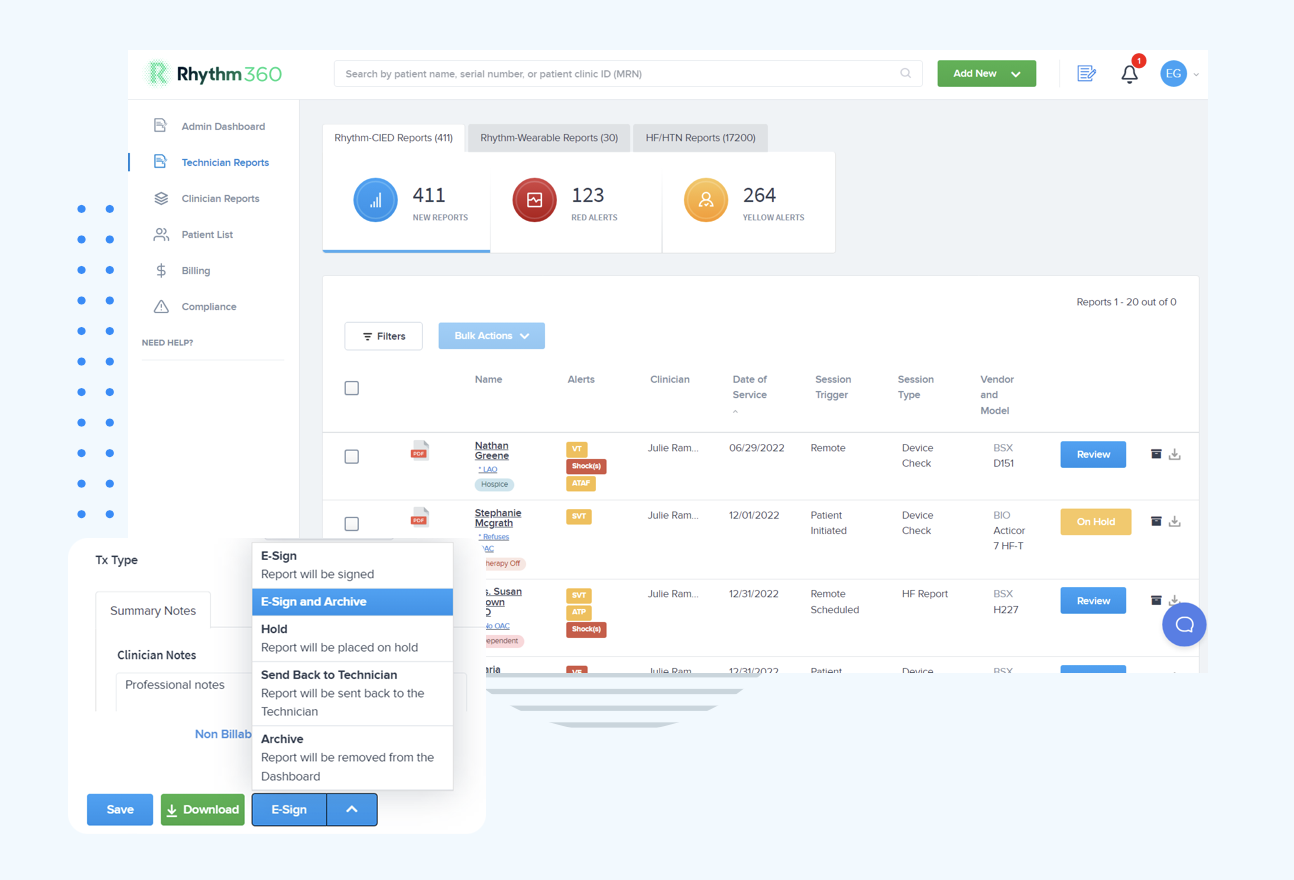
| Step | Action | Rhythm360 Feature | Outcome |
|---|---|---|---|
| 1 | Patient enrollment and consent capture | Automated onboarding checklist with documented consent logging | Audit-ready consent on file before first billing cycle |
| 2 | Device setup and CPT 99453 billing trigger | Setup confirmation logged automatically at device activation | One-time setup code billed at $21.71 (2026 rate) without manual entry |
| 3 | Vendor-neutral data ingestion from all OEM portals | API, HL7, XML, and AI-powered PDF parsing via computer vision; >99.9% transmissibility | Single source of truth eliminating redundant portal logins |
| 4 | Transmission day tracking for 16-day threshold | Automated day-count engine per patient per 30-day period | CPT 99454 or 99445 billed based on verified transmission days |
| 5 | AI-powered alert triage and critical event escalation | Prioritized alert queue with 80% reduction in critical response times | Clinically significant events acted on; alert fatigue reduced |
| 6 | Separate time tracking for RPM and CCM | Program-specific time-log buckets with start/stop timestamps and staff ID | No double-counted minutes; concurrent billing supported compliantly |
| 7 | Interactive communication logging for 99457/99470 | Twilio-integrated call and message logging with full audit trail | Synchronous communication documented per CMS requirements |
| 8 | Automated charge capture and CPT code generation | Threshold-triggered billing queue; bi-directional EHR integration (Epic, Cerner, Athenahealth, eClinicalWorks) | Claims submitted only when all thresholds are met; clean claim rate maximized |
| 9 | Denial identification and rework routing | Real-time denial dashboard with root-cause categorization | Unworked denials flagged and routed before appeal windows close |
| 10 | Population-level compliance and revenue reporting | Administrative dashboard showing patient compliance, billable events, and captured vs. potential revenue | Practice-wide visibility into monthly billing performance and leakage |
Remote chronic cardiac care programs draw from two distinct code families. Device-specific CIED interrogation codes cover 93294 through 93298. General RPM management codes cover 99453 through 99470. CPT codes 99453-99454 are not appropriate for CIED device interrogation; CIED remote monitoring is billed under the cardiac-specific codes 93294-93298 instead.
The table below highlights which codes carry the tightest documentation requirements and the highest denial risk when those requirements are missed.
| CPT Code | Description | 2026 Medicare Rate | Key Requirement |
|---|---|---|---|
| 93294 | Remote interrogation, pacemaker (professional) | Varies by locality | Minimum 30-day monitoring period in a calendar year |
| 93295 | Remote interrogation, ICD (professional) | Varies by locality | Minimum 30-day monitoring period; mutually exclusive with 93294 same date |
| 93296 | Remote monitoring platform technical component | Varies by locality | Billed with 93294 or 93295; covers data processing and support |
| 93297 | Remote ILR interpretation (professional) | Varies by locality | No 30-day minimum; billed per clinically indicated transmission period |
| 93298 | ILR/ICM technical component | Varies by locality | The 2026 CPT 93298 service covers more than 15 days up to 30 days of remote interrogation for a subcutaneous cardiac rhythm monitor. |
| 99453 | RPM device setup and patient education (one-time) | $21.71 | Billed once per episode of care; setup confirmation required |
| 99454 | RPM device supply, 16+ transmission days per 30-day period | $52.11/month | 16-day transmission minimum; automated logs required |
| 99445 | RPM device supply, 2-15 transmission days (new 2026) | $52.11/month | Cannot be billed with 99454 in the same 30-day period |
| 99457 | RPM treatment management, first 20 minutes | $51.77/month | Live synchronous interactive communication required |
| 99458 | RPM treatment management, each additional 20 minutes | $41.42/unit | Add-on to 99457; up to two units per month |
| 99470 | RPM treatment management, first 10 minutes (new 2026) | $26.05/month | Cannot be billed with 99457 in the same calendar month |
Combining 99454, 99457, 99458, 99490, and 99439 increases maximum monthly RPM reimbursement per patient. Missing the 16-day transmission minimum for 99454 eliminates the device supply reimbursement entirely for that month. This is a direct, avoidable leakage point that Rhythm360's automated day-count engine prevents.
CMS rules prohibit counting the same minute of clinical staff time toward two different care management programs. RPM and CCM can be billed concurrently for the same cardiac patient in the same month, but only when time and services are documented separately with no overlap.
The operational rule is straightforward: classify each call by its purpose. If it resolves an RPM alert, count it as RPM management time. If it's care coordination unrelated to device monitoring, count it as CCM or APCM time. When the purpose can't be clearly separated, the safest compliance path is to avoid stacking the codes altogether.
Rhythm360 enforces this separation through program-specific time-log buckets. Each entry captures the date, staff member identity and credentials, activity description, duration, and the specific program the time applies to. The platform's Twilio-integrated communication hub timestamps every synchronous patient interaction, the live, two-way call that CPT 99457 and 99470 require. Text messages, portal messages, and voicemails do not qualify for these codes.
| Denial Cause | Root Cause | Rhythm360 Fix |
|---|---|---|
| Transmission days below threshold | Daily readings fall below 2-15 or 16+ payer thresholds | Automated day-count engine with real-time threshold alerts; patient compliance reminders via Twilio |
| Missing or invalid consent | Written patient consent not on file before first billing cycle | Onboarding checklist enforces consent capture and logs it to the patient record before billing is enabled |
| Vague or insufficient time documentation | Vague documentation is the leading cause of RPM denials and audit findings in 2026 | Structured time-log templates require date, staff ID, activity description, duration, and program designation before claim generation |
| Double-counted RPM/CCM minutes | Same minutes allocated to both RPM and CCM programs | Separate program time-tracking buckets with automated reconciliation prevent overlap before claim submission |
| Mutually exclusive codes billed together | 99454 and 99445 billed in the same 30-day period; or 99457 and 99470 billed in the same month | Threshold-triggered billing queue applies code logic rules and blocks conflicting code combinations before submission |
| Missing synchronous communication for 99457/99470 | No documented live two-way interactive communication with patient or caregiver during the billing month | Twilio call logging captures timestamp, method, and substance of every synchronous interaction; management codes blocked until interaction is logged |
| Unworked denials aging past appeal window | Industry sources commonly cite that up to 65% of denied medical claims are never reworked or resubmitted | Real-time denial dashboard with root-cause categorization routes denials to appropriate staff with appeal deadline tracking |
See how Rhythm360's denial dashboard can shrink your unworked-denial backlog. Schedule a demo.
Once denials are minimized, the next opportunity for revenue capture lies in maximizing the codes billed per patient each month. The table below shows monthly reimbursement potential under three billing scenarios, using 2026 Medicare national average rates. Rhythm360's automated charge capture and threshold tracking move patients from the baseline scenario toward the optimized one.
| Scenario | Codes Billed | Monthly Revenue per Patient | Annual Revenue (100 Patients) |
|---|---|---|---|
| Baseline (manual, fragmented) | 99454 only (when threshold met) | ~$52 | ~$62,400 |
| Standard RPM | 99454 + 99457 | ~$104 | ~$124,800 |
| Optimized RPM + CCM (Rhythm360) | 99454 + 99457 + 99458 + 99490 + 99439 | ~$211+ | ~$253,200+ |
The gap between baseline and optimized scenarios runs about $159 per patient per month. That gap comes from fragmented OEM portals and manual workflows. Across a panel of 100 enrolled cardiac patients, it adds up to roughly $190,800 annually. Rhythm360 clients have reported revenue increases of up to 300% through optimized CPT code capture, improved staff efficiency, and the addition of RPM service lines for heart failure and hypertension management. The University of Chicago Medicine, using Rhythm360, reviewed more than 73,000 reports annually in calendar year 2025, with staff noting improved billing and accountability after implementation.
Every remote chronic cardiac care billing cycle requires the following documentation to withstand payer audit scrutiny.
Fragmented OEM portals, manual transmission tracking, and disconnected time logs cause substantial annual billing leakage for cardiology practices delivering remote chronic cardiac care. Four rules make automation essential here. The 16-day transmission requirement for CPT 99454 must be tracked daily. Minutes can't be double-counted between RPM and CCM. New 2026 codes 99445 and 99470 carry their own compatibility restrictions. CIED interrogation codes 93294-93298 demand specific documentation standards. Meeting all four manually, patient by patient, isn't realistic at scale.
Rhythm360 is a vendor-neutral, HIPAA-compliant platform that consolidates data from all major device manufacturers into a single source of truth. It automates CPT code threshold tracking, enforces program-specific time segregation, and integrates bidirectionally with major EHR systems. These gains, the 80% faster alert response and up to 300% revenue increase noted earlier, stem directly from the automation and time-segregation features described throughout this workflow.
CPT 99454 requires that a patient transmit physiologic data on at least 16 days within a 30-day monitoring period for the device supply code to be billable. If a patient transmits on fewer than 16 days, the practice cannot bill 99454 for that month, eliminating roughly $52 in reimbursement per patient per cycle. The 2026 CMS Physician Fee Schedule introduced CPT 99445 for patients who transmit on 2-15 days, allowing practices to capture device supply reimbursement at the same rate for shorter monitoring windows. However, 99454 and 99445 cannot be billed together in the same 30-day period. Rhythm360's automated day-count engine tracks transmission days in real time and triggers patient compliance reminders before the monitoring period ends, reducing missed thresholds.
Yes. CMS permits concurrent billing of RPM and CCM for the same patient in the same calendar month, provided no minute of clinical staff time counts toward both programs simultaneously. The programs must be documented separately: RPM notes address device data review and resulting clinical actions, while CCM notes address care coordination activities and care plan updates. A single combined note covering both programs won't withstand audit scrutiny. Rhythm360 enforces this separation through program-specific time-log buckets that require staff to designate each activity to a specific program, with start and stop timestamps, before a claim can be generated. The platform's threshold-triggered billing queue also blocks claim submission until minimum time thresholds for each program are independently met.
CIED remote monitoring uses device-specific interrogation codes rather than general RPM physiologic monitoring codes. CPT 93294 covers the professional component of remote pacemaker interrogation and requires a minimum 30-day monitoring period in a calendar year. CPT 93295 covers the professional component for ICDs under the same 30-day minimum, and cannot be billed on the same date as 93294 for the same patient. CPT 93296 is the technical component billed alongside 93294 or 93295, covering the monitoring platform infrastructure and data processing. CPT 93297 covers professional interpretation of implantable loop recorder (ILR) transmissions and does not require a 30-day minimum, allowing billing per clinically indicated transmission period. CPT 93298 is the ILR technical component, and the 2026 CPT 93298 service covers more than 15 days up to 30 days of remote interrogation for a subcutaneous cardiac rhythm monitor. Each of these codes requires a clinician interpretation note addressing device function, programmed parameters, and actionable findings. Rhythm360 supports documentation workflows for all CIED interrogation codes within its unified platform.
The most frequent RPM denial causes in cardiology include transmission days falling below the applicable threshold, missing or undocumented patient consent, and vague time documentation that skips the date, staff identity, activity description, or duration. Other causes include double-counted minutes across RPM and CCM programs, mutually exclusive codes billed together (such as 99454 and 99445 in the same month, or 99457 and 99470 in the same month), and missing documentation of the synchronous live interactive communication required for CPT 99457 or 99470. Preventing these failures requires automated transmission day tracking, structured time-log templates that enforce specificity before claim generation, program-segregated time buckets, and a billing queue that applies code compatibility logic before submission. Rhythm360 addresses each of these failure points through its automated charge capture and documentation infrastructure, and its denial dashboard routes unworked denials to appropriate staff before appeal windows close.
Individual OEM portals from manufacturers such as Medtronic, Boston Scientific, Abbott, and Biotronik don't talk to each other, requiring staff to log into separate systems to retrieve transmission data for each device type. This fragmentation creates data silos, increases administrative burden, and makes it operationally difficult to track CPT billing thresholds across a mixed-device patient population. Rhythm360 is a vendor-neutral platform that ingests and normalizes data from all major device manufacturers through API, HL7, XML, and AI-powered PDF parsing via computer vision, achieving greater than 99.9% transmissibility through redundant data feeds. The result is a single dashboard where device technicians and clinicians access a unified view of their entire CIED and RPM patient population, with automated threshold tracking, alert triage, time logging, and EHR-integrated charge capture, capabilities individual OEM portals don't provide. As noted earlier, the University of Chicago Medicine processed over 73,000 reports annually through Rhythm360, reflecting the platform's capacity at scale.