Last updated: June 16, 2026
Every time a practice implants a device from a second or third manufacturer, such as Medtronic, Boston Scientific, Abbott, or Biotronik, staff inherit a separate, non-interoperable portal. This fragmentation creates redundant logins, manual data transcription, siloed alert queues, and billing documentation that frequently falls through the cracks.
The clinical stakes are equally serious. High false-alert rates from monitoring devices contribute to clinician alert fatigue and unsustainable triage workload in ambulatory settings. This erosion of trust has downstream consequences. Without personalized thresholds and layered AI processing, clinicians lose confidence in remote monitoring and keep patients in hospital beds rather than discharging them to home monitoring. That pattern defeats the purpose of remote cardiac programs.
Financial leakage compounds the operational burden. Remote monitoring CPT codes, including 93297, 93298, and 99454, carry strict documentation requirements. CMS Article A56602 states that remote monitoring codes 93293 through 93296 are reported no more than once every 90 days and must not be reported when the monitoring period is less than 30 days. A single documentation gap can void an entire billing cycle. Manual workflows make those gaps routine, which creates a clear need for automation and consolidation.
A platform adequate for 2026 must satisfy six non-negotiable requirements:
The University of Chicago Medicine (UCM) operationalized these requirements at scale. UCM reviewed more than 73,000 reports annually through Rhythm360 in calendar year 2025, averaging more than 18,000 reports per quarter. That volume remains sustainable only with automated ingestion and intelligent triage, not manual portal-hopping.
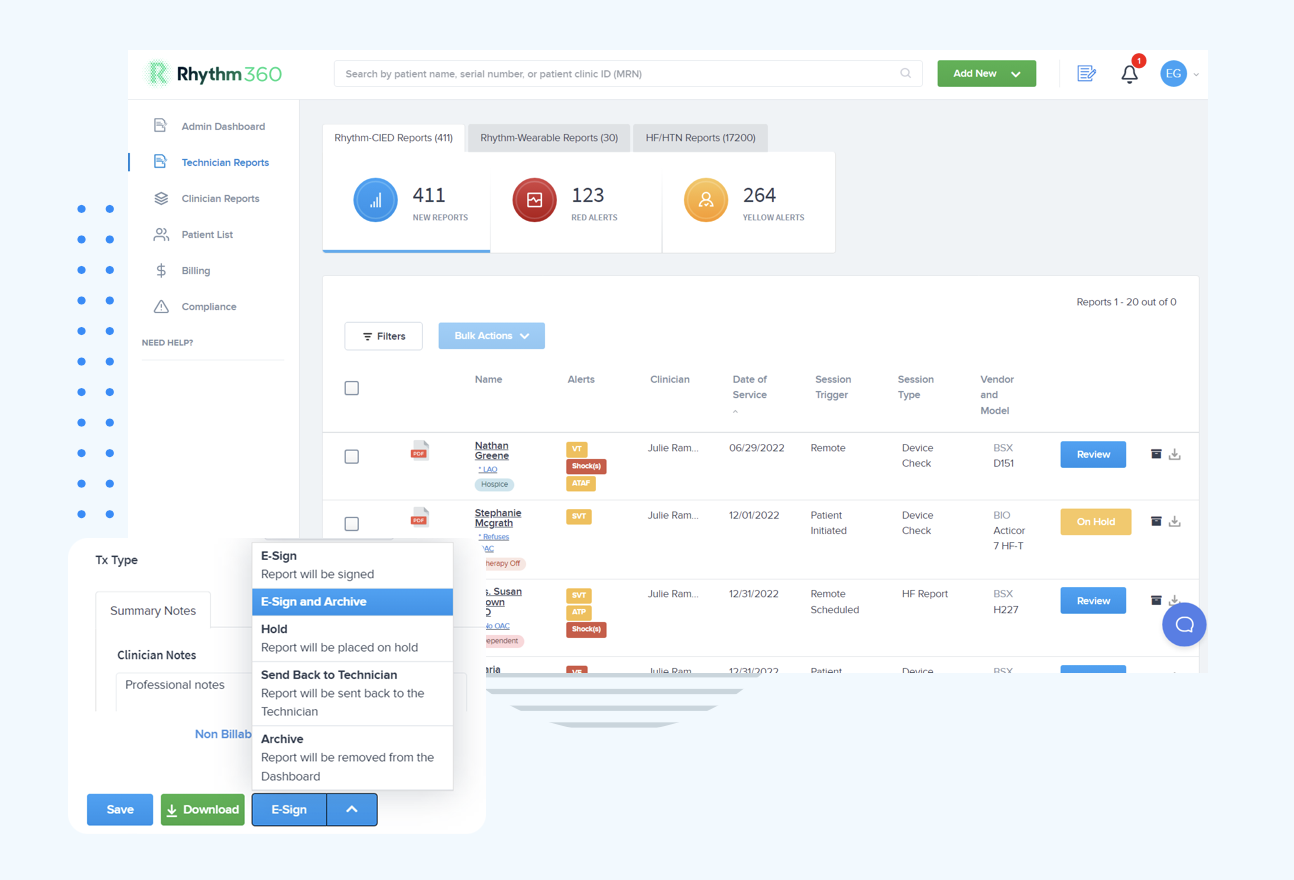
CIED patients, including those with pacemakers, ICDs, CRT devices, or implantable loop recorders, generate continuous device telemetry that requires scheduled interrogations and urgent alert handling. Patch and wearable patients generate high-volume ECG streams suited to diagnostic workups for infrequent or intermittent symptoms.
A meta-analysis of four RCTs found that prolonged ambulatory cardiac monitoring of at least seven days increased detection of atrial fibrillation lasting 30 seconds or more to 13.8% versus 2.5% with short-term monitoring of 48 hours or less. This finding underscores why patch modalities require their own workflow lane. A unified platform must handle both populations while keeping staff in a single system.
Low-latency on-device or edge inference eliminates network-imposed latency, enables operation in low-bandwidth conditions, and supports immediate arrhythmia detection without reliance on centralized cloud servers. This architecture reduces alert delays, which directly affects how effectively a platform manages alert volume and clinician workload.
Alert fatigue in monitoring systems stems from poor signal design rather than alert volume, and systems require personalized baselines because a 32-year-old athlete and a post-surgical patient on home oxygen have radically different circulatory baselines. The same alert can register as a false positive for one patient and a missed true deterioration for another when baselines are not individualized.
Effective AI triage applies layered validation before any escalation reaches a clinician. A multi-agent architecture in which each agent performs root-cause analysis and layered validation on signals before escalation ensures operators only see alerts that survive multiple checks. Rhythm360 applies this principle to CIED and RPM data, filtering non-actionable noise and surfacing only clinically significant events.
The clinical impact is direct. UCM's implementation of Rhythm360 enabled clinicians to review more transmissions daily and identify more abnormalities. As Andrew Beaser, MD, Associate Professor of Medicine at UCM, explained: "We are able to address these issues earlier; rather than waiting for a 3-month visit, we can call patients in for evaluation."
Rhythm360 also offers optional 24/7/365 oversight by certified cardiac technicians (CCTs) supervised by physicians. This human backstop for the AI layer reduces critical alert response times by up to 80%.
Billing for remote arrhythmia monitoring follows complex rules. UnitedHealthcare's Commercial Medical Policy (effective May 1, 2026) covers CPT 93298 for remote interrogation device evaluation of a subcutaneous cardiac rhythm monitor system up to 30 days, CPT 93297 for implantable cardiovascular physiologic monitor systems, and CPT 0650T for remote programming device evaluation. Each code carries distinct documentation requirements that manual workflows routinely fail to satisfy.
Rhythm360 automates the capture and documentation of billable events across these codes, including 99454 for RPM device supply and data transmission. As Gaurav A. Upadhyay, MD, at UCM, observed: "We have improved billing and accountability for our patients after the integration." Practices implementing Rhythm360 have reported revenue increases of up to 300% through more complete CPT code capture and fewer claim rejections, results that can be explored in detail during a platform demo.
A monitoring platform that does not write back to the EHR creates a second documentation burden. Rhythm360 supports bi-directional integration with Epic, Cerner, Athenahealth, eClinicalWorks, and Greenway Health via HL7. This integration enables automated report delivery, alert acknowledgment, and care coordination notes to flow directly into the patient record without manual transcription.
As Andrew Beaser, MD, at UCM, noted: "Decision support, including AI-assisted decision support, will become increasingly important as data volumes grow." EHR integration delivers those AI-generated insights at the point of care instead of isolating them in a separate portal.
Solo practices and small EP clinics benefit most from Rhythm360's SaaS pricing model, which scales with patient volume rather than requiring large upfront infrastructure investment. Mid-size and health-system deployments gain the most from the platform's population-level dashboard, which surfaces compliance gaps, pending billable events, and critical alert queues across thousands of patients simultaneously.
Onboarding, including EHR integration setup, typically takes a few days to a few weeks. This timeline compares favorably to legacy on-premise systems that require months of IT coordination. Rhythm360's implementation team manages the OEM data feed configuration, which removes the need for internal technical resources to negotiate access with each manufacturer separately.
When evaluating any platform, administrators and EPs should confirm several concrete details. First, identify which OEM data feeds are supported natively versus via PDF parsing. Second, determine whether CPT documentation is generated automatically or requires staff review before submission. Third, review the contractual uptime and transmissibility guarantee. Fourth, verify whether the mobile application supports report signing and alert acknowledgment, not just read-only viewing. Fifth, assess the scope of EHR write-back beyond simple PDF attachment.
Rhythm360 provides native multi-OEM ingestion, automated CPT documentation across key CIED and RPM codes, near real time AI-prioritized alert triage, and HIPAA-compliant mobile apps for iOS and Android. For other platforms, request vendor documentation of their current capabilities in each area, since public specifications for 2026 features vary across providers.
Schedule a demo to walk through this checklist against Rhythm360's 2026 feature set with a platform specialist.
True real-time monitoring involves continuous ECG or device telemetry streaming with sub-minute latency. Practices use this model in inpatient or high-acuity ambulatory settings where an ECG technician or automated system monitors the feed continuously. Near real-time monitoring is alert-driven. The device transmits data when a threshold is crossed, and the platform delivers a prioritized notification to the clinical team within minutes.
Scheduled monitoring involves daily or periodic downloads, which are common for stable CIED patients on routine follow-up schedules. Most cardiology practices operate primarily in the near real-time tier for CIED patients and use scheduled downloads for routine interrogations. True real time remains reserved for diagnostic patch studies or high-risk post-procedure monitoring.
The primary codes for CIED remote monitoring include 93293–93296 for pacemaker and ICD remote interrogations. These codes are reportable no more than once every 90 days per CMS rules and only when the monitoring period meets the 30-day minimum. Code 93297 applies to implantable cardiovascular physiologic monitor systems, and 93298 applies to subcutaneous cardiac rhythm monitor systems.
RPM service lines add 99453 for device setup, 99454 for device supply and daily transmission, and 99457 and 99458 for monthly clinical staff time. Automated documentation platforms capture billable events as they occur, flag monitoring periods that meet threshold requirements, and generate compliant reports without manual staff intervention. Practices relying on manual workflows routinely miss billing cycles because a single documentation gap, such as a missing date stamp or incomplete report signature, can disqualify an entire 30- or 90-day period. Automation closes those gaps systematically.
Rhythm360's onboarding process, including EHR integration configuration, typically takes from a few days to a few weeks. The exact duration depends on the number of OEM data feeds being connected and the complexity of the EHR environment. The implementation team manages OEM credentialing and data feed setup directly, which removes the primary bottleneck in most deployments.
Practices with existing Epic, Cerner, or Athenahealth environments can expect bi-directional HL7 integration to be configured within the same onboarding window. The SaaS delivery model removes on-premise infrastructure requirements, which historically extended legacy system deployments to several months.
Rhythm360 uses a redundant data feed architecture that maintains high data transmissibility even when an OEM's server experiences downtime. The platform ingests data via APIs, HL7, XML, and unstructured PDFs using computer vision and AI-powered extrapolation to normalize disparate data formats and fill gaps caused by connectivity interruptions.
This redundancy means a Medtronic CareLink outage, for example, does not create a blind spot in the patient's monitoring record. The redundancy layer is particularly important for practices managing high-acuity patients where a missed transmission during a device malfunction or arrhythmia event carries direct clinical risk.
Practices typically see a significant reduction in the time device technicians and nurses spend on manual data retrieval, portal navigation, and report generation. AI triage filters non-actionable alerts before they reach the clinical queue, which reduces the volume of notifications staff must evaluate each day.
The net effect is that the same team can manage a larger patient population without proportional headcount increases. Existing staff also experience less burnout from alert fatigue. Rhythm360's optional 24/7/365 CCT oversight layer further extends clinical capacity by providing after-hours triage coverage without requiring practices to staff overnight shifts internally.
Fragmented OEM portals create more than workflow inconvenience. They introduce patient safety risk and revenue liability. Practices that manage arrhythmia monitoring effectively at scale in 2026 will rely on a single vendor-neutral platform that ingests all device data, triages alerts intelligently, documents CPT codes automatically, and integrates bidirectionally with the EHR.
The evidence from UCM's deployment of Rhythm360, including the high-volume metrics cited earlier, earlier interventions, and measurably improved billing accountability, shows what that infrastructure looks like in a high-volume academic environment. The same architecture scales down to solo EP practices and up to integrated health systems managing thousands of CIED and RPM patients simultaneously.
Evaluating a platform against the checklist in this guide, including latency model, transmissibility guarantees, CPT automation scope, EHR write-back depth, and mobile access, provides a defensible framework for a purchasing decision that will affect clinical outcomes, staff retention, and practice revenue for years.