Last updated: July 14, 2026
Medical billing produces two distinct claim-status transactions. Cardiology billers need to track both separately.
The 277CA is a pre-adjudication acknowledgment returned by the clearinghouse or payer after an 837 claim is submitted. It reports whether each claim passed business-rule validation and entered the payer's adjudication pipeline (Claim Status Category Code A2) or was rejected before adjudication (A3, A6, A7, or A8). A 277CA A2 confirms only that the claim entered adjudication. It does not indicate payment. The 277 (without the CA) is a status response to a 276 claim-status inquiry and reports current adjudication status after the payer has processed the claim.
For CIED and RPM claims, the distinction matters. A 277CA rejection never enters the payer's adjudication system, carries no appeal rights, and stays invisible to teams that monitor only remittance reports. Meanwhile, the timely-filing clock keeps running from the original date of service.
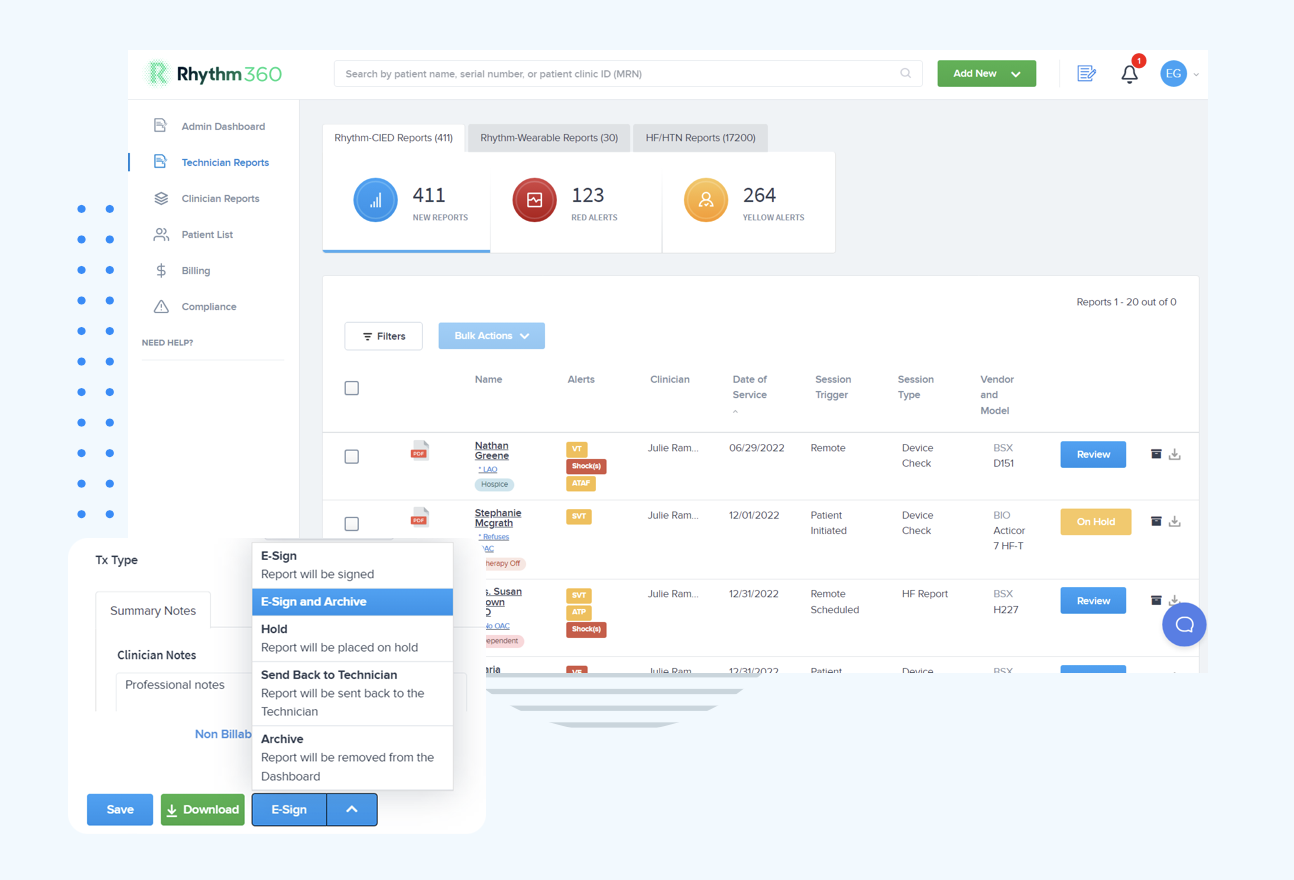
Rhythm360 ingests both 277CA and 277 transactions automatically. It routes rejections to a prioritized work queue inside the same dashboard used for device transmissions, so billing staff see claim status alongside the clinical data that generated the charge.
The 2026 Medicare Physician Fee Schedule created a more granular billing environment for cardiac monitoring services. CPT 99445 reimburses device supply for 2 to 15 days of transmitted data at a national average of approximately $52 per month, while legacy CPT 99454 now explicitly covers 16 to 30 days at the same rate. The two codes are mutually exclusive per patient per 30-day period. CPT 99470 covers the first 10 to 19 minutes of RPM treatment management and is not additive with CPT 99457 in the same month. Once 20 minutes are reached, practices must report 99457 instead.
CIED-specific codes 93294 to 93299 operate on separate frequency and monitoring-period rules. CPT 93294 and 93295 each require a minimum 30-day monitoring period before the evaluation is billable, while 93297 for implantable loop recorders carries no such minimum, allowing billing per transmission period when clinically indicated.
Practices managing patients implanted with devices from Medtronic, Boston Scientific, Abbott, Biotronik, and other manufacturers face a structural problem. Each OEM operates a separate, non-interoperable portal, forcing staff to log into multiple systems, reconcile data manually, and map it to the correct CPT code. That fragmentation is the root cause behind most of the denial triggers described next.
Cardiology practices face notable initial claim denial rates, with RPM claims often carrying higher initial denial rates, driven by a concentrated set of root causes. Here are the five most frequent denial triggers in CIED and RPM billing.
The following workflow describes how Rhythm360 moves a cardiac device transmission from raw data to a billable, trackable claim.
The workflow moves from OEM portal to Rhythm360 ingestion engine, to CPT mapping layer, to clearinghouse, to 277CA return, to Rhythm360 denial alert queue, to corrected resubmission. A parallel track shows 277 post-adjudication status feeding back into the dashboard alongside the 835 ERA.
See this workflow mapped to your device mix and payer panel.
The table below shows how each 277CA status category maps to a real cardiac CPT scenario and the specific action Rhythm360 takes in response.
| Status Category | Code Example | Meaning | Rhythm360 Action |
|---|---|---|---|
| A2, Accepted into adjudication | CPT 93295 (ICD remote interpretation) | Claim passed pre-adjudication validation and entered the payer's adjudication pipeline; payment outcome pending | Claim moves to adjudication tracking queue; no immediate action required |
| A3, Rejected, invalid information | CPT 99454 (device supply, 16 to 30 days) | Claim rejected before adjudication for data error such as missing NPI or subscriber ID mismatch; timely-filing clock continues | AI triage identifies root cause; claim routed to billing work queue for same-day correction and resubmission |
| A7, Rejected, invalid information (payer-level) | CPT 99445 (device supply, 2 to 15 days) | Payer-level rejection after clearinghouse A2; claim never entered adjudication system | Alert escalated with original 277CA timestamp preserved for timely-filing appeal documentation |
| Adjudicated, Paid or denied (post-835) | CPT 99457 (RPM management, 20+ min) | Payer has completed adjudication; 835 ERA returns payment amount, CARC, and RARC codes | Payment posted; CARC-coded denials routed to appeal queue with linked transmission and time-documentation records |
Each item below connects directly to a denial trigger described earlier, not just to a generic compliance rule.
These checklist items depend on infrastructure that connects device data and claim status automatically. Rhythm360 is built on four architectural pillars that address the structural causes of billing fragmentation in cardiac monitoring.
Vendor-neutral ingestion. The platform connects to all major CIED manufacturers, including Medtronic, Boston Scientific, Abbott, and Biotronik, via API, HL7, XML, and PDF parsing with computer vision and AI-powered data normalization. As noted earlier, OEM portal fragmentation forces manual reconciliation across systems. A redundant data feed system acts as a fail-safe when an OEM server is unavailable, sustaining greater than 99.9% transmissibility. One health system managed over 73,000 reports annually with stable dismissal rates following implementation, showing the model scales in high-volume environments.
AI-powered alert triage. The platform filters non-actionable transmissions and prioritizes clinically significant events, including ventricular fibrillation, new-onset atrial fibrillation, lead malfunction, and ERI/RRT indicators, cutting critical-alert response times by up to 80%. The same AI layer categorizes 277CA rejections by root cause and routes them to the right staff queue with the underlying clinical record attached.
Bi-directional EHR integration. Rhythm360 integrates with Epic, Cerner, Athenahealth, eClinicalWorks, Greenway Health, and other systems via HL7, letting automated CPT capture and documentation flow directly into the billing workflow without manual transcription. Connecting RPM documentation with billing systems ensures accurate capture of reimbursable services and streamlines claims submission for the full 93294 to 93299 and 99453 to 99470 code families.
Mobile access. A secure, HIPAA-compliant mobile app lets clinicians review transmissions, sign reports, and coordinate care from any location. This keeps the interactive patient contact required for 99470 and 99457 billing documented in real time, regardless of where the clinician works.
Practices that have implemented Rhythm360 report revenue increases of up to 300%, driven by more complete CPT code capture, better staff efficiency, and new RPM service lines for heart failure and hypertension management.
A 277CA is returned by the clearinghouse or payer within minutes to 48 hours of an 837 claim submission and reports whether each claim passed pre-adjudication validation. In a cardiac device billing workflow, the 277CA is the first signal that a claim for CPT 93294, 99454, or any other code has either entered adjudication or been rejected before the payer ever reviewed it. Without automated ingestion, billing staff must manually query clearinghouse portals to find rejections, a process that burns timely-filing days and creates revenue leakage. Rhythm360 ingests 277CA and 277 transactions automatically and surfaces them alongside the device transmission data that generated the charge, so clinical context and claim status live in one place.
For CPT 99445, documentation must include the device order, proof that the device meets FDA medical device criteria, and a transmission log recording the exact number of days with valid readings within the 30-day billing period, confirming a count between 2 and 15 days. Billing 99445 and 99454 for the same patient in the same 30-day period is not permitted. For CPT 99470, documentation must record the specific date of service, the duration of clinical staff time in minutes (confirming 10 to 19 minutes), a detailed description of activities performed, and the identity of the clinical staff member. At least one live, interactive two-way communication with the patient or caregiver must occur during the calendar month. If total management time reaches 20 minutes, CPT 99457 must be reported instead of 99470. Rhythm360 automates the capture of transmission-day counts and clinical time entries, generating audit-ready documentation for both codes without manual data entry.
Yes. The primary driver of extended A/R days in RPM billing is delayed discovery of 277CA rejections and post-adjudication denials. A claim rejected on day three of a 90-day timely-filing window that isn't discovered until day 30 has already lost 27 days of resolution time. A Medicare claim not worked promptly after the first rejection has a reduced probability of resolution. Practices with structured, real-time claim-status monitoring can achieve high clean claim rates and strong first-pass acceptance, keeping most receivables under 30 days. Rhythm360's dashboard displays billable patient counts, revenue by CPT code, denial breakdowns by payer and reason, and compliance metrics such as transmission-day rates, giving administrators the visibility to act before claims age.
OEM portals from manufacturers such as Medtronic, Boston Scientific, Abbott, and Biotronik deliver device transmission data for their own products only. They don't aggregate data across manufacturers, map transmissions to CPT codes, track billing thresholds, or ingest 277/277CA claim-status transactions. A practice managing patients with devices from multiple manufacturers must log into each portal separately and reconcile records by hand before transferring data into a billing system. Rhythm360 operates as a vendor-neutral layer above all OEM portals, normalizing data from every connected manufacturer into a single dashboard that also surfaces live claim status. Billing compliance checks, including transmission-day counts, consent status, order validity, and NPI enrollment, run against one unified data set instead of being reconstructed manually from scattered sources.
The 2026 Medicare Physician Fee Schedule made cardiac device billing more precise and less forgiving of fragmented workflows. New codes 99445 and 99470 open billing opportunities for shorter monitoring windows, but they also add documentation requirements, such as exact transmission-day counts, 10 to 19 minute time entries, and live interactive contact confirmation, that manual, multi-portal processes struggle to satisfy. The top five denial categories in CIED and RPM billing all trace back to one structural problem: clinical data and claim status live in separate systems, and the gap between them is where revenue disappears.
Rhythm360 closes that gap. By unifying device transmissions from all major manufacturers with automated CPT capture, real-time 277/277CA alert ingestion, and bi-directional EHR integration, the platform gives practice administrators one source of truth for patient monitoring and billing compliance. Building on the 80% alert-response improvement noted earlier, practices also see up to 300% more revenue captured, without adding staff or manual processes.
Talk to Rhythm360 about your 2026 CPT workflow and see live claim status visibility in action across your device population.