Last updated: July 14, 2026
Device technicians and EP clinic administrators start the day logging into four or five separate, non-interoperable portals. Each one has its own interface, alert logic, and export format. The result is fragmented data, duplicated effort, and a clinical environment where critical events fall through the gaps between systems.
Andrew Beaser, MD, Associate Professor of Medicine at the University of Chicago Medicine (UCM), described pre-implementation workflows as "a major challenge and incredibly difficult." Gaurav A. Upadhyay, MD, FACC, FHRS, Director of the Pacing & Defibrillation Device Clinic at UCM, noted that "staffing was always an issue for our center, because our device clinic, like many other medical centers, had struggled with technician turnover and timely weekend coverage."
Alarm fatigue compounds the operational burden. An AHRQ review found that 80–99% of clinical monitoring alarms are false or clinically insignificant. The Joint Commission documented 98 alarm-related sentinel events between 2009 and 2012, with 80 resulting in patient death. When clinicians are conditioned by a relentless stream of non-actionable alerts, the risk of missing a true VT episode or new-onset AFib event rises substantially.
Fixing alarm fatigue starts with standardizing alert classification. Without a shared severity taxonomy, technicians spend time re-evaluating events that a clear tier system would sort automatically. The table below defines the two primary tiers used in CIED remote monitoring workflows.
| Alert Tier | Clinical Examples | Required Response Window |
|---|---|---|
| Critical | Ventricular fibrillation, sustained VT, new-onset AFib, lead fracture, device ERI/RRT, therapy delivered (ICD shock) | Immediate. Same-day clinical intervention or patient contact required. |
| Urgent | Elevated AF burden (>6 hours), non-sustained VT, pacing threshold changes, battery approaching elective replacement | Within 24–72 hours. Scheduled evaluation or protocol-driven follow-up. |
This tiered structure only helps if a platform can apply it consistently across every device feed. That's where a unified dashboard comes in.
A vendor-neutral critical alerts dashboard solves fragmentation at its root. It ingests data from all OEM sources through one normalized pipeline, applies AI triage to rank events by clinical severity, and automates the billing documentation that fragmented workflows routinely leave incomplete.
Rhythm360 by RhythmScience is built on this architecture. The platform ingests CIED and remote physiological monitoring data via API, HL7, XML, and computer-vision-powered PDF parsing, normalizing disparate data streams into a single source of truth. Redundant data feeds maintain continuity when an OEM server experiences downtime. An optional 24/7/365 layer of certified cardiac technician (CCT) oversight, supervised by physicians, adds a clinical safety net for high-volume or after-hours monitoring environments. UCM's Gaurav A. Upadhyay, MD, described the value directly: "That was a big piece for us, to have an integrated review of data from trained personnel."
See Rhythm360's unified dashboard in action by requesting a walkthrough with our team.
Rhythm360's alert command view gives device technicians and clinicians a single, prioritized queue of patient events across all connected device manufacturers.
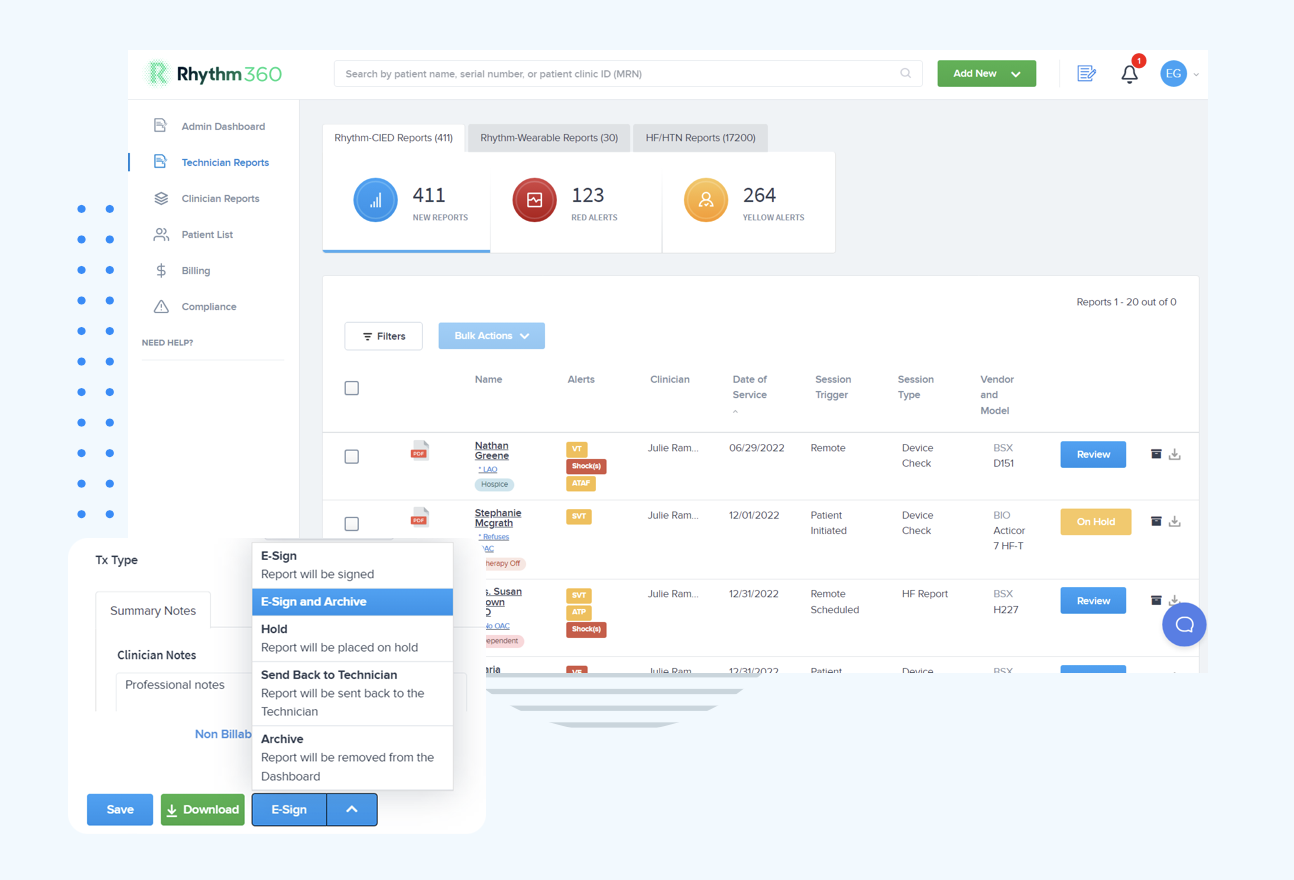
The command view scales with practice volume while keeping clinician attention on the events that matter most.
AI triage within Rhythm360 filters non-actionable transmissions before they reach the clinician queue. This preserves attention for events that actually require intervention.
Faster triage only matters if clinicians can act on it anywhere, not just at a desktop.
Critical alerts cannot wait for a clinician to return to a workstation. Rhythm360's HIPAA-compliant mobile application delivers secure, real-time access to transmissions, reports, and patient records from any location.
Manual data transcription between CIED monitoring platforms and EHR systems causes documentation errors and wastes staff time. Rhythm360 removes this friction through bi-directional integration.
Incomplete CPT documentation is the most common source of revenue leakage in cardiac remote monitoring programs. Rhythm360 automates the capture required to support compliant billing across the full code set.
By tracking billable transmission events and staff time against CPT thresholds for 93298, 93299, 99453, 99454, 99457, and 99458 in real time, Rhythm360 helps practices capture revenue that would otherwise go undocumented. A fully compliant RPM program can generate $104–245 per patient per month across six CPT codes, roughly $170K–192K in annual revenue at 100 enrolled patients before program costs.
That same tracking data feeds pre-billing validation, which flags patients lacking the time-stamped documentation needed to defend 99457 and 99458 claims before submission. UCM's Gaurav A. Upadhyay, MD, observed: "We have improved billing and accountability for our patients after the integration." Practices closing this documentation gap report billing improvements of up to 300% over their prior undocumented baseline.
Data gaps in CIED monitoring create clinical risk, not just inconvenience. Rhythm360's infrastructure is built to maintain transmission continuity regardless of OEM server availability.
This reliability means clinicians act on the most complete view of patient data available at any given moment, which supports every gain described above.
| Rhythm360 Capability | Metric | Clinical / Operational Outcome | Source |
|---|---|---|---|
| EHR integration onboarding | Days to weeks | Minimal disruption to existing clinical workflows | RhythmScience implementation data |
| OEM vendor coverage | All major manufacturers | Medtronic, Boston Scientific, Abbott, Biotronik, and others in one dashboard | RhythmScience platform specifications |
Rhythm360's implementation, including bi-directional EHR integration with Epic, Cerner, Athenahealth, and eClinicalWorks, typically completes within a few days to a few weeks. RhythmScience provides implementation support throughout. Practices don't need to replace existing staff workflows. Rhythm360 layers into and automates the steps that currently require manual effort.
Rhythm360's mobile app bypasses standard Do Not Disturb settings for critical-tier alerts, so on-call clinicians receive notifications for events like sustained VT, ICD therapy delivery, or new-onset AFib regardless of device settings. Clinicians can review reports, sign off on findings, and initiate care coordination directly from the mobile interface, without returning to a workstation first.
Rhythm360 tracks billable transmission events and clinical staff time against the specific thresholds required for each CPT code in real time. It generates the time-stamped documentation needed to support claims for 93298 and 93299 (remote monitoring of implantable cardiac devices) as well as 99453, 99454, 99457, and 99458 (remote physiological monitoring). Pre-billing validation identifies patients whose records lack required documentation before claims go out, reducing rejection rates. All documentation carries a full audit trail for payer review.
Yes. Rhythm360 ingests data from all major CIED manufacturers, including Medtronic, Boston Scientific, Abbott, and Biotronik. Data gets normalized through API connections, HL7 feeds, XML parsing, and computer-vision-powered PDF extraction. Practices managing a mixed-device population get one unified view of their entire patient panel.
Rhythm360 is a HIPAA-compliant, cloud-based platform. All patient data transmitted through the system, including mobile access, EHR integration, and OEM data feeds, is handled under HIPAA privacy and security requirements. The platform maintains a full audit trail for all clinical actions, communications, and billing documentation. RhythmScience's infrastructure includes redundant data feeds and failover architecture to maintain availability and data integrity.
These answers point back to one conclusion. Fragmented OEM portals, alarm fatigue driven by 80–99% non-actionable alert rates, and incomplete CPT documentation aren't inevitable. They're the predictable result of workflows built around disconnected systems.
A unified, real-time critical alerts dashboard fixes each problem at the infrastructure level. It replaces manual portal-hopping with AI-driven triage, automated billing capture, and mobile-first access. Rhythm360 delivers this in a vendor-neutral, HIPAA-compliant platform that scales from solo EP practices to academic medical centers handling tens of thousands of reports a year. These gains, faster response and higher transmissibility, translate directly into the revenue improvement described earlier.
Practices that keep operating across fragmented portals accept both clinical risk and revenue leakage as the cost of business as usual. Rhythm360 offers a direct path out.
Talk to our team about turning your cardiac remote monitoring program into one unified, proactive operation.