Last updated: July 13, 2026
Schedule a demo to see how Rhythm360 unifies CIED and RPM workflows in a single platform.
A 2026 meta-analysis published in Nature Digital Medicine covering 79 randomized trials and 31,669 patients found that remote monitoring reduced total heart failure hospitalizations with an incidence rate ratio of 0.81, representing a 19% reduction, and reduced all-cause mortality with a risk ratio of 0.90, representing a 10% reduction. Benefits remained consistent across geographic regions, NYHA class, ejection fraction, age, and sex.
RPM programs that combine tiered alerting with reimbursement automation have reduced 30-day CHF readmissions. Separate ROI analyses have documented lower readmission rates for heart failure cohorts after clinics implemented continuous monitoring.
Operational fragmentation still limits how many clinics can realize these outcomes. The HRS White Paper on CIED Interoperability documents that each manufacturer has developed proprietary nomenclature, technical standards, and communication protocols, and that traditional EHRs are not well suited to handling CIED data. Approximately 70% of patients who qualify for CRT based on current indications respond favorably. To capture these clinical benefits at scale while managing the operational complexity of multi-vendor device data, cardiology clinics need a unified platform architecture that addresses fragmentation at every layer.
A production-grade real-time heart failure management monitoring platform operates across four integrated layers.
Custom integration layers authenticate with each OEM portal, including Medtronic CareLink, Abbott Merlin.net, Boston Scientific Latitude, and Biotronik Home Monitoring, ingest transmissions on a scheduled cadence, normalize them into a single data model, and route events into billing workflows with the correct 90-day interrogation cycle applied. Rhythm360 extends this architecture with redundant data feeds, HL7, XML, API, and computer-vision-based PDF parsing to maintain greater than 99.9% data transmissibility even when an OEM server is temporarily unavailable.
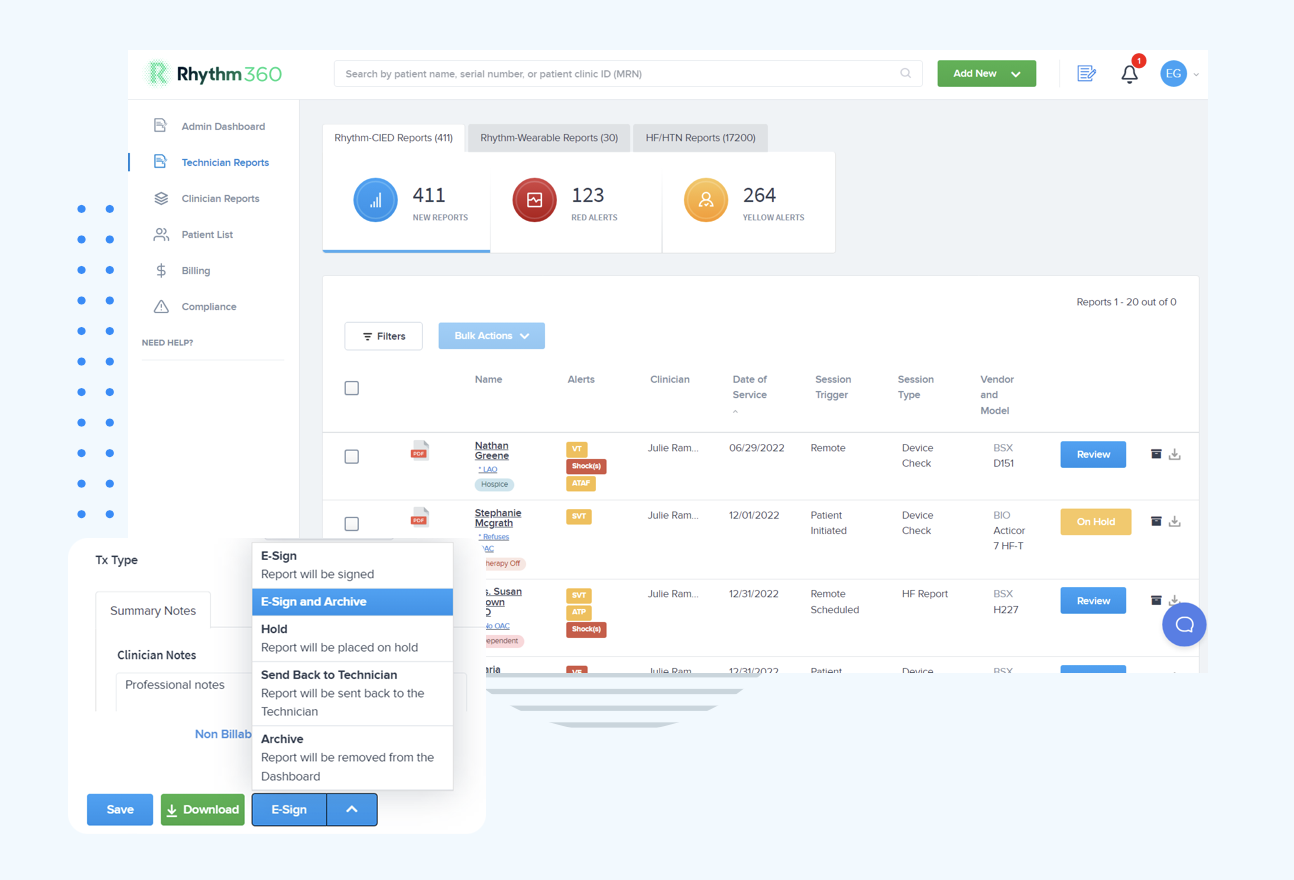
A cross-manufacturer analysis of 2,659 rhythm episodes from 1,710 patients found that 32.9% of alerts from AI-equipped implantable cardiac monitors were non-actionable and another 30.6% were indeterminate; in older devices without built-in AI, 45.4% of alerts were non-actionable. Effective triage depends on platform-level filtering, not device-level filtering alone.
A viable AI-enabled next-generation remote monitoring program for heart failure requires four core elements: a predefined set of actionable events; an escalation pathway with time targets and clear ownership; documentation of actions taken and outcomes; and a feedback loop that learns from false alarms and missed events. Rhythm360's AI triage engine applies these principles to filter non-actionable noise and surface clinically significant events, which supports documented reductions of up to 80% in critical alert response times.
The platform ingests pulmonary artery pressure data from CardioMEMS sensors alongside wearable physiologic signals. The 2026 TRUE-HF study published in Nature Medicine demonstrated that a 10% drop in wearable-derived daily peak oxygen uptake was associated with a 3.62-fold increased hazard ratio for unplanned healthcare utilization. Platforms that normalize these signals alongside CIED data create earlier intervention windows that device-only monitoring cannot provide.
Rhythm360 tracks all patient communications, including automated messages, call logs, and care-coordination notes, within a full audit trail in the patient record. This structure eliminates redundant outreach and supports documentation requirements for time-based CPT codes.
Centralized monitoring platforms introduce implementation decisions that clinic administrators should evaluate before deployment.
Staffing model: Clinics can operate a platform internally with existing device technicians or supplement with optional 24/7 oversight from certified cardiac technicians (CCTs). University of Chicago Medicine reviewed more than 73,000 reports annually through Rhythm360 in calendar year 2025, averaging more than 18,000 reports per quarter, demonstrating that a service-supported triage model scales in high-volume environments.
EHR integration complexity: Bi-directional integration with Epic, Cerner, Athenahealth, eClinicalWorks, and Greenway Health via HL7 typically completes within days to a few weeks. Clinics with custom EHR configurations should confirm integration scope during vendor evaluation.
Alert governance: Alerting systems must incorporate explicit design safeguards including limits on alert volume, explicit prioritization, and audited response times to avoid the illusion of safety and reduce false-positive burden on clinical teams. Clinics should request documented alert-volume benchmarks and escalation-path definitions from any platform vendor.
Vendor neutrality: Platforms that require exclusive OEM relationships or limit device coverage create future lock-in risk as practices add new device lines. Rhythm360 supports all major manufacturers, including Medtronic, Boston Scientific, Abbott, Biotronik, and others, without requiring exclusive agreements. Other platforms exist in the market, so clinics should compare device coverage and workflow automation depth against their specific patient population mix.
Automated CPT tracking converts clinical activity into captured revenue. The table below summarizes 2026 Medicare national average non-facility rates for the RPM codes most relevant to heart failure monitoring programs.
| CPT Code | Service Description | 2026 Medicare Rate | Key Requirement |
|---|---|---|---|
| 99453 | Device setup and patient education | $19.73 (one-time) | Documented patient consent before billing begins |
| 99454 | Device supply, 16+ days of readings per 30-day period | $52.11/month | Minimum 16 days of automated electronic transmission from an FDA-cleared device |
| 99445 | Device supply, 2–15 days of readings per 30-day period | $52.00/month | New in 2026; covers low-adherence months previously unbillable |
| 99457 | First 20 minutes of clinical management per calendar month | $51.77/month | At least one interactive patient communication and a detailed time log with date, duration, and activity description |
| 99458 | Each additional 20 minutes of clinical management | $41.42/unit | Up to two units per month with the same documentation standard as 99457 |
| 99470 | 10–19 minutes of clinical management | $26.05/month | New in 2026; time must be logged as 10–19 minutes, not "less than 20" |
A single Medicare patient fully enrolled in RPM generates reimbursement through setup and ongoing monthly clinical management codes. This structure creates a recurring revenue stream that scales with the number of enrolled patients.
Maximum monthly RPM reimbursement per patient in 2026 reaches approximately $181–$245 using 99454 + 99457 + multiple 99458 or the new 99445/99470 equivalents. Rhythm360's automated CPT tracking and documentation engine helps practices capture previously lost revenue, and clients report up to 300% increases in profitability through improved code capture and the addition of new RPM service lines.
Rhythm360's onboarding process, including EHR integration, typically completes within days to a few weeks. The following checklist outlines the primary readiness steps for a cardiology clinic deploying a unified monitoring platform.
Three operational failure modes account for most clinical and financial losses in fragmented monitoring programs.
Data silos and missed critical events: Remote monitoring data often arrives without sufficient clinical context, with transmissions stored separately from implant records, symptoms, and key clinical events, forcing clinicians to perform manual interpretation across disconnected systems. A critical arrhythmia flagged in one OEM portal but not surfaced in a unified queue can remain unreviewed for hours or days.
Alert fatigue: Alert fatigue in a 3,400-patient chronic-care RPM program dropped 70% after deployment of a rules engine with per-patient personalized thresholds and tiered queues instead of push notifications. Platforms that deliver undifferentiated alert volumes without triage logic increase the risk that clinicians deprioritize or dismiss notifications.
Missed CPT revenue: Vague documentation, such as "reviewed data" without date, duration, and activity description, is the leading cause of RPM denials and audit findings in 2026. Medicare and Medicare Advantage RPM payments totaled $536 million in 2024, and the OIG launched a formal audit in December 2024 focused specifically on documentation gaps around the 16-day transmission requirement for 99454 and the 20-minute time requirement for 99457.
A unified monitoring platform should be evaluated against three metric categories on a quarterly basis.
Gaurav A. Upadhyay, MD, at the University of Chicago Medicine, noted: "We have improved billing and accountability for our patients after the integration." Quarterly internal audits that review a random 10–20% sample of patient records across consent, orders, devices, transmission thresholds, and time documentation represent the standard compliance practice recommended for 2026 RPM programs.
| Capability | Rhythm360 Specification |
|---|---|
| Vendor neutrality | Supports all major CIED manufacturers, including Medtronic, Boston Scientific, Abbott, Biotronik, and others, with no exclusive OEM agreements required. |
| Data transmissibility | Greater than 99.9% achieved via redundant data feeds, computer vision (OCR), and AI-powered extrapolation, consistent with the multi-vendor data unification architecture described above. |
| Critical alert response time reduction | Up to 80% reduction from baseline, as documented in the AI heart failure alert triage framework. |
| Revenue improvement | Up to 300% increase in profitability through improved CPT code capture and new RPM service lines, matching the ROI outcomes described in the clinic calculator section. |
| Annual report volume (UCM, 2025) | High-volume deployment documented in the University of Chicago Medicine case study, with more than 73,000 reports annually. |
| EHR integration | Bi-directional with Epic, Cerner, Athenahealth, eClinicalWorks, Greenway Health, and others via HL7, with onboarding timelines measured in days to a few weeks. |
| Device coverage | Pacemakers, ICDs, ILRs, CRT/CCM devices, CardioMEMS pulmonary artery monitors, and RPM wearables for HF and hypertension. |
| AI alert triage | Filters non-actionable alerts and prioritizes clinically significant events with optional 24/7/365 CCT oversight. |
| CPT automation | Automated tracking of 16-day adherence thresholds, time-based documentation for 99457 and 99458, and billing-ready report generation. |
| Mobile access | HIPAA-compliant mobile app for transmission review, report signing, and care coordination from any location. |
| Communication hub | Twilio-powered patient messaging with a full audit trail, including automated reminders and manual outreach logged in the patient record. |
| Pricing model | SaaS-based, scaled by clinic size and platform usage, with no high setup fees. |
A vendor-neutral platform connects to and normalizes data from all major cardiac device manufacturers, including Medtronic, Boston Scientific, Abbott, Biotronik, and others, without requiring a clinic to use only one manufacturer's devices or monitoring infrastructure. For cardiology clinics, this approach aligns with real-world practice, because most teams implant devices from multiple manufacturers.
Without vendor neutrality, staff must log into separate OEM portals, manually reconcile data, and manage disconnected alert queues for each device line. A vendor-neutral platform consolidates these workflows into a single dashboard, eliminates redundant logins, reduces manual transcription errors, and ensures that a critical alert from any device surfaces in one unified triage queue.
Rhythm360 achieves this through API connections, HL7, XML, and computer-vision-based PDF parsing, with redundant data feeds that maintain greater than 99.9% transmissibility even when an individual OEM server is temporarily unavailable.
AI alert triage reduces fatigue by replacing undifferentiated push notifications with a tiered queue that separates clinically actionable events from non-actionable or indeterminate ones. Effective systems establish per-patient physiological baselines, analyze signal trajectories over time instead of applying static thresholds, and apply explicit prioritization rules with audited response times.
The key safeguard against missed events is the combination of a high negative predictive value, meaning the system reliably clears low-risk transmissions, with a defined escalation pathway that assigns ownership and time targets for each alert tier. Rhythm360 adds an optional layer of 24/7/365 oversight by certified cardiac technicians supervised by physicians, which provides a human-in-the-loop check for any event the AI flags as high priority. This architecture supports the platform's documented 80% reduction in critical alert response times without increasing missed-event rates.
The primary CPT codes for remote heart failure monitoring in outpatient cardiology settings in 2026 are 99453 for one-time device setup, 99454 for device supply with 16 or more days of readings per 30-day period, 99445 for device supply with 2–15 days of readings, new in 2026, 99457 for the first 20 minutes of clinical management per month, 99458 for each additional 20 minutes, and 99470 for 10–19 minutes of management, also new in 2026. For CIED-specific remote interrogation, CPT codes 93296, 93297, and 93298 apply depending on device type and whether the technical or professional component is billed.
The most common documentation errors that lead to denials in 2026 include vague time entries such as "reviewed data" without a specific date, duration in minutes, and description of the activity performed, failure to document at least one interactive patient communication per month for 99457 and 99458, and missing evidence that the patient transmitted device readings on at least 16 separate days for 99454. The OIG launched a formal audit in December 2024 specifically targeting these gaps. Rhythm360 automates 16-day adherence tracking, timestamps all device data, logs interactive communications, and generates billing-ready documentation that meets the specificity requirements for each code.
Implementation timelines for a cloud-based platform like Rhythm360 typically range from a few days to a few weeks, depending on EHR complexity and the number of OEM integrations required. The onboarding process covers four primary workstreams that run in parallel.
The first workstream focuses on OEM portal authentication and data feed configuration for each device manufacturer in the clinic's population. The second workstream sets up bi-directional EHR integration via HL7 with the clinic's existing system, including Epic, Cerner, Athenahealth, eClinicalWorks, Greenway Health, or others.
The third workstream defines alert escalation pathways with tiered queues and ownership assignments. The fourth workstream trains staff on the dashboard, mobile app, and CPT documentation workflows. Clinics should plan for a 30-day post-launch compliance audit to verify that consent records, transmission logs, and time documentation meet 2026 CMS requirements before scaling the program to the full patient population.
The clinical evidence for real-time remote monitoring in heart failure is well established. A 2026 meta-analysis of 79 randomized trials documents a 19% reduction in total HF hospitalizations and a 10% reduction in all-cause mortality. The operational and financial case is equally clear, because fragmented OEM portals create data silos, alert fatigue, and CPT revenue leakage that a unified platform directly addresses.
The evaluation framework for selecting a platform in 2026 centers on five criteria. These criteria include vendor-neutral device coverage across all manufacturers in the clinic's population, AI triage architecture with documented alert-volume controls and escalation pathways, bi-directional EHR integration with a defined onboarding timeline, automated CPT documentation that meets 2026 CMS specificity requirements for 99454, 99457, and the new 99445 and 99470 codes, and verifiable clinical and financial outcome metrics from comparable practice settings.
Rhythm360 by RhythmScience is built to meet each of these criteria, with documented outcomes that include an 80% reduction in critical alert response times, greater than 99.9% data transmissibility, and up to 300% improvement in revenue capture through improved CPT billing. As Andrew Beaser, MD, at the University of Chicago Medicine stated after implementation, "We are able to address these issues earlier; rather than waiting for a 3-month visit, we can call patients in for evaluation."