Last updated: July 14, 2026
Multi-OEM device programs quickly become unmanageable when staff rely on separate manufacturer portals. A clinic implanting devices from Medtronic, Boston Scientific, Abbott, and Biotronik must maintain separate logins across four non-interoperable portals. Each portal uses its own data schema, alert taxonomy, and reporting cadence, which creates data silos that no single staff member can monitor efficiently.
Transmission latency adds another layer of risk. Clinics may not receive timely notice of a cardiac event through manufacturer systems, and disconnection notifications often arrive late. If a pacemaker is out of range of its paired smartphone app or home monitor, alerts or events recorded by the device transmit only after the monitor reconnects. During that gap, the clinic has no real-time visibility.
Alert quality across OEM platforms also varies widely. In a cross-manufacturer analysis of 2,659 rhythm episodes from 1,710 patients with ICMs from Medtronic, Biotronik, Abbott, and Boston Scientific, 32.9% of episodes in AI-equipped devices were non-actionable and another 30.6% were indeterminate. The false-positive problem becomes especially severe for specific event types. Episodes labeled as cardiac “pause” events showed a 46.8% false-positive rate caused by R-wave undersensing, so nearly half of these alerts require manual review to rule out sensing errors rather than true pauses.
Billing workflows suffer in parallel. Manual cardiology RPM and CCM processes often lose billable minutes because time logs sit in separate systems, including the EHR, RPM vendor portals, and cardiac device portals. Automated tracking of the billing window for CPT 93296 helps capture additional revenue for CIED monitoring programs. Manual workflows frequently leave that revenue uncaptured.
Operational inefficiencies from fragmented portals translate directly into clinical and financial risk. The 2023 HRS/EHRA/APHRS/LAHRS Expert Consensus Statement on Practical Management of the Remote Device Clinic identifies variability in remote monitoring uptake and barriers to adoption as primary concerns for teams managing pacemakers, ICDs, and implantable loop recorders.
High alert volumes with many non-actionable events carry a measurable clinical cost. As Niraj Varma, MD, PhD, Professor of Medicine and Consultant Electrophysiologist at the Cleveland Clinic, noted, “When interpretation varies across device platforms and guideline definitions are not consistently applied, it becomes more difficult for physicians to quickly determine which events truly require clinical attention.” Fragmented portals make that variation the norm.
Financial exposure grows alongside clinical risk. Medicare and Medicare Advantage RPM payments reached $536 million in 2024, prompting an OIG audit (Project OAS-25-05-008) focused on documentation gaps around the 16-day transmission requirement for 99454 and the 20-minute time requirement for 99457. Clinics that rely on manual documentation face higher odds of claim denials and audit findings. A 500-patient cardiology CCM/RPM program typically captures $300,000 to $500,000 per year in additional revenue when automation supports 99457, 99458, 99454, and 93296/93297 workflows.
A unified platform replaces the multi-portal login cycle with a single, normalized data environment. Rhythm360 ingests data from all major OEM device clouds using APIs, HL7, XML, and PDF parsing via computer vision, then applies AI-powered extrapolation to fill connectivity gaps and achieve greater than 99.9% data transmissibility through redundant data feeds (see FAQ for technical details).
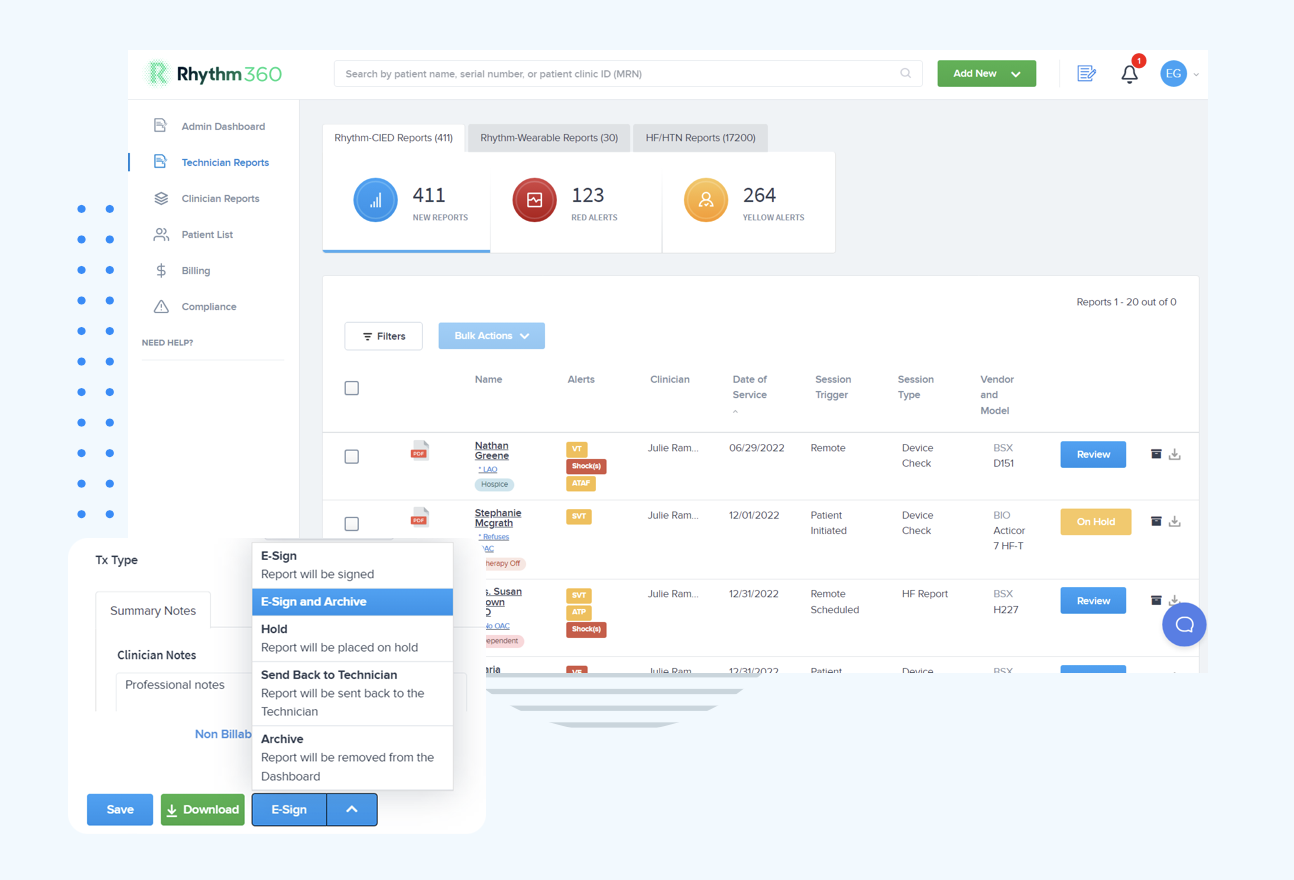
The workflow from device transmission to clinician action follows a clear sequence.
Andrew Beaser, MD, Associate Professor of Medicine at the University of Chicago Medicine, noted, “Decision support, including AI-assisted decision support, will become increasingly important as data volumes grow.” Rhythm360 builds that support into the daily workflow.
EHR integration uses HL7 messages or FHIR APIs as standard protocols to move data from device clouds into patient charts. Rhythm360 supports bi-directional connections with Epic, Cerner, Athenahealth, eClinicalWorks, Greenway Health, and other major systems.
The University of Chicago Medicine (UCM) used Rhythm360 to redesign its cardiovascular remote monitoring program. UCM reviewed more than 73,000 reports annually through Rhythm360 in calendar year 2025, averaging more than 18,000 reports per quarter.
Dr. Beaser reported, “We are able to address these issues earlier; rather than waiting for a 3-month visit, we can call patients in for evaluation.” On billing outcomes, Gaurav A. Upadhyay, MD, at UCM, observed, “We have improved billing and accountability for our patients after the integration.”
Mobile access changed on-call review behavior as well. Dr. Beaser stated, “I am more likely to sign off on these while in meetings because I can easily access them on my phone.”
These capabilities affect real scenarios, such as a Saturday-morning arrhythmia flag. A new-onset AFib or VT episode can be reviewed, triaged, and acted on the same day. Without a unified real-time system, that same event might appear days later during a routine portal check, or never appear if the patient’s home monitor stayed out of range.
Schedule a demo for real-time pacemaker monitoring with Rhythm360.
Rhythm360 uses a SaaS-based pricing model that scales with clinic size and platform usage. Clinics avoid the high setup fees and rigid licensing structures that come with many legacy on-premise systems. Implementation, including EHR integration, typically completes within a few days to a few weeks and fits around existing clinical workflows.
The platform’s architecture supports expansion beyond CIED monitoring. Rhythm360 includes integrated service lines for Heart Failure and Hypertension Remote Physiological Monitoring, with automated billing support for CPT codes 99453, 99454, and 99457. A correctly stacked CCM and RPM workflow for a complex cardiac patient on an ICD and RPM cuff can generate substantial monthly revenue when qualifying codes are billed.
Practices using Rhythm360 have documented an 80% reduction in critical alert response times and up to a 300% increase in revenue generation through improved CPT code capture and the addition of new RPM service lines.
The following criteria help cardiology clinics decide when a vendor-neutral unified platform makes sense.
Other platforms cover portions of the CIED monitoring workflow. The key evaluation step for any clinic is confirming whether a candidate solution meets all of these criteria within a single, integrated environment.
Schedule a demo to see how Rhythm360 fits your clinic’s device mix and workflow.
Remote pacemaker and CIED checks in 2026 rely on the implanted device transmitting stored data, including arrhythmia episodes, lead measurements, battery status, and therapy delivery logs, to a manufacturer cloud server via a paired home monitor or smartphone app. The clinic then accesses that data through the OEM portal or, in a unified environment, through a vendor-neutral dashboard that aggregates transmissions from all manufacturers. Scheduled remote checks typically occur every 90 days for billing under CPT 93294 and 93296. Event-triggered transmissions occur when the device detects a clinically significant episode. The main limitation of manufacturer-only systems is their dependence on the patient’s device staying within range of the home monitor. If connectivity is lost, the clinic receives no data until the connection returns, and disconnection notices often arrive 14 to 21 days later.
Data transmissibility describes the percentage of expected device transmissions that the system successfully receives, processes, and presents for review. A rate above 99.9% means fewer than one in one thousand expected transmissions is lost or left unprocessed. Rhythm360 reaches this level through redundant data feeds, which maintain multiple pathways to ingest OEM data, combined with computer vision to parse unstructured PDF reports and AI-powered extrapolation to identify and fill connectivity gaps. In practice, clinicians can make decisions with confidence that they see the most complete and accurate data available, rather than a partial view shaped by OEM server downtime or patient connectivity failures.
Alert fatigue occurs when clinicians receive many notifications and a large share prove non-actionable, which encourages staff to deprioritize or overlook critical events. AI triage addresses this problem by classifying incoming transmissions before they reach the clinician’s queue. In Rhythm360, the AI layer separates routine transmissions, low-priority findings, and clinically significant events such as new-onset AFib, ventricular tachycardia, lead malfunction, or ERI/RRT indicators. Non-actionable alerts move to a lower priority, while high-priority events surface immediately with the context needed to act. Clinics report an 80% reduction in critical alert response times because clinicians spend their attention on events that matter instead of sorting through noise. Optional 24/7/365 oversight by certified cardiac technicians supervised by physicians adds another triage layer for high-volume programs.
Rhythm360 automates documentation for the primary remote CIED monitoring and RPM CPT codes. For CIED monitoring, this includes 93294 and 93296 for remote interrogation technical components, 93297 and 93298 for remote interrogation with physician analysis for single and multiple lead devices, and 93299 for implantable loop recorder remote data analysis. For remote physiological monitoring, the platform tracks the 16-day transmission threshold required for 99454, logs the time required for 99457 and 99458, and supports documentation for 99453 and chronic care management codes. All documentation includes audit-ready timestamps and formats for bi-directional EHR integration, which reduces manual work for staff and supports compliance with OIG documentation standards.
Manufacturer-specific portals were built to move device data between scheduled visits, not to serve as the backbone of a high-volume cardiology clinic managing hundreds or thousands of CIEDs across multiple OEMs. Clinics that rely on these portals as their primary monitoring infrastructure experience fragmented data, delayed alerts, alert fatigue, and systematic revenue loss from incomplete CPT documentation.
A vendor-neutral, AI-powered platform addresses each of these failure points. A single dashboard replaces multiple logins, AI triage surfaces actionable events and suppresses noise, automated documentation captures billable activity with audit-ready precision, and mobile access ensures clinicians can act on critical alerts from any location. The University of Chicago Medicine’s experience, managing more than 73,000 reports annually through Rhythm360 with documented improvements in early intervention and billing accountability, shows what this infrastructure can deliver at scale.
For cardiology clinics evaluating real-time pacemaker monitoring alert systems in 2026, the decision remains straightforward. The right platform is vendor-neutral, AI-powered, EHR-integrated, mobile-accessible, and capable of automating the CPT documentation that supports sustainable revenue.