

Last updated: October 7, 2026
Talk to Rhythm360 About Cutting Your Alert Response Times
The 2023 HRS/EHRA/APHRS/LAHRS Expert Consensus Statement on Practical Management of the Remote Device Clinic recommends that high-priority CIED remote monitoring alerts be reviewed and appropriate action taken within two days, excluding non-consultation days. Institutional protocol sets the specific timeline within that framework, and the two-day standard functions as a consensus benchmark rather than a universal legal requirement. The 2026 Japanese Heart Rhythm Society Expert Consensus Statement on Remote Monitoring of Cardiac Implantable Electronic Devices, published in the Journal of Arrhythmia (Volume 42, Issue 5, e70437), reiterates this two-day standard and provides detailed guidance on personnel placement, workflow design, and alert notification settings.
Not every alert requires an immediate response, and treating every transmission as emergent contributes directly to alert fatigue. The 2023 consensus states explicitly that remote monitoring is not an emergency-response system, and that patients and families should be told not to treat it as a substitute for emergency care. That two-day standard sets the target. The nine steps below explain how a clinic can consistently meet it.
Clinics shorten cardiac device alert response times by cutting non-actionable alert volume at the source, routing what remains through a tiered triage protocol with named queue ownership, and measuring each stage of the alert-to-action chain separately. The nine steps below translate that model into daily workflow.
Individualized alert programming serves as the first step in a measurement-driven cycle. Tailoring alert thresholds to each patient's clinical history reduces the noise that makes faster response times impossible for the alerts that matter. The Rule of 3 reinforces that work: when an alert has fired three consecutive times without producing an actionable finding, deactivate it. The same logic applies to redundant or duplicative alerts across parameters; where clinically safe, turn them off so they stop competing for reviewer attention.
Some manufacturer platforms, such as Biotronik Home Monitoring, do not allow downgrading alerts tied to serious conditions, which limits how far programming alone can go. That constraint makes upstream triage tools essential. A peer-reviewed study of 384,796 CIED transmissions found that 57% were dismissed as non-actionable (device function normal, no clinical intervention required). Reducing that volume at the source keeps the rest of the workflow manageable.
A tiered triage protocol assigns every incoming transmission to a red, yellow, or green queue with a named owner and a defined review window. The three tiers exist because the two-day consensus standard applies to high-priority events, while lower-priority alerts can safely follow longer review windows. Treating every alert as urgent fuels alert fatigue, so the tiers reserve same-day review for alerts that truly require it.
Each tier carries a defined escalation trigger. If the primary reviewer does not act within the tier's review window, the alert escalates automatically to the fallback owner.
The JHRS consensus recommends that alert management responsibility be assigned to a designated person with clearly defined duties. That designation has to hold when the primary reviewer is on holiday, on another rotation, or unreachable, which makes a named fallback owner as important as the primary assignment. Without that coverage, high-priority alerts stall in unnamed queues. A written coverage matrix, posted in the platform and in the EHR, removes ambiguity about who owns each tier at any hour.
A five-stage measurement framework separates technology delay from staffing delay and workflow delay so the clinic can diagnose its own bottlenecks. The five stages are:
Tracking all five stages separately makes it possible to apply the correct operational fix to the correct bottleneck, instead of adding staff to a problem rooted in technology or workflow design.
The five-stage framework in Step 4 shows where time is lost. The eight-step workflow below shows what must happen at each stage for the alert to move forward and where a named owner must be assigned so it does not stall.
Running this sequence consistently, with named owners at each step, converts a response-time target into a managed metric.
Practices that implant devices from more than one manufacturer, such as Medtronic, Boston Scientific, Abbott, and Biotronik, often rely on separate, non-interoperable portals. Coordinating transmissions across four separate manufacturer portals creates workflow friction. Coordinators must log in to multiple systems, context-switch between different alert hierarchies, and manually transfer data to the EHR. That friction adds directly to receipt-to-review time, the second stage of the five-stage framework.
A single source of truth shortens the earliest stages of the response-time chain. Rhythm360 by RhythmScience is a vendor-neutral, HIPAA-compliant, cloud-based platform. It ingests and normalizes data from all major device manufacturers via API, HL7, XML, and PDF parsing with computer vision. Redundant data feeds push transmissibility above 99.9%. Its AI-powered alert triage and optional 24/7/365 oversight by certified cardiac technicians (CCTs) drive that reduction in critical-alert response times. As Andrew Beaser, MD, Associate Professor of Medicine at the University of Chicago Medicine, noted after implementing Rhythm360: “Decision support, including AI-assisted decision support, will become increasingly important as data volumes grow.” Other vendor-neutral cardiac remote monitoring platforms besides Rhythm360 include Murj, Implicity, and Octagos, which support all major manufacturers such as Medtronic, Abbott, Boston Scientific, and Biotronik.
University of Chicago Medicine reviewed more than 73,000 reports annually through Rhythm360 in calendar year 2025, averaging more than 18,000 reports per quarter, which demonstrates what vendor-neutral aggregation enables at scale.
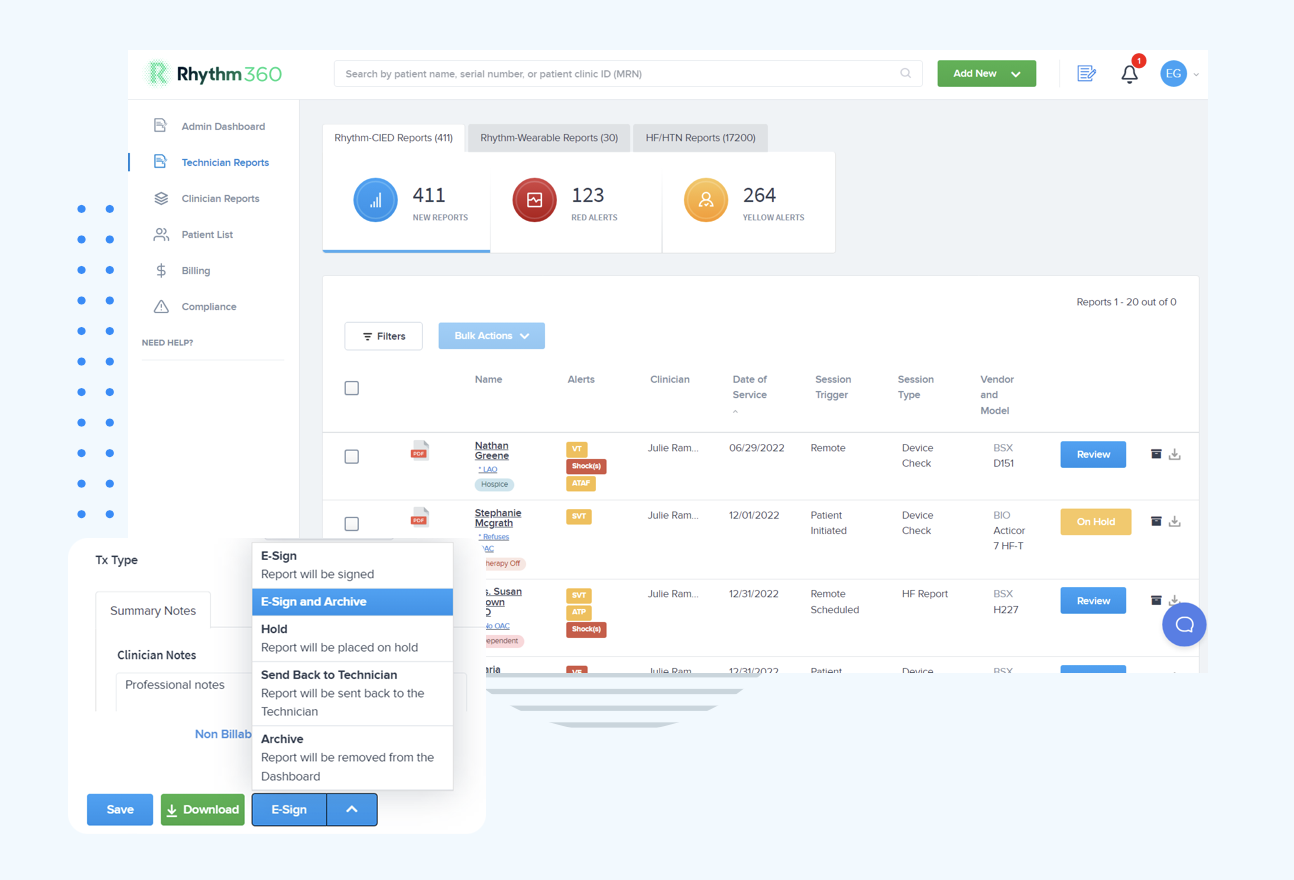
See How Vendor-Neutral Aggregation Works in Your Clinic
Vendor-neutral aggregation in Step 6 creates the unified data stream that alert-based monitoring requires. The RAPTOR-CIED trial is a pragmatic, multi-center, randomized trial comparing the safety and effectiveness of alert-driven care versus guideline-based care for patients with wireless CIEDs. Alert-based monitoring, where clinicians respond to meaningful device-detected events rather than processing every scheduled transmission equally, is the direction the 2023 HRS/EHRA/APHRS/LAHRS consensus explicitly supports. Calendar-based monitoring generates predictable, schedulable volume but does not accelerate response to interval events. Alert-based monitoring reduces routine workload but depends on reliable data transmission and sufficient triage capacity to process unscheduled events without creating a new backlog. A 2024 real-world analysis found that centers are not widely adopting alert-based monitoring strategies, in part because managing multiple proprietary vendor systems makes standardizing workflow models difficult, which vendor-neutral aggregation directly addresses.
How to cut cardiac response times with arrhythmia monitoring covers the operational trade-offs of each model in greater depth.
The JHRS consensus states that key event data should be documented in the medical record with the relevant remote-monitoring output attached. Documentation should capture the review timestamp, the clinical decision reached, and the action taken within the defined review window for that alert tier. Complete documentation makes the response-time metric defensible to a medical director and supports billing capture for eligible transmissions by meeting audit standards.
The 2023 HRS/EHRA/APHRS/LAHRS consensus states that remote monitoring alerts are not an emergency-response system, and that patients and families should hear this clearly at enrollment. Every enrolled patient should receive written and verbal instruction to call 911 or go to the nearest emergency department for acute symptoms such as syncope, chest pain, or palpitations with hemodynamic compromise. Remote monitoring functions as a surveillance and interval review system that detects and routes clinically significant findings within a defined review window. Clear boundaries protect the clinic clinically and legally and reduce patient-initiated calls that interrupt the review workflow.
Best practices for managing critical cardiac alerts covers patient communication protocols in additional detail.
Slow cardiac device alert response times usually trace back to workflow design rather than staffing levels. Individualized alert programming reduces non-actionable volume at the source. A tiered triage protocol with named queue ownership ensures that remaining alerts reach the right reviewer within the right window. A five-stage measurement framework turns response time into a managed metric instead of an estimate. A vendor-neutral aggregation layer then removes portal-switching and data-silo friction that adds delay at every stage of the chain.
Each of these steps can be implemented individually, yet the most effective device clinics run them on a unified platform. Rhythm360 by RhythmScience operationalizes the full workflow (vendor-neutral data ingestion, AI-powered alert triage, optional 24/7/365 CCT oversight, and the same up-to-80% reduction in critical-alert response times) on a single HIPAA-compliant platform built for the volume and complexity that modern CIED programs face.
Schedule a Demo to Cut Cardiac Device Alert Response Times





