Last updated: July 14, 2026
A layered approach to CPT compliance combines five interlocking systems into one prevention framework. Computer-assisted coding with EHR prompts, automated claim scrubbing for NCCI edits and modifiers, standardized CIED documentation templates, a denial analytics dashboard, and quarterly AI-supported audits catch errors at every stage of the billing cycle, before a claim is submitted or denied.
No single tool eliminates cardiology billing errors on its own. Front-end eligibility checks prevent intake denials, but they cannot catch a missing 16-day transmission threshold for CPT 99454. Claim scrubbing catches bundling conflicts, but it cannot compensate for a physician note that never documented Doppler use. Each layer addresses a distinct failure point, and the layers reinforce one another. Practices that implement all five can achieve denial rates below 5%, compared to 15–20% for cardiology practices without systematic controls.
For CIED and remote patient monitoring programs, the stakes run higher. Billing cycles span 30 and 90 days, transmission thresholds are precise, and the 2026 CPT updates introduced new codes most practices have not yet operationalized. A platform that automates documentation, enforces thresholds, and integrates with the EHR turns compliance into a continuous, auditable workflow instead of a manual checklist.
Four categories of errors account for the majority of cardiology CPT denials in 2026.
Missing transmission-day thresholds. Missing the 16-day data transmission threshold is the single most common reason for CPT 99454 claim denials. Under the 2026 Physician Fee Schedule, CPT 99454 requires 16 or more days of transmitted data within a 30-day period. The new companion code CPT 99445 covers 2–15 days. Many practices submit 99454 without first verifying the transmission log, triggering automatic denials.
Mutually exclusive code pairs. Billing both CPT 99454 and CPT 99445 in the same 30-day period for the same patient is prohibited, since the codes are mutually exclusive. By contrast, CPT 93294 and 93295 follow the opposite rule: they can be billed together on the same date, since they represent professional and technical components of the same service rather than competing codes.
Incomplete consent and transmission logs. Missing patient consent documentation and failure to maintain automated device transmission logs are frequent denial causes for RPM claims. Payers treat absent consent documentation as a non-covered service, not a correctable error.
90-day versus 30-day period mismatches. Remote monitoring codes 93294–93298 must be billed per the defined monitoring period, 90 days for pacemakers and ICDs, 30 days for loop recorders, not per transmission. Billing these codes monthly instead of per the defined period triggers denials and audit exposure. CIED remote monitoring transmissions received but not billed within the required 90-day cycle are lost permanently.
Documentation must support every CPT element before claim submission. This principle governs every layer of the compliance stack.
Clinical documentation must explicitly support every CPT code billed. Coders should never assume a feature such as Doppler was performed if the note does not state it. For echocardiography, the note must confirm Doppler and color flow usage when those codes are billed. For stress tests, the clinical indication must appear in the note. For remote monitoring, the physician interpretation note must address device function, programmed parameters, and actionable findings.
Common documentation gaps leading to denials include incomplete medical necessity narratives, inconsistencies across the chart, missing required elements for services, and underspecified diagnoses such as heart failure type or CKD stage. AI-assisted documentation tools that prompt clinicians at the point of care, before the note is finalized, prevent these gaps from reaching the billing team.
The University of Chicago Medicine's implementation of Rhythm360 by RhythmScience shows this principle applied at scale. The institution manages over 73,000 reports annually with stable dismissal rates after centralizing CIED and heart failure monitoring documentation, directly reflecting the same rule: no code gets billed unless the note backs it up.
Cardiology practices carry an average initial denial rate of 11-14%, per MGMA and AAPC specialty benchmarking. That baseline matters because outpatient coding denials rose 126% between 2023 and 2024, meaning the gap between compliant and non-compliant practices is widening fast.
The leading denial categories in 2026 are:
Most of these denials are classified as potentially avoidable. That's the argument for the layered defense described above, and the five systems below build directly on it.
The following five systems form a closed-loop compliance workflow. Each targets a distinct failure point in the billing cycle.
Computer-assisted coding (CAC) tools embedded in the EHR workflow analyze clinical documentation in real time and suggest CPT and ICD-10 codes before the note is finalized. Integrated cardiology EHR systems link documentation directly to code assignment and claim building, reducing rework from manual re-entry across separate tools.
Cardiology teams using AI coding assistants that interpret EKG findings, ejection fractions, and device specifics can reach high coding accuracy. Implementation requires configuring the CAC engine with cardiology-specific rules, device type, monitoring period, transmission days, and routing prompts to the right user without creating alert fatigue.
For CIED and RPM programs, CAC prompts enforce the documentation elements required for each code in the 93294–93298 and 99453–99458 families before the encounter closes. Rhythm360's bi-directional EHR integration with Epic, Cerner, Athenahealth, eClinicalWorks, and Greenway Health enforces this at the point of care, capturing transmission logs, consent records, and interpretation notes automatically.
Claim scrubbing software applies payer-specific rules, CMS NCCI edits, and modifier logic to every claim before submission. Automated claim scrubbing can reach first-pass acceptance rates of 95–98.4%, well above manually reviewed claims.
Cardiology-specific scrubbing software runs every claim through hundreds of checks, including ICD-10 specificity, NCCI bundling, and modifiers such as -26, -TC, and -59, before submission. For CIED billing, the scrubbing logic must enforce the mutual exclusivity of 93294 and 93295, validate that 93296 pairs correctly with its professional component code, and flag 90-day period mismatches before they reach the payer.
Cardiology practices adopting AI-driven claim scrubbing cut coding denials from 22-24% to 3.4-8.4% within 90 days to a few months. NCCI edits change quarterly, so scrubbing engines need automatic updates to stay effective.
Standardized templates for CIED follow-up and RPM encounters enforce required documentation at the point of care. Required documentation for CPT 93294–93298 includes patient demographics, device type and manufacturer, monitoring period dates, and a clinician interpretation note addressing device function, programmed parameters, and actionable findings.
Templates remove assumption-based coding by structuring the note around CPT requirements. A pacemaker remote monitoring template prompts the clinician to confirm monitoring period dates, record the device manufacturer and model, and document a substantive clinical interpretation, the three elements most often missing from denied 93294 claims. For RPM, templates track transmission days against the 16-day threshold for 99454 and the 2–15-day threshold for 99445.
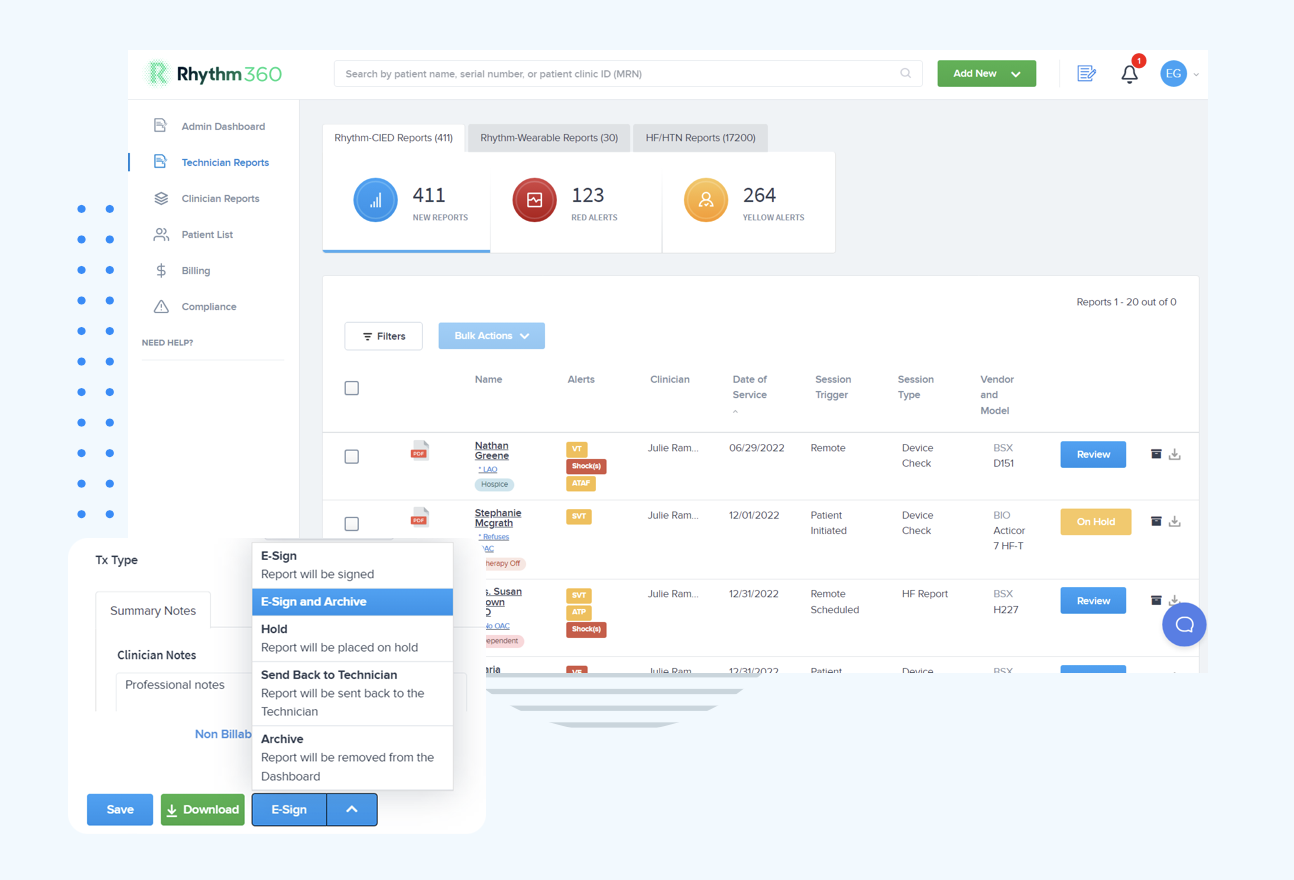
Rhythm360 generates standardized, auditable documentation for every CIED transmission and RPM encounter, pulling data from Medtronic, Boston Scientific, Abbott, Biotronik, and other manufacturers into one normalized record. The table below shows what this automation replaces, and why it maps directly to fewer threshold errors.
| Capability | Without Rhythm360 | With Rhythm360 |
|---|---|---|
| OEM portal logins required per patient | Multiple (varies by device manufacturer) | One unified dashboard |
| Transmission log automation | Manual tracking; prone to threshold errors | Automated; enforces 16-day and 90-day thresholds |
| Documentation completeness for 93294–93298 | Dependent on manual note entry | Structured templates auto-populated from device data |
| Data transmissibility | Variable; OEM outages cause gaps | 99.9% via redundant data feeds and AI-powered extrapolation |
A denial analytics dashboard aggregates denial data by payer, CPT code family, provider, and CARC reason code. This enables root-cause analysis instead of claim-by-claim rework. Analytics tools that surface denial patterns by payer, provider, and CARC code let teams fix systemic issues and target workflow changes to the top denial reasons.
For CIED and RPM programs, the dashboard should surface transmission-threshold failures by device type, consent gaps by provider, and 90-day period billing errors by payer. Practices that act on dashboard data within 48 hours of denial receipt recover more revenue than those that batch-process denials weekly.
Rhythm360's administrative dashboard gives billing managers a real-time view of patient compliance, critical alerts, and captured versus potential revenue, based on CPT code requirements, so they can see where revenue is at risk before claims go out.
Quarterly audits of the top CPT codes by denial volume catch systemic patterns that scrubbing and templates alone miss. AI-powered coding tools cut coding denials by roughly 70% in one documented case.
An effective quarterly audit reviews a sample of claims across the 93294–93298 and 99453–99458 families, checks modifier application against current NCCI edits, and confirms add-on codes were captured where documentation supports them. A quarterly chart review often reveals undercoding patterns that, once corrected, raise revenue without adding patients.
Rhythm360's platform supports this audit function by maintaining a complete, timestamped record of every transmission, interpretation, and billing event, the audit trail CMS guidelines require for AI-assisted coding. As noted earlier, the gains this produces (up to 300% revenue growth, 80% faster alert response) stem from closing the documentation and billing gaps described throughout this guide.
| Outcome Metric | Industry Baseline | Rhythm360 Outcome |
|---|---|---|
| Critical alert response time reduction | Manual triage; variable response | Up to 80% faster response time |
| Revenue generation improvement | Lower clean claim rates without specialist support | Up to 300% increase through optimized CPT code capture |
| Annual reports managed (UCM case) | Fragmented across OEM portals | 73,000+ reports annually with stable dismissal rates |
The 2026 CMS Physician Fee Schedule introduced two changes that directly affect RPM billing compliance in cardiology practices.
New CPT 99445. CPT 99445 covers RPM device supply and data transmission for 2–15 days of physiologic monitoring data in a 30-day period. It took effect January 1, 2026, and should not be billed with 99454 for the same period. Most practices haven't implemented it yet, so 2–15 day RPM data is getting written off instead of billed.
New CPT 99470. CPT 99470 reimburses at a national average of $26 for at least 10 minutes of non-face-to-face RPM services per month and cannot be billed in the same month as CPT 99457. It captures management time in months when staff time falls below the 20-minute threshold for 99457.
Compliance best practices for 2026 RPM billing include:
Rhythm360's automated transmission tracking enforces these thresholds in real time, flagging patients approaching, or missing, the transmission-day requirements before the billing period closes.
CIED billing operates on a distinct framework from RPM and requires automation calibrated to its specific requirements.
90-day monitoring periods. As noted earlier, the 93294–93298 family follows fixed 90-day (pacemakers/ICDs) or 30-day (loop recorder) billing periods rather than per-transmission billing. Automated systems must track the start and end of each 90-day period per patient and trigger billing at period close, not on each transmission event.
93294–93298 documentation requirements. Each code in this family needs specific documentation. CPT 93294 covers professional interpretation of remote transmissions from single- or dual-chamber pacemakers and requires a physician-documented clinical interpretation billed once per monitoring period, not per transmission. CPT 93296 is the technical component billed alongside 93294 or 93295. Automation must enforce these pairing rules and block standalone technical component submissions.
Vendor-neutral data ingestion. A practice managing devices from Medtronic, Boston Scientific, Abbott, and Biotronik cannot enforce 90-day tracking or documentation completeness if transmission data sits in separate OEM portals. Rhythm360 ingests and normalizes data from all major manufacturers via API, HL7, XML, and PDF parsing through computer vision, creating one auditable record per patient regardless of device brand.
This vendor-neutral foundation determines how fast a practice can actually go live. The timeline below shows what onboarding looks like once that architecture is in place.
Rhythm360's onboarding, including bi-directional EHR integration, takes from a few days to a few weeks depending on the practice's existing systems. Integration is supported for Epic, Cerner, Athenahealth, eClinicalWorks, Greenway Health, and other systems via HL7.
The implementation sequence follows a phased approach:
The SaaS-based pricing model scales with clinic size and platform usage, so cost stays proportional to the patient population being monitored.
The most common error is submitting CPT 99454 without verifying that 16 or more days of physiologic data were transmitted within the 30-day billing period. When fewer than 16 days of data exist, the correct code under the 2026 Physician Fee Schedule is CPT 99445, which covers 2–15 days of transmission. Billing 99454 without meeting the threshold triggers an automatic denial. Practices that automate transmission-day tracking before claim submission eliminate this error category entirely.
CIED remote monitoring uses a separate CPT code family (93294–93298) with 90-day monitoring periods for pacemakers and ICDs, compared to the 30-day periods governing RPM codes 99453–99458. CIED codes require a physician-documented clinical interpretation per monitoring period, not per transmission, with professional and technical components billed as a pair. RPM codes track physiologic data transmission days and clinical staff management time within each calendar month. The two frameworks don't mix: RPM codes apply only to devices like blood pressure cuffs and weight scales, while implanted cardiac devices bill under the 93279–93298 series.
Five systems, implemented together, produce the greatest reduction in CPT billing errors. Computer-assisted coding with EHR prompts catches documentation gaps before the note is finalized. Automated claim scrubbing enforces NCCI edits, modifier rules, and payer-specific logic before submission. Standardized CIED documentation templates capture every required element for the 93294–93298 and 99453–99458 families at the point of care. A denial analytics dashboard identifies systemic patterns by code family and payer, so root causes get addressed rather than individual claims reworked. Quarterly AI-supported audits confirm the other four systems work correctly and surface undercoding patterns scrubbing alone can't detect. A vendor-neutral platform like Rhythm360 combines all five into one workflow, closing the data silos that let errors persist across fragmented OEM portals and manual documentation systems.
Revenue recovery starts in the first billing cycle after implementation. The most immediate gains come from previously unbilled encounters: CIED transmissions that closed a 90-day period without a claim, RPM data collected for 2–15 days never submitted under CPT 99445, and management time documented but never converted to a 99457 or 99470 claim. As noted earlier, practices implementing Rhythm360 have seen revenue gains up to 300% through better CPT code capture, improved staff efficiency, and new RPM service lines for heart failure and hypertension patients. The full impact compounds over subsequent quarters as the denial analytics dashboard eliminates systemic error patterns.
Fragmented OEM portals, manual transmission tracking, and outdated CPT workflows aren't administrative inconveniences. They're measurable revenue losses. At an 11-14% average denial rate, with each denied claim costing $25–$118 to rework and 80% of denials classified as potentially avoidable, the financial case for a unified, automated compliance platform is direct.
Rhythm360 by RhythmScience consolidates CIED and RPM monitoring data from all major device manufacturers into one vendor-neutral platform, automates documentation and transmission tracking for 2026 CPT compliance, and integrates bi-directionally with major EHR systems. This turns compliance from a manual process into a continuous, auditable workflow, delivering the same gains outlined throughout this guide: faster alert response, fewer denials, and recovered revenue.
Connect with our team to see how Rhythm360 can reduce your CPT billing errors and capture the revenue your current system is leaving on the table.